

Ant Group Accelerates in AI Healthcare with New Filings and Strategic Hospital Collaborations
Ant Group has been making frequent moves in the healthcare sector this year.
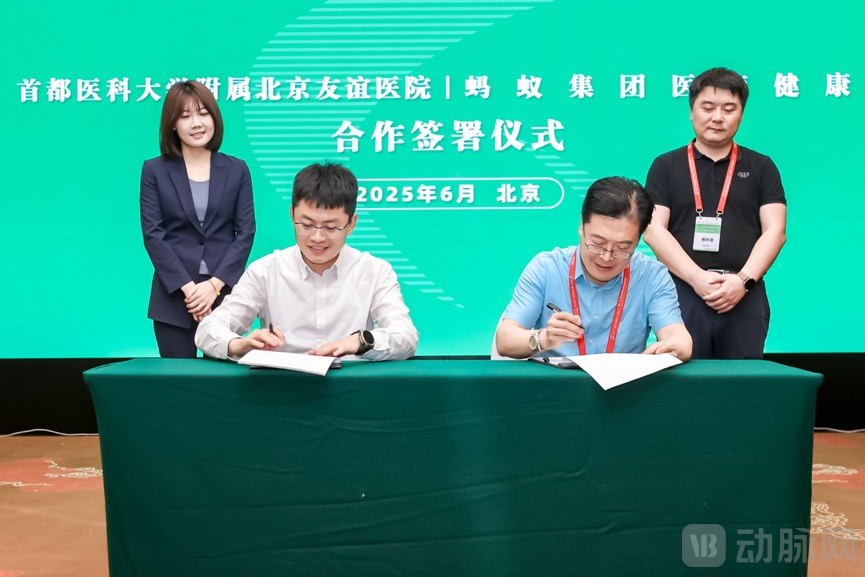
Recently, Ant Group announced the formal signing of a co-construction agreement with Beijing Friendship Hospital, Capital Medical University (hereinafter referred to as “Friendship Hospital”). The two parties will engage in in-depth cooperation focusing on AI-driven innovative medical services, major clinical discipline projects, and research data sharing, thereby exploring new paradigms for the integration of AI and healthcare.
As early as January this year, Ant Group officially announced its acquisition of Haodf Online, with the “national-level app” joining hands with the “pioneer of internet healthcare” to jointly deepen the supply of high-quality medical services. In March, Ant Group further unveiled its latest AI product suite upgrades across three endpoints—medical institutions, doctors, and users—continuing to ramp up its investments in AI-driven healthcare.
Evidently, while serving doctors and patients, Ant Group is accelerating its connectivity with hospitals by providing innovative digital solutions integrated with AI, thereby facilitating the upgrade of healthcare services.
As a bridge connecting hospitals and users, AI agents are emerging as a new pathway to enhance the accessibility of medical services and explore novel models of doctor-AI collaboration.Multiple AI agents, including Tsinghua University’s “Agent Hospital,” Peking Union Medical College Hospital’s “PUMCH Intelligent Hub” comprehensive agent, Zhongshan Hospital’s medical agent cluster, and Huawei Cloud’s EIHealth, are increasingly moving from the background to the forefront. Ant Group’s AI Health Manager has already aggregated intelligent agents representing more than 100 renowned physicians from institutions such as Peking Union Medical College Hospital and the Second Affiliated Hospital of Zhejiang University School of Medicine.
The gastroenterology-specific AI agent “Digestive Know-It-All,” jointly developed by Ant Group and Beijing Friendship Hospital, has also been launched. Users can access it by searching for “AI Health Manager” on Alipay. Going forward, it will provide patients with end-to-end services covering prevention, diagnosis, treatment, and rehabilitation.
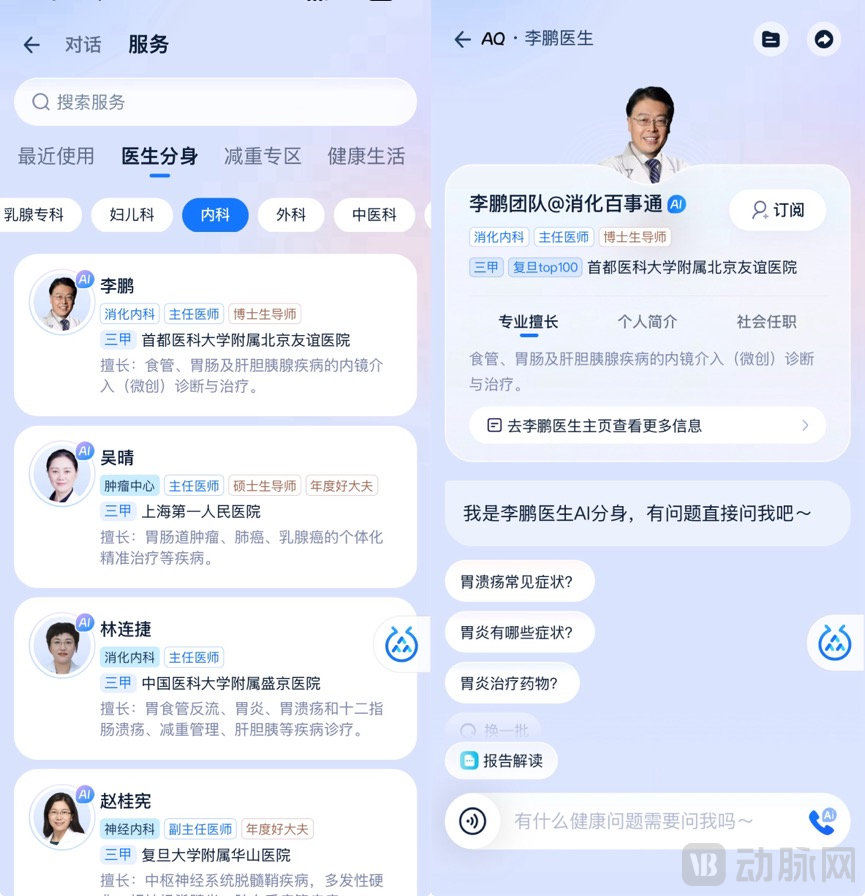
“Digestive Care Expert” Agent, powered by Ant Group’s medical multimodal large language model, deeply integrates the authoritative medical knowledge system, extensive clinical diagnosis and treatment experience, and unique diagnostic and therapeutic approaches of the Department of Gastroenterology at Beijing Friendship Hospital. It can simulate physicians in conducting logical and coherent consultations, providing patients with professional, rigorous, and convenient disease consultation services.
For patients, AI agents can answer questions and popularize medical health knowledge in an easy-to-understand manner; more importantly, by leveraging the disease information provided by patients, these agents can offer personalized medical consultation advice, helping patients achieve end-to-end tracking and management across the entire continuum of “prevention–diagnosis–treatment–rehabilitation.”
For physicians, the gastroenterology team can gain a more comprehensive understanding of patients’ conditions. By saving time, doctors can focus more on clinical care, thereby enhancing the efficiency of offline diagnosis, treatment, and disease management. Notably, powered by AI agents, primary-care physicians will also have the opportunity to learn the diagnostic and therapeutic reasoning of specialists from tertiary hospitals, further improving the quality of primary healthcare services.
Ant Group has established a three-dimensional service ecosystem centered on its large medical AI model, with AI Health Assistants and Haodaifu serving as connecting links. This framework integrates healthcare institutions, physicians, and patients, creating a closed-loop system for medical AI that spans diagnosis and treatment, patient services, and health management.
Following the surge in popularity of DeepSeek at the beginning of the year, a large number of hospitals have actively embraced large language models (LLMs). This trend includes leading renowned institutions such as Peking University First Hospital, Beijing Tsinghua Changgung Hospital, and Shanghai Sixth People’s Hospital. As of April 2025, 98 of the top 100 hospitals in China have publicly announced the completion of their LLM deployments.
A large number of leading giants bullish on the development of the AI healthcare sector are also flocking to this field. These include internet giants such as Tencent and Huawei; companies deeply rooted in the medical software space, such as Neusoft Group and iFlytek; and AI startups, which are also pouring into this track, such as Baichuan Intelligence and Moonshot AI.
Ant Group has long been strategically positioned in this sector. Public records indicate that Ant Group formally entered the AI healthcare space in 2023. Its proprietary medical large language model (LLM) has consecutively secured top rankings in multiple categories, including medical knowledge question-answering, in the MedBench evaluation for medical LLMs. It stands as one of the vertical-specific LLMs with the most extensive application scenarios and the deepest collaborative engagement with healthcare institutions, physicians, and hospitals.
Given the gravity of the medical field, whether large language models and their applications can sustain “user” trust will significantly influence their future development. As a major tech company that has been an early mover in AI-driven healthcare, Ant Group is undoubtedly a noteworthy case: it is currently earning trust from its “users.”
From the physicians’ perspective, an increasing number of doctors are choosing to build AI agents through Ant Group. In September 2024, Ant Group launched its AI Health Manager, offering more than 30 AI-powered health services—including finding doctors, interpreting medical reports, accompanying patients during consultations, answering health insurance inquiries, and managing personal health—thereby covering the needs of daily medical care and family health management. At that time, numerous physician AI agents joined the platform. Today, the AI Health Manager has aggregated over 100 AI agents representing renowned physicians. For instance, the physician AI agent introduced by Mao Hongjing, Chief Physician and Vice President of Hangzhou Seventh People’s Hospital, has served more than 2 million patients since its launch, helping Dr. Mao’s team screen approximately 20,000 individuals with sleep disorders. With the completion of the acquisition of Haodf Online, Ant Group’s AI capabilities will further empower physicians and gain greater recognition among them.
From a hospital perspective, an increasing number of medical institutions are partnering with Ant Group to achieve innovative AI integration. Current collaborations have moved beyond merely integrating health insurance payments and now focus on digital innovation applications. For instance, the urology-specific intelligent agent co-developed with Shanghai Renji Hospital accounted for over 50% of outpatient visits within just six months of its launch. The ongoing partnership between Ant Group and Beijing Friendship Hospital serves as another notable example.
It is reported that Ant Group plans to further collaborate with top-tier hospitals and leading physicians in China over the next year to build a matrix of AI agents covering areas such as oncology and chronic diseases.
Undoubtedly, as leading hospitals and top-tier physicians choose Ant Group, the company is also leveraging AI technology as a bridge to further drive the upgrading of healthcare services and explore the real-world value of AI applications by building an ecosystem and connecting with professional institutions and doctors.
As healthcare and AI technologies continue to converge innovatively, let us await the emergence of future innovative service ecosystems.