

China Resources Boya Bio Adjusts Price Three Times to Sell 80% Stake in Boya Xinhe for RMB 158 Million
It was recently learned that Boya Bio-pharmaceutical Group Co., Ltd. (300294.SZ) has issued an announcement regarding the adjustment of the listing price for its 80% equity stake in Jiangxi Boya Seehot Pharmaceutical Co., Ltd. (hereinafter referred to as “Boya Seehot”).
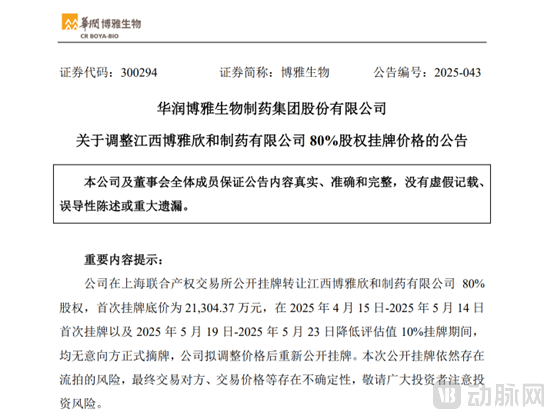
The announcement stated that the company publicly listed an 80% equity stake in Yaxinhe for transfer on the Shanghai United Assets and Equity Exchange, with an initial listing reserve price of RMB 213.0437 million (over RMB 213 million). During the initial listing period from April 15, 2025, to May 14, 2025, and the subsequent listing period from May 19, 2025, to May 23, 2025, during which the assessed value was reduced by 10%, no interested parties formally completed the transaction. The company intends to adjust the price and relist the equity publicly.
Given that no prospective transferees were solicited upon the expiration of the initial disclosure period, the listing price was adjusted downward by 10% from the assessed value based on relevant regulations and internal decision-making. On May 19, 2025, the Company applied to the Shanghai United Assets and Equity Exchange to conduct a second round of listing at a price of RMB 191.7393 million (over RMB 190 million), with the listing period running from May 19, 2025, to May 23, 2025 (Project No.: G32024SH1000398-2). During this listing period, there were still no interested parties to accept the listing.
The announcement further stated that, given the absence of any interested parties to delist the 80% equity interest in Jiangxi Boya Seehot Pharmaceutical Co., Ltd. during both the initial listing period and the subsequent listing period with a 10% reduction in the assessed value, the Company convened the 13th Meeting of the 8th Board of Directors on May 30, 2025. The meeting reviewed and approved the "Proposal on Adjusting the Listing Price for the 80% Equity Interest in Jiangxi Boya Seehot Pharmaceutical Co., Ltd." The Company expressed its intention to continue advancing this equity transfer and proposed to re-list the 80% equity interest at a price further reduced to 80% of the original assessed value. Should there still be no interested parties to delist after the listing at 80% of the assessed value, the price would be further reduced by 5.76%, resulting in a listing price of RMB 158.1655 million (exceeding RMB 158 million, based on comprehensive market feedback).
Non-core assets once held in high regard: transfuse first, then divest
Jiangxi Boya Seehot Pharmaceutical Co., Ltd. was established in 2014, with its core business focusing on the research and development, production, and sales of anti-infective, diabetes, and cardiovascular and cerebrovascular pharmaceuticals. According to the initial equity transfer announcement, upon completion of the equity transfer, Boya Bio-pharmaceutical Group Co., Ltd.’s shareholding in Jiangxi Boya Seehot Pharmaceutical Co., Ltd. will decrease from 90.69% to 10.69%, and Jiangxi Boya Seehot Pharmaceutical Co., Ltd. will no longer be included in the consolidated financial statements of Boya Bio-pharmaceutical Group Co., Ltd.
It should be noted that the pharmaceutical products primarily marketed by Jiangxi Boya Seehot Pharmaceutical Co., Ltd. have little correlation with the blood products that constitute the core business of Boya Bio-pharmaceutical Group Co.,Ltd. More importantly, these two business lines have failed to generate synergistic effects where “1+1>2.” Consequently, Jiangxi Boya Seehot Pharmaceutical Co., Ltd. is not considered a core asset within the China Resources Group.
However, a review of the development trajectory of Jiangxi Boya Seehot Pharmaceutical Co., Ltd. reveals that the company once attracted significant attention, with Boya Bio-pharmaceutical Group Co.,Ltd. placing high expectations on it. Since commencing official production in 2018, Boya Bio-pharmaceutical Group Co.,Ltd., as the parent company, has cumulatively invested over RMB 500 million, primarily directed toward technological research and development and facility construction, with the aim of strengthening its anti-infective drug production line.
The investments failed to yield the expected returns. After clarifying its integrated development strategy for active pharmaceutical ingredients (APIs) and finished dosage forms, centered on the sitafloxacin and statin projects, Jiangxi Boya Seehot Pharmaceutical Co., Ltd. experienced consistently slow progress in R&D. Coupled with factors such as price reductions under centralized procurement and restrictions from environmental protection policies, its products lost competitive advantage and failed to achieve large-scale production. This resulted in performance falling short of expectations and sustained losses.
Financial data shows that Jiangxi Boya Seehot Pharmaceutical Co., Ltd incurred a loss of RMB 56.87 million in 2023. In 2024, the company managed to partially reduce its losses by implementing cost-reduction and efficiency-enhancement measures centered on sitafloxacin and expanding its intermediates business. Although the loss narrowed to RMB 34.62 million, the company still has some way to go before achieving profitability.
Notably, on August 22, 2024, China Resources Boya Bio-pharmaceutical Group Co., Ltd. (hereinafter referred to as “CR Boya Bio”) approved a proposal to increase capital in Jiangxi Boya Seehot Pharmaceutical Co., Ltd. (hereinafter referred to as “Boya Seehot”), planning to utilize approximately RMB 487 million of its own funds for the capital injection. CR Boya Bio indirectly holds 100% equity interest in Boya Seehot through its wholly-owned subsidiary, Jiangxi Boya Pharmaceutical Investment Co., Ltd. This capital increase and share expansion, which carries a notable turn of events, appears to indicate that CR Boya Bio is attempting to steer Boya Seehot out of its negative asset position.
Regrettably, if calculated based on the capital increase of RMB 487 million, Boya Bio-pharmaceutical would still face a loss of RMB 221 million even if the transaction were finally concluded at the initial listing price of RMB 213 million. Less than a year after the capital injection, China Resources Boya decided to sell the majority of its equity in the company, leading to the first listing in 2025.
Strengthening the Blood Products Portfolio
In response to this series of somewhat dramatic developments, Boya Bio-pharmaceutical Group Co., Ltd. (CR Boya) explained that the move was intended to “focus on its core blood products business and optimize its business structure.” The equity transfer aims to concentrate resources on strengthening the core blood products segment and streamline the existing business portfolio. In fact, since China Resources took control of CR Boya in 2021, the company has followed a clear strategic path: centering on its blood products business while gradually exiting other non-core operations.
Looking back to March 2012, Boya Bio-pharmaceutical Group Co., Ltd. (hereinafter referred to as “Boya Bio”), which had not yet become part of the China Resources system, listed on the A-share market. The company maintained a strong growth trajectory through 2019, with both revenue and net profit achieving consecutive dual growth. Specifically, in 2018, the company reported operating revenue of RMB 2.388 billion and net profit attributable to shareholders of the parent company of RMB 469 million.
However, since 2019, Boya Bio-pharmaceutical’s revenue and net profit have undergone a shift, beginning to fluctuate as their growth trend stalled.
In 2021, Boya Bio-pharmaceutical Group Co., Ltd. (Boya Bio) underwent a change in control. China Resources Pharmaceutical Holdings initially became the controlling shareholder of Boya Bio with a 29.28% stake through share transfers and participation in private placements. Since joining the “China Resources” system, China Resources Boya has accelerated its development. However, based on its revenue and net profit performance in recent years, the growth rate has slowed down. From 2021 to 2024, the revenue growth rates of China Resources Boya were 5.47%, 4.08%, -3.87%, and -34.58%, respectively, while the net profit growth rates were 32.48%, 25.45%, -45.06%, and 67.18%, respectively.
Meanwhile, China Resources Pharmaceutical Holdings has continued to increase its stake, raising its shareholding ratio to 30.45%. In the four years since China Resources Pharmaceutical Holdings took over, Boya Bio-pharmaceutical’s revenue and net profit growth failed to meet expectations. Consequently, businesses that cannot sustain continuous investment, such as Jiangxi Boya Seehot Pharmaceutical Co., Ltd., must undergo reevaluation. This series of equity transfer operations can be regarded as a significant step in Boya Bio-pharmaceutical’s strategy to “focus on its core blood products business and optimize resource allocation,” aiming to enhance return on capital and operational efficiency.
As the core business of Boya Bio-pharmaceutical Group Co., Ltd. (Boya Bio), blood products accounted for a significant 87.29% of its revenue in 2024, demonstrating substantial competitive advantages within the industry. By divesting Jiangxi Boya Seehot Pharmaceutical Co., Ltd., a non-core asset, Boya Bio can allocate more resources and focus to its blood products segment, further consolidating its leading position in this field and enhancing the competitiveness and profitability of its core business.
Divesting non-core businesses has been a consistent strategy for Boya Bio-pharmaceutical Group Co., Ltd. in recent years. For instance, the company previously transferred its non-core assets, including Guangdong Fuda Pharmaceutical and Guizhou Tian’an Pharmaceutical. The current sale of Jiangxi Boya Seehot Pharmaceutical Co., Ltd. merely continues this established approach.
As of 2024, Boya Bio-pharmaceutical Group Co., Ltd. (Boya Bio) offers 11 product varieties comprising 31 specifications (including imported recombinant Factor VIII), covering three major categories: albumin, human immunoglobulin, and coagulation factors. The company operates 20 plasma collection stations, with one under construction, totaling 21 stations. In 2024, the total plasma collection volume reached 630.6 tons, representing a year-on-year increase of 10.4%. Among this, Boya Bio’s headquarters collected 522.04 tons of plasma, a year-on-year increase of 11.7%, which is higher than the industry average growth rate.
Blood products have long been recognized as a high-barrier sector, characterized by significant entry thresholds. Given the unique nature of blood products and the stringent safety requirements, the Chinese government has strengthened regulatory oversight, implementing strict measures across total volume control, distribution management, and production quality. Currently, fewer than 30 blood product manufacturers operate normally in China. Meanwhile, as major pharmaceutical companies accelerate their growth through external mergers and acquisitions as well as organic expansion, market concentration in the blood products industry continues to rise.
Against this backdrop, striving for business growth has become a key objective for industry players.
Boya Bio-pharmaceutical Group Co., Ltd. stated that it strives to double its total number of plasma collection stations, plasma collection volume, and core financial indicators during the 14th Five-Year Plan period; maintain a leading position in the domestic market for fibrinogen and PCC products; and build an intelligent manufacturing plant with an annual plasma processing capacity of over 1,200 tons. To implement these strategies, Boya Bio must ensure adequate cash flow while achieving business growth.
Previously, VCBeat New Medicine pointed out that upon the successful completion of the equity transfer of Jiangxi Boya Seehot Pharmaceutical Co., Ltd., Boya Bio-pharmaceutical Group Co., Ltd. would receive a capital inflow of approximately over RMB 100 million. This fund is of significant importance to the company’s strategic adjustment: on one hand, it can be used to repay part of the interest on the Green Cross merger and acquisition loan, thereby alleviating the company’s financial burden; on the other hand, as new resources such as the plasma collection station in Dalad Banner, Inner Mongolia, gradually mature, the company needs to further increase its investment in the blood products sector to achieve steady growth in plasma collection volume and optimize and upgrade its product portfolio.
This may explain the urgency of the equity transfer. Given that China’s blood products market faces robust demand while still grappling with structural supply shortages, it is critically important for both Boya Bio-pharmaceutical Group Co., Ltd. and the broader market that the company seize this opportunity to strategically position itself during the industry’s golden window of growth.