

Jingying Tech Files for IPO with World’s First AI-Powered Full-Respiratory Endoscopy System
“As the domestic substitution of endoscopes enters a critical phase, AI-assisted endoscopic diagnosis is emerging as the next strategic high ground.”
Mr. Liu Qiwei, Deputy General Manager of Shanghai Jingying Information Technology Co., Ltd. (hereinafter referred to as “Jingying Tech”), pointed out that respiratory diseases are common and frequently occurring conditions. Currently,Domestic AI-assisted diagnostic software for the gastrointestinal tract has reached preliminary maturity, but the field of the entire respiratory tract remains a blank.The primary reasons are the relatively simple structure of the gastrointestinal tract, the large body cavity, the simplicity of endoscopic procedures, the high degree of commonality in lesion morphology (such as polyps), and the clear operational pathway. These factors enable AI algorithms to achieve high-precision recognition through training on extensive image datasets.
The respiratory tract exhibits a multi-level branching dynamic structure from the nasal cavity to the alveoli. Coupled with variables such as respiratory motion, mucus interference, and luminal deformation, the thoracic cavity is small and complex, resulting in poor imaging stability. Algorithms must process dynamic airflow and complex anatomical changes in real time, posing greater technical challenges. Furthermore, respiratory diseases encompass infections (pneumonia, tuberculosis), chronic conditions (asthma, chronic obstructive pulmonary disease), and tumors (lung cancer). Data annotation requires collaboration among multidisciplinary experts, and each disease necessitates a specialized model, thereby increasing development difficulty.
Jingying Technology has strategically positioned itself in this blue-ocean market by integrating artificial intelligence–assisted diagnostic technology with traditional endoscopes, launching its first product with a comprehensive focus on the entire respiratory tract.AI-Powered Full Airway Products: AI-Assisted Screening and Diagnostic Systems for Electronic Nasopharyngolaryngoscopy and Electronic Bronchoscopy, directly addressing pain points such as the reliance of traditional diagnosis on physicians’ empirical judgment, the scarcity of primary healthcare resources, and insufficient diagnostic capabilities, thereby driving respiratory diagnosis and treatment from “experience-driven” to “precision-intelligent,” and enabling comprehensive, clear, and accurate examinations in pulmonology and otorhinolaryngology.

In May 2025, Jingying Technology participated in the 8th European Congress on Bronchology and Interventional Pulmonology (ECBIP), during which it reached preliminary cooperation intentions with countries across multiple European language regions, covering clinical research, product distribution, and technical research.
Translated from the Shanghai Ruijin Hospital project, in collaboration with Professor Felix Herth,
The founding team has successfully developed an AI-assisted system for digestive endoscopy.
Jingying Technology’s fully self-developed, independently owned artificial intelligence product for the entire respiratory tract consists of two components: electronic endoscopes and AI hardware/software. These are further categorized into electronic nasopharyngolaryngoscopes with their associated AI hardware/software, and electronic bronchoscopes with their associated AI hardware/software.
Among them,The AI-powered electronic nasopharyngolaryngoscope is a project developed in collaboration with Shanghai Ruijin Hospital; the AI-powered electronic bronchoscope was led by Professor Felix Herth, Chief Medical Officer and a globally renowned interventional pulmonology expert recognized as a leading authority in the field, from the Thoraxklinik at Heidelberg University Hospital.
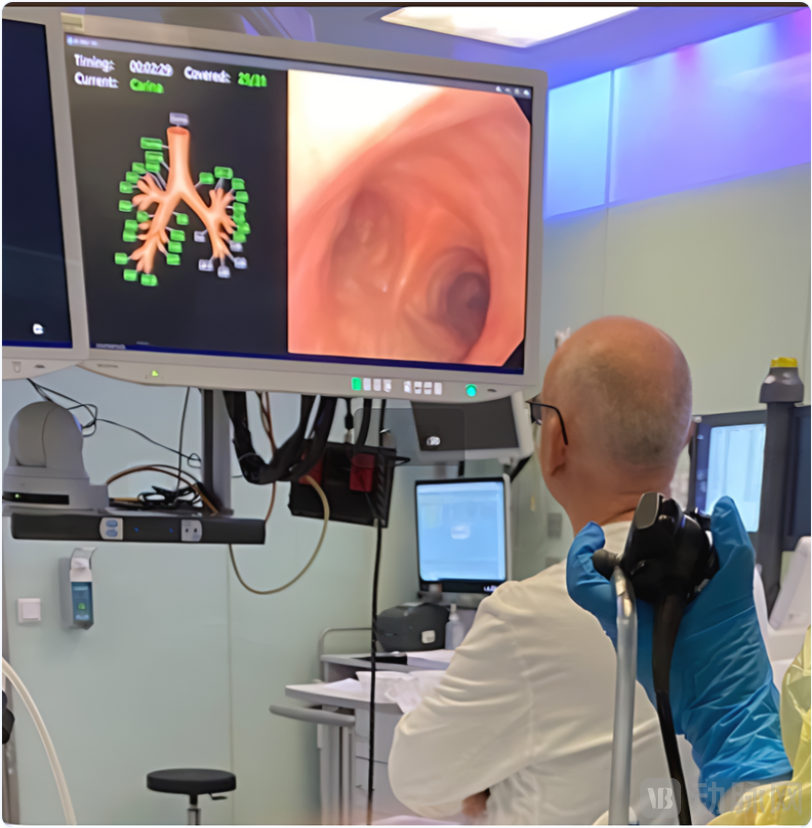
Professor Felix Herth Uses Jingying Technology’s AI-Powered Full Respiratory Tract Product
The founding team of Jingying Technology all have overseas educational and professional backgrounds, with over two decades of deep expertise in respiratory and gastroenterology specialties, as well as comprehensive experience in entrepreneurship and commercialization—Successfully launched an AI-assisted diagnostic system for digestive endoscopy, obtained a Class III medical device registration certificate for real-time quality control and assisted diagnosis in digestive endoscopy, and became the first to secure EU MDR Class IIa certification.Meanwhile, the company has assembled a mature AI team and adheres to deep integration among industry, academia, research, and clinical practice. By collaborating with top-tier Chinese universities on joint R&D, it continuously promotes the clinical translation of technologies, demonstrating strong collaborative innovation capabilities.


“Bronchoscopy and nasopharyngolaryngoscopy follow similar examination pathways, both involving transnasal insertion into the airway. However, these procedures fall under different medical specialties, making it difficult for physicians to complete both in a single session. Therefore, we advocate for the ‘Whole Respiratory Tract’ concept, leveraging Jingying Technology’s AI-powered whole respiratory tract solution to enable comprehensive screening and lesion identification in a single examination,” Liu Qiwei revealed.On July 26 this year, Jingying Technology and Ruijin Hospital, Shanghai Jiao Tong University School of Medicine, will jointly host the First China Conference on Artificial Intelligence for the Entire Respiratory Tract., engaging with industry experts to discuss the integrated innovation of AI technology and respiratory endoscopic diagnosis, and launching industry standards.
As previously mentioned, this AI-powered full respiratory tract product consists of two components: electronic endoscopes and AI software/hardware. It is specifically divided into the electronic nasopharyngolaryngoscope with its associated AI software/hardware, and the electronic bronchoscope with its associated AI software/hardware. The software system operates on a dedicated AI host (hardware).
Hospitals can flexibly procure solutions based on clinical needs: separately configure an AI host and choose to load either a nasopharyngeal/laryngeal or bronchial AI module; bundle multiple modules to achieve comprehensive coverage of the upper and lower respiratory tracts; or directly purchase an integrated all-in-one system solution.

AI-Powered Full Respiratory Tract Products
AI-Powered Electronic Nasopharyngolaryngoscope: Standardizing Nasopharyngolaryngoscopic Examinations
Electronic nasopharyngolaryngoscopy is a routine method for screening head and neck tumors. Over 90% of head and neck tumors are squamous cell carcinomas. Early-stage lesions are hidden within the superficial mucosa, have not yet formed obvious masses, and are difficult to identify with the naked eye due to interference from oral folds, making diagnosis highly dependent on physicians' experience. This reliance on experience, combined with the lack of standardized operational protocols, has led to persistently high rates of missed diagnoses and misdiagnoses.
MirrorVision Technology has integrated triple intelligent capabilities into nasopharyngolaryngoscopy by developing AI models based on over 100,000 high-quality clinical cases, leveraging technologies such as Deep Convolutional Neural Networks (DCNN) and 3D Convolutional Neural Networks (3D CNN):
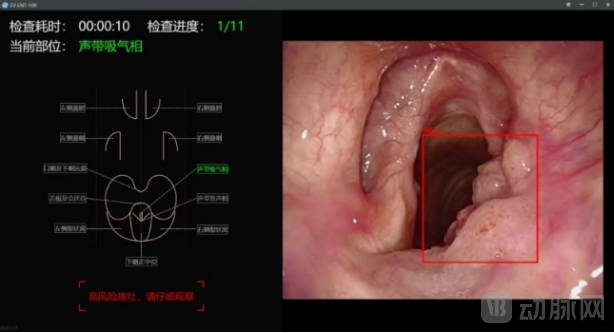
“Comprehensive Visibility”—AI automatically annotates risk areas and provides real-time alerts for unscanned regions, eliminating blind spots in the field of view;
“Accurate Diagnosis”—Intelligently identify pathological features, grade and label risks: low-risk cases are marked with blue boxes, high-risk cases are flagged with red warning boxes, and abnormal cases are highlighted with yellow boxes;
"Clear Vision"—By employing dynamic temporal modeling and a cleanliness scoring system, it effectively suppresses interference from respiratory artifacts and secretion occlusion. When nasal cavity cleanliness is insufficient, the AI provides immediate alerts for reprocessing.
It is reported that the product has obtained its type testing report, and its registration-related clinical trials are nearing completion. The marketing authorization is expected to be granted in approximately two to three months.
AI Electronic Bronchoscope: Proprietary Large Bronchial Model Enhances Examination Efficiency and Reliability
Traditional bronchoscopes exhibit low levels of intelligence and automation, leading to a reliance on physicians’ experience and subjective judgment during examinations, which results in poor procedural standardization. For instance, while bronchial examinations typically require coverage of the 31 branches of the third-generation airways, omissions may occur in clinical practice due to insufficient experience, non-standardized operations, or fatigue-induced oversight. Furthermore, the complex anatomy of the bronchial tree and the presence of multiple lesions contribute to high rates of misdiagnosis and missed diagnosis.
Professor Herth once pointed out, “Bronchoscopy remains a procedure that is highly operator-dependent... However, there are still some issues with our bronchoscopic techniques, particularly in terms of quality control. There are no clear standards regarding how to perform bronchoscopy, which areas require meticulous examination, and how to ensure that all relevant regions have been adequately visualized, especially for young physicians or those who do not frequently perform bronchoscopy.”[1]
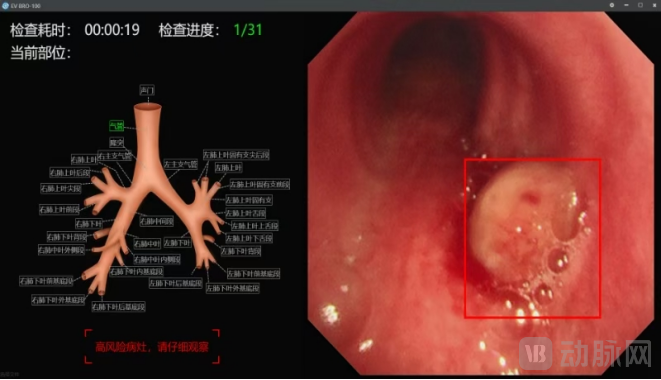
To address the aforementioned challenges, Jingying Technology, in collaboration with Professor Herth, Ruijin Hospital, and other partner institutions, jointly developed an AI bronchoscope with Xi’an University of Electronic Science and Technology. This product featuresBlind Spot Detection, Lesion Recognition, Intelligent Navigation, Image Enhancement, Automatic Image Capture, Procedure Duration Monitoring, Operational Scoringand other functions.
Compared with traditional respiratory endoscopy systems, the AI bronchoscope features an additional external monitor. On this monitor, the left side displays a schematic overview of the human respiratory tract, clearly labeling each anatomical region, while the right side shows real-time endoscopic images. As the inspection catheter equipped with a miniature camera advances, the reached areas are highlighted in green. The system also provides alerts regarding examination duration, progress (including the number of covered and remaining uncovered segments), and the current anatomical location. If a suspected lesion is identified, a risk-level alert is displayed on the right side using a flashing bounding box.
It is reported that the multicenter registry clinical trial for this product is nearing completion, with regulatory approval expected in 2–3 months.
Liu Qiwei revealed that Jingying Technology’s AI-powered full respiratory tract product has achieved compatibility with mainstream endoscopes from Olympus, Fujifilm, and other leading manufacturers, with plans to continuously expand its compatibility to gradually cover endoscopic equipment across multiple brands and models.
Additionally, Jingying Technology’s AI-powered full respiratory tract product obtained educational and training qualifications in January of this year. The related products have been deployed as teaching equipment in multiple medical institutions, generating initial revenue.
In terms of channel strategy, the company primarily adopts an agent-based model; it also provides OEM services for endoscopes and AI software to domestic and international endoscope manufacturers, while simultaneously deepening its engagement in the education and training sector.
In terms of market strategy, Jingying Technology adopts a dual-track approach for both domestic and international markets. On one hand, it is accelerating the development of its distributor network in China to cover more hospitals and medical schools. On the other hand, following domestic certification, it has swiftly initiated CE certification and international multicenter clinical studies. It is reported that the company has reached preliminary cooperation intentions with local endoscope manufacturers and hospitals in parts of Europe and South America.
References:
[1] The 91st CMEF | Professor Herth and Jingying Technology’s Journey in AI Respiratory Medicine