

Tencent Unveils 'Key Prescription' for Cognitive Disorder Affecting Over 30 Million Seniors

Tencent Healthcare
Developer of Digital Healthcare Products
In the public eye, video games are often associated with entertainment. However, in the realm of cognition, they have emerged as a potent therapeutic intervention.
In May 2025, Tencent’s cognitive function training software, “Tencent Brain Training,” received Class II medical device approval from the Guangdong Medical Products Administration for use in adjunctive rehabilitation training for mild cognitive impairment.
Currently, no medication can reverse cognitive decline; however, early intervention at the stage of mild cognitive impairment can effectively delay the progression to Alzheimer’s disease, or even prevent its onset.
The value of “Tencent Brain Training” lies in its ability to help patients with mild cognitive impairment delay disease progression and effectively improve cognition through a portable, real-time, and engaging approach.
It is reported that the clinical exploratory trial of “Tencent Brain Training” was completed at the China Rehabilitation Research Center (Beijing Bo’ai Hospital) and Zhujiang Hospital of Southern Medical University.
In the clinical trial, participants completed a full 12-week course of "Tencent Brain Training" cognitive training and were subsequently assessed using the Loewenstein Occupational Therapy Cognitive Assessment (LOTCA) battery and the Montreal Cognitive Assessment (MoCA).
The results showed that participants who underwent software-based cognitive training demonstrated significantly greater cognitive improvement compared to the control group, demonstrating that “Tencent Brain Training” can significantly enhance cognitive abilities.
Information disclosed by Tencent indicates that the “Tencent Brain Training” cognitive function training software is the product of cross-team collaboration within Tencent, jointly developed by Tencent SSV Time Lab, Tencent Games Social Value Exploration Center, and Tencent Miying; Tencent Music provided content support; and the Department of Psychology at Sun Yat-sen University offered guidance on product research and development.
Unlike ordinary brain-training games encountered in daily life, “Tencent Brain Training” is designed and developed based on evidence-based medicine and cognitive psychology. By integrating elements such as audio, visuals, interactive gameplay, and incentive mechanisms, it provides positive emotional reinforcement, thereby helping patients undergo training in six major cognitive domains—perceptual-motor function, executive function, complex attention, language, learning and memory, and social cognition—to slow cognitive decline.
Furthermore, traditional cognitive training typically targets only a single cognitive function, whereas “Tencent Brain Training” adopts a design in which each training module corresponds to multiple cognitive domains, thereby enhancing patients’ training outcomes and sense of benefit.
Currently, “Tencent Brain Training” features four life-oriented training modules: culinary arts, music, poetry, and organization. Each training theme includes no fewer than 150 levels, following a progressive unlocking model from easy to difficult, thereby helping patients with mild cognitive impairment engage in cognitive training through simple, enjoyable, and highly accessible methods.

Module Composition and Functions of the “Tencent Brain Training” Cognitive Function Training Software
Meanwhile, Tencent has also implemented “elderly-specific customizations” for the UI and visual design of its “Tencent Brain Training” app.
Young people generally prefer cute and trendy art styles, while older adults tend to favor high-contrast, prominent colors. Furthermore, as older adults have less dexterity in their hands and feet compared to younger individuals, we will minimize drag-and-drop interactions in our design, prioritizing tap-based controls instead.
In selecting game content, Tencent also conducted research into the preferences of older adults. Many seniors remain passionate about the music and poetry they enjoyed in their youth, while others favor elements closely integrated with daily life. Accordingly, Tencent’s content design fully incorporates these preferences to help older adults adhere to training regimens and better transfer the benefits of cognitive training to real-life situations.
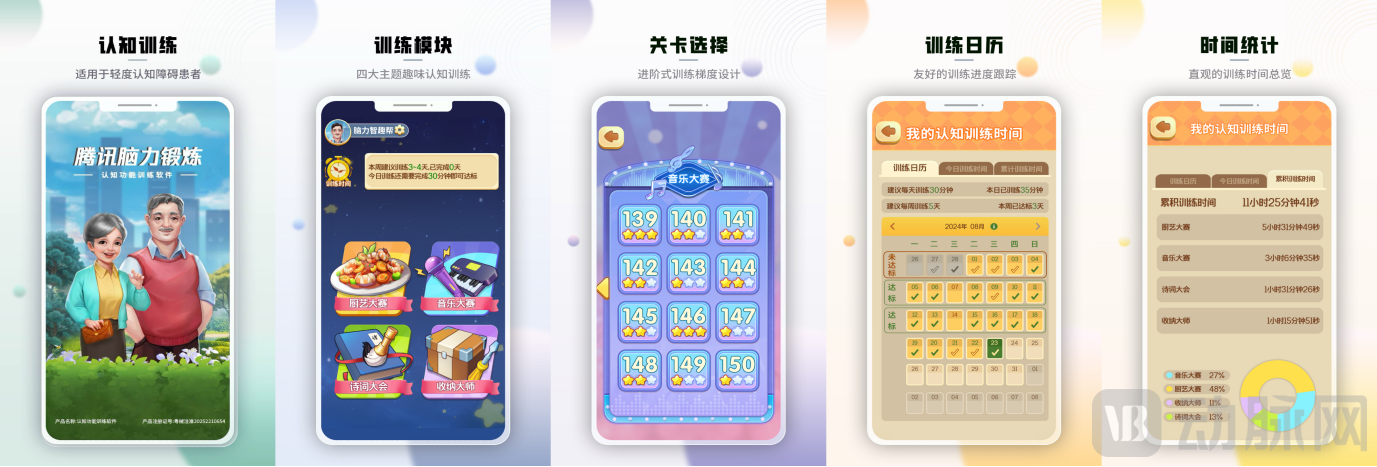
“Tencent Brain Training” Cognitive Function Training Software
For example, in this exploratory clinical trial, the “Storage Master” training module was highly popular among participants. It required participants to categorize and store various items—including seasonings, clothing, and tools familiar to the elderly, as well as some distractors—within a specified time limit. During the training, the difficulty levels of “Storage Master” progressively increased, aiming to enhance participants’ cognitive functions.
In clinical practice, the use of “Tencent Brain Training” requires a physician’s prescription, with patients adhering to medical instructions. Physicians design individualized training regimens for patients, specifying parameters such as daily session duration and weekly frequency. For instance, if a physician sets the daily training limit at 45 minutes, patients are prohibited from continuing further sessions on that day once this threshold is exceeded. Such restrictions help elderly users mitigate health risks associated with prolonged sedentary behavior and extended screen exposure.
Based on participant feedback, elderly users generally hold a positive attitude toward “Tencent Brain Training.”
Aunt Liu is one of the participants in this clinical trial. Before undergoing cognitive assessment, she noticed that she often made mistakes in trivial matters, such as forgetting to add salt to dishes or leaving the stove on after cooking. She told VCBeat, “After completing these training sessions, my cognitive abilities gradually recovered. My brain’s response time seems to have improved, and my memory is better than before. Additionally, I used to feel slightly nervous when performing tasks, but now I can carry them out in an organized and sequential manner.”
There are also some interesting phenomena observed in clinical trials. For instance, an elderly participant reported that cognitive training helped strengthen his relationships with family members. When encountering classical Chinese poems and verses mentioned during the training, he would often seek assistance from his children or grandchildren, who always responded enthusiastically to his inquiries. Receiving increased attention and care motivated him further to engage with the “Tencent Brain Training” program, striving to enhance his cognitive abilities.
Numerous clinical studies have previously confirmed the efficacy of game-based digital therapeutics. In simple terms, gamified design serves as a delivery vehicle within the therapy, encapsulating the active ingredient—information—and delivering it to the “target,” thereby helping patients fully absorb this information.
The key to ensuring effective delivery lies in the ability of such digital therapeutics to incorporate “timely feedback mechanisms” and “strong adherence.”
Professor Ku Yixuan from the Department of Psychology at Sun Yat-sen University stated, “We deal with various matters in our daily lives, but few people provide feedback afterward to inform us whether we have done things correctly or incorrectly.”
“For an elderly person with cognitive impairment, a positive feedback mechanism is crucial. If the senior has an assistant by their side in daily life to provide timely reminders on how to perform each household task and whether it is being done correctly, they are less likely to forget or make mistakes.”
Therefore, the logic behind “Tencent Brain Training” lies in its ability to simulate the daily lives of older adults, helping them distinguish right from wrong and rewarding them for making correct choices through gamified mechanisms. This is a highly effective training approach, after all, no one dislikes instant rewards.
High adherence is another advantage of gamified digital therapeutics. For mild cognitive impairment, effective intervention requires long-term patient commitment. It necessitates regular visits to hospitals or rehabilitation centers and prolonged engagement in training activities such as cognitive tasks. For patients, maintaining sustained active participation in treatment over an extended period is challenging.
In contrast, gamified digital therapeutics partially reduce patients’ reliance on offline resources, create a relaxed therapeutic atmosphere, and leverage reward mechanisms to encourage older adults to actively adhere to cognitive training products. Meanwhile, applications such as “Tencent Brain Training” can be downloaded onto smartphones with a physician’s prescription, thereby enhancing the accessibility of clinical intervention.
Currently, some regions have begun to leverage digital therapeutics for the screening and rehabilitation of cognitive impairment in the elderly. For instance, the Shanghai Mental Health Center and the Alzheimer’s Disease Diagnosis and Treatment Center at Shanghai Jiao Tong University have focused on cognitive disorders, developing a precise and efficient Shanghai assessment standard through a gamified “Three-Minute Cognitive Impairment” screening tool. Certain areas within China have also confirmed that they will rapidly follow suit in implementing digital therapeutic-based screening and training interventions for cognitive impairment among the elderly in the near future.
As a country with a high prevalence of Alzheimer’s disease, China currently has approximately 15 million patients with Alzheimer’s disease, with average treatment costs ranging from 130,000 to 150,000 yuan. Additionally, over 30 million people suffer from mild cognitive impairment, which may gradually progress to Alzheimer’s disease within 3–5 years if left untreated.
If we can leverage “Tencent Brain Training” to keep patients with mild cognitive impairment in this stage, it will save substantial costs for both patient families and the medical insurance system, while alleviating patients’ fear of losing their “past selves.”
In fact, Tencent has long been committed to addressing the prevention and treatment of cognitive impairment among the elderly population, striving to explore new solutions through digital means. Prior to obtaining medical device certification for its “Tencent Brain Training” cognitive function training software, Tencent had already launched the popular science game *Room 301, Building 6* and the screening mini-program *Silver Brain Power*, thereby covering the three key stages in the field of cognitive impairment: public education, screening, and intervention.
NMPA data shows that Tencent has completed registration and market access for six medical devices. Among them, innovative medical devices for conditions such as pneumonia, glaucoma, and colonic polyps have been successfully approved. Tencent has become the first internet technology enterprise in China to hold Class III medical device certificates for multi-disease, multi-modal medical AI.
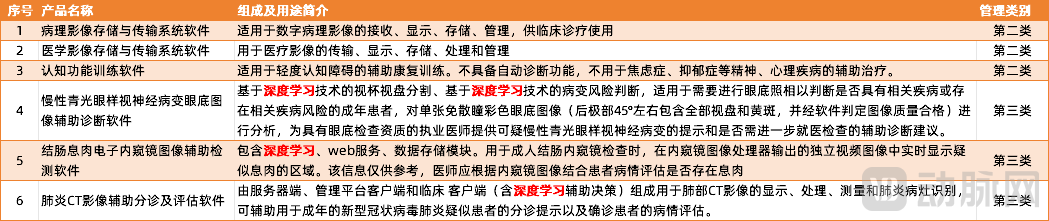
Tencent's Market Access Statistics in the Medical Device Sector (Data as of June 20, 2025)
In the field of internet healthcare, Tencent has developed a wide range of AI solutions and established partnerships with over 10,000 medical institutions, enabling the rapid deployment of these innovative solutions.
As Tencent’s medical AI matrix continues to gain momentum, the tech giant, with its mission of “connecting everything,” may further revolutionize the public health system and advance diagnostic and therapeutic technologies, leveraging digital intelligence to meet the health needs of every individual.