

Behind the 'Return' of Nearly 100 Multinational Pharma Executives to Domestic Chinese Biopharma Firms
Recently, the former Global Senior Vice President of Takeda Pharmaceutical and President of Takeda ChinaShan GuohongThe move to join BeiGene has drawn considerable attention from the industry. This is not an isolated case; not long ago, the former Global Senior Vice President of AstraZenecaFeng Ji, and officially joined Jiangsu Hengrui Pharmaceuticals Co., Ltd. as General Manager and Chief Operating Officer.
In fact, starting this year, numerous executives from foreign companies have announced their joining of domestic pharmaceutical firms, and the trend of executive “return” is gaining significant momentum. This is not baseless; according to incomplete statistics from VCBeat,Nearly 100 Executives from Overseas Pharmaceutical Companies Have “Jumped Ship” to Domestic Firms in the Past Five Years, with representative figures includingBeiGene's Wu Xiaobin、Hengrui Medicine, Jiang Ningjun、Zhang Wenjie, HenliusandZhu Tong, Zai Labetc.
This is absolutely a rare sight to behold,After all, a decade ago, most executives of overseas pharmaceutical companies who resigned chose to return to their home countries to start businesses.For instance, after leaving Eli Lilly, Chen Bo co-founded Junshi Biosciences in 2012. Additionally, Yu Dechao returned to China in 2011 to establish Innovent Biologics, focusing on the research and development of monoclonal antibodies and biosimilars, after stepping down from his position as Vice President at the U.S. biopharmaceutical company Calydon. There are many other similar cases, and it is precisely this group of individuals that has propelled China’s innovative drug industry into a golden age of rapid development.
Nowadays,They no longer engage directly in the market, but instead choose to partner directly with local pharmaceutical companies., what exactly has changed in the interim? What substantive changes will this identity shift bring to domestic pharmaceutical companies that are currently in a critical phase of transformation? Will they ultimately be able to remain in the market? To answer these questions, VCBeat has conducted an in-depth analysis.
Shifting from Foreign Enterprises to Domestic Companies: A Proactive Choice or a Passive Retreat?
According to many industry insiders, the current “return flow” of senior executives from foreign companies is driven by both positive and negative factors.
Among them“The Flip Side” Primarily Refers to the Uncertainty Faced by Overseas Pharmaceutical Companies in the Chinese Market, Which Is Pushing a Wave of Chinese Executives Abroad. Taking this year as an example, since taking office, Trump has successively introduced a series of measures, including tariffs and the “Most-Favored-Nation policy,” all of which are essentially aimed at suppressing China’s innovative pharmaceutical industry. In the future, as global competition between Chinese and U.S. innovative drugs intensifies, there is a high likelihood that the United States will further tighten restrictions on China’s innovative pharmaceuticals, which will significantly impact the development of overseas pharmaceutical companies in the Chinese market.
In response, a senior industry insider stated, “Once Sino-U.S. relations become turbulent, many executives of overseas pharmaceutical companies may face career crises due to being “distrusted.”, those facing milder impacts are gradually being marginalized, with their prospects for advancement significantly narrowed; those suffering more severe consequences may face direct job losses among senior executives due to corporate groups withdrawing from the Chinese market or reducing their investments.
Compared to the “negative side,” the “positive effects” are more diverse.First and foremost, there has been a significant enhancement in the overall strength of domestic pharmaceutical companies., taking key targets as an example, by 2024, China ranked first globally in the proportion of emerging pipelines such as ADCs, cell therapies, bispecific antibodies, and oncolytic viruses. Among these, domestically developed ADC new drugs accounted for over 40% of the global pipeline, gradually establishing a firm foothold in the global market.
Second, the scope for overseas pharmaceutical executives to contribute within Chinese pharmaceutical companies is expanding.For instance, the current surge in business development (BD) deals is driving domestic pharmaceutical companies to rapidly recruit seasoned professionals with a deep understanding of overseas markets and extensive experience in BD transactions. A case in point is Jiang Ningjun, who joined Hengrui Medicine and is primarily responsible for the company’s clinical research and business development efforts. Under his leadership, Hengrui has completed nine out-licensing deals over the past three years, with a total transaction value exceeding $14 billion, thereby becoming a new growth engine for the company.
The final key factor is the allure of astronomical annual salaries.According to the "2022 Talent Market Insights and Compensation Guide" released by MedTrend,Executives from overseas pharmaceutical companies jumping ship to domestic firms see salary increases of at least 30%, with some exceeding 50%. This is no exaggeration. A pharmaceutical executive search consultant told VCBeat, “For many domestic pharmaceutical companies, the headhunting fees for C-level executives alone can reach RMB 500,000 to 600,000,” which underscores their urgent demand for senior executives from overseas pharmaceutical firms.
Wu Xiaobin, who left Pfizer to join BeiGene, once candidly stated that innovation rooted in China has become an unstoppable trend. Factors such as talent, capital, policy support, and market demand all indicate that China’s innovative R&D is entering a harvest period. Meanwhile, driven by the wave of Chinese innovative drugs going global, domestic companies are in urgent need of professionals with international backgrounds to lead drug R&D or execute overseas clinical development strategies. This has given rise to the notable phenomenon of senior executives from multinational pharmaceutical companies joining Chinese innovative biopharma firms.
From R&D to Market: What Results Have Executives Delivered After Returning?
Unlike in the past, when the focus was more on research and development,In recent years, the focus of the “return flow” of senior executives from foreign companies has been primarily on the execution and realization of business objectives.. This is also corroborated by statistical data: among nearly 100 overseas executives who “job-hopped” to domestic pharmaceutical companies over the past five years, 40% were responsible for commercialization, a figure nearly 10 percentage points higher than that for R&D.
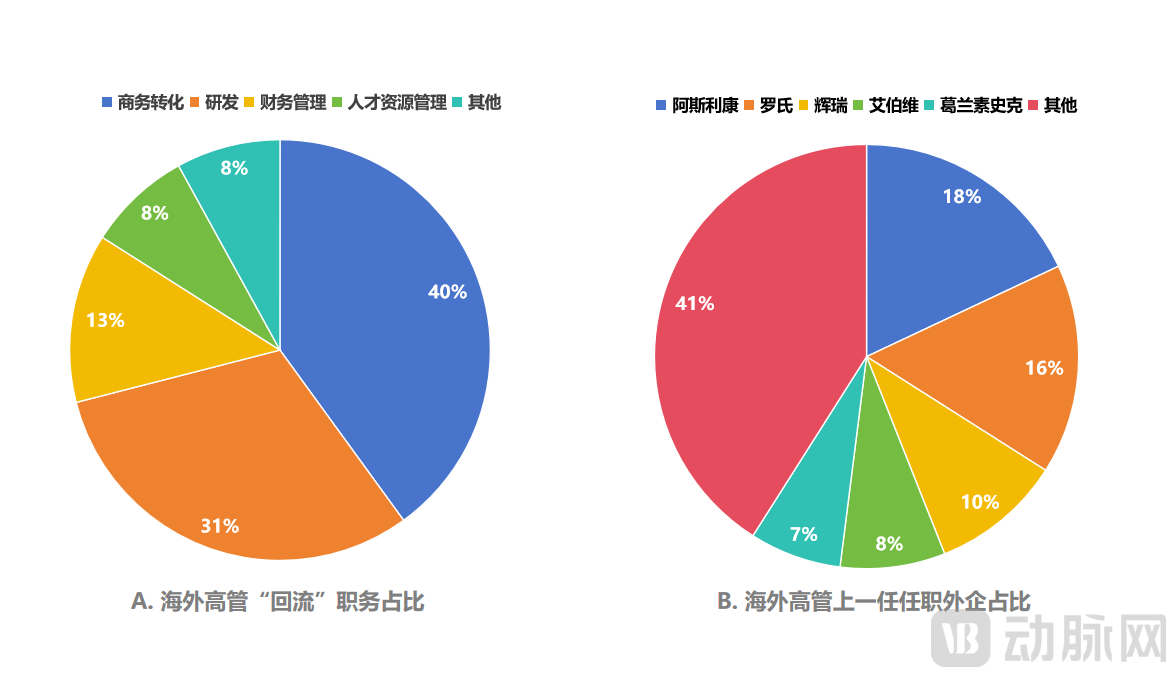 Proportion of Overseas Pharmaceutical Executives’ “Return” Positions and Their Share in Foreign Enterprises (Chart by VCBeat)
There are, of course, reasons behind this.Primarily, the urgent need for cash flow among domestic pharmaceutical companiesIn recent years, as capital has receded, pharmaceutical companies have faced sharply increased financing pressures, forcing them to accelerate the commercialization of marketed products to generate revenue. Furthermore, with policies such as healthcare insurance cost containment and volume-based procurement driving price reductions taking deeper effect, pharmaceutical companies’ profits have experienced cliff-like declines, creating an urgent need to identify new cash flow channels to bridge funding gaps. Clearly, the pressure on domestic pharmaceutical companies to achieve commercial conversion has reached unprecedented levels, making overseas pharmaceutical executives—who largely possess mature experience in this area—highly sought after.
So, after joining domestic pharmaceutical companies, what kind of results have they actually delivered?
On one hand, it is reflected in the market promotion of innovative drug products. WithChen ShaofengFor example, he has held key positions at major pharmaceutical companies such as AstraZeneca, AbbVie, Merck, and Roche, accumulating nearly 30 years of experience in marketing and sales management within the pharmaceutical industry. In February 2024, Chen Shaofeng officially assumed the role of Chief Commercial Officer at InnoCare Pharma, taking full responsibility for the company’s commercial operations. Following his appointment, commercial conversion yielded immediate results: in the first half of the year, InnoCare Pharma achieved revenues of RMB 420 million, a year-on-year increase of 11.17%. By the third quarter, the company’s flagship product, orelabrutinib, generated RMB 276 million in revenue, marking its highest quarterly income since launch.
Another typical case isMou Yanping, he successively served at multinational pharmaceutical companies such as GlaxoSmithKline, AstraZeneca, Johnson & Johnson, and Merck & Co. After leaving these positions, he officially joined Allist in March 2020 as General Manager of Pharmaceuticals, primarily responsible for marketing promotion. During his tenure, he facilitated the successful launch of the core product furmonertinib, achieving first-year sales exceeding RMB 200 million, which became a key factor in Allist’s successful listing on the stock exchange by the end of that year.
In this regard, a senior investor specializing in innovative drugs remarked, “Unlike traditional domestic pharmaceutical companies that continuously expand their marketing teams,Innovative pharmaceutical companies initially require R&D talent; then, as their pipelines advance, roles such as Chief Commercial Officer (CCO) gradually become essential to the industry.. However, it is difficult to find talent for this position in traditional pharmaceutical companies that have historically prioritized customer relationships over other factors. Senior professionals with proven experience in successful drug commercialization and effective academic promotion are typically found in multinational corporations. Having been validated by the market, these individuals are more sought after by domestic pharmaceutical companies.”
On the other hand, it is reflected in outbound business development (BD) transactions for the product pipeline.According to a research report released by Huafu Securities, the total value of overseas business development (BD) transactions for China’s innovative drugs reached $45.5 billion from January to May 2025, approaching the full-year transaction volume of 2024. It is evident that the BD transaction market is highly active and has become a crucial channel for domestic pharmaceutical companies to generate cash flow.
This is clearly inseparable from the significant investments made by domestic pharmaceutical companies in business development (BD) talent in recent years. According to a senior pharmaceutical recruiter who spoke to VCBeat, over the past two years, Chinese innovative drug companies have been fiercely competing for BD candidates. There has been substantial demand for these roles, with no shortage of positions offering annual salaries exceeding RMB 1 million, primarily targeting executives from overseas pharmaceutical companies.
Liu YongjunHe is one of the representative figures in the field, having previously served as an R&D executive at AstraZeneca and Sanofi. He officially joined Innovent Biologics in 2020, where he was responsible for global R&D, pipeline strategy, business development, and international operations. With Dr. Liu Yongjun’s leadership, Innovent Biologics completed overseas business development (BD) deals totaling more than $5 billion between 2020 and 2024, with partners including Eli Lilly, Roche, and Sanofi. In September 2024, Dr. Liu moved to CSPC Pharmaceutical Group, serving as Executive President and President of Global R&D, continuing to oversee pipeline strategy and international business expansion. Just one month later, CSPC closed a landmark BD deal—securing an exclusive collaboration with AstraZeneca for a small-molecule lipid-lowering drug, with a total transaction value of approximately $1.92 billion.
In this regard, a senior BD professional remarked, “An outstanding business development (BD) specialist should be a ‘hexagonal warrior,’ possessing knowledge across R&D, manufacturing, commercialization, legal affairs, finance, and policy, while also being well-versed in overseas markets. The role demands exceptionally high qualifications. Unlike in China, overseas BD transactions started earlier and the market is already highly mature, cultivating a pool of seasoned professionals who align precisely with the current needs of Chinese pharmaceutical companies.”
Those Poached Can’t Be Retained: How to Break the “18-Month Curse”?
In fact, the path of “returning” for executives from overseas pharmaceutical companies is not always smooth. For example, Qian Wei, who was originally the General Manager of Roche Pharmaceuticals’ Oncology Business Unit 1, officially joined Junshi Biosciences as Chief Commercial Officer in July 2021 after leaving his previous position.But just four months later, Qian Wei left Junshi Biosciences and returned to Roche.。
This incident has sparked considerable controversy within the industry. However, it is not an isolated case; according to incomplete statistics from VCBeat,Among the nearly 100 overseas pharmaceutical executives who chose to “return” to China over the past five years, more than half have since left their positions and found new employment., some have returned to multinational corporations like Qian Wei, while others have switched jobs again to new domestic enterprises. For instance, Han Jing, who left Roche, has successively held positions at three Chinese pharmaceutical companies within three years.
Spencer Stuart, a global executive search firm, once released a survey showing that,After recruiting talent, pharmaceutical companies face a turnover rate as high as 70% within the first 0 to 18 months, which has gradually become a workplace jinx.So, what exactly is the reason behind this?
Through analysis, VCBeat identifies three key points:The first point is "acclimatization issues."In fact, when overseas pharmaceutical companies enter the Chinese market, they typically already possess a certain scale of operations and established management systems, having reached a mature stage of corporate development. With clearly defined team roles and responsibilities, they can draw on past experience for various matters, resulting in a gradual and even somewhat conservative approach to overall operations. In contrast, domestic pharmaceutical companies mostly adopt flat management structures, with unclear functional divisions between departments. Founders or CEOs often play a pivotal role in decision-making. Coupled with a strong determination to “overtake on the bend,” these companies tend to be more aggressive in R&D progress, new product launches, and return on investment.
This “differentiation” became the final trigger for the departure of senior executives from multinational corporations. Taking Qian Wei as an example, when he left Junshi Biosciences, the external consensus largely attributed his exit to the underperformance of PD-1 inhibitors. However, Qian Wei quickly denied this, stating that “the deeper reason lay in the underlying ‘decision-making model’ of the company, which differed significantly from that of his previous employer.” In other words, it was a mismatch in “values” between the two parties.
The second core reason is the disagreement over goal achievement.. Because most overseas executives are recruited by domestic pharmaceutical companies with high salaries, expectations for them are substantial, with employers eager to see results from the hiring in the short term. However, this is unrealistic. On one hand, most executives require a certain period of adaptation after joining; on the other hand, the market downturn in recent years has made it more difficult to achieve targets. When results fall short of expectations, various frictions inevitably arise over time. A biotech CEO once complained about talent poached from multinational corporations at high cost: “As soon as they arrived, they demanded that I assemble a team and provide resources. If I could afford to do all that myself, why would I need to hire them?”
In response, a senior industry insider stated, “In fact, the more aggressively companies poach talent with high salaries, the harder it becomes to retain them. This is because sky-high compensation packages can, to some extent, distort industrial logic, leading domestic pharmaceutical companies to harbor excessively high expectations for talent. Once results are not delivered in a timely manner, tensions between both parties escalate, ultimately resulting in an acrimonious split.”
The final fundamental reason is the ever-changing nature of the pharmaceutical industry itself.Innovative drug development is inherently a “nine deaths, one life” endeavor, fraught with countless variables; any single one can lead to the direct “demise” of a team or even an entire pharmaceutical company. This uncertainty is vividly reflected in the experiences of foreign executives who have returned to China.
Taking Dong Lijun as an example, she officially joined Luoxin Pharmaceutical in 2021, bringing along former AstraZeneca colleagues such as senior executives Zhang Anwei and Wang Dong, with ambitions to make a significant impact. However, unforeseen circumstances prevailed. Luoxin Pharmaceutical’s core products were successively included in the centralized volume-based procurement (VBP) program. Between 2021 and 2022, seven products—ambroxol hydrochloride injection, parecoxib sodium for injection, esomeprazole sodium for injection, lansoprazole for injection, edaravone injection, cefmetazole sodium for injection, and meropenem for injection—were all successfully selected in the VBP bids. This undoubtedly constrained the operational scope and strategic flexibility of the so-called “AstraZeneca dream team.” According to financial reports, Luoxin Pharmaceutical’s revenue in 2022 amounted to RMB 3.588 billion, representing a year-on-year decline of 44.62%. The company recorded its first annual loss since its listing on the A-share market four years earlier, which ultimately became the final straw leading to the end of Dong Lijun’s tenure at Luoxin Pharmaceutical.
Overall,Domestic pharmaceutical companies and the returning overseas executives still need time to adapt and align with each other; both parties should maintain greater rationality in this process.. Nevertheless, one established fact is that the growing cohort of domestic pharmaceutical companies is currently attracting the attention of a wave of overseas executives, whose joining will significantly compensate for the weaknesses of these Chinese firms and propel them into a new stage of development.
1. “How ‘Migrating’ Multinational Pharmaceutical Executives Are Breaking the ‘18-Month’ Curse”—E-Drug Manager;
2. “A RMB 6 Million Annual Salary Fails to Retain a Foreign Enterprise Executive” — Jian Shi Ju;
3. “Talent Gap in China’s Innovative Pharmaceutical Companies: Are High Salaries Ineffective and Unable to Retain Executives from Multinational Corporations?” — DeepBlue View