

Shangding Zhiyin Files IPO Prospectus: Two Decades of Innovation in Brain Health Management with 'Brain Neural Age' as Core Metric
Have you ever experienced moments like these: You walk into the kitchen, only to suddenly forget what you went there for; during a conversation, a familiar place name is on the tip of your tongue, yet you just can’t recall it; information you once could memorize at a glance now remains elusive, with key points failing to stick even after repeated readings...
These seemingly “trivial” everyday phenomena may all be signals of brain aging released by the brain. More notably, while many people believe that brain aging is a concern only for the elderly, research indicates that the aging process of the brain begins far earlier than we imagine, and it is a process in which quantitative changes lead to qualitative changes.
As the body’s “command center,” brain aging involves complex biological mechanisms. These changes may represent stage-specific features of normal growth, development, and natural aging, or they may serve as early warnings of accelerated aging triggered by neurological disorders. To precisely assess the trajectory of brain aging, scientists have proposed the concept of Brain Age Gap (BAG), which intuitively reflects brain integrity by comparing the difference between predicted brain age and chronological age, thereby evaluating the risk of age-related neurodegenerative diseases.
In this context, Beijing Shangding Zhiyin Medical Technology Co., Ltd. (hereinafter referred to as “Shangding Zhiyin”), a pioneer in the field of global brain health management, has successfully developed a non-invasive brain nerve fiber tracking technology (Tractography) based on diffusion tensor imaging (DTI) and artificial intelligence, leveraging decades of research achievements from a team of professors at top-tier universities.
This cutting-edge technology enables non-invasive, three-dimensional visualization and reconstruction of white matter neural fiber pathways in the living brain. By integrating artificial intelligence algorithms, it precisely estimates individual brain age, providing key scientific evidence for elucidating brain health status, the aging process, and the risk of potential dementia.
According to WHO statistics, there are approximately 55 million people with dementia worldwide, with new cases emerging every three seconds. As the country with the largest number of dementia patients globally, China has over 15 million cases, accounting for about one-fifth of the global total. With the accelerating pace of population aging and increasing life expectancy, the global number of dementia patients is projected to reach 82 million by 2030. This not only imposes a heavy burden on individuals and families but also poses severe challenges to society, having become a major public health issue affecting people's well-being.
Cerebral nerve fibers act as the brain’s “wiring network,” responsible for transmitting neural signals in various forms to support diverse cognitive functions. With aging, white matter tracts gradually undergo structural damage and functional decline, leading to cognitive impairment.
Currently, the diagnostic tools commonly used in clinical practice for dementia include the AD-8 Dementia Screening Instrument, the Mini-Mental State Examination (MMSE), the Short Portable Mental Status Questionnaire (SPMSQ), and the Memory Impairment Screen (MIS), along with blood tests, imaging studies, and neuropsychological assessments. These tools are primarily employed to assess the current severity of cognitive decline; they cannot predict risk or disease progression, nor can they provide preventive recommendations for high-risk populations.
“DTI is a new MRI technology that has emerged in recent years and is currently the only method capable of non-invasively, comprehensively, and real-time visualizing the spatial distribution, trajectory, and integrity of cerebral nerve fibers. Our team has been deeply engaged in this field since 2003. Through clinical practice, we have found that DTI demonstrates unique value in various neurological disorders, particularly showing outstanding performance in the early screening of dementia,” emphasized Dr. Xu Yongqin, Chief Technical Advisor at Shangding Zhiyin, in an interview.
Specifically, the Shangding Zhiyin team first constructed a large-scale standardized neuroimaging database based on neuroimaging data from healthy individuals. On one hand, they employed automated analysis algorithms to multidimensionally measure brain structural and functional parameters, thereby characterizing the structural features of the normally aging brain. On the other hand, they precisely mapped DTI imaging features onto brain neural connectivity atlases, enabling quantitative analysis of the structure of 76 cerebral nerve fiber tracts.
Building on this foundation, the team developed a brain age prediction model based on data and machine learning algorithms, and optimized it through multi-dimensional cross-validation. This enables precise assessment of the aging degree across eight major cognitive functional networks, including memory, language, and attention. Following multi-stage validation and testing, the model has been applied in clinical auxiliary diagnosis and academic research with high sensitivity and reliability, providing an objective, quantifiable scientific basis for brain health assessment.
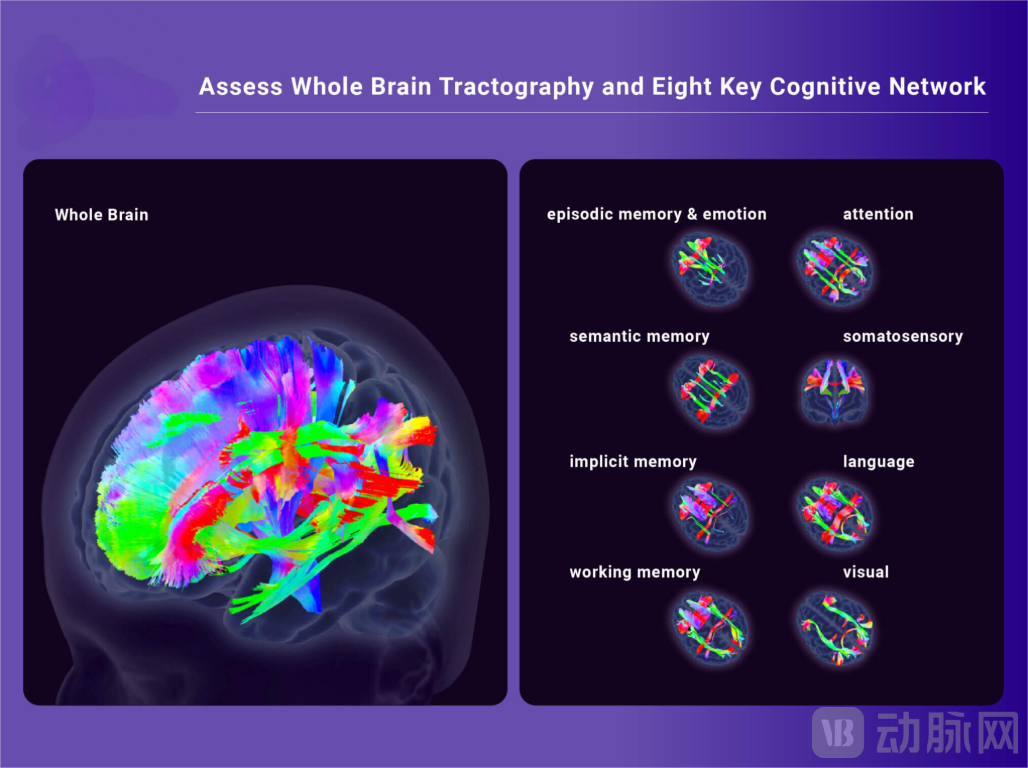
Evaluation of Whole-Brain Tractography and Eight Key Cognitive Networks
Image source: Shangding Zhiyin
Specifically, these eight cognitive functional networks are subdivided based on the brain nerve fiber bundle atlas independently developed by the Shangding Zhiyin team, includingEpisodic Memory, Semantic Memory, Implicit Memory, Working MemoryFour Memory Networks,Language Function, AttentionTwo higher-order functional networks, andSensorimotor Function, Visual FunctionTwo receptive response functional networks; the brain age of each cognitive functional network can reveal varying degrees of aging across the eight networks.
“Even the aging brain retains significant functional plasticity. Therefore, what we need to do is conduct early screening, early assessment, and early intervention. Through years of translating research into practical applications, Shangding Zhiyin has applied brain age analysis technology to a variety of clinical diseases. The related achievements have been granted U.S. patents, with the first patent simultaneously filed inEuropean Union, Canada, Australia, Japan, South Korea, Chinapatents in multiple countries. In addition, the core modules for brain age assessment and brain detection developed by the company have passedUnited StatesFDA 510(k)Marketing Authorization“...can precisely analyze abnormalities, injuries, and degenerative changes in brain structure, enabling scientific prediction of dementia risk,” emphasized Dr. Xu Yongqin.
From Prediction to Prevention
First, an objectively quantified model for assessing brain nerve health, combined with clinical data analysis, can accurately evaluate the degree of cognitive decline in the brain, enabling early prediction and prognostic assessment of dementia. Dr. Xu Yongqin pointed out: “Before the onset of dementia, structural changes have already occurred in patients’ brain nerve fibers. These changes can be detected in advance through brain nerve age analysis technology, thereby providing personalized intervention and improvement treatment plans for individuals, delaying disease progression, and securing a golden window of opportunity for clinical intervention.”
Efficacy Assessment and Intervention
Brain Age Analysis Technology Has Wide-Ranging Applications and Shows Great Potential in Efficacy Evaluation. It is reported that Shangding Zhiyin is collaborating with pharmaceutical companies developing Alzheimer’s disease drugs and medical device manufacturers to help predict patient prognosis following the use of related medications or medical devices, thereby assessing treatment effectiveness.“We conducted a study on patients with mild cognitive impairment and found that those who responded effectively to medication exhibited a smaller brain age gap, whereas non-responders showed a larger brain age gap. This finding provides clinicians with important reference data, helping them develop more precise treatment plans.”
Furthermore, the brain age analysis technology developed by Shangding Zhiyin plays a significant role in the assessment of neurological disorders, such as stroke rehabilitation and Parkinson’s disease, as well as psychiatric conditions, including depression, anxiety, and autism spectrum disorder. By continuously monitoring changes in patients’ brain age, clinicians can timely adjust rehabilitation plans to enhance therapeutic outcomes.
Despite the significant achievements of brain age analysis based on cranial nerves in scientific research, its clinical implementation still faces numerous challenges. Dr. Xu Yongqin candidly stated, “Although DTI technology offers distinct advantages, it encounters challenges in clinical applications, such as prolonged scan times and low signal-to-noise ratio. By developing patented optimization algorithms, we have specifically corrected image distortion and head motion artifacts, significantly enhancing image quality. This has effectively overcome technical bottlenecks, accelerating the adoption and widespread use of this technology in clinical settings.”
Currently, Shangding Zhiyin has established collaborations with more than 20 hospitals worldwide, promoting the clinical application of brain neural age analysis technology. “An increasing number of clinicians are recognizing the value of brain neural age analysis and are willing to adopt it as an auxiliary diagnostic tool to provide more precise medical services for patients,” said Dr. Xu Yongqin.
“In addition to clinical applications in serious medical settings, the trend toward proactive health screening and management is becoming increasingly pronounced, driven by an aging population, heightened public health awareness, and advances in science and technology. ‘We plan to establish brain health management centers in first-tier cities such as Beijing and Shanghai to provide one-stop brain health testing and management services. By building our own health management centers and collaborating with hospitals, physical examination centers, and other channels, we aim to bring our brain neural age analysis technology to a broader market,’ said Wu Shuai, Chairman of Shangding Zhiyin.”
The convenience of testing has heightened patients’ health awareness, making the demand for early screening and diagnosis more proactive and driving continuous growth in demand. Wu Shuai further pointed out: “In this context, the Brain Health Management Center not only provides professional brain age assessment services but also develops personalized brain health improvement plans based on test results. These plans encompass a range of interventions, including lifestyle modifications, cognitive training, and pharmacological treatment. Moreover, the center extends its value proposition from single-point testing to comprehensive, full-cycle health management, thereby further enhancing user stickiness.”
Furthermore, China’s digital economy has witnessed rapid growth in recent years, and the era of monetizing data assets has arrived.Brain data, as a high-value data asset, possesses unique potential to drive the innovative upgrading of the brain health industry.In response, Shangding Zhiyin has proactively established a strategic presence by combining self-operated initiatives with collaborative partnerships to extensively gather a large volume of high-quality brain imaging data. On one hand, these data are used to continuously optimize algorithms, enhancing their accuracy and reliability; on the other hand, they enable in-depth collaborations with pharmaceutical companies, insurance institutions, and other stakeholders to further unlock the commercial value of the data, thereby supporting the high-quality development of the brain health industry.
Brain Age Analysis Technology, as an innovative achievement in the fields of neuroscience and medical imaging, provides new perspectives and tools for brain health management.As Dr. Xu Yongqin stated, “Brain neural age analysis technology provides us with a new perspective to examine brain health. Through this technology, we can detect potential issues earlier, thereby securing more time for treatment. We believe that in the near future, brain neural age analysis technology will become an indispensable part of brain health management.”
Currently, Shangding Zhiyin is in the midst of a new round of financing. Wu Shuai stated, “China has a large population of patients with cognitive impairment, yet it faces challenges such as low diagnosis rates, low treatment rates, and uneven distribution of medical resources. In active response to national initiatives, Shangding Zhiyin is participating in the nationwide brain health screening program. The company is currently applying for Class II and Class III medical device registration certificates for its B2B offerings. Meanwhile, on the B2C front, it is collaborating with health examination centers, insurance companies, hospital research projects, and policy-driven initiatives to promote early screening and intervention for cognitive impairment, thereby helping optimize the allocation of medical resources in the field of brain health and contributing to the improvement of public brain health.”