State-Owned Pharma Giant Sinopharm Modern Doubles Down on Synthetic Biology, Signaling Industry Growth Surge
Shyndec Pharmaceutical
Pharmaceutical R&D and Manufacturing Company
Recently, according to announcements by listed companies, Sinopharm Modern, a central state-owned enterprise-controlled listed company, explicitly stated at its 2024 Annual General Meeting of Shareholders that it will actively deploy the application of synthetic biology technologies.
The announcement stated that Sinopharm Modern has established in-depth collaborations with universities and research institutions, including East China University of Science and Technology and Shanghai Jiao Tong University, on the application of synthetic biology technologies.
Currently, the projects “Development of Industrialization Technologies for Penicillin Bioprocess Optimization and Intelligent Biomanufacturing” and “Development of Key Technologies for Efficient Biosynthesis of Clavulanic Acid” have been successfully approved. By effectively leveraging synthetic biology to improve and enhance processes, the laboratory titer of clavulanic acid, a major bulk drug ingredient, has increased by 5%.
According to the official website, Sinopharm Modern is a high-tech pharmaceutical manufacturing enterprise founded by an academician of the Chinese Academy of Engineering, specializing in the research and development, production, and sales of novel drug formulations. Positioned as the unified chemical pharmaceutical industrial platform under Sinopharm Group, it is a publicly listed company controlled by a central state-owned enterprise, with 22 wholly-owned and holding subsidiaries.
The financial report indicates that Sinopharm Modern has a broad product portfolio, with business segments including pharmaceutical intermediates and active pharmaceutical ingredients (APIs), chemical formulations, animal vaccines, and general health products. Its products cover therapeutic areas such as systemic anti-infectives, cardiovascular agents, antineoplastic and immunomodulating agents. As of the end of 2024, Sinopharm Modern held 1,451 drug approval numbers.
In 2024, Sinopharm Modern achieved operating revenue of RMB 10.938 billion, with 28 products each generating over RMB 100 million in sales, accounting for 69.69% of the total sales volume. The net profit attributable to shareholders of the listed company, after deducting non-recurring gains and losses, amounted to RMB 1.043 billion, representing a year-on-year increase of 52.72%.
Sinopharm Modern’s foray into synthetic biology was long anticipated; on July 24, 2024, Sinopharm Modern added the “synthetic biology” concept to its portfolio.
According to data from Tonghuashun, the rationale for inclusion at the time was as follows: On July 23, 2024, Shanghai Modern Pharmaceutical Co., Ltd. responded on the “Hudong Yi” platform that the company has gradually established and advanced collaborations with renowned domestic universities concerning synthetic biology technologies.
On June 6, 2025, Shanghai Modern Pharmaceutical Co., Ltd. stated that the company has actively pursued technological exploration into applying synthetic biology techniques to improve processes for pharmaceutical intermediates and active pharmaceutical ingredients (APIs), and has established project collaborations with relevant universities to reduce production costs and minimize environmental pollution.
This announcement provides a more detailed overview of the company’s strategic layout in the field of synthetic biology, specifically highlighting the “Industrial Technology Development for Penicillin Bioprocess Optimization and Intelligent Biomanufacturing” and the “Development of Key Technologies for High-Efficiency Biosynthesis of Clavulanic Acid.”
According to the annual report, in 2024, market demand for Sinopharm Modern’s penicillin-class pharmaceutical intermediates and active pharmaceutical ingredients (APIs) remained robust. The sales volumes of its key products—ampicillin acid, amoxicillin, clavulanate potassium series, and industrial penicillin potassium salt—increased by 105.68%, 35.55%, 31.43%, and 31.47% year-on-year, respectively.
In 2024, Sinopharm Modern invested RMB 5.4294 million in R&D for the optimization of penicillin fermentation processes and the development of industrialized technologies for intelligent biomanufacturing.
Researchers from the State Key Laboratory of Bioreactor Engineering at East China University of Science and Technology published a study titled “Optimization of Penicillin Production Process and Metabolic Analysis to Enhance Yield,” which demonstrated that performing two seed-culture transfers during the middle and late stages of fermentation effectively alleviated related issues. This approach maintained a consistently high rate of penicillin synthesis, extended the fermentation cycle by nearly twofold compared with the conventional process, and increased the total yield by 17.46%.
Furthermore, according to previous related studies, the clavulanic acid fermentation process has many shortcomings and needs optimization. For example, most of the strains used for clavulanic acid fermentation in China are imported low-yield strains, which not only result in unsatisfactory fermentation efficiency but also lead to high production consumption.
By leveraging synthetic biology to improve and enhance its processes, Sinopharm Modern has increased the laboratory potency of its active pharmaceutical ingredient, clavulanic acid, by 5%.
Behind the strategic moves of state-owned enterprise-controlled listed companies in synthetic biology lie national policies that continuously encourage and support the development of this field.
China has included synthetic biology in strategic plans such as the National Outline for Strategic Development of Biotechnology and the 14th Five-Year Plan for Bioeconomy Development, establishing an industrial system with a rational structure and comprehensive functions.
The “14th Five-Year Plan for Bioeconomy Development” indicates that the bioeconomy has become a new driver of high-quality development, focusing on areas such as medical health, biological agriculture, and bioenergy, to consolidate the innovation foundation of the bioeconomy, and lists synthetic biology as one of the core areas for the accelerated evolution of biotechnology.
In terms of science and technology policy, the “863” Program and the “973” Program strategically laid out funding initiatives for synthetic biology R&D, launching the National Key R&D Program’s key special project on “Synthetic Biology.”
It is understood that synthetic biology, as a disruptive technology reshaping traditional production methods, has opened a window of opportunity for the restructuring of the global manufacturing landscape.
Compared with traditional chemical methods, bio-manufacturing centered on synthetic biology features renewable raw materials and clean, efficient processes. It can fundamentally transform the traditional manufacturing industries—such as chemicals, pharmaceuticals, energy, and agriculture—that heavily rely on fossil feedstocks and unsustainable, high-pollution, high-emission processing models, thereby driving the manufacturing sector toward high-end and green transformation.
According to forecasts by the McKinsey Global Institute, the economic value of synthetic biology and biomanufacturing will reach $100 billion in 2025, with 60% of global material production potentially achievable through biomanufacturing methods in the future.
In addition to Sinopharm Modern, numerous state-owned enterprises are actively positioning themselves in the field of biomanufacturing.
For instance, Sinopharm Weiyuan has attracted significant attention within the industry. On November 22, 2023, Weiyuan Synthesis entered into a cooperation agreement with Sinopharm International, and jointly established Sinopharm Weiyuan Technology (Qinhuangdao) Co., Ltd. in the National Health Industry Demonstration Zone (Beidaihe New Area).
Reportedly, the first collaborative project between the two parties, allulose, has completed pilot-scale trials, and regulatory filings have been initiated globally. Small-scale trial production is expected to commence by the end of 2023. The joint venture currently has a reserved annual biological manufacturing capacity of 30,000 metric tons for allulose, with the ability to rapidly expand production to 60,000 metric tons.
Sinopharm International, a wholly-owned subsidiary of China National Pharmaceutical Group Corporation (hereinafter referred to as “Sinopharm”), has a registered capital of RMB 5 billion. It serves as the platform for four pillar industries under Sinopharm’s overall development strategy of “Four Beams and Eight Pillars, Top 100 Enterprises with Trillion-Yuan Revenue,” namely international operations, the broader health industry, duty-free business, and integrated medical-elderly care and wellness services.
Allulose, also known as fig sugar, is a monosaccharide that occurs naturally in trace amounts. As a representative of rare natural sugars, it offers sweetness similar to sucrose but with negligible calories. It can undergo the Maillard reaction (e.g., caramelization and baking) with food components and is considered a promising next-generation “healthy sugar.”
In addition to Sinopharm Weiyuan, China Resources Double-Crane Pharmaceutical announced in April 2024 that it had established a Synthetic Biology Research Institute in 2023 and initiated the construction of a synthetic biology pilot-scale base at Shenzhou Biologics, thereby building a three-tier industrial system encompassing R&D laboratory-scale trials, pilot-scale testing, and industrialization. The company is rapidly advancing the development of this three-tier system; the laboratory-scale platform has been basically established, laying a solid foundation for pilot-scale testing and industrialization while enhancing capabilities for pilot-scale translation.
It is understood that as early as August 2022, China Resources Double-Crane Pharmaceutical Co., Ltd. acquired a 50.11% equity stake in Shenzhou Biotechnology Co., Ltd. for RMB 502 million, primarily to optimize its business layout, rapidly enter the bio-fermentation sector, enhance its product acquisition capabilities in this field, and enrich its product pipeline.

—END—
Training on Registration and Market Access for Biomanufacturing Products
Grand Opening
July 26–27, 2025, Beijing Yizhuang International Biomedical Park: “Training on Registration and Market Access for Biomanufacturing Products” Grand Launch.
Co-hosted by VCBeat and Dr. Fang, this event focuses for the first time on six high-potential sectors—pharmaceuticals, cosmetics, food, animal health, agriculture, and materials—providing you with a practical guide to breaking through from the laboratory to the market.
Highlight 1: A Lineup of Top-Tier Experts
Bringing together over ten industry-leading experts from the pharmaceuticals, veterinary medicines, and food sectors—including Yu Li (former expert at the Beijing Institute for Drug Control), Dong Yichun (Secretary-General of the China Veterinary Drug Association), and Si Rong (international leader in food regulations)—this program offers in-depth analysis of global regulatory standards (such as those of the FDA and NMPA) to help you precisely select registration pathways and build compliant submission dossiers.
Highlight 2: Practice-Oriented
Addressing Corporate Pain Points: Bridging the Pilot-Scale "Valley of Death" and Overcoming Registration and Market Access Hurdles. Through case studies, master strategies for pharmaceutical IND/NDA submissions, cosmetic new ingredient filings, and veterinary drug approvals, while formulating winning pricing and volume-based procurement response plans. Enhance market competitiveness through efficient cross-domain collaboration.
The specific schedule is as follows:
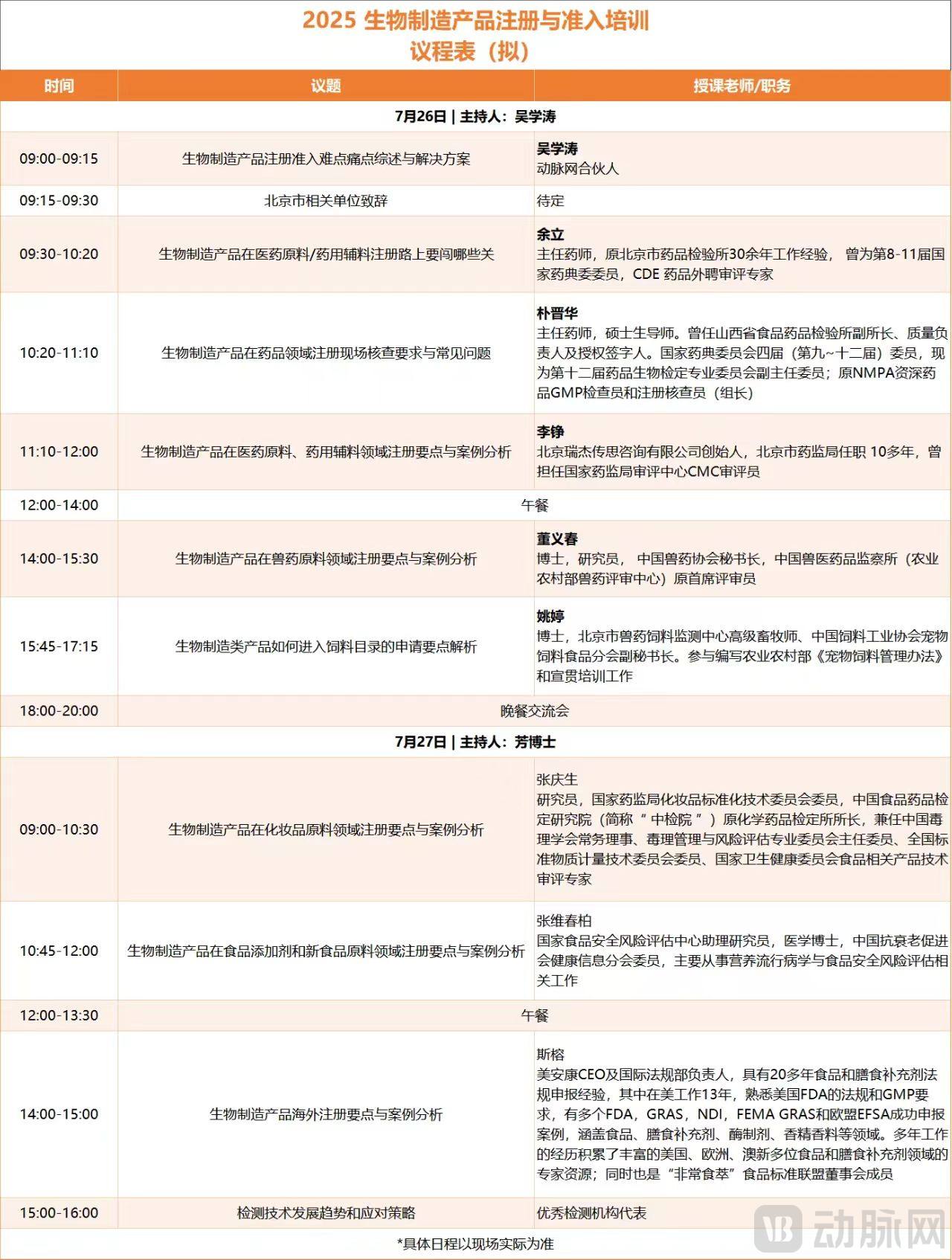
Limited to 80 seats, first come first served. Engage face-to-face with experts to help your product transition from “biomanufacturing” to “market success”!
Scan the QR code below to register and secure your seat, embarking on a journey toward compliance-driven breakthroughs!