

Bayer and Tsinghua University Deepen Strategic Research Collaboration to Accelerate Translational Innovation in Drug Discovery
Today, Bayer and Tsinghua University signed the sixth phase of their strategic research collaboration agreement, further facilitating the translation of basic research findings into new drug development across multiple key areas—including oncology, cardiovascular and renal diseases, neurology and rare diseases, and immunology—and accelerating cutting-edge scientific advancements along the pharmaceutical innovation value chain.
Under the cooperation agreement, Bayer will continue to fund joint research projects over the next three years and provide awards to Tsinghua University scientists who have made outstanding scientific contributions in the fields of life sciences and pharmaceutical innovation, thereby further deepening bilateral scientific exchange and dialogue.
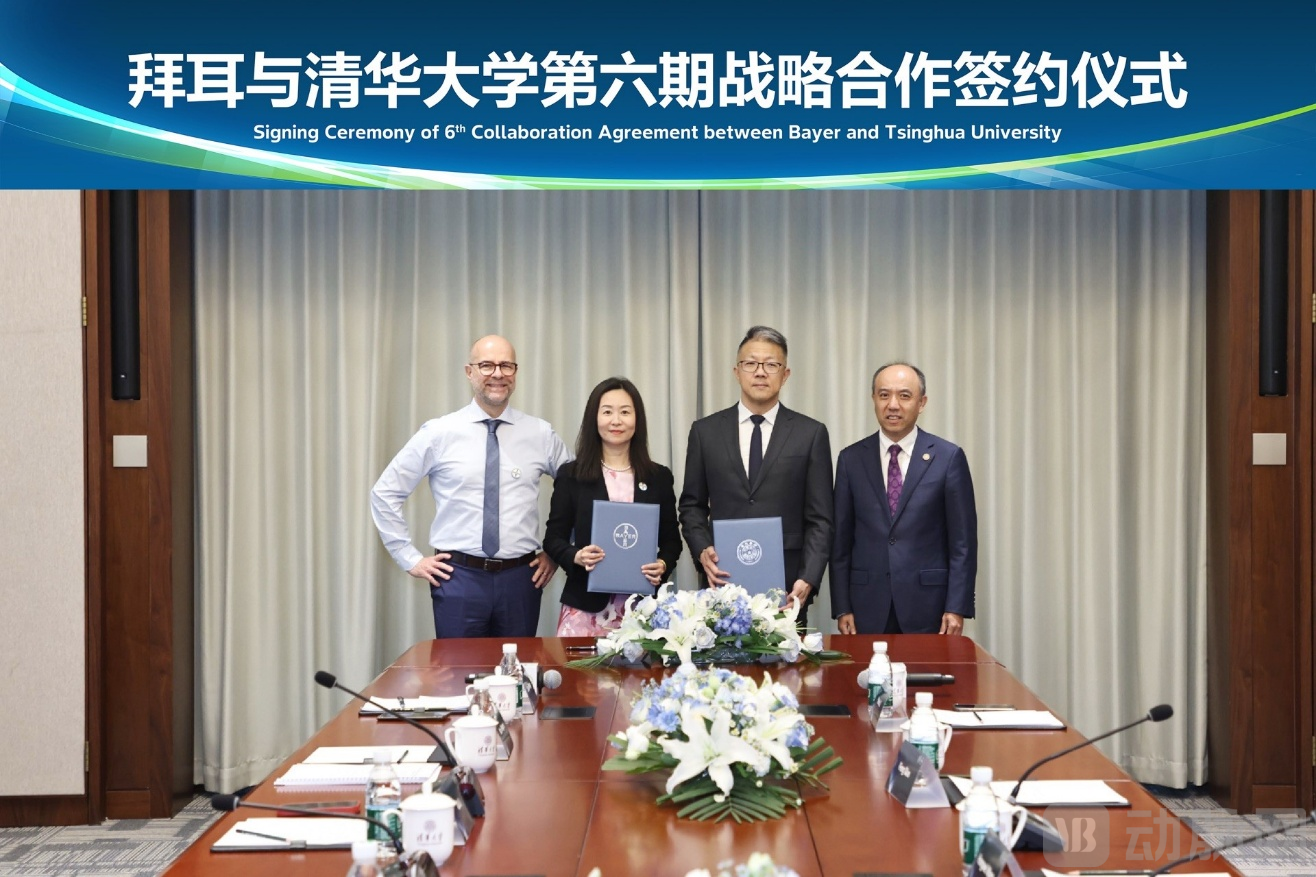 Bayer and Tsinghua University Jointly Sign the “Bayer-Tsinghua University Phase VI Strategic Research Cooperation Agreement”
As early as 2009, Bayer, as a multinational pharmaceutical company, took the lead in establishing a strategic scientific research partnership with Tsinghua University. Over the past sixteen years, Bayer and Tsinghua University have jointly conducted 75 collaborative research projects and published 15 co-authored papers in internationally renowned academic journals. In addition, distinguished Tsinghua scholars, including Professor Yan Ning, Professor Ding Sheng, Professor Qi Hai, Professor Shi Songhai, Professor Liu Lei, and Professor Qian Feng, have been honored with the title of “Bayer Chair Professor,” while more than 100 outstanding scientists have received the “Bayer Fellow” award. These awards aim to recognize their exceptional contributions to the fields of life sciences, medicine, and drug development. In 2022, Bayer and Tsinghua University jointly established the “Bayer Research Translation Fund” for the first time to further strengthen the translation of early-stage scientific achievements; over the past three years, nine projects have received funding support.
“China’s innovation ecosystem is developing at a rapid pace, with remarkable progress made in scientific and pharmaceutical research. This achievement is inseparable from the tireless efforts and multi-party collaboration of innovators in both the scientific and business communities,” said Christian Rommel, Global Head of Research and Development for Bayer’s Pharmaceuticals Division. “We are delighted to see that, built on sixteen years of close collaboration between scientists from both sides, the partnership between Bayer and Tsinghua University has become a model for scientific cooperation between multinational pharmaceutical companies and leading local academic institutions in China. We look forward to this strategic partnership continuing to push the boundaries of frontier science and delivering more drugs and therapies with breakthrough potential.”
Professor Wang Hongwei, Vice President of Tsinghua University and recipient of the 2018 “Bayer Chair Professor” award, stated: “Over the past sixteen years, Tsinghua University and Bayer have continuously promoted the integrated innovation of scientific research and drug development, built on a foundation of high mutual trust and deep synergy, achieving fruitful results. Our cooperation has constantly expanded in both depth and breadth, driving forward-cutting scientific research addressing major human health needs, and setting a paradigm for deep collaboration between Chinese universities and international pharmaceutical companies across the entire drug R&D value chain. The signing of the sixth phase of our cooperation agreement marks an important milestone in our joint efforts to address global health challenges and accelerate the translation of basic research into pharmaceutical applications. We highly value and cherish our long-term strategic partnership with Bayer. In the future, Tsinghua will continue to leverage its strengths in disciplines, talent, and platforms to work with Bayer in exploring frontiers of original innovation, contributing to the sustainable development of global healthcare.”
As a key component of Bayer’s long-term commitment to China, the company places high priority on and maintains sustained attention to local scientific research collaborations. It strongly supports source innovation in China and the translation of new drug R&D into clinical applications, having established long-term strategic scientific research partnerships with Tsinghua University in 2009 and Peking University in 2014, respectively. To date, Bayer has conducted more than 100 collaborative research projects with these two leading Chinese universities, covering areas such as novel target discovery and structural elucidation, studies on disease pathogenesis and mechanisms of drug action, drug screening, efficacy evaluation, and exploration of new molecular entities, novel chemical synthesis methods, and innovative dosage forms.
As China has gradually become a key global hub for biotechnology innovation, Bayer is deeply integrating into the local innovation ecosystem, actively collaborating with Chinese innovation partners to continuously explore and drive open innovation. Bayer Co.Lab officially launched in China in September 2024, aiming to empower 10–15 local startups, with a focus on frontier innovations in oncology, cardiovascular and renal diseases, new technology platforms, and cell and gene therapies. To date, five Chinese biotechnology companies have signed agreements to join Bayer Co.Lab. In addition, Bayer and Puhe Medicine announced a global licensing agreement for an oral small-molecule PRMT5 inhibitor that selectively targets MTAP-deleted tumors. Bayer has obtained exclusive global rights to develop, manufacture, and commercialize MTA-cooperative PRMT5 inhibitors and has already enrolled the first patient in a Phase I first-in-human dose-escalation clinical trial.