Can Chinese Bioreactor Makers Surpass Sartorius and Cytiva? Key Hurdles Remain
“Bioreactors can be described as the most critical tools in the field of biomanufacturing. Biomanufacturing relies on four core technologies: microbial strains, culture media, processes, and bioreactors. The first three technologies are all realized through bioreactors.”
“Using agriculture as an analogy, the microbial strain is the seed, the culture medium is the fertilizer, the process technology represents the climate and irrigation, and the bioreactor is equivalent to the land. This illustrates just how critical bioreactors are in biomanufacturing,” said Hao Youyou, Founder and Chairman of Shanghai Mansen Biotechnology Co., Ltd., in an interview with VCBeat.
Recently, the General Office of the Ministry of Industry and Information Technology (MIIT) and the General Office of the Chinese Academy of Sciences (CAS) jointly issued the “Notice on Launching the ‘Open Competition’ Mechanism for Innovative Tasks in High-Performance Bioreactors” (hereinafter referred to as the “Notice”). The initiative will focus on nine specific tasks across three categories—bioreactor systems, key components and consumables, and industrial operating systems—to be undertaken through an open competition mechanism.
Hao Yuyou stated that this marks the first time in history that the national government has launched a “Jiebang Guashuai” initiative specifically targeting bioreactors. Unlike other sectors, China’s biomanufacturing industry ranks among the global first tier and even holds a leading position in certain areas.
A senior expert in the bioreactor field pointed out to VCBeat that while the localization of conventional bioreactors in China has been largely achieved, only a few domestic companies can meet higher-level performance specifications. Judging from the three types of bioreactors covered by the current “Open Competition Mechanism” (Jiebang Guashuai) initiative, the original intention appears to be increasing the localization rate of cutting-edge and highly sophisticated products.
It is understood that Sartorius, Cytiva, Thermo Fisher Scientific, and Merck Millipore are leading foreign enterprises in the bioreactor field. Domestic companies include Womei Biotech, Manson Biotech, Dibio, BioLink, Anjiyi, Xinannuo, Tofflon, Truking Technology, Lepu Biopharma, and Huakan Biotech. In recent years, domestic companies have been developing rapidly and gradually capturing a larger market share.
VCBeat learned through research and interviews that domestic alternatives have captured a significant share in most segments of the bioreactor market. However, international manufacturers still dominate the segment for parallel cell culture bioreactors, particularly those intended for human use, where high-level import substitution has yet to be achieved.
01
Parallel Bioreactors:
Automation and Data Are Extremely Important
Microbial parallel bioreactors, cell parallel bioreactors, and large-scale cell bioreactor systems are the three types of reactor systems focused on in this "open competition" initiative.
According to VCBeat's research and interviews, the domestic substitution of microbial parallel bioreactors is progressing rapidly, with a substitution rate likely exceeding 80%.
However, according to Li Chao, Deputy General Manager of Suzhou Womei Biological Co., Ltd. and Executive Dean of the Qingdao Innovation Research Institute of East China University of Science and Technology, the technological capabilities of domestic intelligent parallel bioreactors and ultra-large-scale high-end bioreactors still require further improvement, which constitutes one of the core objectives of the current “open competition” initiative.
“The Notice highlights the automation and intelligence of the entire process, ranging from material preparation, sampling process monitoring, and material harvesting to reactor data acquisition. This is the core value of microbial parallel bioreactors, particularly when handling large-scale experimental workloads. However, many domestic parallel bioreactors still require manual operation, resulting in low efficiency and inevitable errors. More importantly, the reliance on manual methods for biological process data collection hinders effective data aggregation and traceability,” pointed out Li Chao.
According to the “Notice,” for microbial parallel bioreactors, development is expected to be completed by 2027, achieving a throughput of at least 12 bioreactors. The system will feature one-touch operation, including one-touch setup, one-touch start/stop, and one-touch calibration, and will enable automated functions such as media preparation, inoculation, feeding, induction, sampling and analysis, and cleaning. For cell-based parallel bioreactors, the Notice also sets forth goals of single-use design, miniaturization, high throughput, and high-precision control.
“Following the automation of the entire bioprocess workflow, automatic data storage can be achieved, ensuring full traceability of process data. Currently, domestic parallel bioreactors are somewhat lacking in automation, with a few companies such as Womei Biotech making strategic investments in this area,” said Li Chao.
Besides automation, data is also extremely important, and the two complement each other.
“Parallel bioreactors must prioritize data generation as their primary objective; data is not inherently good or bad, but rather credible or non-credible.” Hao Youyou emphasized that to ensure sufficient data credibility, one must pursue parallelism. Whether true parallelism is achieved is not determined by external factors, but hinges on underlying logic and technology.
“The current problem in the industry is that a large number of companies are clustering to develop parallel bioreactors. However, if the underlying technical issues are not resolved, it will be impossible to ensure the authenticity and reliability of the data, making it difficult to meet customers’ ultimate needs,” said Hao Youyou.
An industry professional in the bioreactor sector also told VCBeat that both the quantity and quality of data are indispensable when constructing big data models for intelligent biomanufacturing. “Compared with traditional manual operations, automated high-throughput bioreactors offer significant advantages: they not only efficiently generate vast amounts of data but, more importantly, keep inter-system errors within an extremely narrow range, thereby ensuring data reliability.”
“Data quality directly determines the value of a model.” The expert illustrated with an example, “If all parameter settings are completely consistent, but the data error still reaches 20%, the value of these data will be significantly reduced—it is difficult to assess their authenticity, and problems are likely to arise during production scale-up, ultimately leading to scale-up failure.”
The expert specifically highlighted that cutting-edge technologies involved in this “Open Competition” project, such as perfusion technology and Process Analytical Technology (PAT), are driving revolutionary changes in data management. “In the past, we primarily relied on offline monitoring to obtain data, which tended to be discrete, discontinuous, and lagging. With PAT and high-throughput technologies, we can now acquire more abundant and continuous real-time data, laying a solid data foundation for intelligent manufacturing.”
The “Notice” indicates that the expansion of third-party PAT tools or equipment (such as Raman spectroscopy) is encouraged, enabling cascaded feedback regulation and supporting ATF perfusion culture, so as to achieve breakthroughs in key technologies including precise microenvironment control, multimodal in situ online sensing, and scalable parallel control.
02
Cell Parallel Bioreactor:
A Few Areas Where Domestic Substitution Remains Challenging
Compared with microbial parallel bioreactors, the domestic substitution rate for cell parallel bioreactors is not high; according to interviews and research conducted by VCBeat, the market share of domestically produced products may be around 40%.
Li Chao stated that in fields such as veterinary biological products and human vaccines, cell-based parallel bioreactors have already achieved over 50% domestic substitution. Currently, only the human-use sector remains dominated by international manufacturers, with limited large-scale domestic replacement; imported products from companies like Sartorius and Applikon still hold the majority share.
According to Li Chao’s analysis, on the one hand, products in the human healthcare sector are predominantly pharmaceuticals with high value-added; pharmaceutical companies are less sensitive to cost and primarily prioritize system stability. Imported bioreactors have accumulated extensive case studies in both hardware and software, earning broad market recognition.
On the other hand, there is the issue of compliance, as systematic re-certification is required after equipment replacement. “While replacing a bioreactor may save RMB 100,000, the cost of completing all necessary recertifications could exceed RMB 300,000. Therefore, for parallel cell culture bioreactors intended for human therapeutic applications, domestically produced products must demonstrate significantly superior quality and cost-effectiveness compared to imported alternatives in order to achieve substitution.”
“Domestic companies need to prioritize regulatory approval and recognition of their products, and strengthen their capabilities in obtaining regulatory certification for bioreaction systems in drug application scenarios, which requires significant effort,” emphasized Li Chao.
It is worth noting that among multiple factors, stability appears to be the core benchmark for competing cell-based parallel bioreactors.
In Hao Yuyou’s view, the low domestic substitution rate of cell-based parallel bioreactors is largely attributable to the exceptionally high requirements for stability.
“Microbial cultures can complete a batch in just a few days or even overnight, so even if the bioreactor’s stability is somewhat compromised, the resulting losses are minimal. In contrast, animal cell fermentation involves lengthy cycles—often exceeding a month—thus demanding exceptionally high reliability and stability. If a cell culture reaches day 29 and an entire batch is rendered unusable due to bioreactor failure, the financial impact on the company would be substantial. Achieving such stringent stability requires bioreactor manufacturers to look beyond mere commercial considerations; they must also possess a deep commitment to the industry and their products, along with a relentless pursuit of excellence,” stated Hao Yuyou.
An Lijun also pointed out to VCBeat that when it comes to mammalian cell culture, a well-known domestic CDMO company often chooses to use single-use bioreactor bags. Switching to stainless steel tanks could incur significantly higher costs and expose the process to risks associated with varying operational conditions. Should any issue arise in a specific tank’s reaction, it could result in losses ranging from tens of millions to over one hundred million yuan, a risk that many pharmaceutical companies are unwilling to take.
Furthermore, when discussing domestic versus imported bioreactors, the aforementioned experts acknowledged that the gap is primarily evident in the sector of large-scale single-use bioreactors. “Taking single-use cell culture bioreactors with capacities exceeding 2,000 liters as an example, although there are outstanding Chinese enterprises engaged in R&D, overall customer acceptance still needs to be improved, and this segment remains monopolized by international giants.”
However, this expert also recognizes the opportunities for domestic substitution: “Chinese companies can gradually gain market recognition by leveraging the characteristics of niche segments, strictly adhering to regulatory requirements, and providing small-footprint single-use bioreactors that meet GMP production standards in specialized fields such as cell and gene therapy (CGT) and stem cells.”
03
Large-Scale Cell Bioreactor Systems:
Driving Practical Application to Enable Iterative Cycles
Large-scale cell bioreactor systems are also a key focus area of this “open competition” initiative.
VCBeat learned from its research that the domestic share of large-scale cell bioreactor systems (stainless steel) may have already reached 50% or even over 60%.
An Lijun, Chairman of Xin’annuo, told VCBeat that large-scale cell bioreactor systems—essentially large stainless-steel fermentation tanks—are an area where China’s domestic fermentation technology currently holds a clear overall advantage compared with foreign counterparts, and the gap between Chinese and international companies in stainless-steel tank technology is not significant.
These experts are also optimistic about the progress of domestic production in the field of large-scale stainless steel bioreactors.
“In this field, numerous excellent domestic suppliers have emerged in China, achieving a significant degree of import substitution with Chinese-made alternatives,” the expert revealed. “Many pharmaceutical companies producing antibodies have chosen to procure domestically manufactured stainless steel bioreactors with capacities of 5,000 liters or even 10,000 liters, which fully demonstrates the technical prowess and market acceptance of Chinese-made equipment.”
Li Chao also stated to VCBeat that in the field of large-scale cell bioreactor systems, domestic companies have already been able to scale up volumes to over 10,000 or 15,000 liters, such as Womei Biotechnology. In fact, the gap between domestically produced and imported products in this area is not significant; in terms of large-scale manufacturing and engineering, Chinese enterprises are either leading or on par with top international companies.
"Although the current substitution rate is relatively high, Li Chao believes that issues regarding market acceptance will still persist."
According to Li Chao’s analysis, under mass production conditions, the raw material cost for a single batch can reach millions or even tens of millions of yuan. Therefore, the primary consideration must be the reliability and stability of the bioreactor, as any error is unacceptable. However, large-scale bioreactors constitute complex systems; inadequate attention to detail or lack of experience can lead to issues, thereby adversely affecting user experience.
An Lijun also stated that the primary challenge with large-scale cell bioreactors lies in the hardware, which involves numerous control points such as valves. This complexity makes it difficult to prevent issues, necessitating close attention to many detailed aspects.
Li Chao further pointed out that large-scale projects are systematic engineering endeavors, making it difficult to address every aspect comprehensively during the initial design phase; instead, issues must be identified and iterations made through practical application. Therefore, the key to advancing domestically produced reactors lies in promoting their actual deployment and use. The more they are put into practice, the faster improvements will be made, bringing them increasingly closer to international leading standards. Without real-world implementation of domestically manufactured equipment, performance enhancements will remain elusive. This is likely the underlying intent of the “Jiebang Guashuai” (open competition) mechanism: to drive the practical application of domestic equipment at the national level and foster a virtuous cycle of development.
“In addition, domestic companies have not yet achieved a higher rate of substitution, largely because the market demand for ultra-large-scale bioreactors is limited, with only a handful of projects launched each year. Nevertheless, this area is indeed poised to become a future development direction, so we are also strategically positioning ourselves in this field,” added Li Chao.
“In addition, domestic large-scale cell bioreactors still need to improve their software systems. This is a common weakness among Chinese companies. It is necessary to gradually promote the development of original underlying operating systems made in China, and enterprises need to develop software systems based on their own product characteristics,” added An Lijun.

—END—
Registration and Market Access Training for Bio-manufactured Products
Major Launch
July 26–27, 2025, Beijing Yizhuang International Biopharmaceutical Park: “Training on Registration and Market Access for Biomanufacturing Products” Grandly Launches.
Co-hosted by VCBeat and Dr. Fang, this event focuses for the first time on six prime sectors—pharmaceuticals, cosmetics, food, animal health, agriculture, and materials—providing you with a practical guide to breaking through from the laboratory to the market.
Highlight 1: A Lineup of Top-Tier Experts
Bringing together over ten industry-leading experts from the pharmaceutical, veterinary drug, and food sectors—including Yu Li (former expert at the Beijing Institute for Drug Control), Dong Yichun (Secretary-General of the China Veterinary Drug Association), and Si Rong (international leader in food regulations)—this program offers in-depth analysis of global regulatory standards (such as those of the FDA and NMPA) to help you precisely select registration pathways and build compliant submission dossiers.
Highlight 2: Practice-Oriented Purpose
Addressing corporate pain points by bridging the “valley of death” in pilot-scale trials and overcoming regulatory access barriers. Through case studies, master strategies for pharmaceutical IND/NDA submissions, new cosmetic ingredient filings, and veterinary drug approvals, while formulating winning pricing and volume-based procurement (VBP) response plans. Enhance market competitiveness through efficient cross-domain collaboration.
The detailed schedule is as follows:
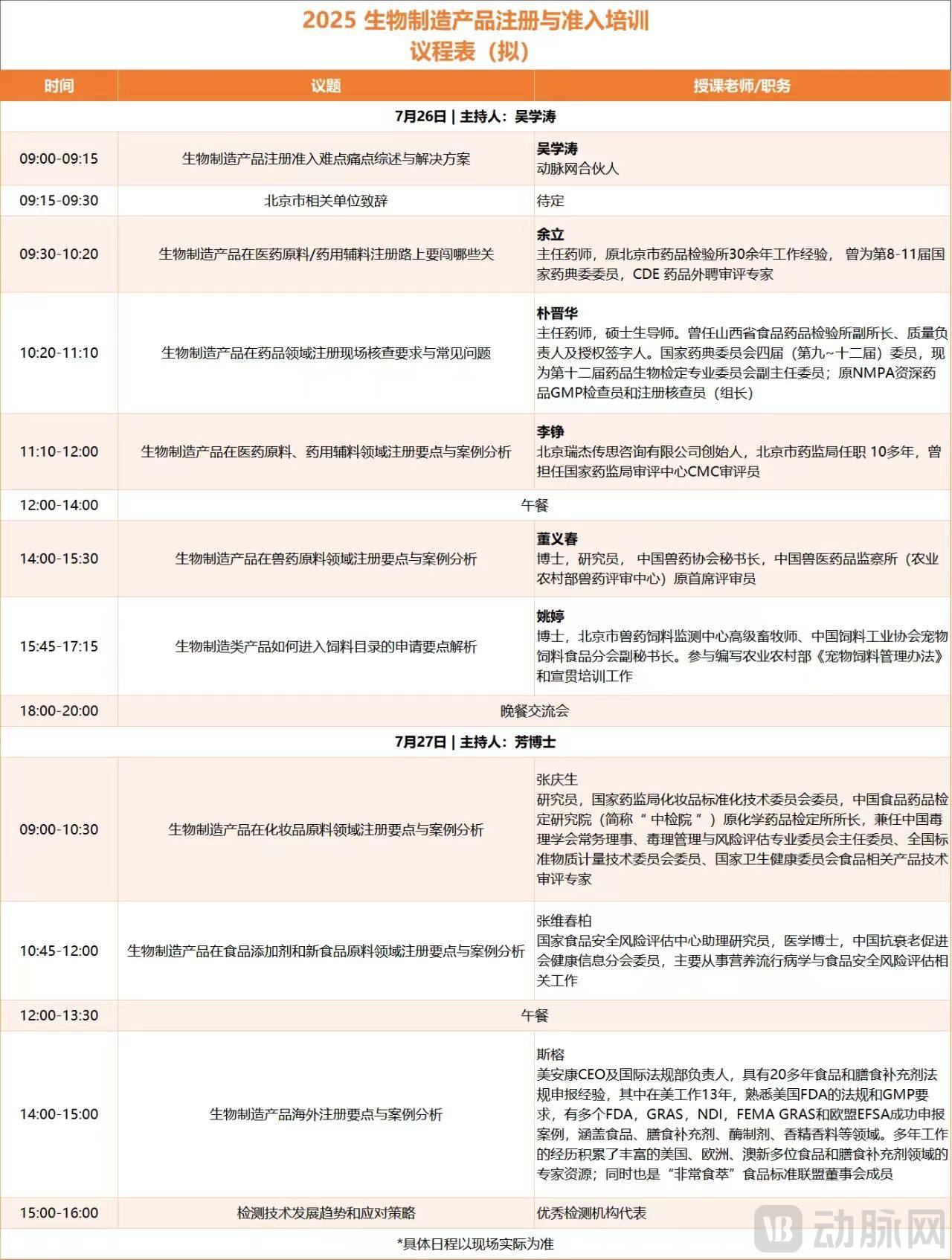
Limited to 80 seats, first come first served. Engage face-to-face with experts to help your products transition from “biomanufacturing” to “market success”!
Scan the QR code below to register and secure your seat, embarking on a journey toward compliance breakthrough!