Day 38 of the Collagen Controversy: Juzi Bio Issues Late-Night Statement—Who Really Benefits from This Domestic Brand 'Business War'?

Giant Biogene
Skin Care Product R&D Developer
On the night of June 23, Giant Biogene issued a statement addressing the recent controversy surrounding recombinant collagen.
Regarding the basis for testing standards, Giant Biogene stated that its product research and development and production reference and cite existing industry standards, while formulating and adhering to enterprise standards to conduct quality control of raw materials and products. Furthermore, all products are manufactured according to the filed formulations and processes, in compliance with the technical documentation requirements for cosmetic filing.
It was also pointed out: “With the rapid development of the recombinant collagen industry and consumers’ increasingly stringent requirements for product quality, our company’s existing quality standards, testing methods, and labeling have gradually revealed certain limitations. These are no longer fully aligned with the high standards and demands driven by industry advancement and technological progress, necessitating continuous optimization and iteration.”
The dispute over recombinant collagen between Bloomage Biotech and Giant Biogene has lasted 38 days since its inception, initially centering on the recombinant collagen content in Giant Biogene’s Comfy brand products, and gradually shifting to focus on controversies surrounding testing methods for recombinant collagen.
According to expert analysis, the detection of recombinant collagen in cosmetics is relatively complex. Currently, there are no unified national standards for the detection of recombinant collagen in complex matrices.
Meanwhile, as the “commercial war” coincides with the 618 shopping festival, Giant Biogene’s Comfy brand has seen its ranking slip. Bloomage Biotech has not disclosed its 618 sales performance but faces the challenge of declining results, and both companies may need to contend with pressure on their stock prices.
Amid the “commercial war” between two domestic brands, who ultimately emerged victorious?
Since May 17, the dispute over recombinant collagen has gradually evolved from a “controversy” into a “corporate battle” between two publicly listed companies. The timeline of events is as follows:
May 17, 19, and 21:
Bloomage Biotechnology has repeatedly published articles stating that the notion of hyaluronic acid being obsolete is a falsehood, that the concept of recombinant collagen has been favored by capital markets, that recombinant collagen products currently on the market are essentially polypeptides, and it has called on industry practitioners and capital markets to return to the essence of science and the original principles of commercial civilization.
May 24:
Dr. Hao Yu, a PhD in Chemistry from the University of Hong Kong, released test reports on Comfy, a star product under Giant Biogene, stating that no collagen was detected. He presented results obtained using the international standard HPLC (High-Performance Liquid Chromatography) method for quantitative amino acid analysis, which showed that the actual content of recombinant collagen in Comfy’s flagship product, the “Collagen Stick,” was only 0.0177%, far below the labeled minimum of 0.1%, with the key ingredient glycine undetected.
June 1:
Bloomage Biotech issued a statement in support of Dr. Hao Yu’s efforts to safeguard consumer rights, declaring, “If you seek battle, you shall have it! If you want a ‘commercial war,’ you will certainly get a real one.”
On the same day, June 1:
Just three hours after Bloomage Biotech issued its statement on the same day, Giant Biogene released a solemn statement: it accepted the apology from the testing institution used by “Dr. Big Mouth” (Hao Yu), but would hold the rumor-mongers legally accountable. The company emphasized that its products can withstand scientific scrutiny, its brand can stand the test of time, and its original commitment can bear user examination.
June 4:
Giant Biogene released multiple test results for Comfy Collagen Stick 1.0 and Comfy Collagen Stick 2.0, stating that recombinant collagen is genuinely added to Comfy-related products and that there is no “false advertising or consumer misleading” as alleged online.
June 14:
Bloomage Biotech stated: “Testing whether recombinant collagen has been added to relevant products and whether such addition meets standards is not merely a matter of standardization. The absence of specific standards in a particular subsector does not mean there are no reference standards, nor does it imply the lack of scientific methods.” “We believe that a clear, scientifically robust conclusion, withstandable through cross-validation, is the only way to prevent prolonged debates across various sectors and will also help related companies address their current challenges more promptly.
During this period, Hao Yu, a Ph.D. in Chemistry from the University of Hong Kong, published multiple articles discussing recombinant collagen.
Initially, the core of this controversy centered on the actual content of recombinant collagen in Giant Biogene’s flagship product, Comfy. As the dispute has evolved, the focus has now shifted to the testing methods for recombinant collagen.
Giant Biogene stated in its latest announcement that it has conducted a comprehensive self-inspection of all stages involved in the production, testing, and packaging and labeling of recombinant collagen raw materials and products, and has performed methodological validation for different testing methods.
It has been observed that existing quality standards, testing methods, and labeling requirements are gradually revealing their limitations in certain aspects, making it difficult to fully align with the high standards and rigorous demands driven by industry development and technological advancements. Consequently, continuous optimization and iterative improvements are necessary.
Moving forward, Giant Biogene will collaborate with research institutions to accelerate the optimization and validation of qualitative and quantitative detection methods for recombinant collagen in cosmetics; progressively and proactively disclose key technical parameters and quality control data for raw materials and finished products to empower industry development and welcome public oversight; and continue to participate in the formulation of national and industry standards related to recombinant collagen used in cosmetics, thereby promoting the standardized development of the industry.
Notably, according to Xinhua News Agency, a seminar on “Detection Methods for Recombinant Collagen in Complex Matrices” was recently held. Co-organized by the Science and Technology Innovation China Working Committee of the Chinese Society for Biotechnology and the Changping Synthetic Biology Manufacturing Translation Acceleration Center, the event focused on discussions regarding collagen detection in cosmetics.
Giant Biogene’s Comfy Collagen Stick is precisely a cosmetic-grade product.
Based on the seminar content, the main protein detection methods include the Kjeldahl method, Biuret method, Coomassie Brilliant Blue method, Folin–Ciocalteu method, BCA method, and characteristic peptide method. Each method has its own characteristics and suitable application scenarios, regardless of whether it is new or old.
However, the detection of recombinant collagen in cosmetics is complex. The presence of various ingredients, such as plant extracts, proteins, polysaccharides, lipids, surfactants, and colorants, significantly interferes with collagen signals, resulting in weak signal intensity during analysis. Furthermore, given that collagen is typically added at low concentrations in cosmetic formulations, quantitative detection of these trace levels poses considerable challenges.
Currently, no unified national standard has been issued for the detection of recombinant collagen in complex matrices.
According to experts at the seminar, China has established multiple standards related to collagen; however, there is a lack of unified testing standards in the cosmetics sector. This is because recombinant collagen is influenced by factors such as product dosage form, matrix morphology, matrix composition, potential reactants, possible products, and the stability of the analyte, making it difficult to standardize product testing methods.
In addition to issues surrounding testing standards, the highly anticipated “618” shopping festival is unfolding alongside the commercial rivalry between Bloomage Biotech and Giant Biogene.
According to the analysis, in the Tmall Beauty 618 full-cycle TOP 20 rankings, Giant Biogene’s Comfy brand ranked 12th in 2024, dropping to 16th this year.
Among the Top 10 beauty brands on Douyin’s 618 shopping festival leaderboard, Comfy ranked 8th in 2024; this year, however, it is absent from the list, having slipped to 12th place.
In another report, Goldman Sachs released a research note stating that it had lowered its sales/net profit forecasts for Giant Biogene for 2025-27 by 7-8%/9-12%, following recent social media questions about the actual collagen content in Ke Fu Mei’s recombinant collagen repair single-use essence being too low, as the latest tracking data showed weaker-than-expected sales during the 618 shopping festival.
It is understood that in 2011, Giant Biogene launched the “Comfy” brand based on its scientific research achievements in recombinant human-like collagen. Since its listing on the Hong Kong Stock Exchange in November 2022, Comfy achieved sales revenues of RMB 2.788 billion and RMB 4.542 billion in 2023 and 2024, respectively, accounting for 79% and 82.0% of the company’s total revenue, thereby becoming a key pillar of its financial performance.
From the perspective of secondary market reactions, Giant Biogene’s stock price gradually declined from RMB 81.99 per share to RMB 51.2 per share between May 17 and June 23, representing a 37.6% shrinkage in market capitalization. However, following the release of its latest statement, the company’s stock price rose by as much as 7.32%, reaching RMB 54.95 per share.
During the 618 shopping festival, Bloomage Biotech disclosed relatively little performance data. From the perspective of the secondary market, its stock price showed no significant fluctuations during the period in question. The opening prices on May 16 and June 24 were RMB 50.79 per share and RMB 50.8 per share, respectively. However, compared with the level of RMB 313.1 per share in July 2021, the stock has fallen by 83.8%.
Meanwhile, Bloomage Biotech also faces pressure on its financial performance.
In 2024, Bloomage Biotech achieved a total revenue of RMB 5.371 billion, a year-on-year decrease of 11.61%. Its net profit attributable to shareholders after deducting non-recurring gains and losses amounted to RMB 107 million, down 78.13% year on year. Among these, the raw material products segment generated revenue of RMB 1.236 billion, representing a growth of 9.47%.
In the first quarter of 2025, Bloomage Biotech achieved a revenue of RMB 1.078 billion, a year-on-year decrease of 20.77%, and realized a net profit attributable to shareholders after deducting non-recurring gains and losses of RMB 81.91 million, a year-on-year decrease of 64.62%.
Bloomage Biotech stated that the decline was mainly due to a drop in its consumer products business and losses from one-time asset impairments aimed at strengthening asset quality.
Who Will Be the Winner in a Shared Dilemma?
“Everyone lost. If we must name a winner, it would be the overseas giants.” In the view of Dr. Fang, Managing Director of Ti Capital and holder of a Ph.D. in Economics from Zhejiang University, without the rise of domestic brands, overseas skincare giants would not have participated in the 618 shopping festival promotions; likewise, without the advancement of domestically produced skincare ingredients, many Chinese brands would not have emerged or expanded into international markets.
“Who will reap the benefits in the commercial battles during the early stages of the biomanufacturing industry’s development?”

—END—
Training on Registration and Market Access for Biomanufacturing Products
Major Launch
July 26–27, 2025, Beijing Yizhuang International Biopharmaceutical Park: “Training on Registration and Market Access for Biomanufacturing Products” Grandly Launches.
Co-hosted by VCBeat and Dr. Fang, this event focuses for the first time on six high-potential sectors—pharmaceuticals, cosmetics, food, animal health, agriculture, and materials—providing you with a practical guide to breaking through from the laboratory to the market.
Highlight 1: A Lineup of Top-Tier Experts
Bringing together over a dozen industry-leading experts and practical instructors from the pharmaceutical, veterinary drug, and food sectors, including Yu Li (former expert at the Beijing Institute for Drug Control), Dong Yichun (Secretary-General of the China Veterinary Drug Association), and Si Rong (international leader in food regulations). They will provide in-depth analysis of global regulatory standards (such as those of the FDA and NMPA), helping you precisely select registration pathways and build compliant submission dossiers.
Highlight 2: Practice-Oriented
Addressing Corporate Pain Points: Bridging the “Valley of Death” in Pilot-Scale Trials and Overcoming Regulatory Access Barriers. Through case studies, master strategies for pharmaceutical IND/NDA submissions, new cosmetic ingredient filings, and veterinary drug approvals, while formulating winning pricing and volume-based procurement (VBP) response plans. Achieve efficient cross-domain collaboration to enhance market competitiveness.
The detailed schedule is as follows:
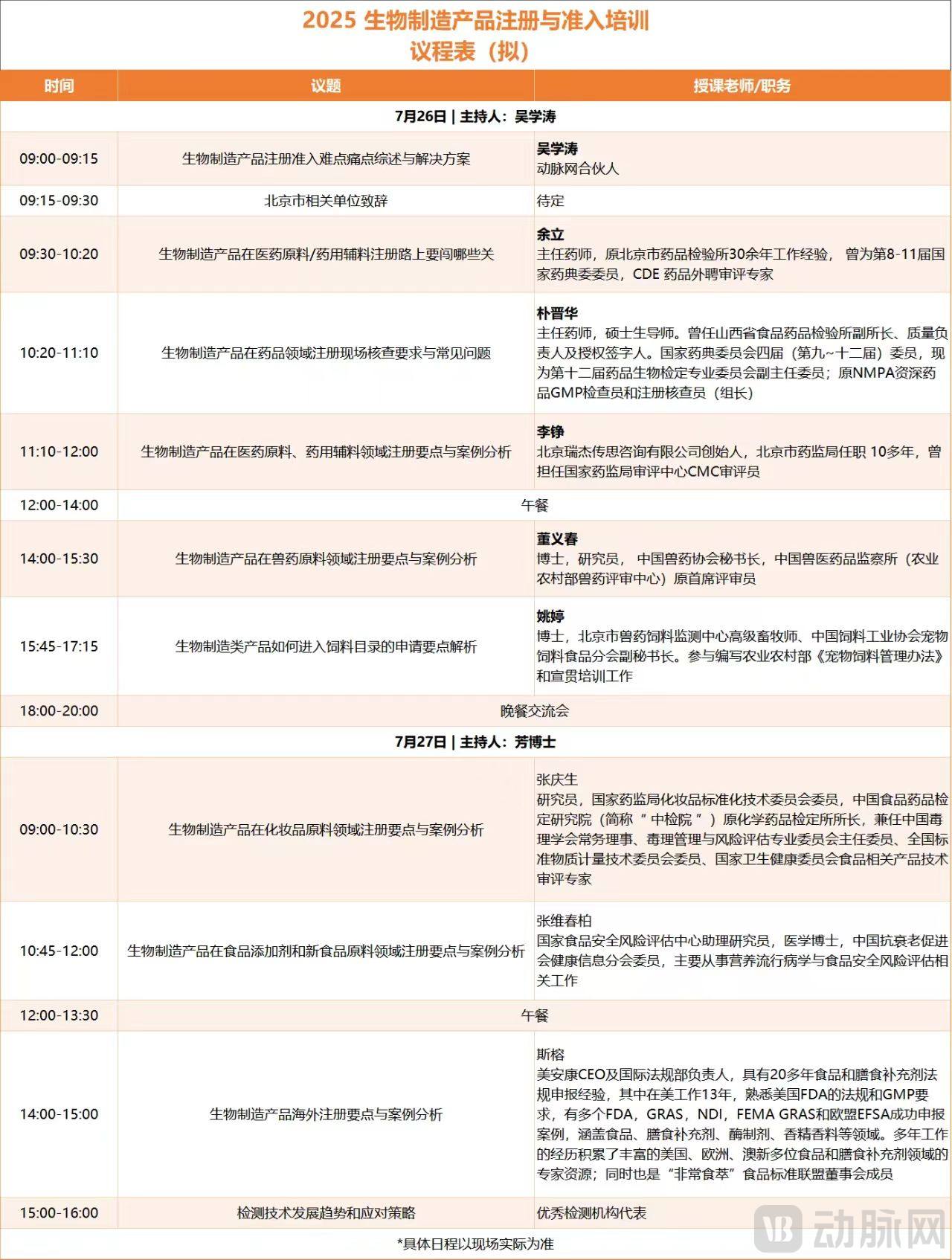
Limited to 80 seats, first come, first served. Engage face-to-face with experts to help your product leap from “bio-manufacturing” to “market success”!
Scan the QR code below to register and secure your seat, embarking on a journey toward compliance-driven breakthroughs!