

Outcomes4Me Files for IPO After Raising $38M to Expand AI-Powered Cancer Care Platform Serving 280,000 Patients

Outcomes4Me
Breast Cancer Treatment Platform Developer
In May 2025, Outcomes4Me, a Massachusetts-based healthcare technology company, secured $21 million in financing. The round was led by Salica Investments, with participation from Labcorp Venture Fund and Forecast Labs.
To date, Outcomes4Me has raised a total of $38 million (approximately RMB 270 million). These funds will be used to further develop its core product—an AI-driven cancer care platform—to provide patients with more personalized and intelligent solutions, thereby improving the cancer care experience.
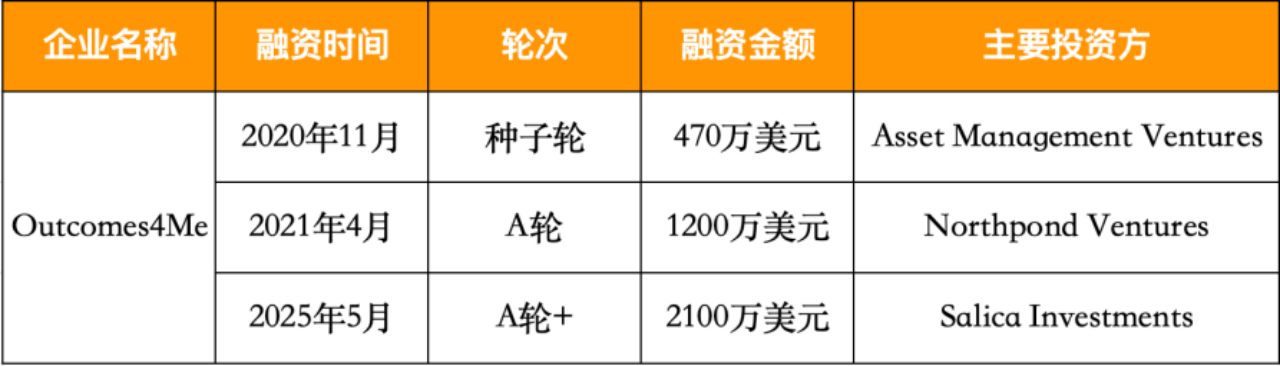
(Outcomes4Me’s Funding History, Chart by VCBeat)
Dr. Maya R. Said is the founder and CEO of Outcomes4Me, with her personal experiences serving as one of the catalysts for establishing the company. Dr. Said has publicly shared that during her tenure at Novartis, she faced a serious health issue. Despite having high-quality health insurance and support from family members well-versed in medicine, she still felt confused and fearful about her condition and the steps to take moving forward. As a result, “patient-centricity” has become one of the core objectives of Outcomes4Me.
In medicine, cancer care refers to the full-cycle medical and supportive services provided to cancer patients, spanning from diagnosis and treatment to rehabilitation (or palliative care). The aim of such care is to enhance treatment efficacy, prolong survival, and improve patients’ quality of life.
According to the "2022 Global Cancer Statistics Report," there were 19.976 million new cancer cases and 9.744 million cancer-related deaths worldwide in 2022. With the surge in the global number of cancer patients, the demand for cancer care has correspondingly increased.
However, cancer care still faces several clinical pain points:
First, the patient's treatment adherence is low., side effects such as nausea, pain, and myelosuppression caused by chemotherapy/radiotherapy are often not intervened in time, making patients prone to discontinuing treatment in the later stages.
Secondly, patients have limited channels to learn about clinical trials., which is also one of the reasons for the low matching rate in clinical trials. For some patients with "no cure available" and those facing financial hardships, clinical trials may offer a hope for rebirth.
Furthermore, case records, follow-up information, and other data are fragmented across multiple platforms, making it highly likely that patients will experience fragmented care—treating symptoms in isolation rather than addressing the underlying condition—which severelyImpact on Treatment Continuity。
In this context, the “flow” of information has become a key factor. In other words, more intelligent collection, organization, and analysis of medical data have become an urgent issue to address for patients receiving cancer care.
Outcomes4Me’s AI-powered cancer care platform was developed specifically to address this need. The platform features three core functionalities: personalized treatment recommendations, clinical trial matching, and symptom tracking.
Personalized Treatment Recommendations: The platform leverages AI and machine learning (ML) to analyze patients’ medical records (such as pathology reports and genetic testing data), thereby providing treatment options tailored to their conditions, including chemotherapy, targeted therapy, and immunotherapy.
Clinical Trial Matching to Improve Patient Treatment Engagement: The platform leverages AI algorithms to integrate clinical trial data from over 700 healthcare institutions across the United States and Canada, screening global clinical trials to help patients identify research studies suited to their specific cancer type and stage. This capability shortens the time required to match patients with appropriate trials, addresses the current pain point of limited access to clinical trials for cancer patients, and thereby increases their participation in therapeutic studies.
Symptom Tracking, Optimized Care Management: Patients can use the app to record symptoms during treatment (such as pain and fatigue) and share data with their healthcare team to optimize care management. Notably, the app complies with U.S. medical privacy regulations, ensuring the security of patient data.
According to the official Outcomes4Me website, patients can download and use the app free of charge. Currently, Outcomes4Me has accumulated 280,000 users. In the future, if the app can further expand its coverage to include more indications and obtain FDA clearance, its influence will increase significantly.
On a global scale, comparable products to Outcomes4Me include PathAI’s AI Sight image management system and Owkin’s MSIntuit CRC digital pathology solution. These are all AI-driven cancer care platforms designed to help cancer patients better understand their condition, optimize treatment plans, and match with clinical trials.
Cancer Incidence in China Continues to Rise. According to the 2024 report by the National Cancer Center, there were 4.8247 million new cancer cases in China in 2022, accounting for 24.1% of the global total, and 2.5742 million cancer-related deaths, representing 26.5% of the global total.
From a policy perspective, in November 2024, the National Health Commission, the National Administration of Traditional Chinese Medicine, and the National Disease Control and Prevention Administration jointly issued the Reference Guidelines for Artificial Intelligence Application Scenarios in the Health Sector. The guidelines specify 13 major categories and 84 subcategories of AI application scenarios, signaling that AI will be accelerated in its adoption within the healthcare industry to provide patients with smarter, more efficient, and more precise medical services.
China has witnessed rapid development in the field of AI-driven cancer care platforms, giving rise to a series of digital-intelligence platforms such as the “CSCO AI Intelligent Clinical Decision Support System” (Haixin Zhihui), “Ant Group’s AI Health Steward,” and the “Alibaba Health CACA-AI Smart Grassroots Science Popularization Empowerment Project.”
Driven by the combined forces of market demand and policy support, these digital-intelligence platforms have been highly active in the first half of 2025 alone. In April, Ali Health partnered with the China Anti-Cancer Association to launch the “Healthy Smart Doctor CACA-AI Smart Grassroots Science Popularization Empowerment Project,” aiming to make AI technology accessible at the grassroots level. In May, the Chinese Society of Clinical Oncology (CSCO), Haixin Zhihui, and Ant Health jointly released CSCO AI Pro, an intelligent agent specialized in breast oncology, which dynamically analyzes individual patient characteristics to provide physicians with precise, efficient, and real-time clinical support.
Many hospitals are also keeping pace with the times by actively exploring diverse applications of “AI + Nursing” technologies. In June, the oncology nursing team at Sun Yat-sen Memorial Hospital, Sun Yat-sen University, launched an integrated terminal featuring “symptom assessment–AI matching–VR intervention,” providing patients with personalized, precision nursing care plans tailored to each individual.
Due to the unique nature of cancer treatment, patients face a series of challenges after discharge, including the risk of recurrence, interruption in access to information on disease treatment and monitoring, and a lack of knowledge regarding disease management and medication. Consequently, cancer patients have an increasingly urgent need for information, making continuity of care information vital for them. In the future, AI technology will further integrate into the healthcare industry. It is anticipated that more domestic “AI + Cancer Care” products will emerge, covering a broader range of cancer types to meet the growing needs of patients.