

Weimai Files for Hong Kong IPO as AI-Powered Full-Care Management Model Achieves Scalable Revenue
Weimai
Digital Health Service Platform Provider
On June 27, Weimai, a provider of AI-powered full-course disease management services, filed for an IPO with the Hong Kong Stock Exchange.
For a long time, Weimai has collaborated with hospitals to establishof physicians, nurses and medical assistants, case managers, and hospital administratorsMultidisciplinary Service Team: Collaboratively Providing Full-Course Disease Management Services for Patients.
The prospectus shows that as of the end of 2024, Weimai has established in-depth cooperation with 157 public hospitals and set up exclusive hospital-wide disease management centers; it cooperates with 4,700 hospitals and medical institutions to provide services such as medical record retrieval, payment settlement, and complete medical history review; the cumulative number of patients receiving full-course health management services is approximately 500,000.
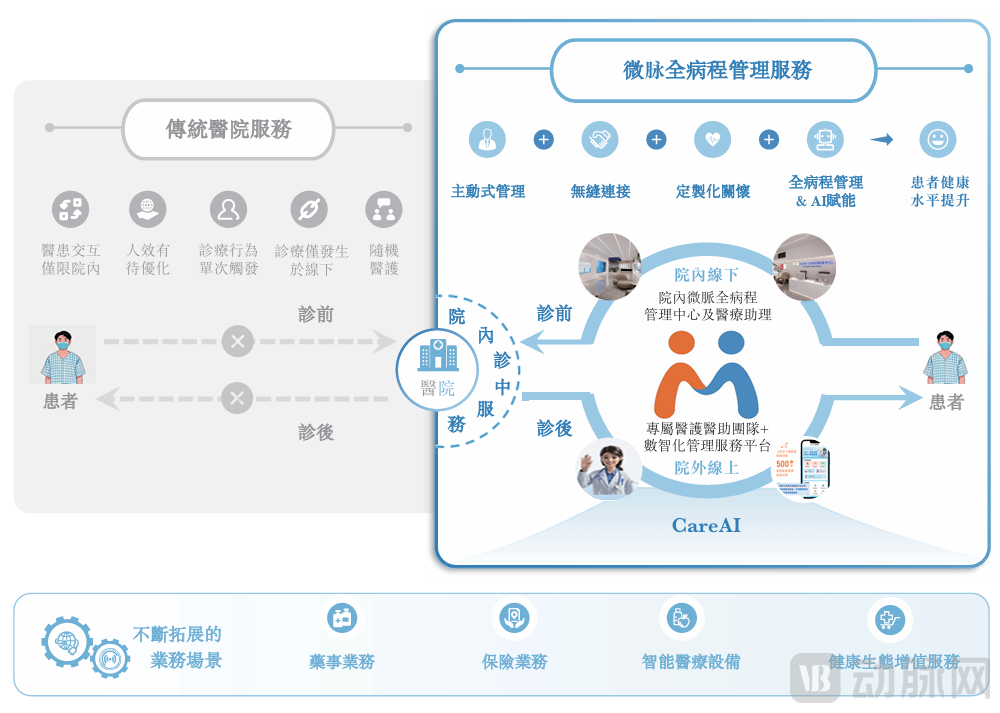
Weimai’s Full-Course Disease Management Service Model, Image Source: Prospectus
Since its establishment, Weimai has received investment from renowned institutions including Source Code Capital, Yuanjing Capital, Micro Light Venture Capital, Matrix Partners China, Lighthouse Capital, Qianji Capital, IDG Capital, Baidu Capital, and CITIC Bank Investment, as well as from local government funds in Yuhang, Deqing, and Nanhu.
After continuous validation of its full-course disease management business model, Weimai has gradually entered a harvest period with steady performance growth: total revenues in 2022, 2023, and 2024 were RMB 512 million, RMB 628 million, and RMB 653 million, respectively. Due to sustained and substantial investments in marketing and promotion, technology research and development, and service operations, Weimai has not yet achieved profitability, although its losses are narrowing.
Weimai’s primary revenue comes from individual patients, and its business model has demonstrated to the industry the potential for generating scalable income through service fees paid by end-users (C-side).
Weimai’s revenue streams include whole-course disease management services, sales of medical and health products, insurance brokerage services, and others, with whole-course disease management services contributing approximately 70% of its revenue.
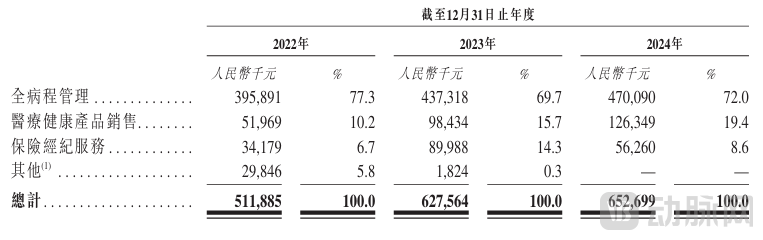
Weimai’s Revenue Structure, Source: Prospectus
As of the end of 2024, Weimai has partnered with 157 hospitals to provide patients with whole-course disease management services. Leveraging technology, data, and its proprietary CareAI, Weimai delivers health management solutions that combine standardization with personalization, covering more than 1,000 diseases. Additionally, Weimai integrates clinical pathways with patient needs to offer diversified service packages.
Under the whole-course disease management business model, Weimai’s revenue is derived primarily from patients who purchase its services, with a smaller portion coming from corporate clients. Meanwhile, Weimai pays medical service fees and consultation fees to hospitals, physicians, and nurses.
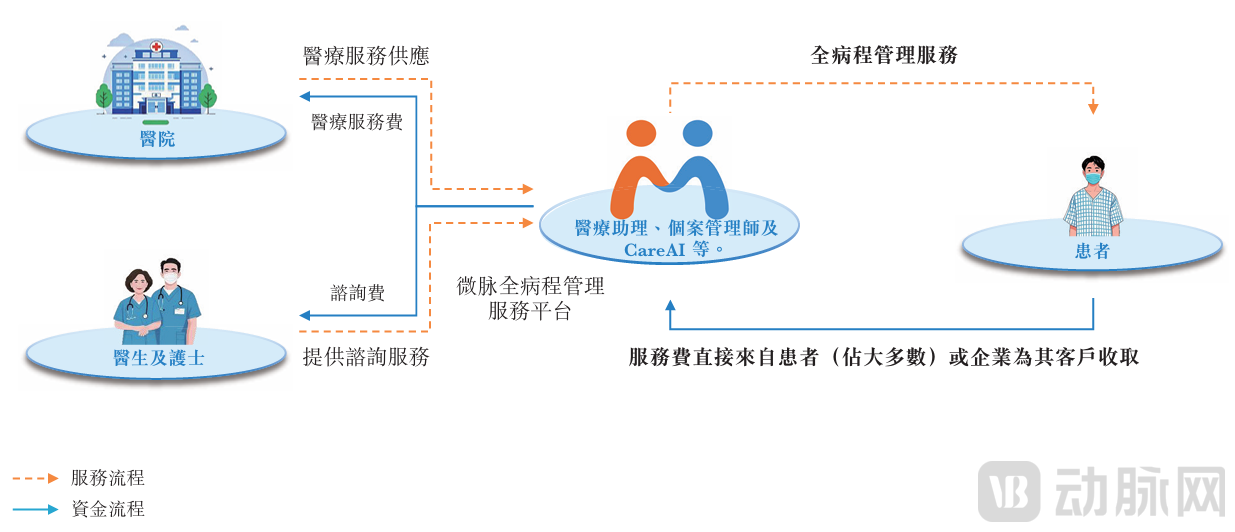
Fund Flow Diagram and Customer Fee Structure, Source: Prospectus
Deep cooperation with hospitals is a fundamental pillar underpinning the viability of Weimai’s business and commercial models.
From a macro perspective, in traditional healthcare services, the connection between patients and hospitals is primarily confined to within-hospital settings, whether for health examinations, outpatient visits, hospitalization, or surgery. However, the actual needs of a large number of patients extend far beyond this scope. There is an urgent demand for continuous medical services after discharge, including rehabilitation guidance, medication management, health education, nutritional intervention, emergency assistance, follow-up appointment scheduling, remote monitoring, and wound care. This current situation urgently requires transformation by the key stakeholders in the healthcare service system.
At the operational level, public hospitals, as the primary providers of medical services in China, must have intrinsic motivation to effectively implement continuous care services. So, why are public hospitals motivated to carry out whole-course disease management?
In recent years, the comprehensive advancement of healthcare payment method reforms has served as a direct impetus for hospitals to implement whole-course disease management.Amid payment method reforms, healthcare institutions are placing greater emphasis on cost control to achieve cost reduction and efficiency improvement. Implementing whole-course disease management not only provides patients with diversified, multi-tiered services but also extends care beyond the hospital setting, thereby enhancing operational efficiency and patient satisfaction.
For certain specialized departments, public hospitals have particularly strong incentives to implement whole-course disease management.Taking obstetrics as an example, with declining fertility intentions and birth rates, many public hospitals are more actively innovating service models and expanding their service offerings. VCBeat has learned that it is no longer novel for some tertiary public maternal and child health institutions to conduct science popularization and live streaming on social media platforms; they have also launched consumer healthcare services related to maternal health, such as medical aesthetics, postpartum rehabilitation, sleep management, and mental health. These specialties or hospitals also have strong incentives to introduce whole-course disease management services.
Overall, driven by multiple factors, Weimai has successfully implemented its whole-course disease management model, with significant willingness among C-end users to pay. The prospectus disclosed that in 2024, Weimai’s average service value per service plan was approximately RMB 1,600, more than four times the industry average.
Over the past two years, large language models and AI agents have ushered in a new leap forward in AI technology. Positioned as a provider of AI-driven whole-course disease management services, Weimai naturally relies on AI as its foundational technological infrastructure.
Currently, driven by the hype surrounding large language models and AI agents, no shortage of companies are jumping on the bandwagon to chase these trends. However, from the perspective of Weimai’s business layout, AI has been integrated into every aspect of its operations, playing a pivotal role.
Weimai has accumulated extensive foundational expertise, data, and clinical experience through its continuous exploration in the field of whole-course disease management. Leveraging this professional competence, it has developed the CareAI platform, which adopts a M.A.S. (Multi-Agent System) and MoM (Mixture of Models) architecture.
Currently, Weimai also operates a provincial-level AI medical research institution, continuously advancing the integration of AI and health management. It trains its MoM adaptive AI architecture using real-world data to enhance the efficiency and precision of patient management in clinical settings. By deeply integrating CareAI into its solutions, Weimai guides healthcare institutions in transitioning from a “treatment-centered” model to “full-cycle health management.”
Specifically within the service workflow, CareAI provides comprehensive support across the pre-consultation, intra-consultation, and post-consultation phases.
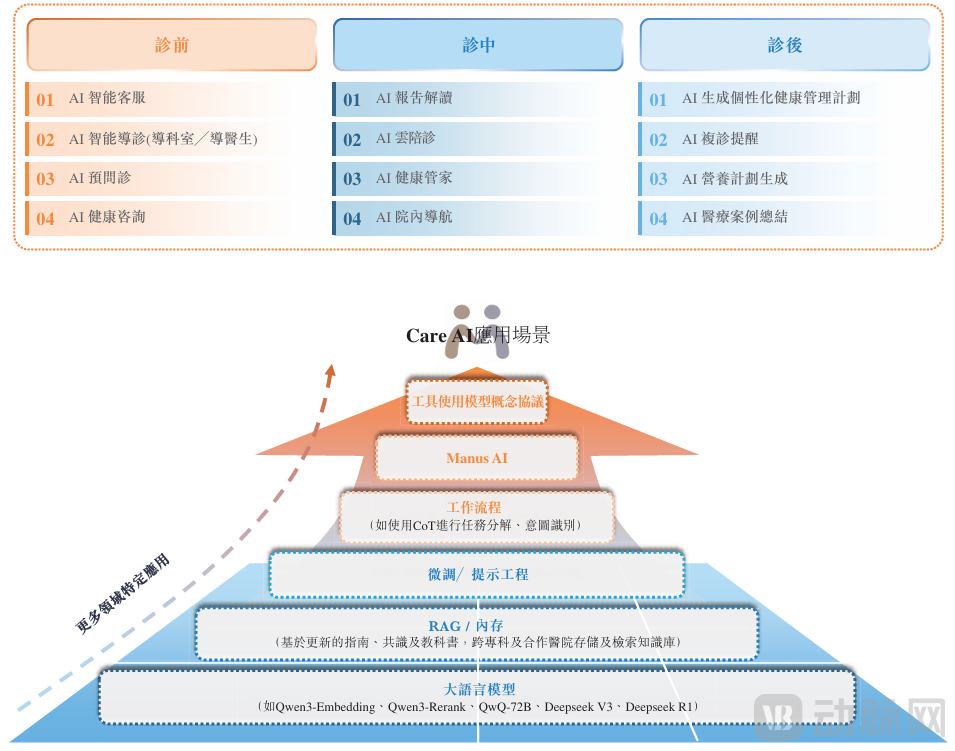
CareAI Application Scenarios, Image Source: Prospectus
In the pre-consultation phase, CareAI leverages a conversational medical model to collect essential patient information for diagnosis and treatment planning, based on clinical guidelines and evidence-based protocols. This approach helps reduce unnecessary hospital visits while ensuring that emerging complications are promptly identified and addressed.
During the consultation phase, CareAI integrates with hospital systems to serve as a continuous communication channel among patients, health management teams, and medical professionals throughout the treatment process, thereby facilitating enhanced coordination in health management. For physicians, CareAI provides clinical support through AI-assisted diagnostic tools, intelligent case analysis, and Clinical Decision Support Systems (CDSS).
In the post-consultation phase, CareAI Tong provides comprehensive patient health management reports to enhance clinical continuity. It also analyzes patient health data to generate personalized reports, highlighting key changes in the patient’s condition since the last visit, medication adherence, symptom progression, and compliance with the health management plan.
Furthermore, Weimai provides patients with 24/7 AI-agent-powered consultation services through its mobile app. These services are supported by a multidisciplinary team, with AI agents working in tandem with human professionals. Whether addressing medication-related issues, symptom inquiries, appointment scheduling, or general health guidance, the AI agents leverage natural language processing, clinical knowledge bases, and patient-specific medical histories to deliver intelligent, context-aware responses, while escalating complex or urgent matters to human team members.
It is evident that AI plays multiple supportive roles in Weimai’s full-course disease management business model. It can rapidly respond to patient needs, reducing response time from hours to minutes, enhancing the service efficiency of care teams, lowering operational costs, and improving patient engagement and satisfaction. As Weimai’s proprietary AI platform, CareAI has become key to service delivery.
For Weimai, expanding its revenue scale means increasing the volume of its full-course-of-care services. The prospectus also disclosed that,Weimai will continue to expand its hospital network and deepen collaborations with existing partner hospitals, including broadening geographic and departmental coverage. To support this business expansion, Weimai employs a range of operational strategies.
First, customized operations for individual hospitals and patients.Weimai signs direct contracts with hospitals and establishes exclusive Weimai Full-Course Disease Management Centers within each facility, deploying medical assistants to the hospitals to build a deeply integrated collaborative model. This approach enables Weimai to directly reach patients and in-hospital physician and nursing teams.
As of now, Weimai has built a team of more than 360 medical assistants responsible for patient-facing services and on-site hospital operations.
Medical assistants are stationed at designated hospitals to promote Weimai’s services and provide personalized health management, while case managers oversee full-cycle health management services and coordinate the work of medical assistants for each patient. The service quality of this team directly translates into patient satisfaction and is critical to member acquisition and business growth.
Weimai has also established comprehensive standardized internal processes to regulate the core components of online and offline, in-hospital and out-of-hospital health management services.
Second, ensure consistency in the quality of cross-hospital services.As the whole-course disease management business expands, ensuring quality consistency is paramount. Weimai guarantees consistency across hospitals, specialties, and personnel through technology-driven processes, standardized training, and cross-regional supervision. Leveraging AI and technological capabilities, Weimai maximizes the digitalization and automation of standard operational procedures to minimize human-induced variations.
Weimai also extensively conducts standardized training and provides training resources to medical assistants and case managers to ensure consistency in practice. Case managers and hospital administrators are responsible for quality assurance, resource allocation, and maintaining hospital relations within designated geographic areas, serving as the primary liaisons for on-site medical assistants, hospitals, and headquarters.
Third, hospital network growth.In selecting partner hospitals, Weimai employs a multi-dimensional criteria model to evaluate potential partners based on their strategic value and long-term growth potential, dedicating substantial time and resources to establish in-hospital full-course disease management centers and technical systems for each institution.
To date, Weimai has partnered with 157 hospitals to provide whole-course disease management services; it has also collaborated with over 4,700 medical institutions on payment settlement, medical record access, and comprehensive medical history review, laying the foundation for deeper cooperation.
Clearly, whole-course disease management is an operations-intensive model, and controlling operational costs has become a key lever for improving profitability during business expansion.
Weimai has implemented multiple measures to control operating expenses, particularly sales and distribution expenses. On the hospital side, a favorable policy environment has reduced the need for large-scale sales and marketing investments to expand hospital partnerships; on the patient side, AI technology has been leveraged to efficiently streamline sales and distribution processes. Meanwhile, after years of accumulation, Weimai has established a certain reputation effect. In 2022, 2023, and 2024, the percentage of sales and distribution expenses to revenue gradually decreased, reaching 38.7%, 21.6%, and 14.5% respectively, with the company’s operating expenses correspondingly decreasing.
The prospectus shows that with the improvement of operational efficiency, Weimai is expected to achieve profitability in the short term.
In fact,Since its inception, Weimai’s sector has undergone multiple rounds of “trend” iterations, with concepts such as internet hospitals, digital therapeutics, and large language models emerging one after another. Although Weimai has intersected with these popular trends, a review of its development trajectory reveals that whole-course disease management has always remained its core strategy.
Nowadays, while having established its primary revenue streams, Weimai is gradually expanding other service revenues, such as insurance brokerage and sales of medical health products.
Weimai has leveraged its whole-course disease management services to establish extensive reach among large patient populations, including pregnant women and their families. This has created opportunities for expanding insurance brokerage services and enabled the identification of healthcare needs that are inadequately covered by existing insurance products. By integrating insurance with health management, Weimai can improve the overall health status of insured patients while reducing claim losses for insurance companies.
Currently, commercial health insurance is also at a critical juncture of transformation, and its deep integration with health management has become an inevitable trend. Whether insurance brokerage services can emerge as a new growth engine for Weimai remains to be seen.
But one thing is certain: diversified revenue streams will provide Weimai with greater room for growth. In view of long-term trends, the healthcare service system integrated with payers will also become more robust.