

China Unveils Landmark Policy to Propel High-Quality Innovation in Pharmaceutical Sector
The pharmaceutical industry is abuzz!
Yesterday, the National Healthcare Security Administration and the National Health Commission jointly issued the “Several Measures to Support the High-Quality Development of Innovative Drugs” (hereinafter referred to as the “Several Measures”), marking a significant step forward in further refining full-chain support measures for the development of innovative drugs.
As China’s innovative drug industry reaches a certain stage of development, with an increasing number of product approvals, companies are shifting their focus beyond regulatory review and approval to prioritize hospital adoption, reimbursement, and market competition.
The reason why the new policy provides “full-chain support” for innovative drugs is mainly due to“Several Measures” proposes policies covering all stages from innovative drug R&D and investment to market access via medical insurance and commercial insurance, clinical application, and diversified payment mechanisms, aiming to address practical challenges facing innovative drugs and set the tone for the evolution of these key areas.
In light of the medical insurance policies of recent years and the overall trajectory of the new healthcare reform, the "Several Measures" mark a formal shift in pharmaceutical policy from the phase of "eliminating inflated prices" to that of "fostering innovation," serving as a watershed moment for the industry.
Over the past decade, China’s innovative drug sector has experienced rapid growth, characterized by vibrant venture capital activity and a robust R&D pipeline. However, this expansion has been accompanied by issues of homogenization, with target selection and pipeline planning often exhibiting a “bandwagon” tendency to chase hotspots.
Currently, homogenization has become a major bottleneck constraining the sustainable development of the innovative drug industry.For example, homogenized competition has driven up the costs of resources such as clinical trials, while low-level duplication has led to overcapacity in certain sectors. Companies lacking differentiation face financing difficulties during “capital winters,” becoming bubbles left in the wake of the innovation and venture capital boom. This trend has also, to some extent, dampened the drive for original innovation and overlooked truly unmet clinical needs, resulting in insufficient overall competitiveness for Chinese innovative drugs in the global market.
To avoid these issues,At yesterday’s press conference on the “Several Measures,” the National Healthcare Security Administration also stated that it would promote the formation of a landscape characterized by “genuine support for innovation, support for true innovation, and support for differentiated innovation.”
Given the lengthy R&D cycle for innovative drugs, the emergence of market saturation has exhibited a certain lag. How can we provide better support for innovative drug development from the source at an early stage? In response, the Several Measures propose breakthrough initiatives for the application of medical insurance data, namely:
·Support the use of medical insurance data for innovative drug R&D.On the basis of ensuring data security and legal compliance, explore the provision of necessary medical insurance data services for innovative drug research and development. Relying on the national unified medical insurance information platform, conduct data collection and analysis on disease spectra and clinical medication needs, develop data products tailored to the requirements of innovative drug R&D, and support pharmaceutical companies, research institutes, and medical institutions in reasonably determining R&D directions and structuring their pipelines, thereby enhancing innovation efficiency.
Health insurance data helps pharmaceutical companies more accurately identify unmet clinical needs, particularly the medication demands for chronic diseases and cancer amid population aging, reveals the efficacy limitations of existing therapies, and enables more targeted development of next-generation drugs. The opening of health insurance data will accelerate the entry of China’s innovative drug industry into an era of data-driven precision R&D.
Meanwhile, post-marketing studies of innovative drugs can continue to drive their alignment with clinical needs. Therefore, the Several Measures states:
·Strengthen real-world studies on innovative drugs.Explore the establishment of scientific real-world study methodologies, encourage innovative drugs to conduct real-world studies, and promote the linkage of study results with drug formulary inclusion, contract renewal, and adjustments to the scope of medical insurance coverage.。
Capital plays a significant role in the development of innovative drug companies. However, the issue lies in the fact that RMB-denominated funds typically have a lifespan of around 7–8 years, which is mismatched with the often decade-long R&D cycles characteristic of innovative drug development.
Historically, initial public offerings (IPOs) served as one of the primary exit routes for investment institutions. However, the IPO channel narrowed significantly over the past two years, impeding exit opportunities. More critically, as funds established around 2015 approach maturity, investment institutions are compelled to prioritize expedited exits.
It is a regrettable reality that innovative enterprises and investors may encounter conflicts, or even sever ties and resort to litigation, due to exit challenges. Capital invested in innovative drugs requires a greater readiness for long-term commitment; meanwhile, the innovative drug sector increasingly relies on the support of patient capital.
In January 2025, the “Guiding Opinions of the General Office of the State Council on Promoting High-Quality Development of Government Investment Funds” pointed out that long-term capital and patient capital should be developed and expanded. The duration of government investment funds should be reasonably determined to leverage their cross-cyclical and counter-cyclical regulatory roles as long-term and patient capital, while actively encouraging investments from long-term capital sources such as the National Social Security Fund and insurance funds.
Currently, the duration of many newly established government-guided funds across various regions has been extended, reaching 15 to 20 years. Hard-tech enterprises, including those in the innovative drug sector, are expected to receive financial support over longer investment horizons. The “Several Measures” released yesterday also noted accordingly:
· Encourage commercial health insurance to expand the scale of investment in innovative drugs.Encourage commercial health insurance companies to provide stable, long-term investment for innovative drug research and development through various means, such as innovative drug investment funds, thereby cultivating patient capital that supports innovation in pharmaceuticals.
It has long been common for commercial insurance companies to invest in healthcare enterprises, but their investments have largely focused on areas that can synergize with insurance, such as medical services, internet-based healthcare, health management, and elderly care. In 2024, the original premium income from national commercial health insurance reached RMB 977.3 billion, a year-on-year increase of 8.2%. How much of this substantial amount can be allocated to investing in innovative drugs?On the one hand, it depends on insurers’ risk assessment of investments in innovative drugs; on the other hand, it hinges on whether detailed implementation rules will be introduced to further support the practical application of “commercial health insurance investing in innovative drugs.”
In any case, the “Several Measures” still propose a new approach to attracting patient capital for innovative drugs.
As China’s innovative drugs enter their harvest period, the number of Class 1 innovative drugs approved for marketing showed a significant upward trend from 2018 to 2024. The number of approvals reached 48 in 2024, more than five times that of 2018, with nearly 40 approvals in the first half of 2025 alone, indicating a clear surge effect.
Policy support in the reimbursement phase is particularly crucial for the commercialization of innovative drugs.
In recent years, a dynamic adjustment mechanism for the National Reimbursement Drug List (NRDL) to facilitate the inclusion of new drugs has been gradually established.Data from the National Healthcare Security Administration shows that the proportion of newly marketed drugs among the new additions to the National Reimbursement Drug List (NRDL) in the same year rose from 32% in 2019 to 98% in 2024. Among the 91 drugs newly included in the NRDL in 2024, 33 achieved “approval and inclusion in the same year.” The time required for new drugs to gain reimbursement coverage through inclusion in the NRDL after market approval has decreased from approximately five years to around one year, with about 80% of innovative drugs being covered by national medical insurance within two years of their launch. Following successful price negotiations for inclusion in the NRDL, most innovative drugs have experienced simultaneous increases in both sales volume and revenue.
However, the National Healthcare Security Administration also stated that,Issues such as the gap between innovative drug companies’ price expectations and the National Medical Insurance Administration’s payment capacity, as well as weak diversified payment mechanisms, have yet to be fully resolved.
Next, while improving the dynamic adjustment mechanism for the National Reimbursement Drug List and reasonably determining reimbursement standards for innovative drugs, the National Healthcare Security Administration will also vigorously support the implementation of commercial health insurance coverage for innovative drugs, as mentioned in the “Several Measures”:
·Establish an innovative drug catalog for commercial health insurance.Priority is given to the inclusion of innovative drugs that demonstrate a high degree of innovation, significant clinical value, and substantial patient benefits, while falling outside the scope of basic medical insurance coverage. Their use is recommended as a reference for multi-tiered medical security systems, including commercial health insurance and mutual medical aid.
·Leverage the functions of the multi-tiered medical security system.Healthcare security authorities provide cooperative support to eligible commercial health insurance products in areas such as data sharing and settlement reconciliation., cases involving the use of innovative drugs covered by relevant commercial health insurance may be excluded from diagnosis-related group (DRG) payment schemes and reimbursed following a review and evaluation process.
In fact,The National Healthcare Security Administration had previously mentioned the work deployment for the commercial health insurance drug formulary on multiple occasions. Also yesterday, this initiative saw a significant substantive breakthrough:The National Healthcare Security Administration has officially released the “Work Plan for Adjusting the 2025 National Drug Catalogue for Basic Medical Insurance, Maternity Insurance, and Work-Related Injury Insurance, as well as the Innovative Drug Catalogue for Commercial Health Insurance (Draft for Comments)” and the “Application Guidelines for Adjusting the 2025 National Drug Catalogue for Basic Medical Insurance, Maternity Insurance, and Work-Related Injury Insurance, as well as the Innovative Drug Catalogue for Commercial Health Insurance (Draft for Comments).”
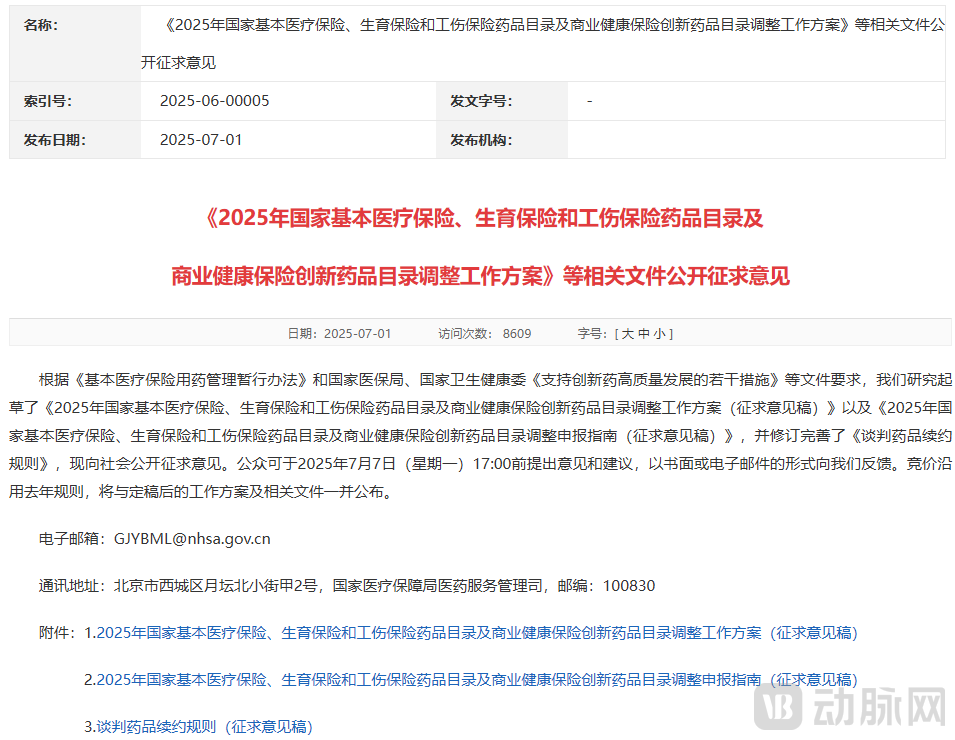
Latest Policy Arrangements for the Drug Catalog of Commercial Health Insurance, Image Source: National Healthcare Security Administration
The National Healthcare Security Administration also stated that the application and adjustment of the Commercial Health Insurance Innovative Drug Catalog are conducted simultaneously with those of the National Reimbursement Drug List, following largely identical procedures.Enterprises may independently apply for inclusion in the National Reimbursement Drug List (NRDL) or in the innovative drug lists of commercial health insurance, or they may apply for both simultaneously.Unlike adjustments to the National Reimbursement Drug List, the Commercial Insurance Innovative Drug Catalog will fully respect the market entity status of commercial health insurance companies, with insurers and industry experts actively participating in all stages, including scheme formulation, expert review, and price negotiation.Experts in commercial health insurance hold significant decision-making authority regarding the inclusion of drugs in the innovative drug catalog for commercial insurance and the negotiation of their prices.
In the past, Huiminbao (city-specific supplemental medical insurance) has made significant explorations into commercial insurance coverage for innovative drugs. With the establishment of a commercial insurance formulary for innovative drugs, both Huiminbao and other commercial insurance products will coordinate with the basic medical insurance system to create a more comprehensive multi-tiered payment framework.
As previously discussed, the pace at which innovative drugs are included in the National Reimbursement Drug List has accelerated in recent years. However, in practice,Due to considerations such as reforms in medical insurance payment methods, drug cost ratios, and performance assessments on the use of volume-based procurement drugs, healthcare institutions frequently fail to prescribe innovative medicines, making it difficult to bridge the “last mile” in the clinical application of these drugs.
Previously, several cities have introduced policies to open a “green channel” for the “last mile” of innovative drugs entering hospitals. For example: exploring separate settlement or inclusion in Diagnosis-Intervention Packet (DIP) payment with score bonuses for expenses related to innovative drugs such as those included in the National Reimbursement Drug List (NRDL) negotiations incurred by designated medical institutions; excluding the costs of NRDL-negotiated drugs from performance evaluation indicators for public medical institutions, such as average outpatient visit cost, average outpatient drug cost per visit, average inpatient stay cost, and average inpatient drug cost per stay; and establishing special case negotiation mechanisms under Diagnosis-Related Groups (DRG) payment systems. These supportive measures aim to encourage medical institutions to adopt innovative drugs and medical devices and apply new medical technologies.
The “Several Measures” issued this time also affirm similar exploratory directions from a top-level design perspective, and explicitly propose:
· Encourage designated medical institutions under the basic medical insurance scheme to convene pharmacy and therapeutics committees within three months after the update and publication of the drug catalog, and to timely adjust drug formularies or establish temporary green channels for procurement as needed, so as to ensure clinical diagnosis and treatment needs and protect patients’ rights to rational medication. Negotiated drugs included in the National Reimbursement Drug List (NRDL) and drugs listed in the commercial health insurance innovative drug catalog shall be exempt from the “one product, two specifications” restriction.
· For cases involving the appropriate use of innovative drugs included in the National Reimbursement Drug List that are not suitable for diagnosis-related group (DRG) standard payments, support is provided for medical institutions to independently apply for special-case unit status.
The new policy aims to address the concerns of medical institutions. If effectively implemented, it is expected to further improve the accessibility of innovative drugs within hospitals in the future.
A review of healthcare insurance policies in recent years reveals that the fundamental objective of payment method reforms, national reimbursement drug list negotiations, and centralized procurement of pharmaceuticals and medical consumables has been to “eliminate inflated prices.” In line with the overall direction of the new healthcare reform, the cost savings generated from these initiatives are primarily channeled toward facilitating the clinical adoption of new drugs and novel diagnostic and therapeutic procedures.
In the past two years, cities such as Beijing, Shanghai, Guangzhou, and Shenzhen have begun implementing measures to support innovative drugs and medical devices through medical insurance, as healthcare reform has progressed to a certain stage.
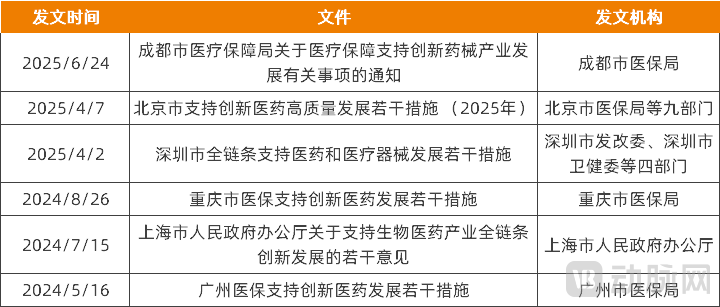
Policies Supporting Innovative Drugs and Medical Devices Under Medical Insurance in Certain Regions, Source: Official Websites of Local Governments
The introduction of the “Several Measures” by the National Healthcare Security Administration marks a shift in top-level design, driving the industry from a phase of “eliminating inefficiencies” to one of “fostering innovation,” and defining the development pathways for multiple segments of the industry.Become an industry watershed.
Meanwhile, the new policy does not broadly “promote innovation”; rather, it targets the previous innovation bubble by closely focusing on the clinical value of innovative drugs, thereby providing more precise support for innovation.In the future, “True Innovation” projects will be better positioned to secure resource support from medical insurance data, innovative investment, and diversified payment mechanisms. Their outcomes will also deliver greater value in clinical applications, thereby creating a virtuous cycle.
Acknowledgments: Yu Jianlin, Deputy General Manager of GTJA Investment; Wei Qiang, Investment Director of Guoke Venture Capital; Shan Jialiang, Managing Partner of Haibang Fund Management; Meng Xiaoying, Partner at Yida Capital; Yi Renxin, Senior Investment Manager at Yida Capital; and Wang Meng, General Manager of Youjia Biotech.