First 'Rice-Derived Human Albumin' Biotech Clears STAR Market Listing Review, Preparing for National Reimbursement Drug Negotiation
Healthgen Biotech
Research and Product Developer of Plant-derived Recombinant Protein Expression Technology
On July 1, according to information from the official website of the Shanghai Stock Exchange (SSE), Healthgen Biotech, the first “rice-based hematopoietic” stock, successfully passed the review by the SSE Listing Review Committee. This marks the first IPO company to gain approval since the reinstatement of the fifth set of listing criteria on the STAR Market.
According to the prospectus, Healthgen Biotech is a biopharmaceutical company that has adopted the fifth listing standard. All of its drug candidates are in the R&D stage, with no approved products on the market, and the company has not yet achieved profitability.
Healthgen Biotech’s sponsor is Guotai Haitong Securities, and its controlling shareholder and actual controller is Yang Daichang.
As of the date of signing the prospectus, Yang Daichang directly held a 15.03% equity interest in Healthgen Biotech, making him the largest shareholder; he controlled 3.75% of the voting rights of Healthgen Biotech through Hezhong Gongchuang and 10.47% of the voting rights of the issuer through concerted action agreements, thereby controlling a total of 29.25% of the voting rights of Healthgen Biotech.
From May 2005 to January 2021, Yang Daichang served as a Professor in the Department of Genetics, College of Life Sciences at Wuhan University. In November 2006, he initiated the establishment of Healthgen Biotech and currently serves as its Chairman and General Manager.
The top ten shareholders of Healthgen Biotech also include Shanghai Tongsheng, Beta Pharma, and the Optics Valley Bio-Fund.
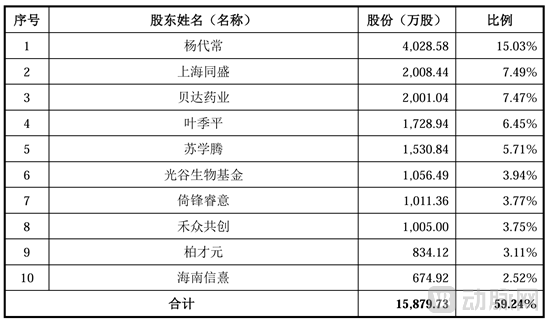
Source: Prospectus (all images below are from the prospectus)
Since its IPO application for the STAR Market was accepted on December 29, 2022, until passing the review meeting, Healthgen Biotech’s IPO journey has spanned two and a half years; however, it still has some way to go before its official listing.
According to relevant statistics, from 2024 to the present, the average time from acceptance to listing for the 20 companies listed on the STAR Market was 624 days, with an average of 277 days required from approval to successful listing.
01
The “First Deal” After the Relaunch of the Fifth Set of Standards
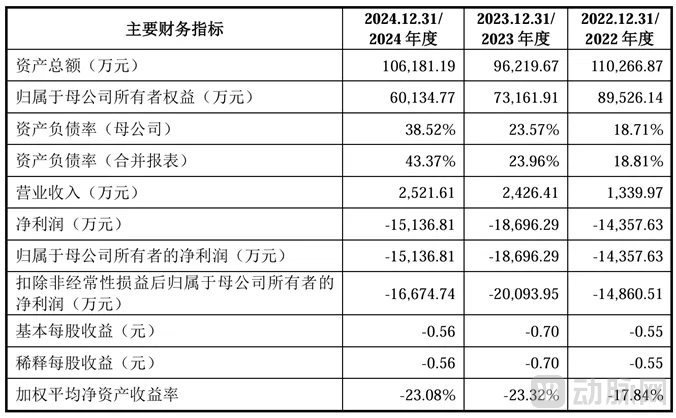
According to the prospectus, Healthgen Biotech’s revenues from 2022 to 2024 were RMB 13.3997 million, RMB 24.2641 million, and RMB 25.2161 million, respectively, with net losses of RMB 149 million, RMB 201 million, and RMB 167 million, respectively, resulting in a cumulative loss of RMB 517 million over the three-year period.
The resumption of the fifth listing standard on the STAR Market has enabled Healthgen Biotech to secure approval despite its losses.
It is understood that the fifth set of listing standards does not impose requirements on a company’s revenue or net profit scale. Instead, it emphasizes criteria such as “main businesses or products must be approved by relevant national authorities and have significant market potential” and “achievement of phased results,” thereby facilitating access to the capital markets for companies that are not yet profitable but possess genuine core competitiveness.
Healthgen Biotech’s successful approval may have given a “shot in the arm” to the entire biopharmaceutical industry.
Tian Lihui, Dean of the Institute of Financial Development at Nankai University, stated in an interview that restoring the applicability of the fifth set of listing criteria for the STAR Market would significantly enhance the inclusiveness and adaptability of the capital market. This move provides a direct financing channel for technology companies that are not yet profitable but possess core technologies and growth potential, thereby stimulating investor enthusiasm for the high-tech sector.
Other industry insiders have pointed out that for innovative pharmaceutical companies, receiving capital infusions from the capital markets is crucial when they lack profitability.
According to a review by National Business Daily, 54 previously unprofitable companies have successfully listed on the STAR Market over the past six years. With the support of the STAR Market, these companies are rapidly entering a period of realizing R&D outcomes and advancing into a new stage of commercial development.
Among the 20 biopharmaceutical companies listed under the fifth set of listing standards, 19 have successfully launched their core products. In 2024, nine new drug products—Zepuning, Maiweijian, Gaoruizhe, Beitaining, Jinlixi, Junshida, Anfangning, and Haikewei—were approved for marketing, five of which are Class 1 innovative drugs.
02
Core Products Expected to Launch Soon
Healthgen Biotech’s continued losses are primarily due to the fact that its core products, such as recombinant human albumin, have not yet been commercialized.
According to a review, Healthgen Biotech’s product portfolio mainly comprises pharmaceuticals, pharmaceutical excipients, and research reagents. Currently, all pharmaceutical products are in the R&D stage and have not yet entered commercial production or sales. The company’s operating revenue is primarily derived from the sale of pharmaceutical excipients, research reagents, and other products, along with a small amount of income from technical services.
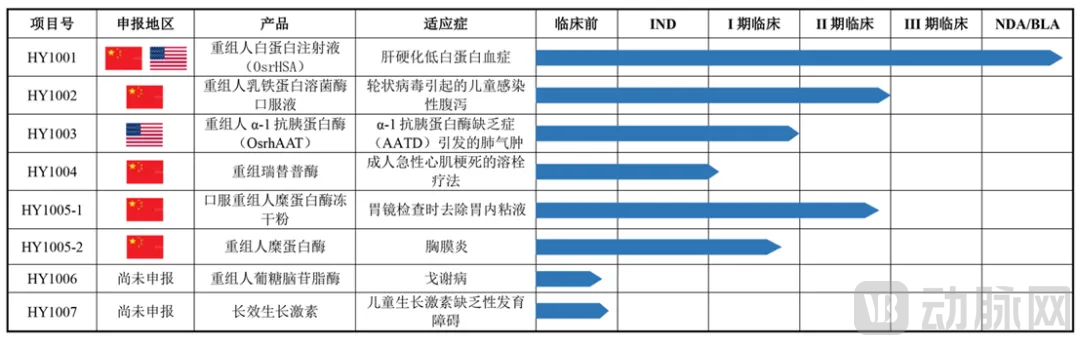
Drug Pipeline Progress
From the perspective of drug development, HY1001 Recombinant Human Albumin Injection (OsrHSA) has completed Phase III clinical trials and obtained the Clinical Study Report (CSR). Its New Drug Application (NDA) was accepted in September 2024. The marketing approval review is progressing smoothly, with most of the review procedures already completed. It is expected to be approved for market launch in the near future, with the anticipated indication being “hypoalbuminemia associated with liver cirrhosis.”
HY1002, a recombinant human lactoferrin and lysozyme oral solution for the treatment of infectious diarrhea in children caused by rotavirus, has completed its Phase II clinical trial. Communication with the Center for Drug Evaluation (CDE) is expected to be completed in the third quarter of 2025, with the Phase III clinical trial scheduled to commence at the end of 2025.
Notably, with its core products yet to be commercialized, Healthgen Biotech saw its fundraising amount shrink by RMB 1.1 billion compared to the figure disclosed in its initial IPO prospectus.
Healthgen Biotech’s initial prospectus indicated a planned fundraising amount of RMB 3.502 billion, which was reduced to RMB 2.4 billion in the version submitted for review. The proposed capital allocations for three projects—the industrialization base construction project for plant-derived recombinant human serum albumin, the new drug research and development project, and the supplementation of working capital—were decreased by RMB 252 million, RMB 152 million, and RMB 700 million, respectively.
03
"Rice Hematopoiesis" Achieved Through Synthetic Biology
Supporting Healthgen Biotech’s core “rice-based hematopoiesis” product is its underlying technology platform.
According to the prospectus, Healthgen Biotech’s “rice-based hematopoiesis” product development is based on its rice endosperm cell bioreactor expression system, which includes the upstream OryzHiExp platform for high-efficiency recombinant protein expression in rice endosperm cells and the downstream OryzPur platform for recombinant protein purification.
Beyond the technology itself, a key factor drawing significant attention to Healthgen Biotech may lie in the underlying human serum albumin market—characterized by substantial demand, a predominance of imports, and considerable room for domestic substitution.
According to Frost & Sullivan data, the market size of human albumin therapeutic drugs in China was RMB 25.8 billion in 2020 and is projected to grow to RMB 57.0 billion by 2030, with a compound annual growth rate (CAGR) of 6.0% from 2025 to 2030.
According to an analysis by Pacific Securities, domestic market supply remains dominated by imports due to constraints in domestic plasma availability, leaving significant room for substitution with domestically produced alternatives.
Data on batch release from the National Institutes for Food and Drug Control (NIFDC) show that 4,401 batches of human albumin were released in China in 2023. Among these, four overseas plasma-derived therapy giants—Octapharma, CSL Behring, Takeda, and Grifols—accounted for nearly 70% of the total batches released. The supply in the domestic market remains predominantly import-dependent, indicating substantial potential for import substitution.
However, the immense demand has also led to significant challenges in scaling up the production of recombinant human serum albumin products.
According to reports, Yang Daichang once analyzed that the dosage of human serum albumin is 20 grams per dose, whereas monoclonal antibodies are dosed at 100 mg per dose—a 200-fold difference. Therefore, only slightly more than 30 kilograms of antibodies would be needed annually in China to meet demand. Vaccine production requirements are even lower. In contrast, the annual market demand for human serum albumin in China exceeds 600 metric tons.
Meanwhile, higher dosages necessitate more stringent safety requirements. The permissible limit for host cell protein impurities in human serum albumin is 0.00001%, compared to 0.01% for antibody drugs—a 100-fold difference—and a 100,000-fold difference relative to vaccines. In terms of endotoxins, human serum albumin must contain less than 0.0083 EU/mg, which is 100 times stricter than the requirement for antibodies and 100,000 times stricter than that for vaccines. Nevertheless, the selling price of human serum albumin is approximately RMB 35–40 per gram, whereas antibody drugs exceed RMB 20,000 per gram.
Therefore, recombinant human serum albumin faces four challenges: purity, safety, production cost, and scalability.
“Recombinant human serum albumin is technically feasible; the key challenge lies in reducing costs. If produced using cell-based methods, the cost per gram runs into thousands of yuan, making a 10-gram dose prohibitively expensive for patients. Therefore, the large-scale production and high-cost barriers of recombinant human serum albumin must be overcome,” said Yang Daichang.
According to reports, Healthgen Biotech’s plant-derived recombinant human serum albumin is extracted from rice, offering certain advantages in terms of scalability and safety.
Furthermore, in the human serum albumin market, apart from the aforementioned foreign enterprises, there are multiple domestic players such as Tiantan Biological, Shanghai RAAS, and Hualan Biological. However, the recombinant human albumin market appears to remain a blue ocean.
According to the prospectus, as of May 31, 2025, Healthgen Biotech’s recombinant human albumin drug was the only one registered and launched in the global market, having been approved in Russia in April 2024 and in Kyrgyzstan in March 2025.
Medway, a recombinant human albumin drug produced by Mitsubishi Tanabe Pharma Corporation of Japan using a Pichia pastoris expression system, was approved for marketing in Japan in 2007 but was withdrawn from the market in 2009 due to alleged fabrication of clinical trial data.
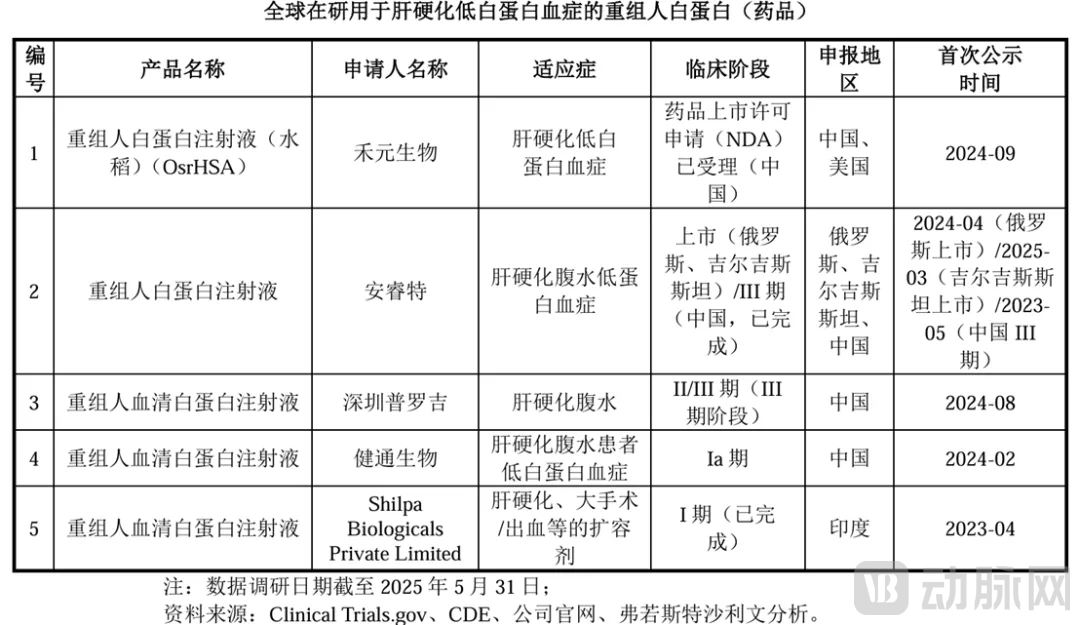
Currently, in addition to Healthgen Biotech, Anruite, Shenzhen Progea, and Jiantong Biologics are all developing recombinant human albumin products in China. None of these products have been launched yet. Healthgen Biotech is poised to become the first company in China to launch a recombinant human albumin product indicated for hypoalbuminemia associated with liver cirrhosis.
However, Healthgen Biotech stated in its prospectus that although HY1001 enjoys a first-mover advantage, there are currently two other recombinant human albumin drug candidates in China that have completed or entered Phase III clinical trials. If regulatory reviews proceed smoothly, these competing products are expected to receive approval and be launched sequentially within the next one to three years, thereby competing with HY1001. At that time, the Company may need to undertake larger-scale research and development as well as marketing activities.
Furthermore, as a relatively innovative product, there may be certain uncertainties regarding its post-launch commercialization and actual clinical acceptance.
Healthgen Biotech further pointed out in its prospectus that HY1001 may face the risk of sales falling short of expectations.
Because plasma-derived human serum albumin (pHSA) has decades of real-world clinical use experience, recombinant human albumin product HY1001, similar to other innovative drugs, will require extensive academic promotion, market education, and real-world data studies to gain widespread acceptance and recognition from doctors and patients. As a result, there will be a period of market introduction.
Additionally, the future commercial market for HY1001 can be divided into out-of-hospital and in-hospital segments.
According to the prospectus, prior to its inclusion in the National Reimbursement Drug List (NRDL), sales of HY1001 were primarily concentrated in the out-of-hospital market. Market access in this segment required completing procedures such as designated institution association filing and public listing announcements in various provinces, establishing collaborations with retail pharmacies, and realizing out-of-hospital sales through prescription outflow channels.
Meanwhile, Healthgen Biotech is actively preparing for negotiations to be included in the National Reimbursement Drug List (NRDL) and will participate in these negotiations. If included in the NRDL, the product will face a certain degree of price reduction. Furthermore, achieving large-scale in-hospital sales will still require subsequent procedures such as provincial-level online listing and public notification, as well as approval by hospital Pharmacy and Therapeutics Committees. The Company will need some time to fulfill the necessary market access procedures in accordance with relevant regulations.
—END—
Training on Registration and Market Access for Biomanufacturing Products
Grand Opening
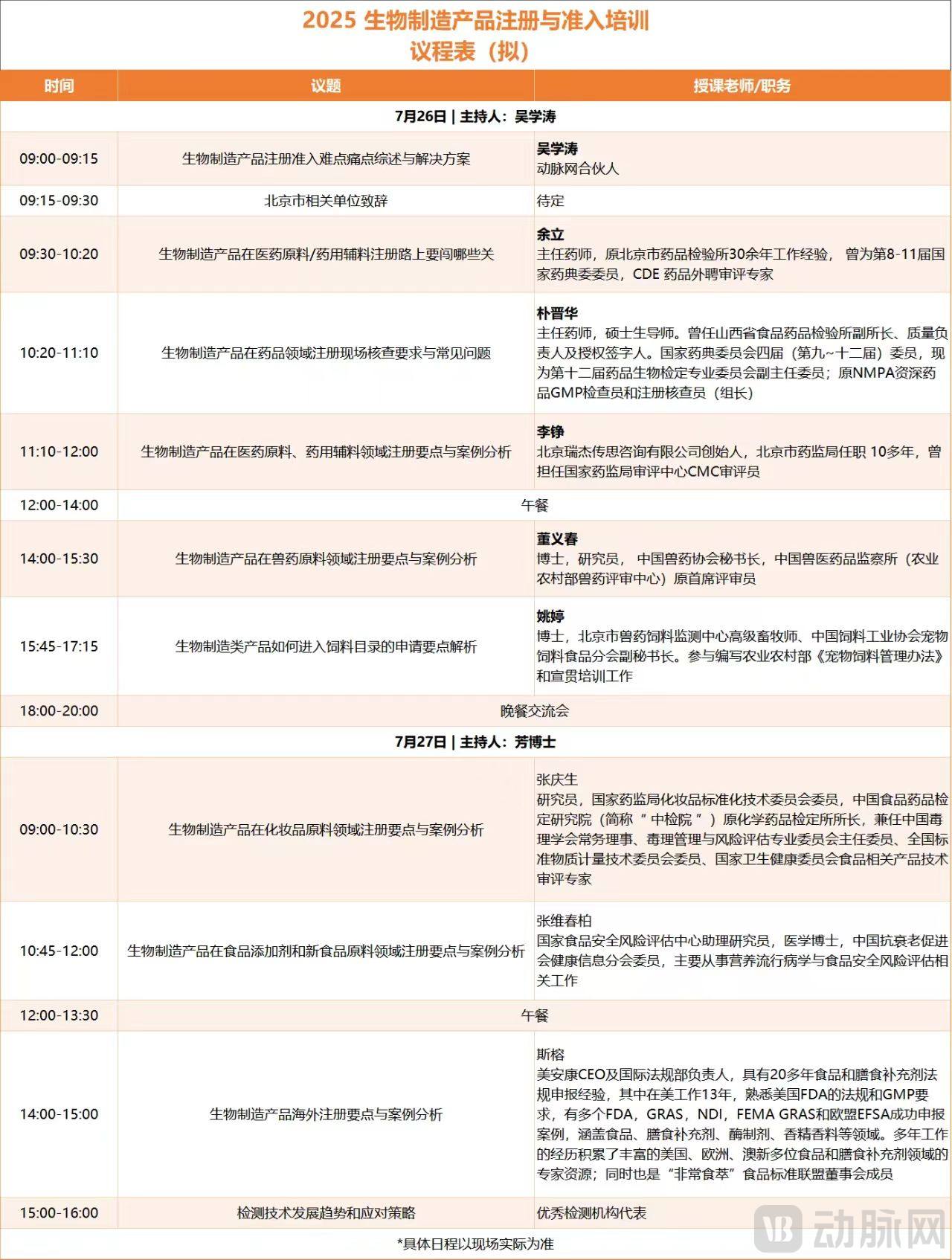
On July 26–27, 2025, the “Training on Registration and Market Access for Biomanufacturing Products” will be grandly launched at the Beijing Yizhuang International Biopharmaceutical Park.
Co-hosted by VCBeat and Dr. Fang, this event focuses for the first time on six high-potential sectors (pharmaceuticals, cosmetics, food, animal health, agriculture, and materials), providing you with a practical guide to breaking through from the laboratory to the market.
Highlight 1: A Lineup of Top-Tier Experts
Bringing together over a dozen industry-leading experts and practical instructors from the pharmaceutical, veterinary drug, and food sectors, including Yu Li (former expert at the Beijing Institute for Drug Control), Dong Yichun (Secretary-General of the China Veterinary Drug Association), and Si Rong (international leader in food regulations). They will provide in-depth analysis of global regulatory standards (such as those of the FDA and NMPA), helping you precisely select registration pathways and build compliant submission dossiers.
Highlight 2: Practice-Oriented
Addressing corporate pain points by bridging the “valley of death” in pilot-scale development and overcoming regulatory access barriers. Through case studies, master strategies for pharmaceutical IND/NDA submissions, new cosmetic ingredient filings, and veterinary drug approvals, while formulating winning approaches to pricing and centralized procurement responses. Enhance market competitiveness through efficient cross-domain collaboration.
The specific schedule is as follows:
Limited to 80 seats, first come, first served. Meet experts face-to-face and help your product move from “bio-manufacturing” to “market success”!
Scan the QR code below to register and secure your spot, embarking on a journey toward compliance-driven breakthroughs!