

Mindray Makes Bold Move into Surgical Robotics, Taking Direct Aim at da Vinci

Mindray
Medical Device R&D Manufacturer
The da Vinci Surgical System Welcomes Another Formidable Rival in China!
Recently, Mindray stated in its latest investor exchange meeting that there is still a gap between its domestically produced laparoscopic surgical robot and the da Vinci Surgical System. Leveraging its advantages across the industrial chain, Mindray’s entry into the surgical robotics market aims to establish itself as a world-class surgical robot manufacturer.
Mindray Has Sent a Strong Signal of Entering the Laparoscopic Surgical Robot Market. As the leading medical device company in China, Mindray embarked on its global M&A journey in 2008, expanding into new growth areas through acquisitions. Its continuous M&A strategy aims to position it among the top 20, or even the top 10, medical device companies worldwide. Surgical robots represent a crucial piece of the puzzle for becoming an industry giant, with global leaders such as Johnson & Johnson and Medtronic already having established their presence in the laparoscopic surgical robot sector.
According to industry insiders, Mindray has adopted the integrated approach of the da Vinci Surgical System for its surgical robot, which is currently still in the research and development phase.
The laparoscopic surgical robot market is fiercely competitive. Intuitive Surgical’s da Vinci system has long dominated the field, while in recent years, strong emerging Chinese players have also made their mark. As a latecomer to this sector, how can Mindray achieve a breakthrough?
As early as 2012, Mindray acquired Hangzhou Guangdian, entering the minimally invasive surgery industry. Mindray recognized the market potential of minimally invasive surgery at an early stage and has continuously strengthened its presence in the advanced minimally invasive surgical devices market in recent years. However, possibly due to patent constraints and limited market maturity, Mindray did not officially announce its active exploration of the surgical robotics business until 2023.
Mindray has been progressively elevating the R&D priority of surgical robots. Its narrative on the surgical robot business has evolved from “active exploration” in 2023, to “structured exploration” in 2024, and most recently to “facilitating breakthroughs in domestically produced surgical robots.”
Mindray has always been quick to respond to market trends, yet it missed the first window of opportunity for the development of laparoscopic surgical robots.
During the three years when Mindray did not engage in surgical robotics, the domestic surgical robot market in China was in a critical window of development. In 2024, the number of installed laparoscopic surgical robots in China exceeded 100 units. The number of installed da Vinci surgical robots in China was 55 units in 2023 and 58 units in 2024.
There is significant clinical demand for laparoscopic surgical robots. Due to the da Vinci Surgical System’s strong capability in performing complex procedures within confined spaces, it enables surgeons to conduct intricate operations more easily and smoothly, thereby driving substantial clinical demand for laparoscopic surgical robots.
Surgical volume data can intuitively reflect clinical demand. According to the prospectus of Sizherui, from 2018 to 2021, the average annual number of laparoscopic surgeries assisted by each surgical robot in China was over 250 cases per year.
A surgical robotics company once stated to VCBeat: “These figures do not reflect true clinical demand. The lower average annual number of procedures per unit is primarily attributable to the large volume of new installations between 2018 and 2021. In reality, many hospitals perform more than 1,000 procedures per robot annually, demonstrating high frequency of use and strong clinical acceptance, particularly for complex surgeries.”
Taking the “World’s Largest Hospital,” the First Affiliated Hospital of Zhengzhou University, as an example, the hospital introduced the da Vinci Surgical System in 2014 and had performed more than 13,000 da Vinci robot-assisted surgeries by 2023.
In recent years, the market for laparoscopic surgical robots has benefited from favorable policy support, leading to further expansion. In March 2023, the National Health Commission released the Catalogue for the Administration of Licensing for the Allocation of Large-Scale Medical Equipment (2023 Edition), followed by the Notice on the “14th Five-Year” Plan for the Allocation of Large-Scale Medical Equipment in June of the same year. Compared with the “13th Five-Year” period, the number of allocation permits for laparoscopic endoscopic surgical systems under the “14th Five-Year” Plan (“14th Five-Year Allocation Permits”) has increased significantly.
According to statistics, by the end of 2024, more than half of the allocation permits under the 14th Five-Year Plan had been issued. With over 200 additional permits scheduled for release in the future, more hospitals will have the opportunity to equip themselves with laparoscopic surgical robots.
Over the past two years, despite a downturn in tenders for large-scale medical equipment, domestic surgical robots have still achieved rapid growth.
Domestic Laparoscopic Surgical Robot Companies Have Seized This Wave of Market DividendsBased on the bidding results from 2023 to 2024, domestically produced laparoscopic surgical robots have demonstrated strong momentum in winning bids, with the total number of domestic wins surpassing that of the da Vinci system in 2024. Among domestic manufacturers, MicroPort MedBot’s Toumai laparoscopic robot saw its orders surge rapidly from 10 units in 2023 to 39 units in 2024. JinFeng Medical’s laparoscopic surgical robot secured 28 bids in 2024 and won an additional 5 bids in the first quarter of 2025.
The release of policy dividends and the resonance with industrial development have ushered in a window of opportunity for domestically produced laparoscopic surgical robots. Regarding the first growth trend, Mindray missed a market development window due to the lack of product launches.
Judging from Mindray’s M&A direction in recent years, the company prioritizes stability when entering new markets and pursuing acquisitions. Its acquisitions of Hytest Biotech and Huitai Medical were both executed after their respective markets had been validated and entered a phase of stable growth. Although Mindray’s entry into the laparoscopic surgical robot market is not particularly early, it may well consider the present moment to be the optimal time for such a move.
According to industry insiders, Mindray’s laparoscopic surgical robot has adopted the integrated design approach of the da Vinci Surgical System.
Existing multi-port laparoscopic surgical robot arm configurations can be categorized into three types: the integrated design represented by the da Vinci system, the machine-tool-integrated design represented by Johnson & Johnson’s OTTAVA, and the modular structure represented by Medtronic’s Hugo. Each of these three arm configurations has its own advantages and limitations.
The integrated system is the most widely used in clinical practice. The global installed base of da Vinci surgical robots has exceeded 10,000 units, with over 2.68 million procedures performed cumulatively in 2024. Medtronic’s Hugo™ robotic-assisted surgery system has received regulatory approval in the European Union, Canada, Australia, and Japan, with indications covering general surgery, urology, and gynecology. Johnson & Johnson completed the first cases of its OTTAVA™ robotic surgery system clinical trials in April 2025.
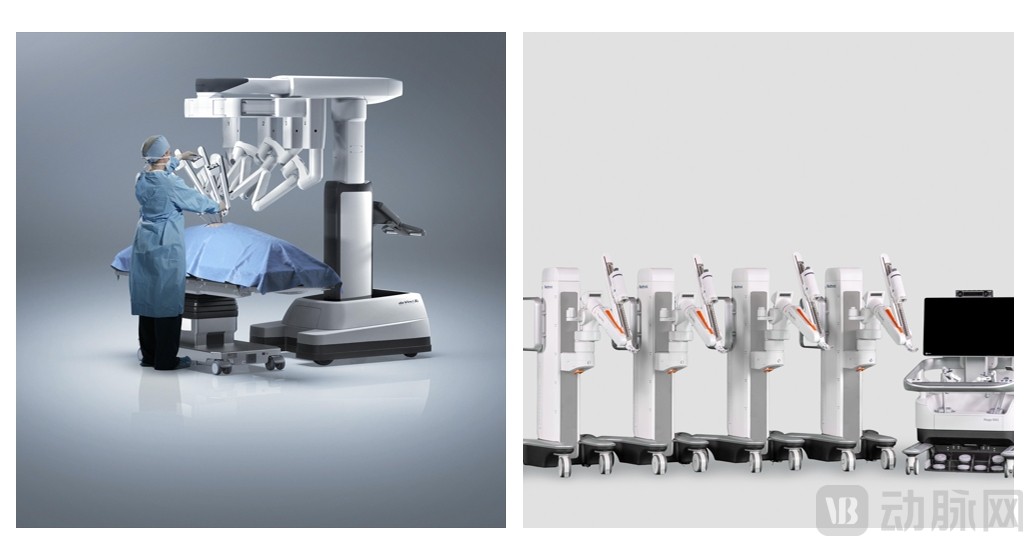
Da Vinci Laparoscopic Surgical Robot and Medtronic Hugo Laparoscopic Surgical Robot
The advantage of the integrated structure lies in its strong capability to perform delicate and complex surgeries in confined spaces, demonstrating outstanding clinical value in complex procedures and significantly improving laparoscopic surgical outcomes.For example, in urological surgery; this is also why the Department of Urology has the highest volume of da Vinci surgical robot procedures.
Mindray’s choice of an integrated surgical robot can lower the barriers and costs associated with future market education, making it more suitable for promotion in large central hospitals. However, competition in this field is exceptionally fierce. Currently, multiple domestic brands have received approval and launched their integrated laparoscopic surgical robots, with these products covering various indications and accumulating extensive clinical application experience. As a latecomer, Mindray needs to achieve breakthroughs in technology, performance, user experience, and cost-effectiveness to stand out in the highly competitive market.
What Is Mindray’s “Secret Weapon” as a Latecomer Entering the Laparoscopic Surgical Robot Market?
Mindray, as the leading domestic medical device company, is making a strong entry into the laparoscopic surgical robot market dominated by the "Da Vinci" system. To establish itself in this field with extremely high technical barriers, the primary challenge Mindray faces is bridging the gap between Chinese-made products and the industry benchmark. This gap lies not in superficial functionalities, but in systemic R&D and manufacturing capabilities as well as the depth of the industrial supply chain.
Mindray believes that the primary gap between domestically produced laparoscopic surgical robots and the da Vinci system lies in systematic R&D and manufacturing capabilities. New market entrants generally lack the ability to establish comprehensive R&D, manufacturing, and sales systems, while large cross-industry enterprises are constrained by insufficient capabilities and technological accumulation. Furthermore, the surgical robot supply chain is extensive, encompassing laparoscopic systems, energy platforms, instruments, and optics.
From a functional perspective, the gaps are mainly reflected in two aspects: one is the image quality of endoscopic surgical robot systems; the other is the supporting surgical instruments.
In terms of image quality, the da Vinci surgical robot is technologically ahead of domestic Chinese companies.It is reported that the Da Vinci Surgical System exclusively utilizes laparoscopic modules manufactured by a German company, delivering superior display performance. The Da Vinci system introduced 3D imaging in 2006 and fluorescence imaging functionality in 2009. In contrast, leading Chinese manufacturers have only recently perfected their fluorescence imaging capabilities. The latest models of the Toumai® robot and the Jingfeng® MP2000 are both equipped with full-field fluorescence imaging systems.
Domestic high-end minimally invasive surgical instruments exhibit weak operational performance in terms of supporting surgical instrumentation.Most enterprise surgical robot operating arms can only manipulate simple tools such as scalpels, scissors, forceps, and tweezers, falling short in the operation of advanced minimally invasive surgical instruments. The true surgical revolution is reflected in the sophisticated manipulation of advanced minimally invasive devices, such as precision energy devices and complex staplers. Compared with simple tools like scalpels, scissors, forceps, and tweezers, manipulating advanced minimally invasive surgical instruments imposes higher requirements on the robotic system’s degrees of freedom and flexibility, operational precision and stability, high-precision motion transmission, sensing and feedback technologies, intelligent control algorithms, and system integration, thereby presenting higher technical barriers.
Faced with core gaps, Mindray is not starting from scratch; its strengths and weaknesses are equally distinct.
Imaging technology remains a weak point: Although Mindray has launched 4K 3D fluorescence endoscopes, it has not yet reached the global top tier in terms of technology. Breakthroughs in cutting-edge imaging still require technological accumulation and time. Catching up with the optical engine of the da Vinci system poses significant challenges.
A comprehensive layout across the entire industrial chain of supporting instruments is a key advantage. This could be Mindray’s “ace in the hole” to address the shortcomings of domestically produced alternatives. Before entering the robotics sector, Mindray had already established a complete portfolio of advanced minimally invasive surgical instruments, with full product lines including endoscopes, ultrasonic scalpels, and staplers. In 2024, Mindray’s minimally invasive surgery business achieved over 30% growth against the market trend, demonstrating its strong market control in the consumables sector. Leveraging equipment sales to drive instrument revenue is Mindray’s area of expertise, and this strategy will provide robust supporting capabilities for its future surgical robots.
However, just as fuel-powered vehicle giants have struggled to compete with Tesla, leaders in minimally invasive surgery may not necessarily excel in surgical robotics. For instance, Johnson & Johnson and Medtronic, both dominant players in the field of minimally invasive surgical devices, still lag behind Intuitive Surgical in the surgical robot sector.
As a leading enterprise in China’s medical device industry, Mindray possesses a certain foundation and advantages in entering the surgical robotics sector, but it also faces numerous challenges, including those at the technological and supply chain levels. Mindray’s entry serves as a wake-up call to existing market participants; in a rapidly iterating and updating market, only companies that evolve quickly can remain invincible.