Profit Soars by 548%: Can Synthetic Biology Become the 'Second Growth Engine' for Listed Companies?

Menovo
R&D, Manufacturing, and Sales of Specialty Active Pharmaceutical Ingredients (APIs) and Formulations
On July 3, Brother Enterprises, a vitamin manufacturer and seller, released its 2025 semi-annual performance forecast, projecting a net profit of RMB 60 million to RMB 75 million, representing a year-on-year increase of 325.00% to 431.25%. The net profit after deducting non-recurring gains and losses is expected to range from RMB 57 million to RMB 72 million, with a substantial growth rate of 413.66% to 548.83%.
This performance growth continues the company’s trend of turning losses into profits since 2024. In 2024, Brother Enterprises achieved an operating revenue of RMB 3.441 billion, a year-on-year increase of 21.99%, and a net profit attributable to shareholders of the parent company of RMB 40.8137 million, a year-on-year increase of 123.26%.
Notably, Brother is attempting to reduce production costs through synthetic biology methods.
An industry insider told VCBeat that, for the industry, once synthetic biology methods achieve significant breakthroughs, price reductions will be substantial, imposing considerable competitive pressure on traditional manufacturers. Ultimately, only a few leading companies employing synthetic biology methods may capture the majority of the market share.
Meanwhile, Menovo, another publicly listed CRO company with business involving synthetic biology, also announced that its net profit attributable to shareholders of the parent company for the first half of 2025 is expected to range from RMB 46 million to RMB 52 million, representing a year-on-year increase of RMB 27.0575 million to RMB 33.0575 million, or a growth rate of 142.84% to 174.52%.
The net profit attributable to shareholders of the parent company, excluding non-recurring items, is expected to range from RMB 30.6252 million to RMB 36.6252 million, representing a year-on-year increase of RMB 10.9689 million to RMB 16.9689 million, or a year-on-year growth of 55.80% to 86.33%.
01
Behind the Doubling of Profits
Although both companies operate in the pharmaceutical sector, the drivers behind their rapid profit growth differ.
For Brother Enterprises, the announcement indicates that the significant year-on-year surge in its performance this period was primarily driven by the dual benefits of rising vitamin product prices and declining costs for certain products. These two factors jointly contributed to a substantial increase in the company’s overall gross profit margin.
It is understood that since Brother Enterprises launched its first vitamin product, “Vitamin K3,” into the market in 2000, it has established an industrial platform comprising four major vitamin products: Vitamin K3, Vitamin B1, Vitamin B3, and Vitamin B5. The company supplies vitamin products to numerous customers worldwide across the feed, food, daily chemical, and pharmaceutical industries.
After nearly two years of price bottoming, the vitamin sector led the charge in raising prices in 2024. In the first half of the year, manufacturers collectively raised and stabilized prices, while the BASF explosion in the third quarter rapidly pushed the market to a peak. Driven by the low base in 2023 and price increases, the vitamin sector’s operating revenue grew by 22.5% year-on-year in 2024, with net profit attributable to shareholders increasing by 162.6% year-on-year. In Q1 2025, both revenue and net profit attributable to shareholders continued their strong growth trend, with revenue rising by 10.8% year-on-year and net profit attributable to shareholders surging by 110.3% year-on-year.
In fact, Brother’s revenue growth is not an isolated case in the industry. According to a research report released by Zhongtai Securities, the vitamin sector benefited from price increases and realized performance gains in 2024 and the first quarter of 2025, with year-on-year substantial increases in both revenue and net profit attributable to shareholders.
However, vitamin prices currently appear to be trending downward.
According to Baichuan Yingsu data, as of June 8, the average market price of Vitamin A was RMB 63/kg, a decrease of 3.08% from the previous week, a decrease of 47.50% from the beginning of this year, and a decrease of 23.17% from the same period last year. The average market price of Vitamin E was RMB 88/kg, a decrease of 6.38% from the previous week, a decrease of 33.83% from the beginning of this year, and an increase of 27.54% from the same period last year.
Regarding Menovo’s half-year performance, the announcement did not explain the specific reasons for the growth, but only pointed out that it was mainly due to the increase in the company’s operating income and the improvement of gross profit margin during the reporting period.
Menovo is an international pharmaceutical manufacturing company specializing in the research and development, production, and sales of specialty active pharmaceutical ingredients (APIs) and formulations. Its main products cover therapeutic areas including cardiovascular diseases, central nervous system disorders, antiviral treatments, diabetes management, and gastrointestinal conditions.
Based on historical development trends, the current growth may be significantly correlated with the expansion of its formulation business.
By business segment, Menovo’s formulation business delivered strong performance in 2024, with revenue increasing by 83.52% year-on-year, becoming a key driver of the company’s revenue growth.
According to a review, Menovo had more than 50 formulation projects under development in 2024, with 15 projects undergoing regulatory review. Additionally, 19 products (covering 25 approval documents) obtained drug registration certificates in the Chinese market and entered the commercialization phase.
According to data from Securities Daily, Menovo has long maintained cooperative relationships with renowned international pharmaceutical companies such as KRKA, MSD (Merck & Co.), SERVIER, and GEDEON RICHTER. The competitive advantages of its integrated finished dosage form and active pharmaceutical ingredient (API) model are gradually becoming evident.
However, Menovo’s CDMO business declined by 39.3%. In response, Menovo stated that it will continue to increase investment and accelerate its layout in frontier technology areas such as cell and gene therapy (CGT), antibody-drug conjugates (ADCs), and synthetic biology.
02
Racing to Target Synthetic Biology
Although the drivers of profit growth differ, both listed companies have set their sights on synthetic biology.
Brother has stated that some of its products involve enzymatic catalysis processes, and its R&D projects include enzyme synthesis, enzymatic catalysis, and bio-fermentation technologies.
Brother has been continuously advancing the application of biosynthesis technology in the research and development of vitamin production. For instance, in June 2024, Brother was granted a new invention patent covering a nitrilase, the engineered strain constructed therefrom, and its application in the green synthesis of niacin.
As synthetic biology technology advances, cost and environmental sustainability may become critical factors in competition within the vitamin industry.
It is understood that biomanufacturing holds considerable promise for vitamin production. For instance, researchers at the Institute of Microbiology, Chinese Academy of Sciences, previously developed a biofermentation method for producing VB5 (vitamin B5). Using corn-derived glucose as the raw material, this method achieved a conversion rate exceeding 30%, with lower costs than chemical synthesis, while reducing water consumption by 92% and energy consumption by 16%.
Meanwhile, companies such as NHU are also continuously expanding their presence in this field, potentially competing with Brother Enterprises.
In April 2023, NHU completed construction of the world’s first green production line for vitamin B5 (VB5) using biological fermentation, with an annual capacity of 2,500 metric tons. As of October 2023, the company had produced over 1,500 metric tons of VB5 via this biological fermentation process within six months, accounting for 10% of global VB5 sales.
It is also worth noting that synthetic biology holds significant potential for development in the field of microbiology. Currently, China has achieved biomanufacturing only for a limited number of products, such as vitamin C and B vitamins. The majority of vitamin varieties still rely on chemical synthesis, which is associated with issues including lengthy process routes, harsh reaction conditions, substantial pollutant emissions, and low product yields.
Menovo is betting on the GLP-1 sector through synthetic biology.
Among all R&D pipelines, the strategic cooperation in synthetic biology signed between Menovo and the University of Michigan since 2024 has attracted significant industry attention.
In April 2024, Menovo and the University of Michigan announced a collaboration to develop novel delivery systems targeting glucagon-like peptide-1 (GLP-1)-related pathways, achieving positive data in obesity animal models by June 2025.
Notably, this project utilizes probiotics as the delivery vehicle.
Due to the high cost of cell-based vectors, the need for injection, and the unsuitability of certain active ingredients for prolonged retention in the body, the probiotic platform can circumvent these issues. It enables the continuous delivery of GLP-1 analogs to the intestine via probiotics, thereby achieving therapeutic efficacy while reducing the likelihood of side effects and providing a long-acting, sustained-release effect.
The key technologies involve enzyme engineering, genetic engineering, and metabolic engineering. Among these, enzyme engineering is used to construct high-efficiency bioreactors, genetic engineering addresses platform expression levels, and metabolic engineering regulates enzyme synthesis and inhibits the function of specific hydrolases.
Although this delivery platform represents an innovation, the GLP-1 therapeutic landscape appears to be “overcrowded” when viewed from an industry-wide perspective.
According to relevant analyses, there are currently more than 100 GLP-1 drugs under clinical investigation worldwide, with nearly half originating from Chinese pharmaceutical companies. Multinational pharmaceutical giants such as Novo Nordisk and Eli Lilly hold leading positions in the development of GLP-1 therapies.
Meanwhile, competition in the domestic GLP-1 market has become increasingly “fierce,” with Chinese companies such as Hengrui Medicine, Innovent Biologics, and CSPC Pharmaceutical Group accelerating the research and development of GLP-1 drugs. According to the PharmaCube database, there are currently 206 GLP-1 pipeline candidates being developed by Chinese pharmaceutical companies.

—END—
Training on Registration and Market Access for Biomanufacturing Products
Grand Opening
July 26–27, 2025, Beijing·Yizhuang International Biomedical Park, “Training on Registration and Market Access for Biomanufacturing Products” Grand Launch.
Co-hosted by VCBeat and Dr. Fang, this event focuses for the first time on six high-potential sectors (pharmaceuticals, cosmetics, food, animal health, agriculture, and materials), providing you with a practical guide to breaking through from the laboratory to the market.
Highlight 1: Top-Tier Expert Lineup
Featuring over a dozen industry-leading experts from the pharmaceutical, veterinary drug, and food sectors—including Yu Li (former expert at the Beijing Institute for Drug Control), Dong Yichun (Secretary-General of the China Veterinary Drug Association), and Si Rong (international leader in food regulations)—this program offers in-depth analysis of global regulatory standards (such as those of the FDA and NMPA) to help you precisely select registration pathways and build compliant submission dossiers.
Highlight 2: Practice-Oriented Purpose
Addressing corporate pain points to bridge the "valley of death" in pilot-scale trials and overcome regulatory access barriers. Through case studies, master strategies for pharmaceutical IND/NDA submissions, new cosmetic ingredient filings, and veterinary drug approvals, while formulating winning pricing and volume-based procurement response plans. Achieve efficient cross-domain collaboration to enhance market competitiveness.
The detailed schedule is as follows:
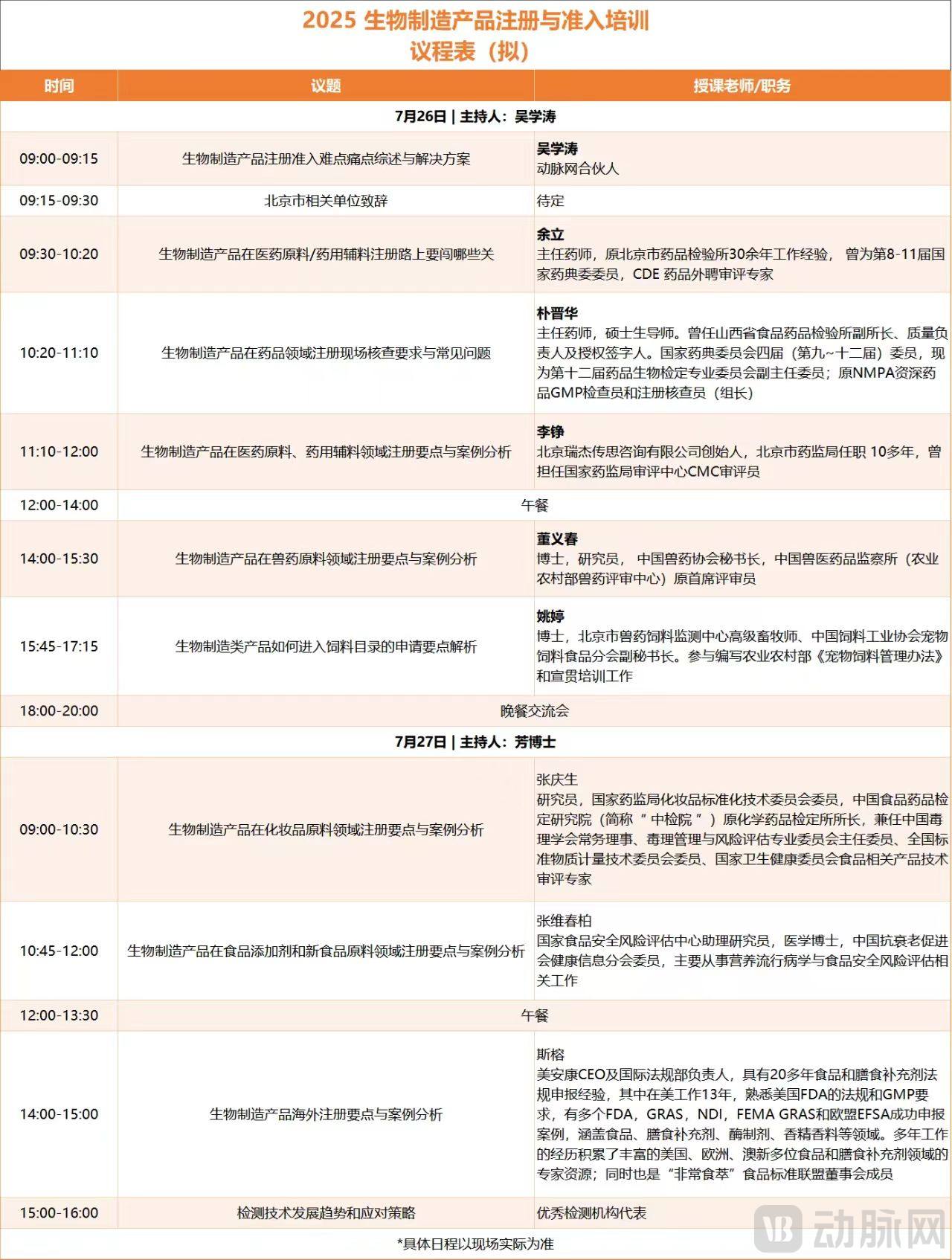
Limited to 80 seats, first come, first served. Engage face-to-face with experts to help your products transition from “bio-manufacturing” to “market success”!
Scan the QR code below to register and secure your seat, embarking on a journey toward compliance breakthroughs!