Plant Extract Leader ChenGuang Biotech Reports 130% Profit Surge and Explores Synthetic Biology for Key Products
On the evening of July 9, Chenguang Biotech (300138) disclosed its earnings forecast, projecting operating revenue for the first half of 2025 to reach RMB 3.46 billion to RMB 3.76 billion, representing a year-on-year growth rate of -0.89% to 7.71%; net profit attributable to shareholders of the listed company is expected to be RMB 202 million to RMB 232 million, marking a year-on-year increase of 102.33% to 132.38%.
The substantial increase in profit was primarily driven by the market recovery in the cottonseed-related business segment during the first half of 2025, which turned a loss into a profit year-on-year. Additionally, the gross profits from plant extraction businesses, including capsanthin, chili oleoresin, and steviol glycosides, all increased year-on-year.
Chenguang Biotech operates in the natural plant extract sector, with its business segmented into plant extracts, cottonseed, and others. Its three flagship products—capsanthin, capsicum oleoresin, and lutein—rank first or among the top globally.
Notably, Chenguang Biotech has consistently maintained a close watch on developments in synthetic biology. In its 2024 annual report, the company explicitly stated that it would focus on the field of synthetic biology for lycopene and food-grade lutein, exploring new application directions.
VCBeat learned through research interviews that lutein prices are currently low, making the advantages of synthetic biology less apparent, while also facing uncertainties in pilot-scale amplification. Lycopene may be more suitable for cost reduction via synthetic biology, but it must address regulatory approval challenges.
01
Cottonseed Business Turns Profitable
Affected by market conditions, Chenguang Biotech's cottonseed business once suffered significant losses but has now turned profitable.
According to research reports from China Post Securities and Founder Securities, Chenguang Biotech achieved annual revenue of RMB 6.994 billion in 2024, a year-on-year increase of 1.79%, while net profit attributable to shareholders stood at RMB 94 million, a year-on-year decrease of 80.39%. Affected by the decline in soybean oil and soybean meal prices, the company’s cottonseed business incurred significant losses; meanwhile, due to falling raw material prices, the selling prices or gross margins of products in its plant extraction business declined to varying degrees.
By the first quarter of 2025, Chenguang Biotech’s performance began to rebound, with net profit attributable to shareholders of the parent company projected to reach RMB 90 million to RMB 120 million, representing a year-on-year increase of 133.21% to 210.95%. The company’s plant extraction business continued to gain momentum, while prices for cottonseed also recovered amid the gradual upturn in commodity markets such as soybean oil and soybean meal. As a result, the cottonseed-related business turned profitable compared to the loss incurred in the same period last year.
It is understood that cottonseed-related businesses, due to their commodity-like nature, are characterized by large revenue volumes, high volatility, and low gross profit margins.
Since 2020, the gross profit margin of the cottonseed business has shown a downward trend. In particular, in 2024, due to unfavorable external macroeconomic conditions and other factors, the gross profit margin of the cottonseed-related business declined to 0.18%, while the company’s overall gross profit margin for 2024 was 7.96%.
In addition to its cottonseed business, improvements in operations such as plant extraction are also driving Chenguang Biotech’s performance.
According to the company's annual data, Chenguang Biotech holds over 60% of the global market share for capsanthin and approximately 30% of the lutein market.
In addition, Chenguang Biotech’s tiered products, including lycopene, steviol glycosides, and rosemary extract, are in a phase of rapid growth, with multi-product development yielding significant results.
In its latest announcement, Chenguang Biotech stated that the company’s sustained rapid growth is the result of multiple contributing factors.
First, the market share of our core products continues to rise, with capsanthin, chili oleoresin, and lutein ranking among the top in the market.
Secondly, the company’s product portfolio has become increasingly diversified, establishing second-tier products such as steviol glycosides and Sichuan pepper extracts.
Third, the entire plant extract industry has continued to maintain rapid organic growth. These factors have collectively driven the expansion of the company’s business scale and remain the primary drivers of its business development.
02
Cost, Cost
In addition to the growth of its core business, cost is also a key factor that Chenguang Biotech needs to focus on for its performance growth.
According to a research report by Founder Securities, since the cost of raw materials for general plant extracts typically accounts for more than 90% of operating costs, fluctuations in raw material prices have a significant impact on Chenguang Biotech’s sustainable development.
Therefore, in recent years, Chenguang Biotech has continuously advanced refined management across all aspects of product R&D, procurement, production, and sales, while steadily strengthening its low-cost industrial manufacturing capabilities.
The strategic layout in synthetic biology for lycopene and food-grade lutein may also be aimed at further solidifying cost advantages.
VCBeat’s research has found that, in theory, synthetic biology technologies can indeed be applied to these two products. However, they must overcome two major pain points: pilot-scale production and regulatory approval. These challenges are also faced by the entire biomanufacturing industry.
It is understood that there are currently two mainstream forms of biomanufacturing: biosynthesis and enzymatic conversion. The former involves production using genetically edited chassis cells or engineered strains, while the latter relies on single or multiple enzymes to convert substrates and intermediates; these enzymes can also be improved or manufactured through methods such as genetic editing.
Based on research interviews, lutein may currently be better suited for biosynthetic production; however, challenges related to cost and pilot-scale scale-up must be addressed.
In theory, lutein can be produced via biosynthesis; however, overall yields remain low. Currently, this approach offers no significant cost advantage over extraction methods, and thus has not been widely adopted within the industry. Widespread industrial consideration will only occur when the overall cost of biosynthetic production becomes sufficiently competitive.
Furthermore, the application of synthetic biology in lutein production also involves stability issues following scale-up. While conversion may be theoretically achievable at the small-scale laboratory stage, it remains to be verified over time whether large-scale manufacturing can be realized and whether the resulting product can effectively replace natural raw materials.
Moreover, the price of natural lutein raw materials is already quite low. Generally, products with higher unit prices are more suitable for production via synthetic biology methods, thereby creating greater potential profit margins through reduced production costs.
Regarding lycopene, VCBeat’s research indicates that this product may be more suitable for production via synthetic biology than lutein, as its higher unit price offers greater potential for profit improvement through cost reduction enabled by synthetic biology. Some research institutions have reported excellent yields, and certain companies have already begun advancing the industrialization of synthetically produced lycopene.
However, regulatory compliance poses a significant challenge, and products may not be approved for domestic sale even after manufacturing is completed. Currently, allulose remains the only successful case in China. The registration and market access application process for food ingredients produced via synthetic biology may take two to three years, with other requirements also being quite stringent. Consequently, some companies may opt to pursue regulatory approval in overseas markets first.

—END—
Training on Registration and Market Access for Biomanufacturing Products
Grand Opening
July 26–27, 2025, Beijing · Yizhuang International Biopharmaceutical Park: “Training on Registration and Market Access for Biomanufacturing Products” Grandly Launches.
Co-hosted by VCBeat and Dr. Fang, this event focuses for the first time on six high-potential sectors (pharmaceuticals, cosmetics, food, animal health, agriculture, and materials), providing you with a practical guide to breaking through from the laboratory to the market.
Highlight 1: Top-Tier Expert Lineup
Featuring over a dozen industry-leading experts from the pharmaceutical, veterinary drug, and food sectors—including Yu Li (former expert at the Beijing Institute for Drug Control), Dong Yichun (Secretary-General of the China Veterinary Drug Association), and Si Rong (international leader in food regulations)—this program offers in-depth analysis of global regulatory standards (such as those of the FDA and NMPA) to help you precisely select registration pathways and build compliant submission dossiers.
Highlight 2: Practical Purpose-Oriented
Addressing corporate pain points and overcoming the "valley of death" in pilot-scale production and regulatory market access hurdles. Through case studies, master strategies for pharmaceutical IND/NDA submissions, new cosmetic ingredient filings, and veterinary drug approvals, while formulating winning pricing and volume-based procurement response plans. Enhance cross-functional collaboration to boost market competitiveness.
The detailed schedule is as follows:
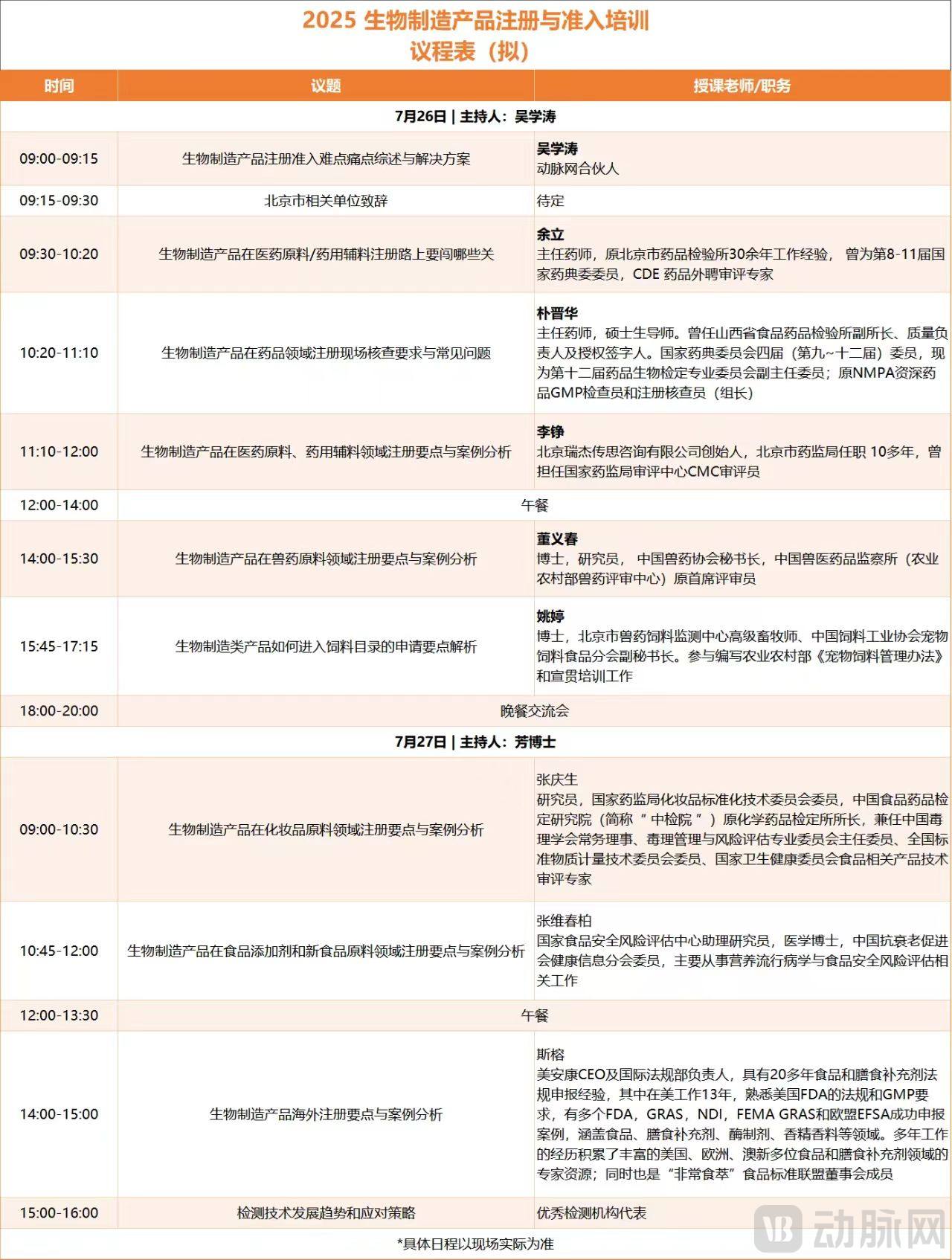
Limited to 80 seats, first come, first served. Meet experts face-to-face to help your product move from “biomanufacturing” to “market success”!
Scan the QR code below to register and secure your spot, embarking on a journey toward compliance breakthrough!