

Pathos AI Files for IPO Following $365M Series D Funding to Advance AI-Driven Oncology Pipeline

Pathos AI
Biotechnology Developer
Recently, biotechnology company Pathos AI announced the completion of a $365 million Series D financing round, bringing its post-money valuation to approximately $1.6 billion. The proceeds will be used to support the advancement of the company’s clinical-stage product pipeline and to continue investing in its proprietary artificial intelligence foundation model specifically built for oncology.
As AI large models accelerate their penetration into the healthcare sector and numerous companies rush to deploy pharmaceutical large models, what exactly constitutes Pathos’ core competitiveness? Let us decode it point by point.
1Anchoring in the Oncology Drug Development Track: Leveraging AI to Accelerate Clinical Development of Innovative Drugs
Pathos AI, founded in 2020 and headquartered in New York, USA, is a biotechnology company focused on artificial intelligence-driven drug development, particularly for oncology treatments. The leadership team features a distinct interdisciplinary profile, with members possessing diverse professional backgrounds that provide multidimensional perspectives and complementary expertise for research.
CEO Iker Huerga brings over 20 years of experience at the intersection of machine learning and oncology. He previously served as Chief Data Scientist for Oncology R&D at AstraZeneca and Executive Vice President at Tempus Labs, and has founded multiple AI-driven oncology startups, focusing on the application of multimodal AI in clinical trials and precision medicine.
Dr. Jens Renstrup, Chief Medical Officer, and the Chief Scientific Officer hold dual MD/MBA degrees and bring over 25 years of global experience in the pharmaceutical and biotechnology industries. Dr. Renstrup previously served as Chief Medical Officer at Springworks Therapeutics and Head of Global Medical Affairs at Alexion Pharmaceuticals, with deep expertise in oncology drug development and cross-therapeutic pipeline advancement. Chief Scientific Officer Eric Schadt holds a Ph.D. in biomathematics. He is the former Founding CEO of Sema4 and former Chair of the Department of Genetics and Genomic Sciences at the Icahn School of Medicine at Mount Sinai, where he led the development of computational biology methods for ultra-large-scale data analysis.

CEO Iker Huerga (left), Chief Medical Officer Jens Renstrup (center), and Chief Scientific Officer Eric Schadt (right)
Source: Pathos Official Website
Since its inception, Pathos has attracted significant capital attention through its innovative exploration in the field of AI-driven oncology drug R&D, achieving remarkable milestones in its fundraising journey:
In March 2023, Pathos AI secured $20 million in venture capital funding. This seed capital laid a solid foundation for the company’s early-stage technology R&D, team building, and initial construction of its data platform, helping it emerge as a notable player in the AI-driven drug discovery sector.
In October 2024, Pathos AI completed a $62 million Series C financing round led by New Enterprise Associates (NEA), with participation from Revolution Growth, Lightbank, and Builders VC. The post-money valuation reached $600 million, bringing the company’s total fundraising to $102 million. The funds will primarily be used to expand its world-class team of scientists and engineers, accelerate in-depth research and development of its AI-driven drug discovery platform, and fully advance the clinical-stage pipeline in precision oncology, thereby laying the groundwork for future business expansion and technological breakthroughs.
This year, Pathos has just completed a $365 million Series D financing round. Against the backdrop of tightening global capital market conditions, securing such a large-scale investment underscores investors’ strong confidence in the AI-driven oncology drug development model pioneered by Pathos.
2PathOS Core Technology Platform: Three Key Advantages Covering the Entire Drug Development Process
In the global biopharmaceutical market, oncology is one of the fastest-growing segments. Pathos’s proprietary platform, the PathOS Platform, is an AI foundation model specifically designed for oncology, with its core competitiveness stemming from deep focus on the oncology field and technological innovation.
Driven by the integration of multimodal spatiotemporal data and AI algorithmic modeling, Pathos leverages the PathOS Platform to achieve high-throughput screening of cancer cells and personalized prediction. It applies AI-predicted targets to clinical trial design, thereby covering the entire process from target discovery to clinical implementation through three key differentiating advantages:
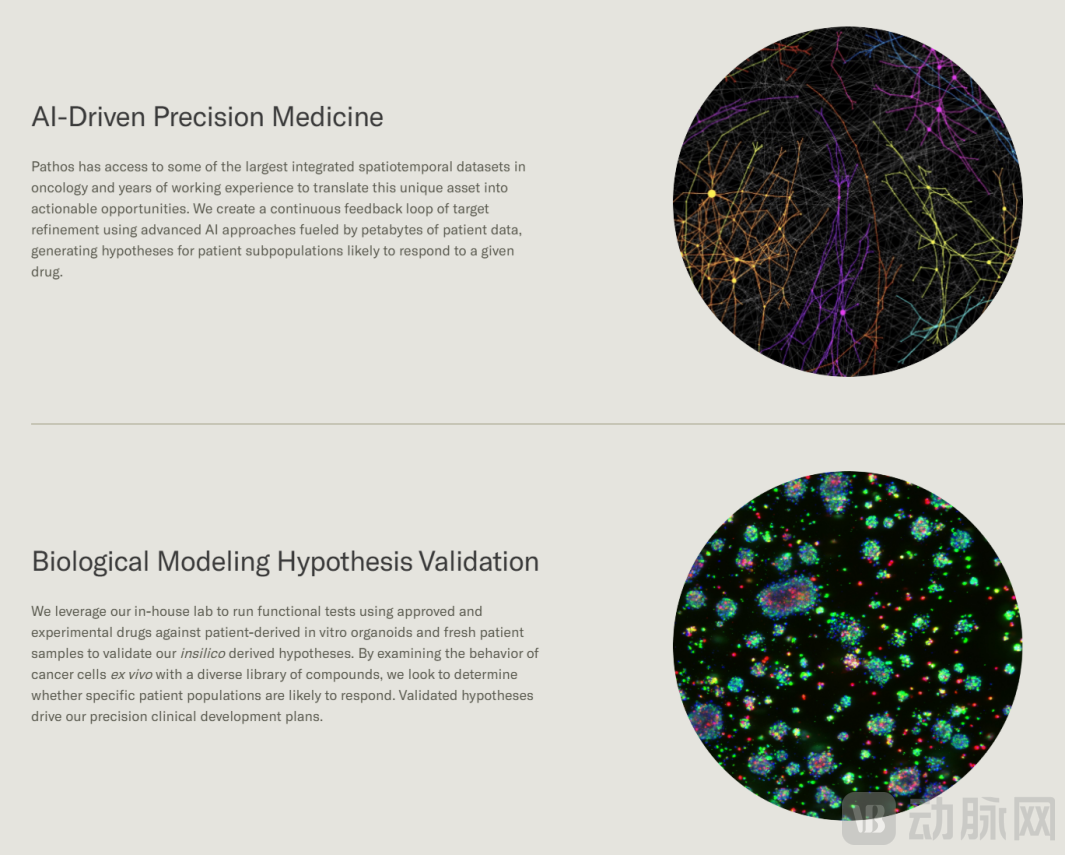
Pathos AI Concept Art Source: Pathos Official Website
l PB-scale multimodal data integration to build a foundational data infrastructure for oncology research
The PathOS Platform integrates petabyte-scale multimodal oncology datasets, encompassing clinical diagnosis and treatment, functional genomics, and imaging data, all derived from real-world clinical care of cancer patients. This multidimensional data fusion overcomes the limitations of single-data-type approaches, enabling more precise characterization of tumor heterogeneity and reflecting the distinctive features of oncologic diseases.
Compared with traditional single-modality data, this multimodal dataset provides richer training materials for AI models, enabling them to demonstrate enhanced analytical capabilities in target discovery, patient response prediction, and clinical trial design.
l Self-learning Discovery Engine, dynamically optimizing the R&D process
The self-learning and self-healing discovery engine integrated into the PathOS Platform automatically identifies and ranks drug targets using multiple orthogonal methods, while dynamically refining predictive models in real time as new data emerges. For instance, when new efficacy data from clinical trials become available, the engine automatically adjusts target prioritization, thereby eliminating the lag associated with manual intervention. Furthermore, this engine consolidates end-to-end data spanning from target discovery to clinical trials, ensuring consistency and coherence across all stages of development and facilitating continuous optimization of the drug R&D process.
l Causal AI Framework: A Breakthrough from Correlation Analysis to Mechanistic Prediction
Unlike traditional AI’s correlation analysis, Pathos’ causal AI framework directly targets the core biological mechanisms of drug action. By reasoning through the causal chain of drug–target–efficacy, it more accurately captures the relationship between drug mechanisms and patient outcomes, enabling precise prediction of the probability of patient response to therapy. This technological approach can improve clinical success rates, reduce blind trial-and-error, and lower the high failure rates commonly seen in oncology drug development.
This demonstrates that the PathOS Platform, powered by three core technologies, provides comprehensive coverage of the entire drug development lifecycle—from drug target discovery to clinical trial design and patient selection.Its advanced AI algorithms simultaneously optimize patient selection, biomarker development, and trial operations, making drug development more precise and efficient. This data-algorithm-clinical model not only accelerates the clinical drug development process but also drives oncology treatment toward greater precision and personalization, forming the core competitiveness of Pathos AI in the field of AI-driven oncology drug discovery.
3Two Clinical Pipelines Are Advancing Rapidly, Tackling Multiple Oncology Challenges
Currently, Pathos has two clinical pipeline drugs—Pocenbrodib and P-500. Crucially, both pipelines are licensed from external partners. Pathos leverages its key advantage—the PathOS Platform’s causal AI model—to accelerate the clinical development of these pipelines, while simultaneously accumulating data for its model platform and generating corroborative evidence.
Among them,Pocenbrodib is a drug for which Pathos obtained global licensing rights from Novo Nordisk in 2023., the drug was initially developed by Forma Therapeutics (a biopharmaceutical company focused on cancer treatment); andP-500 was licensed by Pathos from Prelude Therapeutics (a biopharmaceutical company focused on precision oncology) in 2024.。

Pathos’s R&D Pipeline Source: Pathos Official Website
l Pocenbrodib: Small-molecule inhibitors targeting prostate cancer and multiple solid tumors
Prostate cancer is a highly prevalent malignant tumor in men, and its advanced stage, metastatic castration-resistant prostate cancer (mCRPC), has long been a clinical challenge. Despite undergoing androgen deprivation therapy, patients often experience continued tumor growth and metastasis. Conventional anti-androgen therapies frequently fail due to the persistent activation of the androgen receptor (AR) and its variants in cancer cells, resulting in extremely limited treatment options.
Data show that the median overall survival for patients with metastatic castration-resistant prostate cancer (mCRPC) is only 13–36 months. The efficacy of existing therapies in suppressing tumor cells gradually diminishes, and drug resistance has become a major obstacle to treatment. Consequently, patient survival rates and quality of life remain inadequately ensured, underscoring an urgent need for mechanism-innovative therapies to overcome the challenge of drug resistance.
Pocenbrodib (formerly known as FT-7051) is a small-molecule inhibitor that functions by selectively targeting and inhibiting CREBBP/EP300 (also known as CBP/p300). CBP/p300 are proteins that play a critical role in activating genes involved in cancer cell growth and proliferation, and can drive tumor proliferation by promoting the expression of the androgen receptor (AR) and its variants.
Following the inhibition of these protein activities by Pocenbrodib, the expression of key cancer drivers, including AR and its variants, is affected. This mechanism of action suppresses the growth and proliferation of cancer cells, holding significant implications for the treatment of advanced prostate cancer and opening new avenues for treating various other solid tumors. It demonstrates potential clinical value both as a monotherapy and in combination with other therapeutic modalities.
In March 2025, Pathos initiated the Phase 1b/2a clinical trial of Pocenbrodib using its AI foundation model.This trial will evaluate the safety, pharmacokinetics, and preliminary antitumor activity of its monotherapy, as well as its combination with Zytiga (abiraterone), Lynparza (olaparib), or Pluvicto (lutetium Lu 177 vipivotide tetraxetan), to provide key data for subsequent clinical stages.
l P-500: Innovative Therapies That Break Through the Blood-Brain Barrier to Directly Target Brain Tumors
High-grade gliomas are the most common primary malignant intracranial tumors, characterized by strong invasiveness, a high tendency for recurrence, and poor prognosis. Uveal melanoma is the most common intraocular malignancy in adults; some patients experience metastasis, particularly to the brain, posing a severe threat to their life and health. Due to their specific anatomical locations, these two types of brain tumors present significant therapeutic challenges.
In conventional therapies for brain tumors, the presence of the blood-brain barrier (BBB) hinders many drugs from reaching the brain to exert their therapeutic effects, thereby limiting the selection of pharmacological agents for brain tumor treatment. Furthermore, cancer cells in high-grade gliomas and uveal melanomas proliferate and disseminate rapidly; existing treatments struggle to effectively control disease progression, resulting in short patient survival times and a significant decline in quality of life.
P-500 (formerly known as PRT811) is a selective small-molecule inhibitor of protein arginine methyltransferase 5 (PRMT5), specifically designed for the treatment of brain tumors. As a key enzyme regulating cell proliferation and RNA splicing, PRMT5 utilizes S-adenosylmethionine (SAM) to add methyl groups to cellular proteins, thereby modulating protein function and interactions. Multiple processes that support the growth and spread of cancer cells are dependent on PRMT5.
P-500 exerts its antitumor effects by inhibiting PRMT5, thereby interfering with key processes associated with cancer cell growth and dissemination. Furthermore, preclinical studies have demonstrated that PRMT5 inhibition can sensitize cancer cells to other therapies, thus expanding the application of P-500 to combination treatments for additional indications.
Currently, P-500 is undergoing Phase I clinical trials for solid tumors, including high-grade gliomas and uveal melanoma. Pathos plans to initiate further clinical trials of this drug in 2025, holding promise to bring new hope to patients with advanced solid tumors, particularly brain tumors.
4Partners with AstraZeneca and Tempus AI to Focus on Oncology Drug R&D
On April 23, 2025, Pathos announced a multi-year strategic collaboration with global biopharmaceutical giant AstraZeneca and leading AI healthcare company Tempus AI (specializing in AI-driven diagnostics and data services). The three parties will jointly build a multimodal foundational model for oncology, leveraging data sharing and technological synergy to develop novel drug discovery paradigms.
Specifically, the collaboration with AstraZeneca enables Pathos to leverage its extensive experience and resources in oncology R&D to jointly advance the development of oncology drugs, while the partnership with Tempus AI provides Pathos with access to substantial high-quality data and advanced AI technical support. This collaboration marks a deep integration between AI-driven pharmaceutical companies, traditional pharmaceutical firms, and healthcare data platforms, reflecting the new competitive landscape characterized by convergent development in the current healthcare industry.
From a broad industry perspective, AI-driven drug discovery is in a phase of rapid development. The “2025 AI Drug Discovery Market Analysis and Future Development Trends Report” indicates that the global market size for AI-driven drug discovery is projected to reach $20 billion in 2025, with a compound annual growth rate exceeding 30%. More than 100 startups and large pharmaceutical companies have already established their presence in this field. The application of AI technologies has expanded from early-stage drug molecule design to encompass the entire value chain, including target identification and clinical trial optimization.
In fact, AI’s penetration into the pharmaceutical industry has transcended the single dimension of technological application and is profoundly transforming corporate operations, business models, and even the entire industrial ecosystem. For the healthcare sector as a whole, AI is no longer merely a tool to enhance R&D efficiency; it will continue to drive the reshaping of industrial structures and value chains in the future.
In this profound transformation, whether Pathos AI can identify trends, precisely leverage the advantages of AI, and accelerate innovation efficiency through cross-enterprise resource integration—thereby injecting powerful momentum into drug R&D and setting new industry standards in oncology drug development—may find its answer in future clinical trial data.