

Somnee Files for IPO Following $10M Seed Round, Pioneering AI-Powered Sleep Neurotechnology

Somnee
Developer of Sleep Wearable Devices

Khosla Ventures
Venture Capital Firms

Seaside Ventures
Venture Capital Firms

Nelstone Ventures
Venture Capital Fund
People spend approximately one-third of their lives sleeping, yet the fast-paced nature of modern life has made sleep problems increasingly prevalent. According to statistics from the World Health Organization, the global prevalence of sleep disorders has reached 27%. In China, the "2025 Report on Sleep Health in China" indicates that the rate of sleep disturbances among individuals aged 18 and above has reached 48.5%.
Sleep deprivation can lead to impaired memory, neuronal damage, and even an increased risk of cardiovascular and cerebrovascular diseases. As awareness of sleep health rises, the sleep economy is expanding rapidly. According to Frost & Sullivan, the global sleep economy is projected to reach $585 billion by 2025. Demand for smart sleep-aid devices and products that improve sleep environments continues to grow. Amidst this booming market, Somnee, a developer of sleep wearables founded in 2017, is one of the key players navigating these “rapids.”
Somnee Announces $10 Million Seed Funding RoundRecently, Somnee announced the completion of a $10 million seed funding round. The round was led by Khosla Ventures, with participation from TIME Ventures (founded by Salesforce founder Marc Benioff), the DeVos family (owners of the NBA’s Orlando Magic), LEAD VC, Seaside Ventures, Metalab, and Nelstone Ventures. The proceeds will be used to support the research and development, as well as the market launch, of Somnee’s second-generation smart sleep headband.
1Starting from “Why We Sleep,” Somnee Enters the Field of Sleep Innovation
Somnee’s founding team is a multidisciplinary group, integrating professionals from both academia and industry.
Co-founder and Chief Sleep Advisor Dr. Matthew Walker is a Professor of Neuroscience at the University of California, Berkeley, and Director of the Center for Human Sleep Science. With over three decades of research in sleep neuroscience, he authored the international bestseller *Why We Sleep*. His presence and works have established the company’s theoretical foundation in sleep neuroscience.
Dr. Ram Gurumoorthy, Chief Technology Officer, brings over 20 years of commercialization experience in the field of neuroscience. He previously led brain science research at NeuroFocus (acquired by Nielsen), ensuring the successful translation and implementation of technology. As former Chief Marketing Officer of Fitbit, Chief Executive Officer Tim Rosa helped grow Fitbit into a globally leading benchmark brand in health wearables. He also spearheaded Fitbit’s acquisition by Google and its subsequent journey toward an initial public offering (IPO), bringing mature consumer-product operational thinking to the team.
“Sleep is the most important thing we can do each day to reset our brain and physical health,” says Dr. Matt Walker. Somnee exists to create better quality sleep. “We attempt to communicate with the brain in its ‘native language’—gentle, precisely timed electrical pulses—much like a conductor guiding an orchestra to harmony through subtle gestures.”
Currently, Somnee’s technological R&D relies on collaborations with institutions such as the University of California, Berkeley, and Stanford University. Somnee has published multiple research findings in authoritative journals including Frontiers in Human Neuroscience. Its products have undergone beta testing with NBA teams and their training staff; clinical validation in the professional sports sector has further confirmed the technology’s efficacy, helping to establish a complete closed loop from academic research to industrial application.
2Secured 24 Patents: Personalized Neuromodulation Helps Reduce Sleep Onset Latency by 50%
As a neuroscience-based smart sleep product, the Somnee sleep headband is a soft, lightweight, and flexible wearable device. Its headband-style design facilitates easy wear without imposing significant restrictions on users’ sleep positions, allowing for relatively comfortable use and thereby enhancing user willingness to adopt and adhere to the product.
Furthermore, the Somnee sleep headband features the following characteristics:
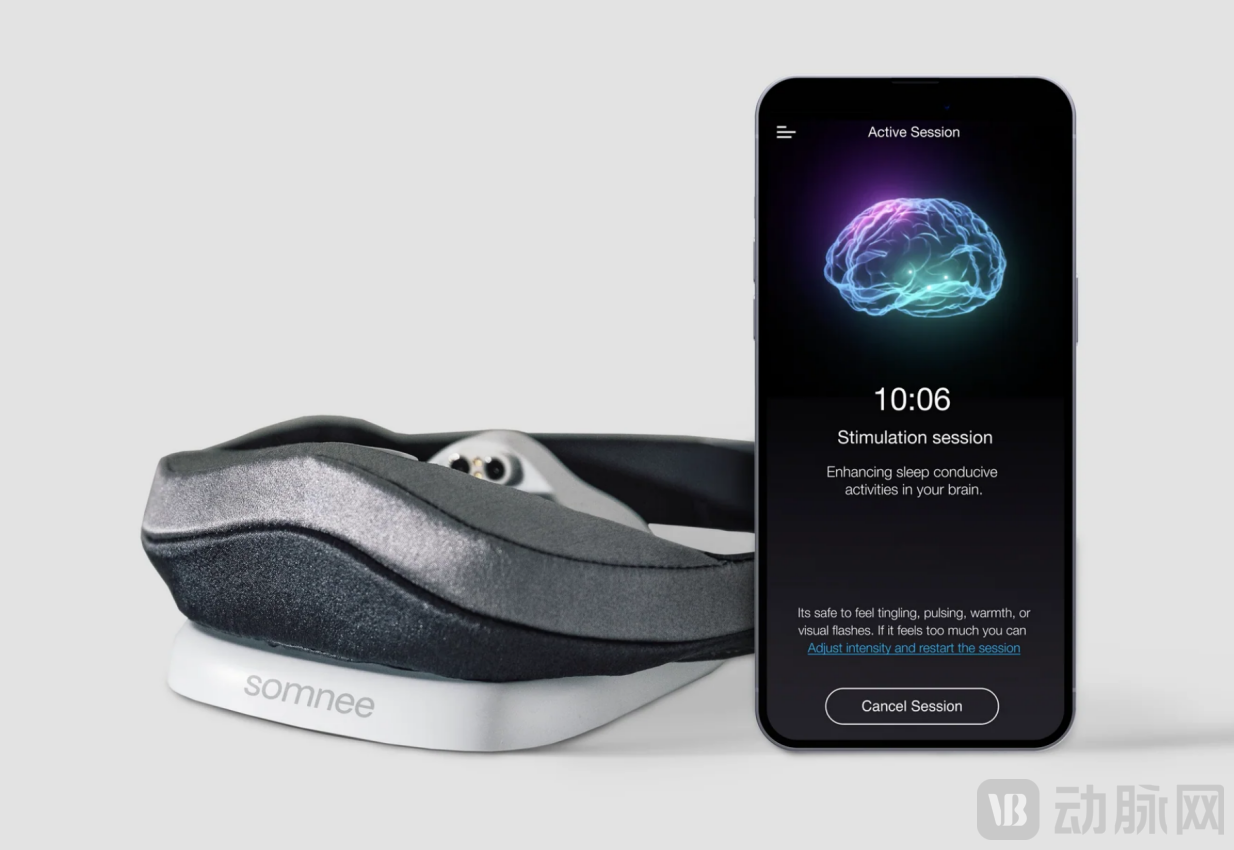
Somnee Sleep Headband and App Source: Somnee Official Website
Precise Brainwave Monitoring: Providing Precise Targets for Intervention.The Somnee headband features built-in, laboratory-grade EEG sensors that monitor users’ brainwave activity in real time to identify individual sleep patterns. As the gold standard for classifying different stages of human sleep, EEG offers the advantage of precisely capturing subtle changes in cerebral electrical activity, thereby providing accurate targets for gentle electrical stimulation interventions.
Personalized Non-Invasive Neurostimulation for Effective Improvement of Sleep Quality.Based on EEG monitoring data, the headband acquires brainwave signals and employs machine learning to generate personalized neurostimulation protocols. It utilizes transcranial electrical stimulation (tES) technology to deliver a gentle 15-minute intervention that guides users into natural sleep. Real-world usage studies have demonstrated that Somnee can learn users’ brain rhythms and sleep patterns to optimize sleep-promoting effects. In a controlled trial involving 55 participants and over 1,800 nights of data, this technology was proven to effectively improve sleep quality and accelerate sleep onset, offering both scientific rigor and non-invasive advantages.
Companion app for timely tracking of sleep data.The headband is accompanied by a powerful app that offers features such as sleep diaries, sleep readiness scores, and EEG waveforms. Users can also build long-term health profiles by answering daily questions about factors like sleep quality and anxiety levels. The app integrates sleep assessment methods designed by Dr. Matthew Walker to help users understand how their daily behaviors impact their sleep.
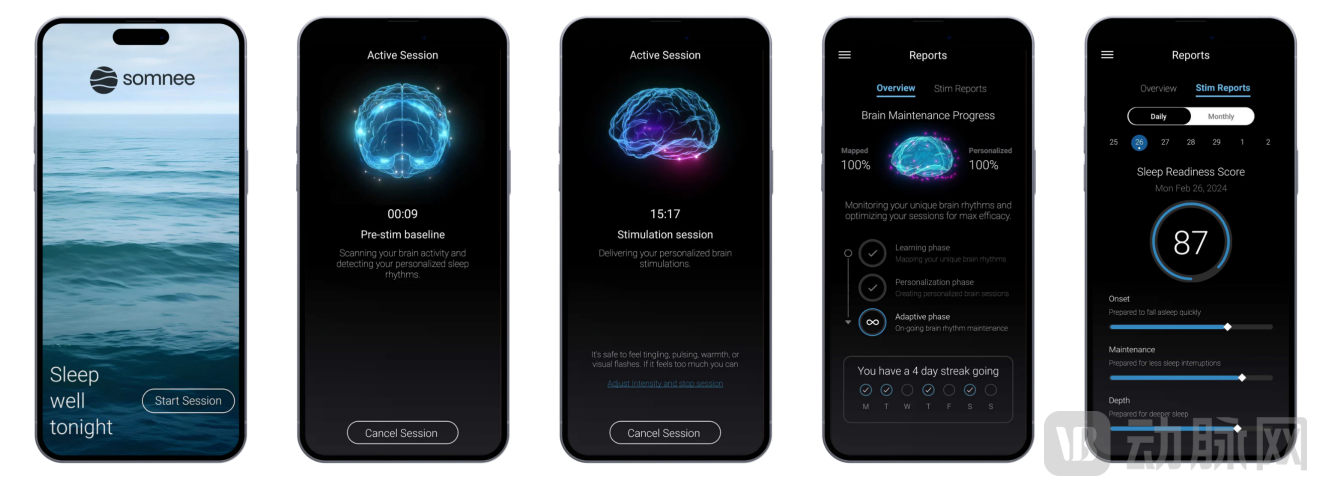 Somnee Companion App Feature Demo Source: Somnee Official Website
Research and testing featured on the official Somnee website indicate that the Somnee sleep headband is the only sleep aid that uses personalized stimulation to directly improve sleep quality. Users need only wear it for 15 minutes to halve their sleep onset latency, increase total sleep time by more than 30 minutes, and reduce nighttime awakenings or body movements by one-third. It demonstrates significant efficacy in improving sleep efficiency and duration, outperforming melatonin, cognitive behavioral therapy for insomnia (CBT-I), and hypnotic medications.
To date, Somnee has conducted over three years of sleep research at the Advanced Sleep Laboratory in Berkeley, California, and has carried out home-based pilot studies, collecting data from more than 1,500 nights. These sleep studies and pilots were blinded, controlled trials, overseen by a Scientific Advisory Board and approved by an independent Institutional Review Board (IRB). The experiments utilized laboratory-grade EEG and EKG systems to record sleep activity, with data scored by certified polysomnographic technologists following standard medical sleep laboratory protocols.
Experimental data demonstrate the efficacy of Somnee in improving sleep efficiency and duration. In recent sleep laboratory studies (n=31) and real-world studies (n=55), comparisons between Somnee’s effects and published experimental results for melatonin revealed that Somnee is four times as effective as melatonin pills.
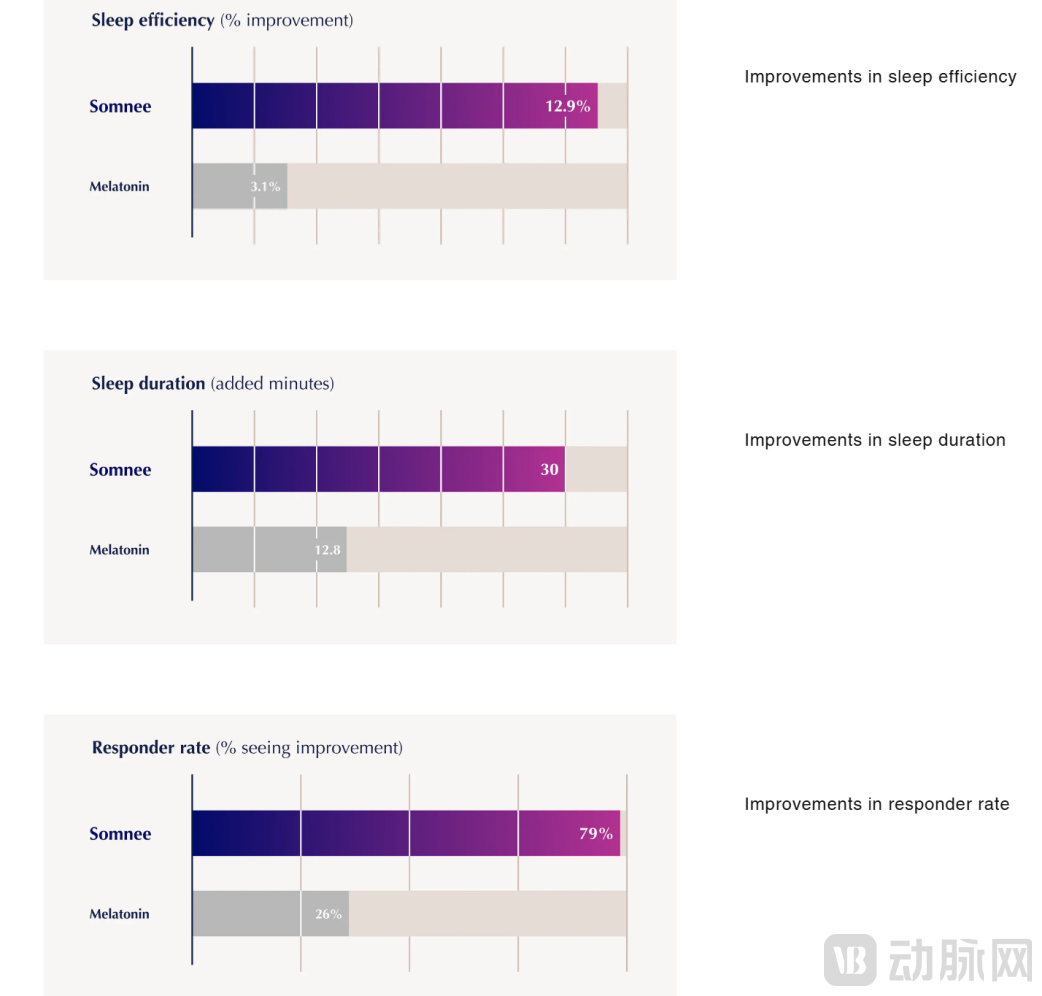
Comparison of Somnee’s Effects with Melatonin Experimental Data Source: Somnee Official Website
Currently, Somnee’s proprietary technologies have secured 24 patents, further solidifying its innovative standing in the sleep technology sector. Moreover, Somnee products have garnered numerous accolades, including GQ’s “Best Sleep Tech of 2024,” Fast Company’s “Next Big Thing in Tech 2024,” and Men’s Journal’s “Best Sleep Aid Product of 2025.” The brand has also been selected for the NBA 2025 Innovation Program, underscoring growing market recognition of its technological prowess.
3From Basic Detection to Medical-Grade Intervention, Domestic Wearable Devices Accelerate Their Expansion in the Sleep Sector
Since entering the consumer market in 2010, wearable devices have become deeply integrated into modern life. In the field of sleep health, these devices have become a focal point for the industry, as they enable continuous, quantitative monitoring of sleep states in natural settings without the need for cumbersome professional procedures.
Somnee, with AI-driven neurotechnology at its core, is providing a scientific alternative to traditional sleep aids through closed-loop neural stimulation solutions, driving the sleep economy toward precision. Furthermore, it is extending its technology to broader neurological health scenarios, such as anxiety relief and cognitive enhancement.
Meanwhile, domestic companies are also actively engaging in the research and development of wearable devices for sleep applications.
Lifesense’s Health Watch H1 smartwatch, along with the Mambo HR5 and M6 smart bands, leverage heart rate monitoring technology to enable real-time sleep tracking. The accompanying “Lifesense Health” app provides users with analytical data such as sleep scores and trends, facilitating a comprehensive understanding of their sleep status. Rouling Technology focuses on applying brain-computer interface (BCI) technology in the field of sleep, aiming to popularize sleep monitoring and intervention products for households through miniaturized and flexible devices.
Huawei Health has been active in the sleep domain since 2016 and has now established a comprehensive, closed-loop service integrating sleep monitoring, analytical assessment, risk screening, and management improvement. The Huawei Watch GT2 Pro ECG edition became Huawei’s first smart wearable device to obtain a Class II Medical Device Registration Certificate from the National Medical Products Administration (NMPA). Additionally, the sleep apnea risk screening feature of the Huawei Band series (models 9 and 10) has also received NMPA Class II medical device certification, enabling effective screening.
It is evident that domestic enterprises are making significant strides across multiple fronts in the field of wearable sleep technology. They are transitioning from basic sleep monitoring to comprehensive sleep health management, and evolving from hardware-centric features to integrated software services, thereby holistically addressing the diverse sleep health needs of various user groups.
In the future, as global wearable devices achieve breakthroughs in battery life, algorithms, and the integration of professional services, Chinese enterprises will leverage localized scenario-based innovation and technological iteration to accelerate their presence in the sleep health management sector, potentially establishing comprehensive, ecosystem-driven solutions that span home, medical, and sports settings.