2025 Cell Therapy Drug Innovation Development Forum: A Must-Attend Event for Industry, Academia, Research, and Investment Leaders
With technological advancements and the expansion of clinical applications, the cell therapy industry is entering a phase of rapid development, emerging as one of the most promising and dynamic frontier sectors today. Data from Qichacha shows that over the past decade (2014–2023), the number of newly registered cell therapy-related enterprises in China has increased year by year, reaching a cumulative total of 33,000 in 2023—the highest annual increment in the past ten years. The capital market is equally vibrant: according to MedTracker, there were 53 financing events in China’s cell therapy industry in 2024, with total funding exceeding RMB 3.5 billion, making immune cell therapies and stem cell therapies hot investment targets. Policy signals are also positive; in July, regulatory authorities released the “Technical Guidelines for Pharmaceutical Change Research and Evaluation of Cell Therapy Products (Draft for Comment),” a significant policy initiative.
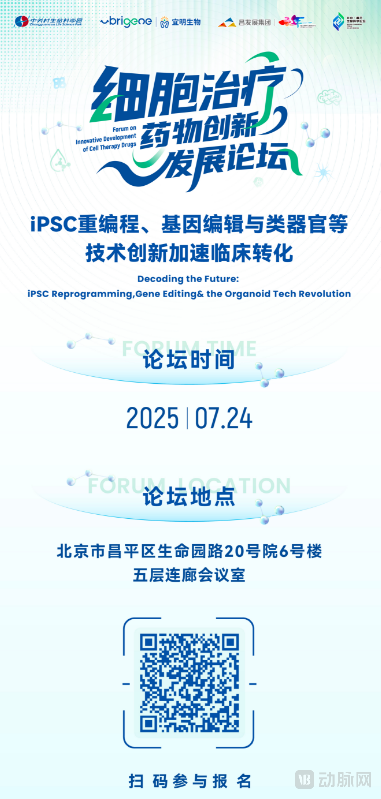
At a golden juncture marked by the resonance of industry, capital, and policy, the “2025 Cell Therapy Drug Innovation Development Forum” has emerged and will be grandly held in Beijing on July 24. Supported by the Administrative Committee of Future Science City (Life Science Park Administrative Committee), the forum is jointly organized by Beijing Zhongguancun Life Science Park Development Co., Ltd., Beijing Changping Science and Technology Park Development Group Co., Ltd., and ImmuneOnco (Beijing) Biopharmaceuticals Co., Ltd. Themed “Technological Innovations Such as iPSC Reprogramming, Gene Editing, and Organoids Accelerating Clinical Translation,” the forum will focus on frontier technologies including iPSC reprogramming, gene editing, and organoids, exploring ways to overcome R&D bottlenecks and accelerate clinical translation.
“Industry-Academia-Research-Investment” Panoramic Coverage + “Immersive” Site Visits,
Achieving Synchronized Upgrading of Cognition, Resources, and Collaboration
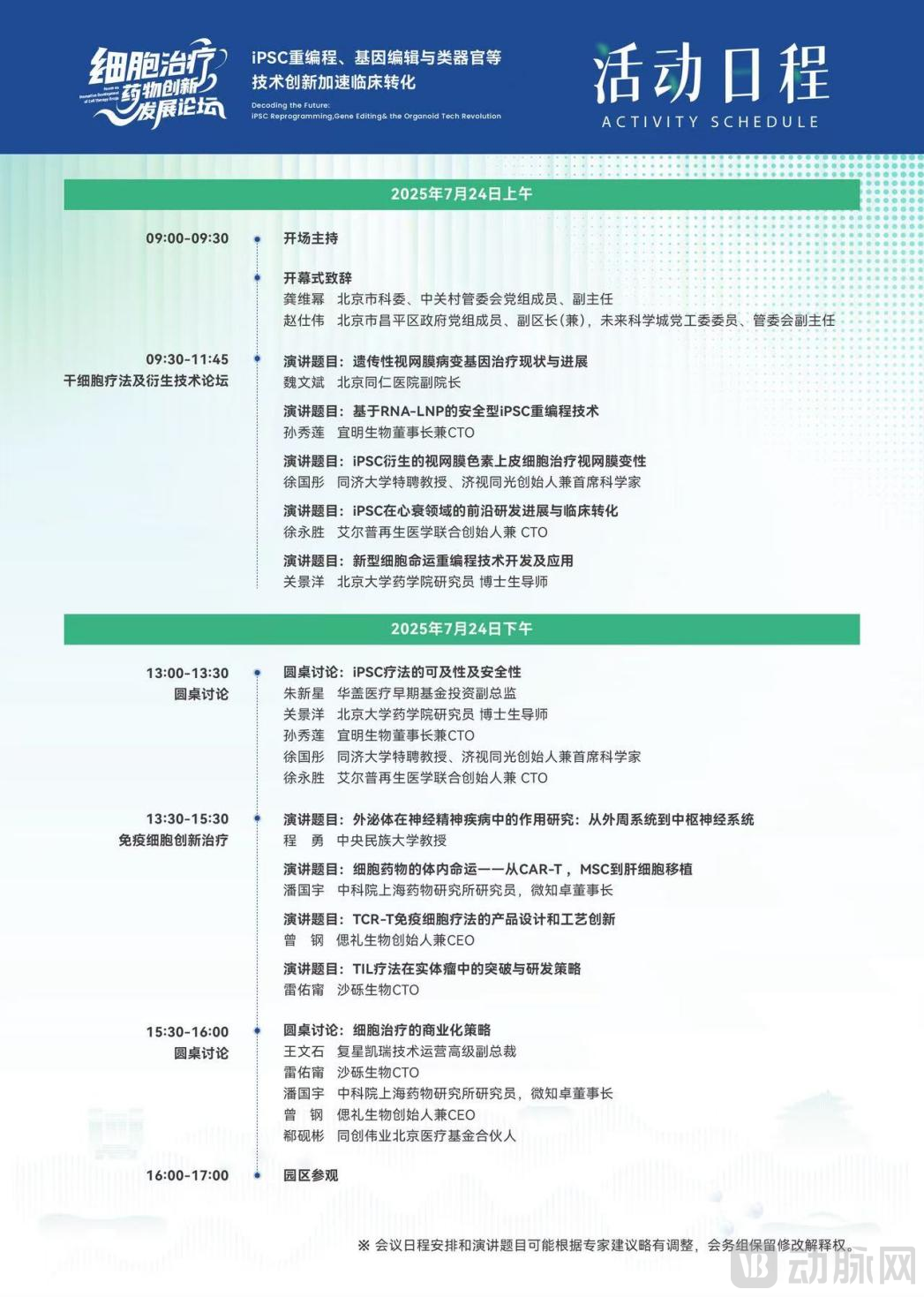
Centering on cutting-edge technologies such as cellular reprogramming, gene editing, and organoids, as well as industry topics including the accessibility, safety, and commercialization of cell therapy drugs, this forum brought together numerous distinguished scientists, clinical experts, investment institutions, and leading innovative enterprises. It delivered a substantive feast covering global frontier scientific advances, technology and applications, market investment, and product commercialization strategies for the cell therapy industry, thereby fostering in-depth exchange and collaboration among industry partners.
The forum features two sub-forums: the “Stem Cell Therapy and Derivative Technologies Forum” and the “Innovative Immunotherapy Forum.” It includes nine keynote speeches and two roundtable discussions, inviting executives from leading and innovative companies, experts and scholars from renowned hospitals and universities, and industry investors from authoritative institutions as keynote or roundtable panelists. They will explore hot-button issues and pain points in the cell therapy industry from diverse perspectives, conveying to attendees the innovative momentum driving industry development.Four Highlights of This Forum You Can’t Miss:
“Manufacturing” Industry Vanguards Reveal Product Design and Process Innovation:Currently, the cell therapy industry is at a critical juncture, transitioning from “technical validation” to “scale-up validation.” The sector has achieved milestone breakthroughs across three key dimensions: from hematologic malignancies to solid tumors, from autologous to universal (off-the-shelf) therapies, and from ex vivo to in vivo approaches. However, pressing challenges remain in product design and process innovation, cost control, and commercialization. To address these issues, leading industry practitioners will share practical insights at the forum, covering various subfields such as immune cell therapy and stem cell therapy, as well as different stages of Chemistry, Manufacturing, and Controls (CMC).
“Academic” Titans Directly Address the Development and Application of Innovative Technologies:In recent years, research groups at leading Chinese universities have achieved successive breakthroughs in hot fields such as chemically reprogrammed induced pluripotent stem cells (iPSCs), in vivo CAR-T therapy, and in situ neural regeneration. For example, Guan Jingyang, an Associate Research Fellow at the School of Pharmaceutical Sciences, Peking University, and a featured speaker at the forum, has published papers as first or co-first author in prestigious journals including Science, Cell, and Nature. He established a technology for chemical reprogramming to induce human pluripotent stem cells, providing a novel approach for their preparation. The chemical reprogramming technology he focuses on offers advantages over traditional reprogramming methods, including greater safety, simplicity, flexibility, and controllability, and is emerging as a highly promising new direction in the field of cell fate regulation.
Former R&D Experts Share Current Status and Progress in Treatment:Cell therapy R&D in research institutes and at the clinical frontline is currently in a critical window where “technical validation” intersects with “regulatory validation.” During this period, researchers and clinical experts must work closely together, aligning product translation efforts with the most authentic needs of clinical patients, to rapidly bridge the gap from the laboratory to Investigator-Initiated Trials (IITs) and deliver safe and effective products to patients. At this forum, clinicians from top-tier tertiary hospitals and scientific experts from leading research institutions will gather to share the latest findings and practical experiences in basic research and clinical translation of cell therapy drugs.
“Investors” Analyze the Accessibility and Commercialization of Cell Therapy:While biopharmaceutical investment faces a chill, the cell therapy sector is igniting a fervor of capital. Since 2025, more than ten financing and M&A transactions have occurred in China’s cell therapy field, with substantial funds flowing into niche segments such as iPSCs and CAR-T therapies, driven by simultaneous breakthroughs in clinical development and commercialization. This industry boom is no accident but the inevitable outcome of accumulated advancements in policy, technology, clinical practice, and capital. However, pain points remain in establishing closed-loop commercial models and securing clinical reimbursement. How can we bridge this “last mile”? This forum will feature cross-disciplinary dialogues among top domestic investors, scientists, and entrepreneurs, aiming to help the industry overcome challenges in translation and commercialization, thereby fostering a virtuous cycle and sustainable development of the industrial ecosystem.
Through the full industry chain of “production, academia, research, and investment,” along with personal insights and cross-disciplinary exchanges from experts across various fields, this forum will present to attendees a comprehensive feast covering the entire lifecycle of cell therapy—from basic research, technology development, and clinical trials to industrial translation, market access, capital operations, and global expansion.
Furthermore, following the forum, attendees will have the opportunity to engage in an “immersive” visit to the Beijing Zhongguancun Life Science Park. As a key pillar of the “Three Cities and One District” master platform for Beijing’s International Science and Technology Innovation Center, the Park bears the significant responsibility of building Beijing into a science and technology innovation hub and a source of original innovations in the life sciences. Leveraging the development of the “Two Zones” and the construction of Changping’s National Key Laboratories, the Park further enriches the aggregation of industrial elements, enhances independent innovation capabilities, and strives to create a “Life Valley” representing world-class standards, continuously delivering breakthrough scientific discoveries and cutting-edge technologies in the life sciences. By personally experiencing the top-tier research and industrialization ecosystem in China’s life sciences sector, attendees will achieve a simultaneous elevation in their understanding, resources, and collaborative opportunities.
Dual-Engine Drive by Cutting-Edge Industrial Technologies and Premier Park Resources,
Empowering the High-Quality Development of Cell Therapy
This forum focuses on cutting-edge technologies such as iPSC reprogramming, gene editing, and organoids, aiming to provide viable pathways for overcoming R&D bottlenecks in cell therapy and facilitating clinical translation.Taking iPSC reprogramming technology as an example, this technique endows ordinary somatic cells with differentiation capacity and unlimited potential similar to those of embryonic stem cells, serving as the foundation for advancements in disease model construction, drug development and screening, and cell therapy. Therefore, a deep understanding of the iPSC reprogramming process is crucial. Currently, reprogramming technologies primarily introduce transcription factors into somatic cells via viral transduction or non-viral delivery methods; however, neither approach can simultaneously achieve optimal safety and reprogramming efficiency, thereby hindering their widespread adoption.
Is there a technology that can achieve both safety and efficiency? At this forum, YiMing Bio will present its RNA-LNP reprogramming technology to provide the answer.It is reported that ImmuneOnco has developed an iPSC Reprogramming RNA-LNP Cocktail Kit based on RNA-LNP technology. This product achieves high-efficiency reprogramming of various cell types, including fibroblasts and peripheral blood mononuclear cells (PBMCs), through a non-plasmid, non-viral vector system, with PBMC reprogramming efficiency reaching up to 0.31%. By avoiding the genomic integration risks associated with traditional plasmid and viral vectors, it provides key technical support for the standardized production of stem cell therapies, making autologous iPSC-based cell drugs feasible.
In addition to niche cutting-edge technologies, cell therapy as a whole is also considered a frontier sector within the biopharmaceutical industry. On one hand, frontier industries such as cell therapy represent opportunities and blue-ocean markets. On the other hand, these blue-ocean markets come with challenges and difficulties.Zhongguancun Life Science Park, the organizer of this event, has extensive experience in addressing the challenges faced by these cutting-edge industries.
In terms of the industrial ecosystem, after 20 years of exploration and development, Zhongguancun Life Science Park has been established as one of the parks with the most concentrated innovation resources in China's life sciences sector. It has formed a complete industrial chain centered on basic research, encompassing R&D pilot testing, production and distribution, and clinical applications, thereby providing comprehensive industrial services to enterprises located within the park.
In terms of policy support, Zhongguancun Life Science Park stands as a highland for the development of the pharmaceutical and health industries, benefiting from the convergence of four national-level functional zones: the Zhongguancun National Independent Innovation Demonstration Zone, the National Comprehensive Demonstration Zone for Expanding the Opening-up of the Service Sector, the Pilot Free Trade Zone, and the Core Area of Beijing’s High-Level Talent Hub. The park has successively established the Medical Device Innovation Service Station under the Center for Medical Device Evaluation of the National Medical Products Administration (NMPA) and the Beijing Pharmaceutical and Medical Device Innovation Service Station. By securing various policy pilots, it provides enterprises with comprehensive financial support across the entire value chain, spanning from clinical research to market approval, and from industrialization to global market expansion.
The advancement of the industry relies on the support of every innovative enterprise and participant. We hereby cordially invite all peers in the life and health industry to join us in Changping, Beijing, on July 24 for the “2025 Forum on Innovative Development of Cell Therapy Drugs,” working together to propel the development of the cell therapy industry.