

Healthcare Giants Leverage C2M Reverse Customization for Instant Product Success
In recent years, a wide range of health and wellness products—including medical devices, over-the-counter (OTC) drugs, and nutritional supplements—have partnered with e-commerce platforms to develop C2M (Customer-to-Manufacturer) reverse-customized products. This approach leverages real-time, multi-dimensional user behavior data from the platforms, such as searches, browsing history, reviews, orders, and repeat purchases, to accurately ascertain consumer needs, identify market gaps, and conduct more targeted product development.
To date, numerous companies—including Yuwell Medical, Intco Medical, Cofoe Medical, Zhende Medical, By-Health, and Haleon—have partnered with mainstream e-commerce platforms to explore the C2M (Consumer-to-Manufacturer) model. By addressing gaps in usage scenarios and sales channels, these companies have launched customized products that have achieved impressive sales figures. For instance, one innovative line of nursing supplies generated RMB 1 million in transaction volume on its first day of launch, significantly driving revenue growth for other products within the same store.
This deep collaboration model is empowering healthcare enterprises to more precisely and agilely grasp user needs, optimize product development pathways, and achieve efficient supply-demand matching.
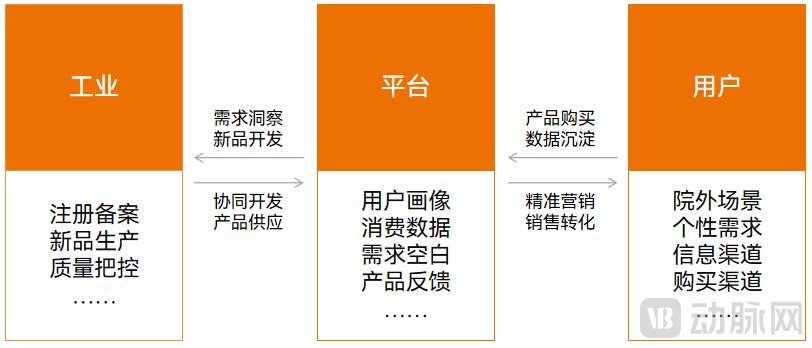
C2M Reverse Customization Model for Medical and Health Products
Developing and marketing products based on market demand is a fundamental principle of the marketplace. However, compared with the traditional model of R&D and mass production, the C2M (Consumer-to-Manufacturer) reverse customization model offers numerous advantages. By leveraging digital platforms, C2M reverse customization channels dispersed, personalized consumer demands directly to the production side, enabling precise matching between aggregated demand and manufacturing capacity. This model incorporates consumer demand as a factor of production into the manufacturing process, thereby optimizing the allocation of production factors and driving product manufacturing toward greater personalization and customization.
Over the past decade, C2M (Consumer-to-Manufacturer) reverse customization has achieved large-scale application in sectors such as apparel, home furnishings, and electronics, with leading e-commerce platforms accumulating extensive experience in this process.With the rapid development of pharmaceutical e-commerce, this model has gradually penetrated into the consumer market for medical and health products, driven by several underlying imperatives.
First, a portion of the in-hospital market is accelerating its shift to out-of-hospital channels, and the consumerization of medical products has become an irreversible trend. In this process, the success of one product may trigger rapid follow-up across the entire sector, leading to intensified homogeneous competition and escalating price wars.In such circumstances, profit margins will be squeezed not only for upstream manufacturers but also for other stakeholders across the industry chain.
Taking medical devices as an example, after several leading medical aesthetics raw material companies popularized medical device-grade dressings (i.e., “mechanical-certified masks”), a large number of Class II or Class I dressing products centered on concepts such as hyaluronic acid and recombinant collagen emerged within just two to three years. To date, numerous similar products have been approved for market launch, with prices having dropped from over RMB 50 per box to around RMB 20 per box (5 pieces) due to intense competition.
Other highly competitive segments also include health supplements and personal protective equipment (PPE). As Zhende Medical pointed out in its annual report, the medical device manufacturing industry still lacks characteristics of large-scale and intensive production, with low market concentration. Product quality for the same type of devices varies significantly, and the issue of low-level redundant production is prominent.
Secondly, pharmaceutical e-commerce platforms have accumulated massive amounts of data on both the supply and demand sides during their rapid development. These data are sufficient to support precise insights into consumer needs and scientific control over product customization.
Yu Lanqi, head of the medical nursing category at JD Health’s Medical Devices Business Unit, told VCBeat that when formulating its C2M (Consumer-to-Manufacturer) strategy, the platform primarily draws on data across several key dimensions: price ranges and gaps in product distribution within the existing supply, user purchasing behaviors and preferences, as well as user feedback and complaints regarding current products.
Meanwhile, new models such as interest-based e-commerce, content marketing, and live-streaming commerce have rapidly emerged, further streamlining the channels for capturing user needs and consumer decision-making data, thereby making demand insights more efficient and precise.
Third, it is precisely by leveraging big data to gain deep insights into user needs that unmet personalized demands, as well as the common needs of certain niche groups, have gradually come to light.
Ding Zhaoliang (Danggui), Founder and CEO of Knowledge Matrix, believes that new media can precisely reach clearly defined niche audiences with specific needs, rapidly capturing their core demands for products. “For instance, while both post-cesarean section patients and post-thyroidectomy patients use scar sheets, their needs differ significantly. The former’s scars are typically covered by clothing, so their primary concern is the efficacy of scar repair; in contrast, the latter’s scars are exposed, leading to high demands for the ‘thinness’ and ‘invisibility’ of the scar sheets.”
As personalized consumer demand becomes mainstream, market logic has gradually shifted from being manufacturer-centric to consumer-centric, which serves as a key prerequisite for the emergence of the C2M model in the healthcare product sector.
In the vast out-of-hospital market, users’ scenarios for utilizing medical and health products are highly diverse, with their personalized needs stemming precisely from these varied contexts. Therefore, scenario-based reverse customization has become the key to the C2M (Consumer-to-Manufacturer) model.
Ding Zhaoliang (Danggui) pointed out that many companies still rely on traditional market research methods during product development and market positioning, often yielding suboptimal results. The root cause lies in their continued focus on delivering medical solutions and prioritizing the technical feasibility of products, while overlooking the actual scenarios in which users engage with these products.
Home-based health is the most prevalent scenario for the use of general health products and a major battleground for reverse customization.
It is understood that in recent years, JD Health has collaborated with numerous medical and healthcare brands to promote C2M (Consumer-to-Manufacturer) reverse customization of products such as medical devices, common pharmaceuticals, and nutritional supplements. Taking home care scenarios as an example, JD Health partnered with Shinva Medical to “adapt” sterilizers originally designed for operating room sterilization by lowering sterilization parameters and reducing product size to make them suitable for household use, thereby meeting the needs of long-term bedridden elderly individuals. As medical gloves entered the household market, more personalized demands emerged. In response, JD Health collaborated with Intco Medical to launch pearlescent medical gloves suitable for young women, large-pack food-grade gloves for household staple use, and is currently preparing to introduce children’s gloves.
The core principle behind these products is to drive the penetration of medical-grade devices into home settings. Beyond the home environment, consumer lifestyle scenarios also harbor segmented demands for health and medical products.
Dining and entertainment scenarios are also strongly correlated with medical and health products.
In fitness and exercise scenarios, continuous glucose monitors (CGMs) are a typical case.As product availability expands and market penetration increases, continuous glucose monitoring (CGM) is no longer the “exclusive” domain of patients with diabetes. A growing number of individuals focused on weight loss, fitness, and other health goals are adopting CGM devices to monitor blood glucose levels and exercise-related metrics. According to the *Blue Book on Characteristics of Continuous Glucose Monitoring Data from 70,000 Chinese Individuals*, released in 2024 by VCBeat’s VBInsight, approximately 20.1% of CGM users in the report’s sample were non-diabetic individuals.
“From the perspectives of product design and marketing strategies, existing continuous glucose monitors (CGMs) remain focused solely on individuals with diabetes. To address the needs of non-diabetic populations in areas such as weight management and exercise, should CGM manufacturers consider launching a ‘sports edition’—featuring a more stylish design and integrating blood glucose monitoring with heart rate tracking? This is a direction worth considering,” stated Ding Zhaoliang (Danggui). Similarly, while most electrocardiogram (ECG) products currently target patients, there is untapped potential to explore how ECG monitoring can enhance athletic performance in scenarios such as cycling and marathons when viewed through a consumer lens. Evidently, a consumer-centric approach aligns more closely with the scenario-specific needs of particular population groups, rather than focusing exclusively on the technology itself.
Another example is the travel scenario.In analyzing the health needs of travelers, Meituan Medicine and Health found that medications for colds, gastrointestinal issues, and heatstroke are highly relevant to travel scenarios. During the May Day holiday, Meituan Medicine and Health partnered with 999 to launch related products, including a bundled package of four travel-relevant medications: Ganmaoling, Sanjiu Weitai, Huoxiang Zhengqi, and Piyanping. This bundle attracted users with discounted pricing and convenient purchasing options. Additionally, a small-pack format of ibuprofen sustained-release capsules (6 capsules per box) was introduced to meet medication needs during travel.
It can be said that the broader the range of consumer scenarios, the wider the coverage of medical and health products.The state’s active promotion of consumption stimulus, support for innovation in service consumption scenarios and business format integration, deepening of cross-sector consumption integration across online-offline channels and commerce-tourism-culture-sports-health sectors, and creation of diversified consumption scenarios all provide broad opportunities for the scenario-based penetration of medical and health products.
The core of reverse customization lies in upgrading, iterating, or segmenting product functionalities, and even developing entirely new products based on specific demands.
Post-pandemic, face masks have become a staple in daily life, yet the industry faces challenges of overall overcapacity and the need for further optimization of supply-demand matching. Beyond conventional disposable medical masks, demand has begun to diverge among different population groups.
Yu Lanqi cited the example of JD Health’s collaboration with Chaoya Group in 2025 to launch “low-resistance breathable masks.” JD Health led product functional design, packaging and specification design, and cost accounting, while Chaoya Group manufactured the masks using “Cloud-Soft Fabric,” a hypoallergenic material with a skin-friendly texture, thereby addressing the pain points of traditional masks, namely inadequate breathability and high allergenic potential. Additionally, JD Health partnered with Winner Medical to introduce medical-grade sun-protection masks, catering to the protective and sun-blocking needs of specific populations in outdoor settings.
“Since certain healthcare products require registration or filing, adequate time must be allocated for these processes. Yu Lanqi noted that activities such as regulatory preparation, product development, and marketing promotion can be coordinated and advanced in parallel to minimize the overall customization cycle. ‘The key lies in efficient collaboration; this process is not as complex as it may seem.’”
Reverse customization aims to precisely meet user needs, with marketing and promotion strategies integrated throughout the process. Elements closely tied to marketing—such as product bundling, packaging design improvements, and branded merchandise—can also be considered part of the customization scope.
The four medication combination packs for the May Day travel scenario mentioned above are a typical example of product bundling. Similarly, JD Health and Cofoe Medical jointly launched the “All-in-One Mom Care Kit,” which combines thermometers, four types of test kits, fever-reducing patches, children’s masks, as well as children’s bandages and adhesive bandages, to meet the relatively high-frequency needs for pediatric viral protection and wound care.
Of course, this does not mean that forced bundling is a viable strategy; all product bundles must be grounded in extensive behavioral data showing that users frequently purchase multiple products together, ensuring they align with users’ actual needs.
Furthermore, in its marketing collaboration with Flonase, Meituan Medicine customized cream-infused tissues as promotional giveaways for rhinitis patients, thereby boosting product sales by enhancing user experience.
Customization that does not involve the product itself typically does not require regulatory registration or filing, enabling faster market entry. In an era where user novelty wears off rapidly, this agile pace of innovation is particularly critical.
Ding Zhaoliang (Danggui) believes that the supply-demand imbalance and information asymmetry in the current big health market remain prominent: on one hand, high-quality products from R&D-focused companies face sales challenges, with their application scenarios not yet fully explored; on the other hand, users have strong demands but struggle to find high-quality upstream products.
In the future, as stakeholder engagement in the industry grows, the product logic of the broader health sector will shift from “what companies can produce” to “what users need.” The value of the reverse customization model will become increasingly evident; it is not only a powerful tool for breaking through homogeneous competition and alleviating overcapacity but also a critical pathway for enhancing scenario-based fit and further expanding the out-of-hospital market.