

EndNodule: AI-Powered Lung Nodule Risk Assessment Mini-Program Files Prospectus
With the continuous advancement of medical imaging technology and the widespread adoption of CT scanners, an increasing number of residents are able to undergo lung cancer screening and prevention within their communities, naturally leading to a higher detection rate of pulmonary nodules.
Generally, pulmonary nodules detected in residents are mostly micronodules, with a diameter of less than or equal to 5 mm in lung tissue. Only a small proportion exhibit imaging features suggestive of early-stage lung cancer, while the vast majority are benign nodules.
Consensus guidelines such as the “Chinese Expert Consensus on the Diagnosis and Treatment of Pulmonary Nodules (2024 Edition)” recommend that micronodules can be managed with regular follow-up at primary care hospitals, without the need for additional intervention. However, for patients, a report indicating the presence of small pulmonary nodules invariably triggers fear. Concerned about a potential link to lung cancer, they anxiously consult specialists in hopes of gaining a clearer understanding of the diagnostic findings.
This phenomenon of “overutilization of medical services” not only affects patients’ physical and mental health but also, to some extent, strains already scarce medical resources.
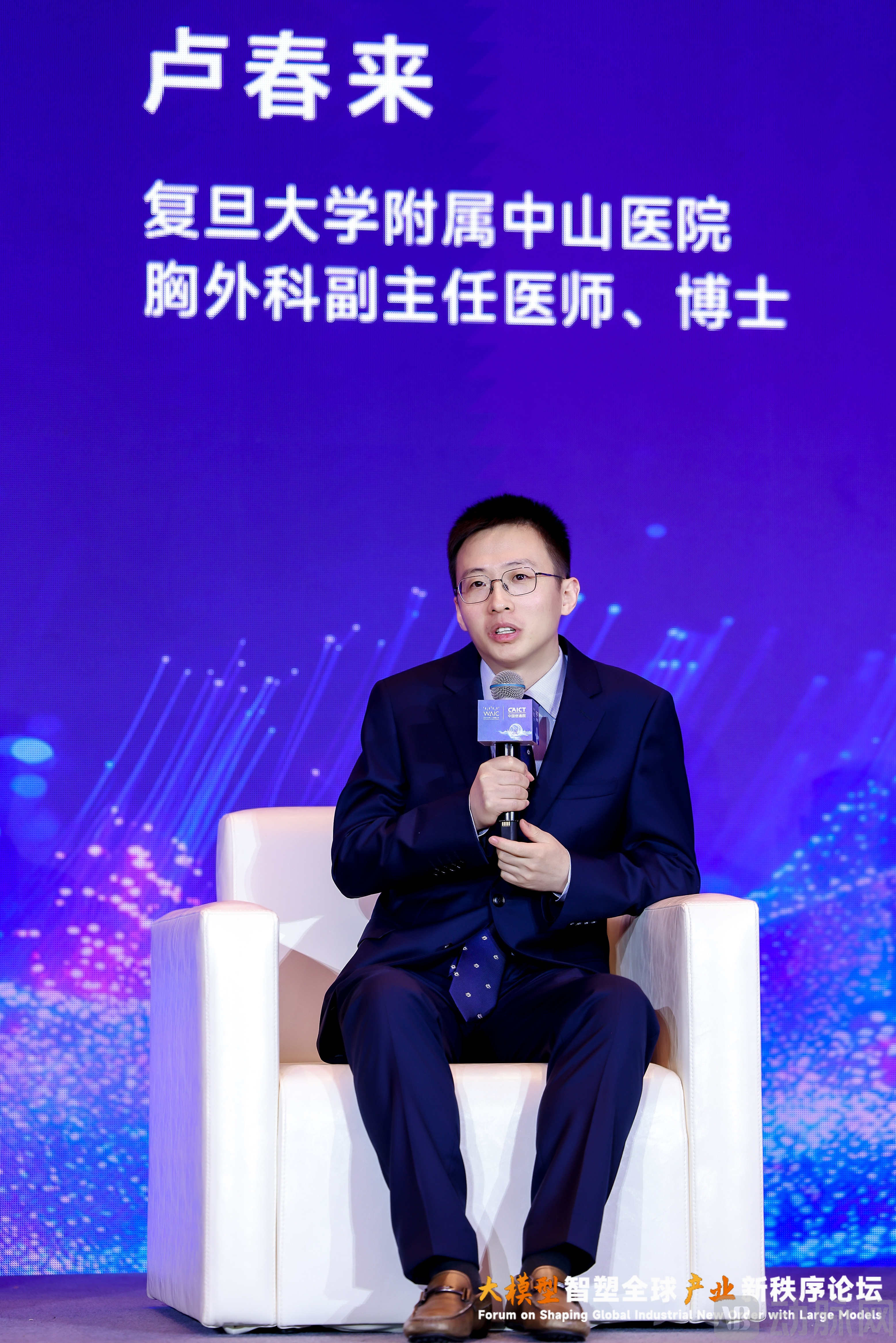
At the “2025 WAIC Forum on Large Models Reshaping the New Global Industrial Order,” hosted by the China Academy of Information and Communications Technology (CAICT), Lu Chunlai shared the development philosophy behind “Zhongjiezhe” — enabling technology to truly address problems from the patient’s perspective.
“In our era, the internet is highly developed, and patients who receive their reports often search online for ways to interpret them. If they consult us doctors, we can provide clear answers and reassure them to follow up regularly. However, more often than not, the popular science platforms and large language models that patients turn to cannot accurately interpret the reports. Out of caution, these tools list various possibilities for pulmonary nodules, which not only fails to address patients’ concerns but also exacerbates their anxiety, compelling them to seek medical consultations at hospitals.”Lu Chunlai, Associate Chief Physician, Department of Thoracic Surgery, Zhongshan Hospital Affiliated to Fudan UniversityTell VCBeat.
“In my outpatient clinic, I typically see around 60 patients in a morning session, yet fewer than 10 truly require medical intervention. Many patients who genuinely need treatment struggle to secure timely appointments. Medical resources in China remain relatively scarce; we aim to allocate these limited resources precisely to patients in urgent need of treatment, thereby maximizing the value of healthcare resources.”
To address the aforementioned issues, Lu Chunlai led his team in developing an AI tool for pulmonary nodule detection called “Nodule Terminator.”It can automatically identify keywords in CT reports that describe pulmonary nodules as high-risk or low-risk, thereby assessing the risk level of the pulmonary nodules.
During the 2025 World Artificial Intelligence Conference, Lu Chunlai publicly demonstrated the use of “Nodule Terminator.” The tool is extremely lightweight and accessible via a mini-program. Users need only upload examination reports captured with their smartphones, and the AI can assess the risk level of nodules within 10 seconds, advising patients whether to “seek medical attention promptly” or “undergo regular follow-up.”
“Currently, the application of AI in medical imaging is focused on the physician side, assisting doctors in delineating and diagnosing pulmonary nodules. However, few companies are willing to provide such services directly to patients,” said Lu Chunlai. “Our team hopes to leverage this tool to deliver authoritative results for patients eager for confirmation, thereby alleviating their unease and anxiety. At the same time, this process will optimize the allocation of outpatient resources, enabling patients with pulmonary nodules requiring intervention to receive timely treatment.”
Since the rise of DeepSeek at the beginning of this year, which has empowered domestic hospitals with capabilities for localized deployment and model customization, a plethora of tools have emerged. These tools enable physicians to participate in model development, driving AI applications from triage and consultation toward serious medical practice.
Nevertheless, developing a specialty-specific application remains challenging. Every developer must confront the hurdles of cleaning and organizing data, algorithms, and medical knowledge, as well as establishing complex mapping relationships.
Lu Chunlai told VCBeat, “Our initial demo had very low accuracy. Due to regional disparities in medical education, the terminology used in many reports is not strictly standardized. For instance, some physicians use the term ‘ground-glass nodule,’ while others use ‘ground-glass-like nodule.’ Additionally, while millimeters are commonly used to measure the diameter of pulmonary nodules, some hospitals are accustomed to using centimeters.”
To address these issues and enable “Zhongjiezhe” to interpret imaging reports from across China, Lu Chunlai and his team have been optimizing knowledge graphs with curated corpora while simultaneously collecting pulmonary nodule reports from hospitals nationwide for clinical validation.
In the ongoing clinical studies, the research team plans to enroll a total of 500 patients from multiple centers, categorize these samples into low-risk and high-risk groups, and upload them to the mini-program for validation. Current interim study results show that,“Zhongjiezhe” demonstrates a test accuracy of approximately 95%. We look forward to the final study results, which will provide a scientific basis for the clinical implementation of “Zhongjiezhe.”。
Even so, Lu Chunlai’s team continues to optimize the capabilities of “Zhongjiezhe.”
“In the next step, we will continue to optimize the ‘Zhongjiezhe’ system’s ability to accurately identify pulmonary nodules in reports. Attentive patients may notice that a chest CT report often includes descriptions and diagnoses of other organs, such as hepatic cysts or heterogeneous thyroid density. Such information can interfere with the logic of AI algorithms. We aim to eliminate these confounding factors to further enhance model performance,” said Lu Chunlai.
“No physician can identify a patient’s disease with 100% certainty, but we aim to bring this probability as close to 1 as possible through data accumulation and algorithm optimization.”"Strive to miss no positive cases, while imposing no additional burden on negative ones."
Lu Chunlai said, “As I often say, ‘The warmth of technology means that life does not have to wander in data.“‘The Final Chapter’ calculates risk scores, but what I truly aim to do is ensure that when patients face cold, impersonal reports, they can feel that ‘someone understands your anxiety and is working on solutions for you.’”