

2025 National Smart Medical Insurance Innovation Competition Launches with Expanded Access to De-identified Data
By Wu Yinggang and intern He Duo
On the morning of August 1, the National Healthcare Security Administration held a press conference to announce the launch of the 2025 National Smart Healthcare Insurance Competition. Themed “Inviting Talents from All Quarters to Empower Pharmaceutical Innovation with Intelligence,” the competition is hosted by the National Healthcare Security Administration and the Shanghai Municipal People’s Government, with co-organization from the healthcare security administrations of Jiangsu, Zhejiang, and Anhui provinces. The event will span three months, with the finals scheduled to take place in Shanghai in October.
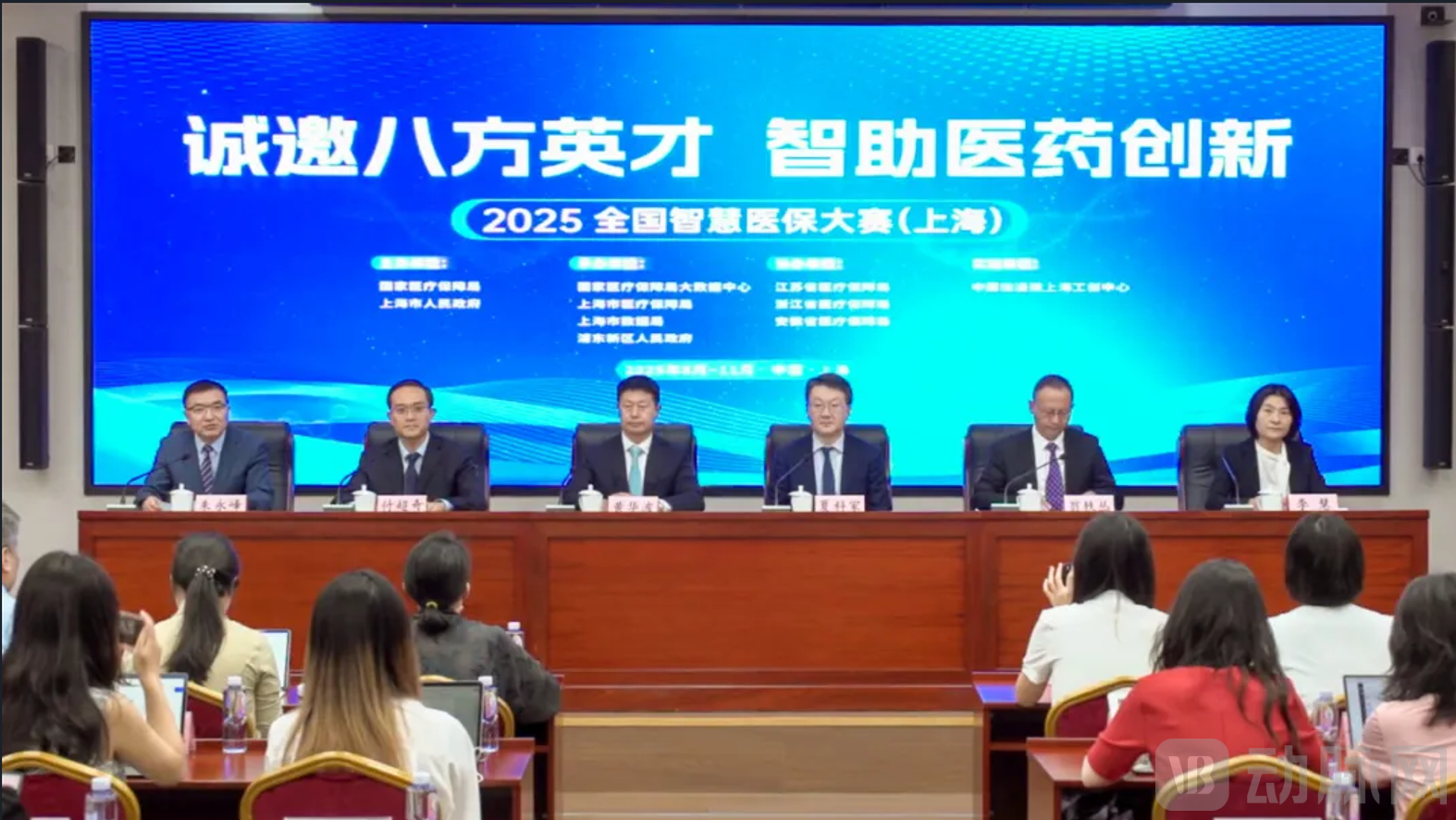
The competition is hosted by the Big Data Center of the National Healthcare Security Administration, the Shanghai Municipal Healthcare Security Administration, the Shanghai Municipal Data Bureau, and the People’s Government of Pudong New Area. Huang Huabo, Deputy Director of the National Healthcare Security Administration, stated that this year’s competition has eliminated traditional track categories for the first time. It is open to eleven participating fields, including innovative drug development, post-marketing real-world studies, comprehensive value assessment of pharmaceuticals and medical devices, healthcare, financial insurance and platform economy, government services, academic research, healthcare security operational services, intelligent supervision of healthcare security, long-term care insurance, livelihood service assurance, network and data security, and other areas that innovatively expand the empowerment of healthcare security data.
This competition encourages active team-based participation from a wide range of institutions, including government departments at all levels (such as healthcare security administrations), centralized drug and consumable procurement agencies, designated medical and pharmaceutical institutions, enterprises, universities, research institutes, and academic associations. Both projects that have not yet been implemented and those already in operation are eligible to compete.
According to the official competition website, participating teams must register via the website by 17:00 on August 31, 2025. Teams whose registration applications are approved must submit all preliminary round materials, including a PDF document introducing the project and scanned copies of the project authorization letter, and complete the online project summary form by 17:00 on September 11, 2025.
The organizers will conduct the preliminary review within a specified period after the submission deadline for preliminary materials. A certain number of projects will be selected in each field according to a predetermined ratio. All projects that pass the public notice stage of the preliminary round will advance to the finals.
The finals consist of two stages. The first is the on-site deployment stage. The organizers will provide a centralized workspace along with the necessary hardware and software infrastructure. Finalist teams are required to enter the centralized workspace 20 days in advance to carry out data integration, system deployment, and practical operations. The second stage is the evaluation phase. All finalist teams will conduct on-site demonstrations and defend their projects before the judges.
The final round is not divided by track; first, second, and third prizes will be awarded to a number of participants based on their scores in descending order, while all other finalists will receive the Excellence Award.
Xia Kejia, Party Secretary and Director of the Shanghai Municipal Healthcare Security Administration, stated that unprecedentedly rich de-identified data would be provided to participating teams. This initiative aims to further unlock the potential for the development and utilization of healthcare security data, address the shortage of real-world data in previous studies, and promote integrated research collaboration in areas such as medical data across the Yangtze River Delta region. The dataset includes: de-identified public data from Shanghai’s healthcare security system and selected non-healthcare-security sectors; and de-identified healthcare security data from one prefecture-level city each in Jiangsu, Zhejiang, and Anhui provinces within the Yangtze River Delta.
Meanwhile, the richness of the database once again validates this pioneering approach of forgoing traditional tracks in favor of thematic domains, aiming to encourage cross-industry and cross-sector integrated innovation.
In response to public concerns over data security, Shanghai has announced that it will strengthen local self-supervision under strict national oversight. By implementing multi-layered safeguards across institutional, technical, and managerial dimensions, the city aims to ensure that de-identified data remains usable but non-transferable, does not involve personal privacy, and guarantees the security and availability of data for this competition.
According to reports, Shanghai will provide participating teams with a high-quality trusted data space. Covering an area of over 3,000 square meters, this facility will be exclusively available to finalist teams in a closed environment, accommodating more than 200 competing teams to access and utilize the aforementioned de-identified data for model development, training, and export. Meanwhile, continuous monitoring will be implemented on individual identities, locations, and operations involving data access, ensuring that data information remains controllable, traceable, and confined within the designated domain.
Following the competition, outstanding projects and their translational achievements will receive expanded data support from Shanghai and across China, under strict safety safeguards. Leaders from the Shanghai Municipal Healthcare Security Administration and the National Healthcare Security Administration jointly committed to assisting award-winning teams in implementing their innovations through multiple avenues: expanding channels for the development and utilization of local medical data, accelerating the market adoption of laboratory-based innovations, delivering more convenient and effective government services, and promoting project outcomes on national and global platforms.