

How Brunei's BruHealth Journey Charts the Future of Digital Health
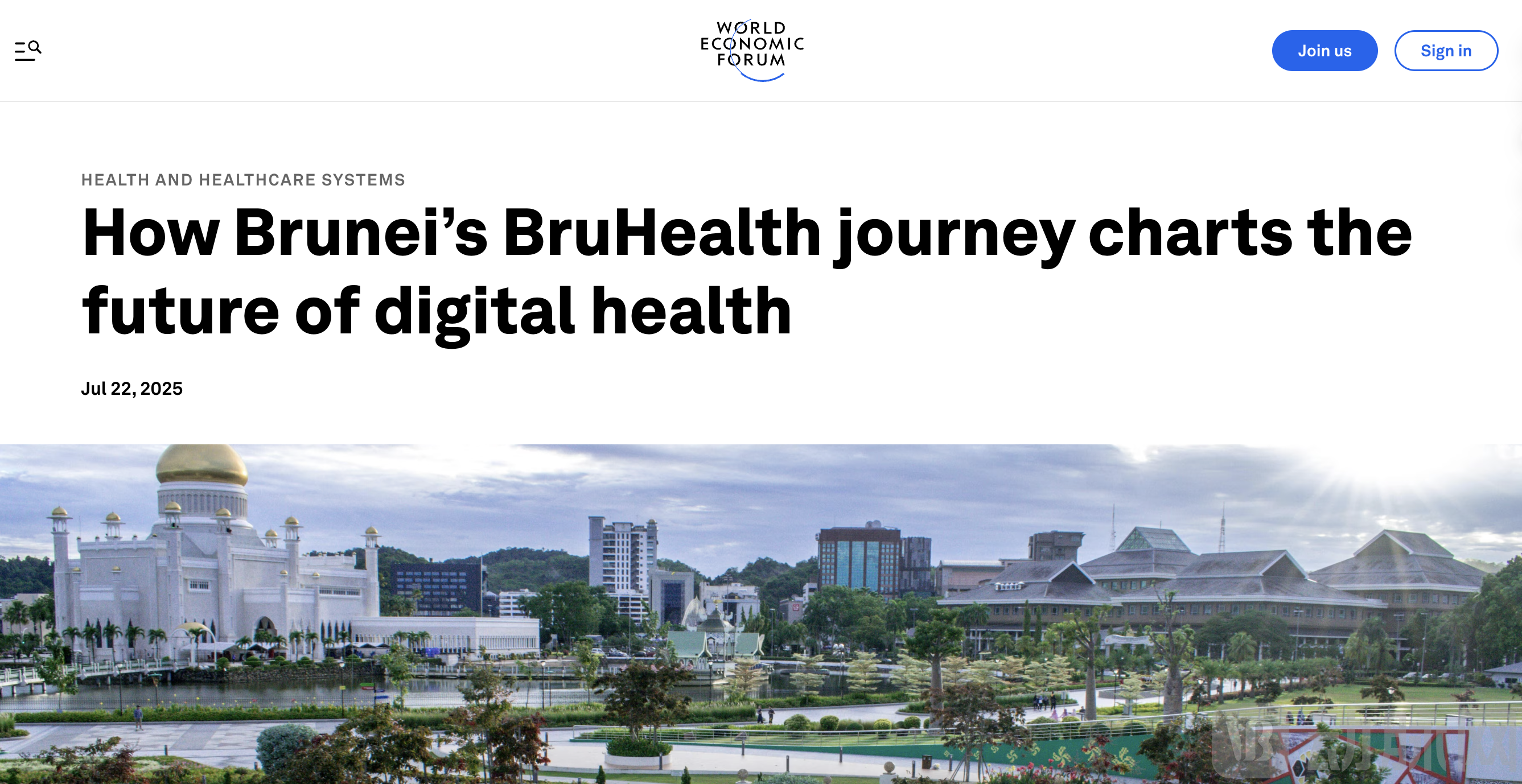
BruneiBruHealth: Mapping the Future of Digital Health
Minister of Health of Brunei, Mohammad Isham bin Jaafar
Gong Rujing, Founder and Chairman of Yidu Tech
● The experience of building Brunei’s BruHealth platform demonstrates how a digital platform can evolve from a crisis response tool into a vital force that supports and strengthens the nation’s overall healthcare system.
● Although Brunei’s national context possesses certain unique characteristics that make its model difficult to replicate in full, the experience accumulated through this practice may offer valuable insights for the global digital health transformation.
● Brunei’s practice confirms that truly sustainable digital health transformation requires the organic integration of intelligent systems, the implementation of inclusive design principles, and sustained governance mechanisms.
The World Health Organization projects that the global shortage of health workers will reach 11.1 million by 2030, while 4.5 billion people worldwide still lack access to basic healthcare services. Meanwhile, non-communicable diseases have become the leading cause of premature death globally, compelling healthcare systems in countries around the world to transition from a treatment-focused model to one centered on prevention.
The previous global pandemic spurred an unprecedented wave of digital health innovation worldwide. Although many countries encountered technological and systemic challenges during implementation, these experiences have yielded valuable lessons for the digital transformation of healthcare.
At a time when countries around the world are actively exploring digital health solutions, sharing practical experiences from different nations and regions has become particularly important for mutual learning and collaborative improvement. Brunei’s development of its national digital health platform, BruHealth, offers a noteworthy example worth drawing upon.
Initially, the core function of BruHealth was to track infectious disease pandemics, but it quickly evolved into aIntegrating health management, medical care services, and the cultivation of personalized healthy habitsa comprehensive platform. As of now, Brunei63% of residents in China log into the platform at least once a week, 566,403 users have viewed their laboratory test results via the platform, and 335,320 users have accessed their imaging examination reports.
Implementation Implications for Sustainable Health Engagement
Drawing from the practical experience of Brunei’s Ministry of Health, we can summarize several universally applicable lessons for healthcare transformation, although these insights are inevitably constrained by local contextual factors.
The Ministry of Health of Brunei adopted a “step-by-step, user-feedback-driven” development approach, rather than launching a complex system on a large scale from the outset, to avoid overwhelming users with intricate functionalities. Functional modules were rolled out gradually, includingPersonal Health Records, Appointment Scheduling, Online Queuing, Video Consultations, Preventive Screeningetc. This approach has effectively enhanced user stickiness and long-term engagement.
Another key innovation lies in how to enable residentsTransforming “Short-Term Health Enthusiasm” into “Long-Term Health Behaviors”. Traditional public health advocacy often struggles to achieve long-term behavioral change. To address this, the BruHealth platform has introduced“BruPoints Reward Mechanism”: Residents can earn points by participating in health screenings, meeting daily step goals, and adhering to medication regimens, which can then be redeemed for gifts at partner merchants. This approach not only creates tangible incentives for preventive health behaviors but also supports the development of local businesses.
These capabilities demonstrate that digital platforms can not only serve clinical healthcare but also achieve “universal participation” in health promotion. For example, government-initiated“BN on the Move”The National Step Challenge attracted nearly 49,000 participants, who collectively walked over 1 billion steps in eight days; and“Oyen Challenge”By leveraging gamification mechanisms and friendly competition, users are continuously motivated to maintain a healthy lifestyle. This demonstrates that, when properly designed, digital tools can generate powerful momentum for health-related behavioral change.
Certainly, Brunei has also encountered challenges common worldwide: the elderly and those with limited digital skills are more prone to being “left behind” by the digitalization process, while language barriers also restrict usage among certain populations. In response, the country continues to optimize platform experiences by offering streamlined interfaces and multilingual options, and promotes digital literacy education through community initiatives, striving to achieve inclusive and accessible digital services.
From a policy perspective,The Sustainable Transformation of Digital Health Is Not Merely a Technological Issue, but a Systemic Enhancement of Governance Capabilities.To this end, the Brunei Ministry of Health has established three core entities: the “Ministry of Health Smart Information Center” for automated disease surveillance, the “Digital Health Special Unit” to coordinate the digital transformation of healthcare services, and an enhanced epidemic response system through the “Epidemic Intelligence and Response Center.”
As the rotating chair of “ASEAN Health Cluster 3” under the ASEAN health cooperation mechanism, Brunei has also actively leveraged regional cooperation platforms to engage in knowledge exchange and coordinated responses with countries facing similar challenges. Health security issues transcend national borders, requiring cross-border coordination and joint efforts to safeguard public health.
The critical question facing global health leaders today is not “whether to digitize,” but rather “whether this transformation will ultimately advance or hinder the achievement of universal health coverage and health equity.”
Based on Brunei's experience, only thoseGenuinely prioritizing resident participation, proactively addressing equity issues, and continuously advancing institutional capacity buildingdigital health initiatives, it is possible to build a more resilient and sustainable national health system.
Technological Innovation Empowers the Intelligentization of Health Systems
The collaborative project between Yidu Tech and the Ministry of Health of Brunei Darussalam, implemented by the local joint venture EVYD, fully demonstrates the value of international cooperation—effectively promoting innovation in medical technology while fully respecting the local market environment and regulatory requirements.
The launch of BruHealth 5.0 marks the platform’s transition from an “information dissemination tool” to a “learning-based health ecosystem.” The new-generation system leverages AI technology to analyze users’ behavioral patterns, including diet, sleep, stress, and exercise, and dynamically adjusts health recommendations based on individual needs, achievingFrom “One-Size-Fits-All” to “Personalized Approaches”transformation.
This technological approach addresses a core challenge in traditional public health—how to align health interventions precisely with individual risks and lifestyles. Preliminary data show that,AI-Driven Personalized RecommendationsIt is more effective than general health education in stimulating user engagement and willingness to change behavior.
Certainly, the application of AI in healthcare must adhere to ethical principles. Yidu Tech has consistently emphasized principles such as algorithmic transparency, physician oversight of AI recommendations, and dynamic monitoring for potential biases during deployment, ensuringFairness, Transparency, and People-Centricity. These measures represent new challenges that AI healthcare applications face as they move toward large-scale deployment.
Yidu Tech's technical architecture emphasizes“Modular Design and Cross-Regional Adaptability”. The platform can be rapidly adapted to the regulatory environments, cultural preferences, and infrastructure conditions of different countries, preserving core functionalities while supporting the migration and reuse of technical capabilities.
Looking ahead, Yidu Tech will leverage its experience in building the BruHealth platform to further advance cutting-edge applications such as precision public health, digital therapeutics, and AI-driven health insights. While enhancing technological sophistication, it will alwaysFocus on Accessibility, ensuring that technological advancements truly benefit the general public and create value, rather than erecting barriers.
This aligns closely with the objectives of the World Economic Forum’s “Digital Health Transformation Initiative”: the success of digital health transformation hinges not on technology deployment per se, but on the organic integration of intelligent systems with inclusive design and robust governance mechanisms. Truly valuable technological innovations are invariably those solutions that enhance the service capacity of healthcare systems and benefit all populations.