

YouChangda Redefines the Overlooked Billion-Dollar Market with an Intelligent Platform for Colonic Drug Delivery
Diarrhea at least 7 times a day.
Persistent abdominal pain, bloody stools, fatigue, weight loss, and malnutrition... These conditions, which are difficult for most people to imagine, are merely part of the daily reality for some patients with inflammatory bowel disease (IBD).
IBD, or Inflammatory Bowel Disease, includes Crohn's disease (CD) and Ulcerative Colitis (UC). For a long time, it has been regarded as a "Western disease" prevalent in early industrialized regions such as North America and Europe.
However, the latest study published in Nature on April 30, 2025, titled “Global evolution of inflammatory bowel disease across epidemiologic stages,” uses extensive data to demonstrate to the public that this perception is outdated.
The increasing disease burden continues to drive the expansion of the IBD market size. Currently, there are approximately 6 to 8 million IBD patients worldwide, with over 5 million of them in Europe and North America. Meanwhile, the incidence of IBD in China is also rising rapidly, with the number of patients reaching 910,000 in 2019. According to Transparency Market Research, the IBD market size is projected to reach $49 billion by 2030.
IBD patients face not only the suffering caused by the disease itself but, more significantly, the helplessness associated with treatment, long-term decline in quality of life, and social and psychological pressures.
Although numerous medications are currently available to help alleviate symptoms and reduce inflammation, there is still no cure for inflammatory bowel disease (IBD) in the true sense; most treatments focus on symptom control and slowing disease progression. Furthermore, while retention enema therapy has been clinically proven effective as an important local treatment for IBD (particularly ulcerative colitis), patient adherence remains extremely low due to the poor experience, operational inconvenience, and loss of dignity associated with traditional devices. This has created a “well-regarded but underutilized” value bottleneck.
Diseases that have gradually entered mainstream public discourse alongside industrialization struggle to gain market attention in the short term. Although retention enema therapy has a history spanning thousands of years, there have been few innovations. Most improvement efforts have focused either on modifying the medication—such as developing foam-based formulations to prolong retention time within the body—or on making minor enhancements to the delivery devices. Rarely have these two aspects been integrated and improved simultaneously.
In other words, the treatment and long-term management of IBD require “source innovation.”
This is precisely the path being explored by the Youchangda team, which brings together authoritative clinical and academic leaders: Professor Huang Dequan, who boasts 37 years of experience in clinical practice, scientific research, and teaching in proctology, and who served as a core expert in the development of multiple national guidelines for the diagnosis and treatment of anorectal diseases as well as industry standards; Professor Ai Hua (AIMBE Fellow) from the National Engineering Research Center for Biomaterials at Sichuan University, providing academic support; and Dr. Fang Ming, a fifth-generation academic inheritor of the Sichuan School of Traditional Chinese Medicine, who holds doctoral degrees in both materials science and Traditional Chinese Medicine. The team also includes senior professionals covering the entire industry chain, such as artificial intelligence experts.
To this end, VCBeat conducted an exclusive interview with Yan Ge, founder and CEO of Youchangda. In contrast to pharmaceutical and medical device companies that opt for traditional incremental improvements, Youchangda has carved out a unique path—redefining an entire sector by revolutionizing its underlying logic.
Entering from a Niche Segment to Reassess the Bottlenecks in the Value Chain of IBD
VCBeat: In the current economic climate, where everyone is relatively cautious, what was the catalyst that led you to start your own business?
Yan Ge:Indeed, launching a startup in any environment requires immense determination. For me personally, this entrepreneurial venture is a natural extension of my career over the past two decades. I joined my previous two American companies when they were just entering China or expanding into new sectors in Asia. My primary responsibilities included strategy formulation, new business development, and team management—essentially, I was always engaged in building things from the ground up. Now, as an entrepreneur, whether it involves team building, product development, or market expansion, the core workflows are not fundamentally different from what I did before. Of course, the biggest difference is that this time I am investing real capital, bringing with it a new level of commitment and pressure. But once embarked on this journey, I am giving it my all.
It is precisely for this reason that the Youchangda project is not a whimsical impulse, but a strategic choice born of long-term incubation and thorough preparation. Our core team has spent over four years refining, deliberating, and laying the groundwork for this initiative. During this period, we invested millions in self-funded capital, free from external pressure for returns, which allowed us to methodically and rigorously validate our technology, market fit, and business model.
During my tenure at a multinational corporation, I was responsible for the business of pharmaceutical raw materials. Domestic clients showed significant interest in drug-eluting devices, prompting us to explore this area. However, as our primary focus was on supplying medical materials, we later discovered that the regulatory landscape for drug-eluting devices in China was highly complex. This led me to consider whether there might be a way to simplify compliance for such devices.
My initial thought was to separate the drug from the device. Once the device obtained regulatory approval, it could be used in conjunction with the corresponding medication, thereby maintaining a clear distinction between the drug and the device. Later, during the pandemic, I reflected on this issue at home and devised a solution: designing a device that controls the timing of drug permeation, thereby creating a long-acting drug-delivery product.
VCBeat: Why did you and your “champion team” decide to enter the stagnant “slow” field of retention enema, which has been quiet for nearly a century, to tackle a seemingly “niche” challenge?
Yan Ge:Our decision to enter this field is grounded in our team’s shared insights. We have observed that the traditional market for retention enema therapy has been overlooked by industry giants, while existing smaller players are largely confined to incremental improvements, lacking disruptive innovation. This gap presents a significant opportunity for us.
You mentioned “niche,” which is a highly precise entry point. Our initial strategy is indeed focused on IBD (inflammatory bowel disease). Although this patient population may appear niche, it possesses several characteristics that are highly favorable for “source innovation”: patients tend to be younger and digitally savvy, with tightly connected communities and strong unmet needs for improving quality of life. This is a group that requires long-term treatment as well as substantial psychological support.
This compels us, as entrepreneurs, to consider how innovative business models can deliver greater humanistic care and social value to this community while generating commercial value, ensuring they are better served and seen.
Yet our vision extends far beyond this. Retention enema therapy is applicable to over 200 diseases. By integrating inflammatory bowel disease (IBD) with proctology, gynecology, and other specialties, we are addressing a massive market with an annual service scale approaching RMB 10 billion. Therefore, we have chosen to start with the “niche entry point” of IBD to leverage this undervalued “large market.” After more than four years of preparation, we believe this is no longer a formidable challenge, but rather a value depression awaiting our unlocking.
VCBeat: You have described traditional therapies as a “bottleneck in industrial chain value.” Could you elaborate on the overlooked “value black hole” that results in a lose-lose-lose outcome for all three parties involved?
Yan Ge:Yes, the “value bottleneck” is our starting point for thinking about this issue. Imagine that a pharmaceutical company invests billions in developing a precise “missile” (drug), and physicians devise a perfect “battle plan,” yet the entity ultimately launching this missile is a highly inaccurate “slingshot” built a century ago. The final outcome is all too predictable.
Specifically, this “value black hole” manifests in three aspects:

What we aim to do is leverage technology to penetrate this black hole and unlock the value that rightfully belongs to the industry chain.
Breaking Through + Innovating: The "Trinity" Ecological Closed Loop, Building New Industry Infrastructure
VCBeat: In the face of these pain points, how does Youchangda’s “trinity” ecological closed loop systematically break through?
Yan Ge:We believe that merely improving a single hardware component is far from sufficient; a systematic solution driven by an ecosystem-oriented mindset is essential. Our “trinity” closed-loop ecosystem was designed precisely for this purpose.
VCBeat: Specifically, what are the highlights of Youchangda's innovative hardware?
Yan Ge:Our hardware innovation can be summarized as “conceptual elevation.” Rather than merely improving upon traditional enema devices, we have drawn design inspiration from two highly mature and advanced medical fields:
First, our core host,Drawing on the precise and controllable drug delivery principles of insulin pumps, replacing crude gravity drip infusion with a micro-infusion pump to achieve precise, programmable control over drug administration rate and dosage. This is the fundamental guarantee of patient comfort and therapeutic efficacy.
Second, our tubing consumables,Drawing on the design principles and medical-grade polymer materials of peripherally inserted central catheters (PICCs), while ensuring biosafety, it significantly enhances softness and comfort.
In simple terms, we are leveraging the “dimensionality reduction” strategies of chronic disease management and interventional therapy to transform a field that has remained stagnant for a century. This approach has created a generational gap in user experience between our product and all existing alternatives. This is also why pharmaceutical companies that have recently engaged with us have been pleasantly surprised by its comfort level.
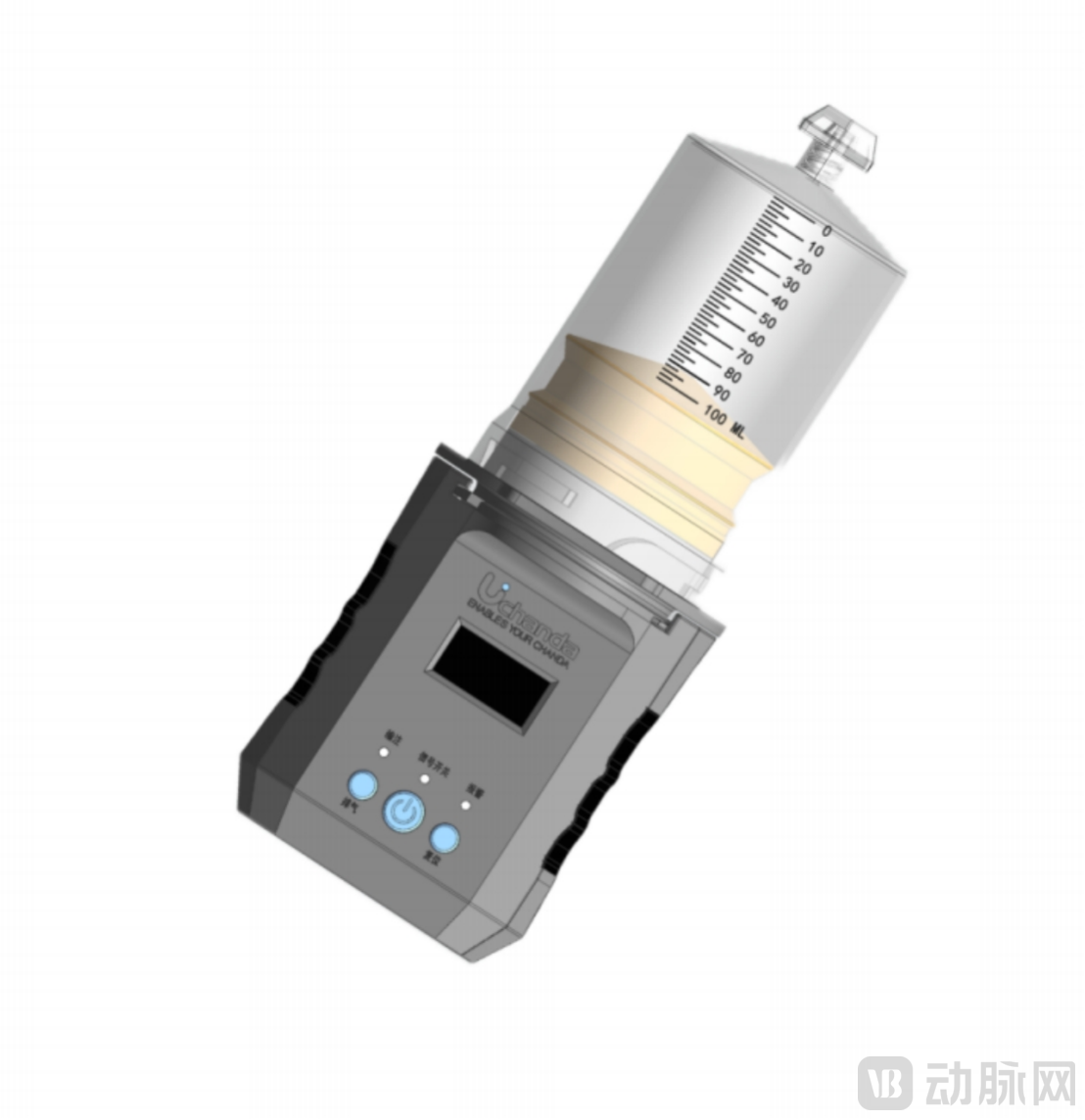
VCBeat: How has UChangda’s smart hardware fundamentally changed the game?
Yan Ge:First, smart hardware serves as our “data entry point” and the “cornerstone of therapeutic efficacy.” It fundamentally changes the game: by enabling precise, controlled, slow-rate drug administration, we have extended the effective retention time of medications from less than 30 minutes to over two hours, representing a qualitative leap in therapeutic outcomes. More importantly, it transforms what was once an ambiguous “administration act” into a standardized, recordable “data acquisition process.” No longer merely a simple tool, it has become an intelligent “data sensor” that extends deep into patients’ homes.
Second, the AI assistant serves as a “connector,” linking devices and individuals to address adherence challenges through intelligent reminders and convenient recording. Finally, the big data platform acts as a “value amplifier,” analyzing collected data to empower physicians and pharmaceutical companies in return. This forms a complete closed loop spanning therapeutic efficacy, data, and services.
VCBeat: You mentioned that Uchangda is not just about hardware, but is also building “new industry infrastructure.” What does this specifically refer to?
Yan Ge:Yes, “new industry infrastructure” is our ultimate positioning. You can understand it this way: if various drugs are the “cars” running on the road, then traditional enema methods are a bumpy “dirt road.” What Youchangda aims to do is build a smooth, efficient, and intelligent “highway” connecting pharmaceutical companies, doctors, and patients.
VCBeat: How will it evolve and ultimately unlock “data value”?
Yan Ge:The evolution of this “expressway” is a process of value amplification at successive levels:
Leveraging Industry Momentum and Clinical Evidence to Revitalize a Century-Old Dormant Market
VCBeat: What stage of development is Youchangda currently in?
Yan Ge:We are currently in the critical validation phase of going from zero to one. Team assembly, core product development, and the first batch of trial production have all been completed efficiently. Product registration is progressing steadily, with approval expected by the end of this year. It is fair to say that we are fully prepared in terms of technology and product readiness. This confidence also stems from the continuous testing we have conducted since the creation of our first prototype three years ago—I was the first “user,” personally verifying the disruptive experience it delivers.
More importantly, another core preparatory effort by our team has been the strategic and in-depth layout of intellectual property. We recognize that in an innovative field, safeguarding our own interests is tantamount to protecting future partners. Therefore, over the past few years, we have built a robust patent portfolio comprising more than 14 patents, covering hardware, consumables, software algorithms, and even drug combinations. This provides a solid and worry-free legal foundation for our future business collaborations.
VCBeat: To turn this grand vision into reality, what are the biggest challenges the company currently faces and the resources it needs most?
Yan Ge:To turn this vision into reality, the greatest challenge we currently face is not technology itself, but how best to integrate resources to catalyze a market that has remained dormant for a century. This requires strong industry momentum and robust clinical evidence.
Therefore, what we need most is strategic partners who share our vision. We are very open and are actively seeking not just financial investment. We hope to attract partners like this:
1.Partners with extensive resources in clinical research: They can collaborate with us to conduct high-quality clinical studies at top-tier medical centers, jointly establishing the gold standard for the clinical value of this technology through robust evidence-based medicine.
2.Influential Partners in the Industrial Ecosystem: Whether they are leading pharmaceutical companies or premier internet healthcare platforms, their participation will significantly accelerate the development of our “new industry infrastructure,” enabling more patients and physicians to benefit from it more rapidly.