China Issues First-Ever Regulatory Guidelines for Digital Therapeutics, Marking Industry Milestone
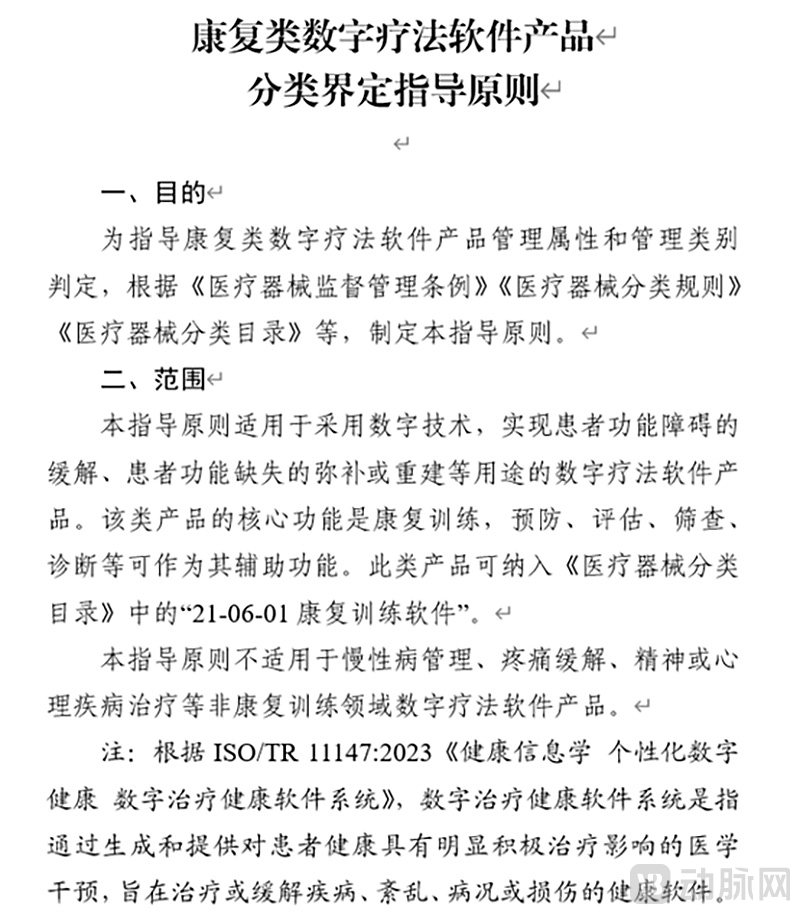
On July 30, the National Medical Products Administration (NMPA) released the “Guiding Principles for the Classification of Rehabilitation Digital Therapeutics Software” (hereinafter referred to as the “Guiding Principles”) on its official website and announced that it would take effect immediately upon issuance.This is the first regulatory policy officially issued in China that explicitly targets digital therapeutics., marking a milestone event of significant importance in the digital therapeutics industry.
What impact will the release of this regulatory policy have? How does the industry view it? Is there room for further policy optimization? VCBeat reached out to senior practitioners in the digital therapeutics industry to gain insights.
The Guidelines provide corresponding provisions on the scope of rehabilitation-related digital therapeutics, the principles for defining their regulatory attributes, and the principles for determining their regulatory categories.
At the core of how digital therapeutics are defined,The Guidelines suggest referencing the definition of digital therapeutics in ISO/TR 11147:2023 “Health informatics — Personalized digital health — Digital therapeutic health software systems,” which refers to health software designed to treat or alleviate diseases, disorders, conditions, or injuries by generating and delivering medical interventions that have a significant positive therapeutic impact on patient health.。
On this basis, the Guidelines provide a definition of digital therapeutics for rehabilitation: software products that utilize digital technology to alleviate functional impairments, compensate for or reconstruct lost functions in patients. Their core function is rehabilitative training, while prevention, assessment, screening, and diagnosis may serve as auxiliary functions.
This also marks the first time that official authorities have formally provided a definition of digital therapeutics.。
The Guidelines also clarify the three essential characteristics that rehabilitation-focused digital therapeutics must possess:First, it provides software-driven interventions to patients, offering rehabilitation training for functional impairments caused by diseases, injuries, or physiological structural defects. Second, it has clearly defined intended clinical use, usage scenarios, limitations, indications, and contraindications. Third, it is based on evidence-based medicine and adheres to widely accepted rehabilitation medicine theories, such as clinical guidelines, standard treatment protocols, expert consensus, and clinical studies.。
Compared with the previously industry-recognized characteristics of digital therapeutics, the Guiding Principles fully align with the first and third characteristics. The addition of the second characteristic, “having a clearly defined clinical intended use…,” clarifies the medical device nature of digital therapeutics. This is particularly important for rehabilitation-oriented digital therapeutic software products regulated as medical devices. The scenarios listed subsequently in the Guiding Principles that are excluded from being classified as rehabilitation-oriented digital therapeutic software products are all deemed non-medical devices because their intended uses do not meet the definition of a medical device.
Finally, the Guidelines specify that certain categories of rehabilitation digital therapeutics are regulated as Class II medical devices, with two exceptions. First, if a product employs artificial intelligence technology to achieve its intended use, it shall be classified in accordance with the Guidelines for the Classification and Determination of Artificial Intelligence Medical Software Products. Second, if a product is intended to be used in combination with or in conjunction with auxiliary devices to facilitate rehabilitation training, its regulatory classification shall be determined comprehensively based on the classification of the associated auxiliary devices.
This also marks the first time that the authorities have explicitly clarified the principles for determining the regulatory classification of digital therapeutics, specifying that they should generally be regulated as Class II medical devices.。
In fact, prior to the release of the Guidelines, relevant domestic authorities had convened multiple seminars to explore regulatory policies for digital therapeutics.
As early as September 2022, the Institute of Medical Device Control of the National Institutes for Food and Drug Control (NIFDC), which serves as the secretariat for the Technical Committee on Standardization of Artificial Intelligence Medical Devices, organized and convened a technical seminar on the classification and definition guidelines for digital therapeutic medical devices. Nearly 30 entities participated, including the Center for Medical Device Standardization Administration of the National Medical Products Administration (NMPA), medical device testing institutions, clinical institutions, and enterprise representatives, to explore the formulation of the “Guiding Principles for the Classification and Definition of Digital Therapeutic Medical Device Products.”
Since then, annual symposia, including internal industry discussions, have been held to explore the regulation of digital therapeutics. The most recent one took place this May, when the Beijing Center for Medical Device Evaluation and Inspection convened relevant stakeholders from various sectors to launch a research project on “Technical Review Standards for Rehabilitation Digital Therapeutic Medical Devices.”
Despite extensive discussions, digital therapeutics remains a relatively cutting-edge concept, and its multidisciplinary nature further complicates regulatory oversight. Consequently, no formal policies have been enacted as a result of these deliberations.
It was not until the release of the Guidelines that China finally ushered in its first formal regulatory policy on digital therapeutics. The issuance and implementation of these Guidelines also provided a relatively clear definition of the scope and core elements for rehabilitation-focused digital therapeutics from a regulatory perspective, laying the foundation for the development of more detailed regulatory policies in the future. This marks a significant milestone for China’s digital therapeutics industry.
According to VCBeat, the industry has responded positively to the release and implementation of the “Guiding Principles.”
Shukang is a representative of digital therapeutics (DTx) in the rehabilitation field in China and among the first batch of DTx companies to obtain medical device registration certificates. Dr. Dong, its Medical Director, believes that the issuance and implementation of the “Guiding Principles” hold profound significance for promoting the establishment of standardized development benchmarks in the industry and enhancing clinical and industrial awareness and acceptance of rehabilitation-related digital therapeutics: “This marks the first time that regulatory authorities have clearly defined the managerial attributes and classification of rehabilitation-related digital therapeutic products at the national level. This is not only an important starting point for the construction of China’s digital therapeutics regulatory system, but also further affirms, from an authoritative perspective, the identity and compliance of the earliest batch of rehabilitation-related digital therapeutic products registered as medical devices, including Shukang Pro. Moreover, it lays the foundation for better integration of rehabilitation digital therapeutics into the healthcare system.”
“The Guidelines take functional positioning as the core entry point and establish clear product boundaries based on the explicit goal of ‘rehabilitation training.’ This approach facilitates the identification of digital therapeutic products that genuinely possess medical intervention properties in practice,” he added.
Lu Yiming, Co-founder and Chief Medical Officer of Fudong Musculoskeletal, also believes that the Guidelines will significantly promote the application of digital therapeutics in rehabilitation: “Digital therapeutics offer distinct advantages in reducing patients’ healthcare costs and improving access to care, holding substantial potential for application in rehabilitation settings. If left without guidance and regulatory oversight, the field risks deviating in undesirable directions. The introduction of the Guidelines is therefore essential to prevent a ‘race to the bottom’ where inferior products drive out high-quality ones.”
“To be honest, the industry has long awaited regulatory policies such as the Guidelines,” he remarked.
Lu Yiming further stated to VCBeat that the Guidelines prioritized digital therapeutics for rehabilitation, a decision likely driven by multiple factors: “From a population-wide perspective, rehabilitation undoubtedly has the broadest target audience and represents the most urgently needed medical service at present. Furthermore, rehabilitation itself is relatively low-risk. Given that policy-making for digital therapeutics is still in an exploratory phase, it is clearly most practical to begin with areas that have the widest reach and are relatively straightforward.”
Dr. Dong noted that the rehabilitation process is often characterized by its long-term nature, continuity, and poor service accessibility. The cross-temporal and spatial intervention capabilities of digital therapeutics, along with their remote data monitoring and feedback mechanisms, precisely address the key pain points in rehabilitation services. This suggests that digital therapeutics for rehabilitation may have a practical foundation for achieving standardization first, in terms of clinical value, technological maturity, and regulatory oversight.
“Compared with other fields, the functional assessments and training parameter indicators involved in rehabilitation interventions may be more quantifiable and objective, making it easier to establish a unified regulatory logic framework. These advantages position digital therapeutics for rehabilitation as well-placed to become the first category clearly defined by regulators,” he explained to VCBeat.
It is worth noting that although the “Guiding Principles” target digital therapeutics for rehabilitation, they do not explicitly classify all digital therapeutics. However, in the scope of application, it is stated that they “do not apply to digital therapeutic software products in non-rehabilitation training areas, such as chronic disease management, pain relief, and treatment of mental or psychological disorders.”
This may also indicate that regulators have a clear understanding of the general classification of digital therapeutics, paving the way for the subsequent introduction of regulatory policies for other types of digital therapeutics.
However, the Guidelines encompass not only traditional exercise-based rehabilitation but also rehabilitative training for mild cognitive impairment caused by organic lesions such as speech, visual, and auditory impairments, and stroke (excluding rehabilitation for psychiatric and psychological disorders); further refinement of the rules is still required.
Ma Zhigong, Assistant to the General Manager of Peisheng Medical, believes that the release of the Guidelines is undoubtedly a positive development for companies currently applying for medical device registration certificates. As the first version of the Guidelines, it is not surprising that they are not overly detailed; at the very least, they clearly indicate that these product categories will be regulated and implemented as Class II medical devices. However, he also noted that further policy supplements will be needed for the Guidelines in the future.
“Taking speech, visual, and hearing impairments as examples, I believe that the biofeedback mechanisms and biomarkers for visual and hearing disorders are relatively well-defined and can be observed using medical devices or instruments. However, there is currently no reliable way to assess speech impairments through biological indicators, which suggests fundamental differences in validation methodologies. This necessitates the future development of more detailed regulatory review standards, corresponding respectively to the categories mentioned in the Guidelines.”
“Judging from the historical development of AI-enabled medical devices, the introduction of more detailed follow-up policies was virtually inevitable. Since 2020, the National Medical Products Administration (NMPA) has successively issued documents such as the ‘Review Points for Medical Device Software with Deep Learning-Assisted Decision-Making,’ ‘Guiding Principles for the Classification and Categorization of AI-Based Medical Software,’ ‘Guiding Principles for Registration Review of Cybersecurity in Medical Devices (2022 Revised Edition),’ and ‘Guiding Principles for Registration Review of AI-Enabled Medical Devices.’ These documents have clarified the requirements for determining the regulatory attributes and classification categories of AI-enabled medical device products, as well as review requirements, thereby guiding the registration and application process for medical device software. During this period, China’s registration and approval process for AI-enabled medical devices has evolved from sporadic, isolated cases at the outset to large-scale approvals. I believe that with the release of these Guiding Principles, more refined approval policies will inevitably be introduced in the future, and the approval process for digital therapeutics will gradually become standardized.”
Regarding the approval of AI-integrated digital therapeutics, Ma Zhigong stated in an interview with VCBeat that currently popular open-source large language models (LLMs) face certain challenges in the actual approval process: “Regulatory authorities require applicants to provide all training data sources for the LLM. However, companies can only provide the training data generated after locally deploying the open-source LLM, and cannot provide the original training data used by the open-source LLM developers to train the model. Under current regulations, certification cannot be obtained in such scenarios, which hinders the application of open-source LLMs.”
Dr. Dong shared Shukang’s experience with VCBeat: “Shukang Pro does incorporate artificial intelligence technologies in modules such as intelligent exercise prescription formulation, rehabilitation task recommendation, and training efficacy assessment. However, all its backend logic is grounded in evidence-based medicine, with design processes that are traceable and interpretable, distinguishing it from black-box generative AI algorithms. Furthermore, while our product provides personalized intelligent recommendations, these always require review and approval by professional medical personnel before being sent to patients for implementation, thereby ensuring that physicians remain the core decision-makers within the clinical intervention pathway. Consequently, under the current regulatory framework, Shukang Pro remains classified as a Class II medical device and is not subject to the regulatory requirements applicable to Class III devices.”
Undoubtedly, as the first official regulatory policy explicitly targeting digital therapeutics, the "Guiding Principles" hold significant importance and will serve as a major catalyst for industry development. The "Guiding Principles" represent merely the initial step in a series of regulatory measures; with the future introduction of more refined regulatory frameworks, digital therapeutics will finally embark on a path toward regulatory recognition and standardized approval processes. This constitutes a substantial benefit for the digital therapeutics industry, which has long been advancing under considerable pressure.
VCBeat will continue to closely monitor developments in the digital therapeutics industry and provide readers with first-hand reporting.
2025 Digital Therapeutics Conference to be Held in Haikou, Hainan on August 15–16. Centered on “Policy Interpretation + Clinical Practice + Industrial Implementation,” the conference aims to deeply address industry pain points and remove obstacles to the development of the digital therapeutics sector. Scan the QR code for more details.