

Industry Competition Landscape to Be Reshaped: 22-Province Alliance Bulk Procurement Signals New Direction for the Inferior Vena Cava Filter Market
“The other shoe” has finally dropped.
In March this year, the Heilongjiang Provincial Public Resource Trading Platform released the “Notice on Convening a Symposium with Enterprises Participating in the Centralized Procurement of Medical Consumables Such as Inferior Vena Cava (IVC) Filters and Ablation Electrodes.” According to the notice, Heilongjiang Province intends to take the lead in carrying out centralized procurement of medical consumables, including IVC filters. At that time, some pointed out that two categories of consumables—IVC filters and IVC filter retrieval kits—had previously participated in information maintenance for the fifth round of national centralized procurement of medical consumables but were not included in the formal procurement documents. Therefore, this round of “inter-provincial alliance centralized procurement” led by Heilongjiang Province may be upgraded to a national alliance procurement.
Now, speculation is about to become reality. On August 8, the Heilongjiang Provincial Public Resource Trading Platform issued the "Notice on Carrying Out Information Maintenance Work for Medical Consumables Such as Vena Cava Filters and Ablation Electrodes,"Starting from August 11, 2025, information maintenance work for medical consumables such as vena cava filters will be organized and carried out, with 22 provinces (autonomous regions and municipalities) participating in this centralized procurement.
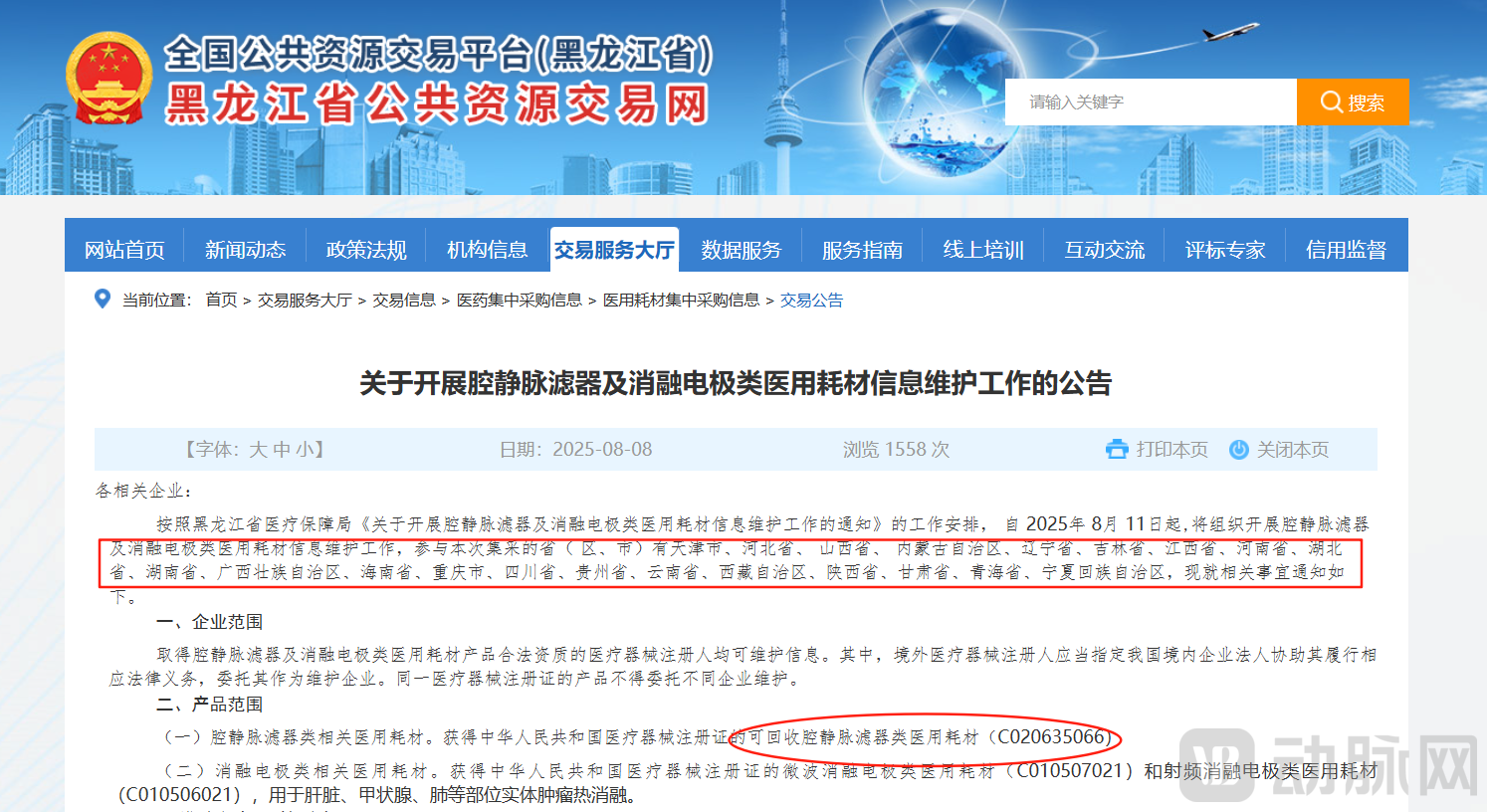
This also means that the vena cava filter sector is on the verge of significant new adjustments.
Centralized procurement of inferior vena cava filters may take into account the following factors:
First, inferior vena cava filters are indispensable clinical products used to prevent pulmonary embolism caused by deep vein thrombosis.
Pulmonary embolism (PE) is a condition with acute onset and high mortality. Deep vein thrombosis (DVT) of the lower extremities is the primary precipitating factor for PE, and together they are referred to as venous thromboembolism (VTE). Epidemiological surveys indicate that approximately 60%–70% of patients with DVT develop PE, and the mortality rate among untreated PE patients is as high as 20%–30%. In China, PE is the most common pulmonary vascular disease and ranks as the third most prevalent cardiovascular disease. Clinical management of DVT, the main cause of PE, aims to improve the hypercoagulable state and restore vessel patency to prevent PE. Among existing treatment modalities, anticoagulation therapy is the foundational approach for VTE; however, its efficacy is limited in patients with poor response or low adherence. Although thrombolytic therapy and venous thrombectomy can alleviate thrombotic obstruction, thrombectomy alone is associated with a high postoperative recurrence rate and is indicated only for patients with acute central or mixed-type DVT. For patients who cannot undergo anticoagulation therapy or in whom anticoagulation fails, inferior vena cava filters (IVCFs) serve as an alternative treatment option by physically preventing thrombi from dislodging from the venous systems of the lower extremities and pelvis.
Second, market demand is growing, and clinical applications have become relatively mature.According to a study published by Professor Zhang Fuxian in November 2023 in the Journal of Vascular Surgery (JVS), an internationally renowned journal in vascular surgery, an analysis of 171,310 patients with venous thromboembolism (VTE) across 53 medical centers (27 radiology centers and 26 vascular surgery centers) in 21 provinces of China over a 10-year period revealed that, on one hand, VTE diagnoses and hospitalizations increased by 3.8-fold and 4.8-fold, respectively, between 2009 and 2019; on the other hand, hospitalized patients accounted for 83,969 cases (49%). Among these hospitalized patients, 40,478 inferior vena cava filters (IVCFs) were implanted, 76% of which were retrievable, indicating that related procedures are being rapidly adopted in clinical practice.
Third, the burden on patients remains heavy.For example, in Anhui’s single procurement round in 2024, the unit price of Bard’s inferior vena cava filter, a foreign brand, remained as high as RMB 18,000.
Given the aforementioned factors, it is imperative to initiate centralized procurement of inferior vena cava filters without delay.
So, what types of inferior vena cava filters are eligible for inclusion in centralized procurement?
From the five rounds of centralized procurement of high-value medical consumables conducted in the past, we may glimpse certain trends:
From a product perspective, volume-based procurement is shifting from “low-price competition” to “high quality at competitive prices.” This transition is primarily reflected in two aspects: first, the optimization of competitive mechanisms to avoid excessively low-priced bidding and price-only competition.In the fifth round of centralized procurement for high-value medical consumables, companies that failed to win bids in the initial round were permitted to submit secondary bids at prices no lower than 1.1 times the lowest quoted price. For instance, in the centralized procurement of peripheral venous stents, Contecs won the bid with the lowest price of RMB 2,280, while Boston Scientific successfully secured a contract through the aforementioned mechanism by resubmitting a bid at RMB 3,080, thereby establishing a reasonable price differential.Second, technical bonus points are awarded to innovative devices to better meet clinical needs.For example, in the centralized procurement of cochlear implants, the implant and speech processor are subject to price comparison through bidding after being converted based on product-specific conversion factors. Taking the implant as an example, those compatible with 3.0 T MRI receive a higher conversion factor compared to products that are not MRI-compatible.
From a service perspective, centralized procurement is evolving from "volume-based procurement" to "volume- and service-based procurement."Ancillary services, such as surgical training and postoperative follow-up, have also been included in the procurement scope. For instance, in the fifth round of centralized procurement for cochlear implants, the declared price for speech processors included one session of device programming and one instance of after-sales service. Earlier centralized procurements for artificial joints and orthopedic spinal consumables also specified prices for ancillary services.
In other words, the current centralized procurement of inferior vena cava (IVC) filters may consider "high quality at competitive prices" and the availability of supporting services.So, are domestic enterprises expected to win bids in this round of centralized procurement?
From a product perspective—
Currently, long-acting retrievable inferior vena cava filters are becoming the mainstream products in the market and are expected to be a key focus of this volume-based procurement.From the perspective of the domestic market, Professor Zhang Fuxian’s ten-year retrospective study shows that from 2009 to 2019, the majority of implanted inferior vena cava filters (IVCFs) were retrievable filters, and the use of permanent IVCFs has been largely abandoned. In overseas markets, the FDA recommends an optimal retrieval window for vena cava filters of 29 to 54 days post-implantation. Filters with extended retrieval periods are highly valued in both domestic and international markets. Among retrievable filters, fusiform retrievable filters left in place for more than 14 days are prone to significant neointimal hyperplasia, which can lead to tearing of the neointima covering the filter struts during removal, causing injury or even rupture of the inferior vena cava wall. In contrast, umbrella-shaped long-term retrievable filters offer a longer retrieval window, making them more convenient for clinical application.In this field, corresponding products from domestic companies have been on the market for many years, breaking the monopoly held by foreign enterprises.In the domestic market, with the launch of Kossel’s umbrella-shaped long-acting retrievable inferior vena cava (IVC) filter in 2021, as the first domestically produced umbrella-shaped retrievable filter, it filled an industry gap, offering a retrieval window of up to 90 days. Since its launch, the product has achieved a breakthrough against overseas competitors through years of accumulation.
Moreover, domestic manufacturers’ vena cava filters are continuously undergoing iteration to better meet clinical needs.Currently, centralized procurement is placing increasing emphasis on the innovative capabilities of winning products. This round of centralized procurement targets retrievable filters. Although the grouping rules have not been disclosed, the key criteria for filters—“efficacy, safety, and convenience”—will remain the primary considerations. After overcoming technical bottlenecks, domestic companies are responding more rapidly to market demands through clinical application and feedback, compared with imported overseas products. Taking the first umbrella-shaped long-acting inferior vena cava filter as an example, clinical trials have shown that Octoparms®Vena cava filters achieved 100% successful implantation and 100% successful retrieval, with no occurrences of fracture, tilting, migration, or perforation, and a zero recurrence rate of pulmonary embolism (PE) within six months. Domestic products are already competitive with international counterparts. Building on the first-generation product, Celsus Medical further launched the newly upgraded Octoparms with enhanced functionality this year.®Ⅱ Umbrella-shaped retrievable filter, upgraded in terms of filter stability, specifications, and delivery system, making the product more advantageous in clinical applications.
From a service perspective—
Domestic manufacturers of inferior vena cava filters have previously achieved market penetration through centralized procurement in certain provinces, thereby gaining experience in product distribution and related services.For example, on December 29, 2021, the Medical Consumables Procurement Alliance comprising Shandong, Shanxi, Hebei, and Henan provinces announced the winning bids for the volume-based procurement of five categories of medical consumables, including retrievable inferior vena cava (IVC) filters. Nine companies were shortlisted for retrievable IVC filters, with four being domestic manufacturers, such as Celsus Medical, Lifetech Scientific, Weihai Weixin Medical, and Bowei Medical. Notably, this centralized procurement demonstrated a trend away from “price-only” evaluation. The grouping criteria used product retrieval time as the standard: products with a retrieval time exceeding 30 days were placed in Group A, while those with a retrieval time of less than 30 days were placed in Group B. In Group A, only one domestic product was selected, namely Celsus Medical’s Octoparms.®The inferior vena cava (IVC) filter ranked first in Group A of the bid. Its superior product quality has also been validated by the market. With the further increase in market penetration driven by the successful bid, the market share of high-end, long-lasting, umbrella-shaped IVC filters continues to expand. Moreover, the experience gained from previous bids has helped domestic manufacturers accumulate practical experience in product implementation and support, positioning them to better prepare for this centralized procurement. Products from companies previously recognized for their “high quality and competitive pricing” are expected to achieve strong results again in this nationwide centralized procurement.
In addition to product distribution systems, domestic enterprises are also drawing on the standardized management and training systems of foreign companies, optimizing and upgrading them based on local medical practices.Taking Cosel, a leading enterprise with a dominant market share in the inferior vena cava filter market, as an example, it leverages its local advantages to establish a comprehensive, rapidly responsive clinical support system covering preoperative planning, intraoperative assistance, and postoperative follow-up. This enables its services to quickly reach primary care hospitals, where disease incidence is higher, making it the preferred choice for over 2,000 medical centers across China and benefiting tens of thousands of patients.
Overall, in the vena cava filter sector, domestic companies are no longer inferior to overseas competitors. In this volume-based procurement (VBP) round, domestic enterprises that boast “high quality at competitive prices” and robust on-the-ground service capabilities—key advantages for VBP eligibility—are poised to leverage the “tailwinds of VBP” to further solidify their market leadership.
Meanwhile, several industry insiders revealed to VCBeat that the current volume-based procurement (VBP) of inferior vena cava (IVC) filters may be just the beginning. In the future, retrieval devices used in conjunction with IVC filters are also expected to be included in VBP programs. This development will further benefit the entire industry and ultimately improve patient outcomes.