

Positrigo Secures CHF 7 Million in Funding to Accelerate Commercialization of NeuroLF, the First Dedicated Brain PET System with FDA and CE Certification

Positrigo
Developer, Manufacturer, and Distributor of Brain PET Scanners

HealthCap
Venture Capital Foundation
Recently, Positrigo, a developer of neuroimaging equipment, announced the completion of a new funding round totaling CHF 7 million (approximately RMB 63 million). This round was led by European venture capital firms HealthCap and Navivo.
The financing timeline aligns closely with the R&D progress of Positrigo’s core product, NeuroLF (a brain PET system). The primary objective of this funding round is to accelerate the commercial deployment of NeuroLF in European and American markets, expand market share, and promote the clinical adoption of dedicated brain PET scanners.
1Originating from the ETH Institute for Physics, it addresses imaging challenges in the early diagnosis of brain diseases
Positrigo, founded in 2018 and headquartered in Zurich, Switzerland, originated from the Institute for Particle Physics and Astrophysics at ETH Zurich. Co-founded by Dr. Max Ahnen and Dr. Jannis Fischer, the company specializes in developing compact PET imaging systems dedicated to the diagnosis of brain disorders. Its inception was driven by the aim to address imaging challenges in the early diagnosis of neurodegenerative diseases.
As the global aging wave accelerates, the incidence of neurological disorders such as Alzheimer’s disease and Parkinson’s disease continues to rise. According to a report by Alzheimer’s Disease International (ADI), there were over 55 million people living with dementia worldwide in 2020, and this number is projected to exceed 150 million by 2050. Early diagnosis of these diseases is crucial for effective treatment and disease management.
However, traditional PET-CT systems have several unavoidable shortcomings in the diagnosis of brain diseases: a single unit requires more than 15 square meters of fixed space due to its bulky size; the unit price often reaches millions of US dollars, resulting in high costs; and the operational workflow is complex, with insufficient specificity for brain imaging owing to the “whole-body scanning” design.
These technical shortcomings have deterred primary healthcare institutions from adopting PET-CT equipment, significantly limiting the widespread adoption of early screening for neurological disorders. Positrigo’s mission is to leverage technological innovation to transform brain PET imaging from a “service exclusive to large hospitals” into a “more accessible routine diagnostic tool.”
The realization of this mission is underpinned by profound R&D expertise and the technical support of its core team. Boasting robust R&D capabilities, the team leverages ETH Zurich’s extensive accumulation in particle detection and imaging algorithms. Both founders, Dr. Max Ahnen and Dr. Jannis Fischer, possess solid scientific research credentials.
Jannis studied physics at the Free University of Berlin (FU) and Humboldt University of Berlin (HU), and engaged in academic exchanges with ETH Zurich, the University of California, Los Angeles (UCLA), and CERN. During his doctoral studies, he developed SAFIR, a small-animal PET system with time resolution at the forefront of the industry.
Max has deeply cultivated the field of particle physics. After completing his physics studies at the Technical University of Munich, the Max Planck Institute for Physics, and Durham University, he joined the Institute for Particle Physics at ETH Zurich, focusing on research into gamma-ray Cherenkov telescopes. The duo’s dual accumulation of academic expertise and practical experience has laid a solid foundation for Positrigo’s technological breakthroughs.

Dr. Jannis Fischer (left) Dr. Max Ahnen (right)
Source: Positrigo Official Website
2Low-Cost, High-Precision, Easy-to-Deploy: NeuroLF System Receives Dual FDA and CE Certifications
Positrigo’s flagship product is NeuroLF, a compact brain positron emission tomography (PET) system. This PET-based brain imaging system utilizes positron-emitting radiotracers to visualize and quantify various biochemical processes within the brain, enabling early diagnosis of neurological disorders such as Alzheimer’s disease, Parkinson’s disease, and epilepsy, as well as brain tumors.
Specifically, NeuroLF offers the following performance advantages:
Full-Brain Coverage, Precise Imaging.The detector ring, the “heart” of the device, adopts a brain-like design with a coverage of 14.5 cm, enabling complete whole-brain scanning and ensuring imaging integrity. Moreover, its imaging quality matches the accuracy of existing PET/CT systems, providing a reliable basis for clinical diagnosis.
Compact and agile, easy to deploy.NeuroLF occupies less than 2 square meters and is equipped with mobile wheels at its base, enabling flexible movement across various spaces such as hospitals and clinics. This design eliminates the need for a fixed installation site of over 15 square meters, which is typically required by traditional PET systems. The scanning unit and seat are detachable, allowing for a straightforward installation process without extensive facility modifications, thereby meeting the needs of diverse medical institutions.
Low cost, significant benefits.Conventional systems typically cost between CHF 1.5 million and CHF 5.5 million, whereas the NeuroLF system costs only one-tenth as much as traditional PET scanners. With higher utilization rates driving down per-scan costs, it significantly lowers the procurement and operational barriers for small and medium-sized clinics and community hospitals.
Easy operation, enhanced patient experience.Equipped with fixation devices, the system effectively minimizes patient movement. Patients undergo examinations in ergonomically designed chairs, enhancing their overall experience. The scanner features adjustable vertical positioning to accommodate individuals of varying heights, alleviating discomfort for elderly and mobility-impaired patients, thereby improving compliance with medical procedures. Furthermore, the NeuroLF system adopts a customer-centric design with a concise and intuitive user interface, enabling healthcare professionals to operate it without extensive training. This aligns with hospitals’ needs for optimizing patient flow, simultaneously enhancing patient experience and examination efficiency while optimizing hospital resource allocation.
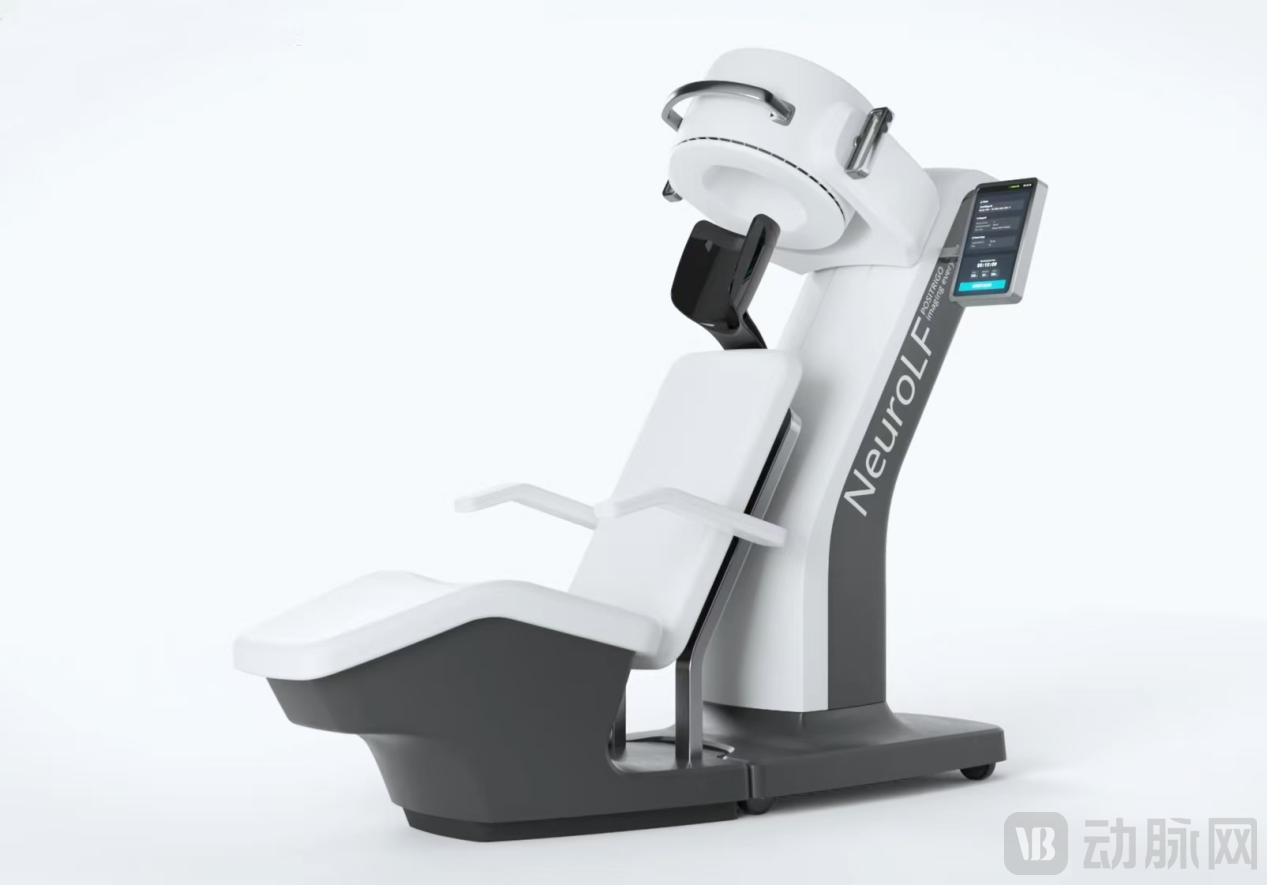
Schematic Diagram of the NeuroLF System Source: Positrigo Official Website
It is worth noting that NeuroLF’s high versatility enables it to support a wide range of tracers, capturing molecular abnormalities in the early stages of disease and facilitating early or even ultra-early diagnosis, thereby serving both research and routine clinical settings. Meanwhile, NeuroLF precisely addresses four major categories of brain disorders—Alzheimer’s disease, neuro-oncology, epilepsy, and movement disorders—directly meeting the diagnostic demands for the high prevalence of neurodegenerative diseases in an aging society.
As the first commercially available system of its kind on the market, NeuroLF has obtained FDA clearance in the United States and CE marking in the European Union, with its technology and safety widely recognized. Its “low-power” design also aligns with the trend toward green healthcare, reducing both environmental impact and economic costs associated with long-term operations.
Overall, NeuroLF addresses many of the pain points associated with traditional PET equipment through its low cost, high precision, and ease of deployment. It not only enables patients at primary care levels to conveniently undergo examinations, promoting early screening and treatment, but also helps medical institutions expand their diagnostic services for brain diseases, thereby allowing Positrigo to carve out a unique competitive path in the field of brain imaging devices.
3Demand and Product Sides Drive Steady Growth in the PET-CT Equipment Market
NeuroLF’s sustained appeal to investors is underpinned by multiple market logics.
From the demand side, the accelerating global aging population has led to a surge in the incidence of neurodegenerative diseases such as Alzheimer’s disease, driving an explosion in demand for PET imaging technology fueled by the need for early diagnosis. From the product side, NeuroLF’s “brain-dedicated” design and high-quality imaging performance meet clinical needs for early diagnosis and align with hospitals’ operational requirements for “disease-specific workflow optimization,” making it particularly suitable for primary healthcare institutions.
Currently, under the trend of precision medicine, the global market for PET-CT equipment is experiencing steady growth. According to an industry analysis report published by Market Growth Reports, the global PET-CT equipment market size was USD 1.886 billion in 2024 and is projected to reach USD 2.443 billion by 2033, indicating significant future market potential for NeuroLF.
Shifting focus back to China, the opportunities in the Chinese market are equally significant. On the policy front, national support for the localization of high-end medical equipment has been strong; after PET-CT devices were reclassified from Class A to Class B in 2018, approval thresholds were lowered, accelerating their adoption at the grassroots level. On the demand side, the continuous growth of the aging population has directly driven a surge in demand for brain disease screening. From an industrial perspective, domestically produced equipment is leveraging its cost and supply chain advantages to rapidly expand into overseas markets, particularly in countries along the “Belt and Road” initiative.
Against this backdrop, Chinese companies are actively positioning themselves in this sector. United Imaging Healthcare has captured market share with the high resolution and rapid imaging capabilities of its uMI Panorama series PET-CT systems, while also intensifying R&D efforts in dedicated brain PET scanners; its related products have successfully entered the European and American markets.
RuiShi Medical has launched China’s first Class III-certified, brain-dedicated all-digital PET scanner (DigitMI i30). This device demonstrates outstanding performance in the diagnosis of neurological disorders and has already achieved overseas sales, expanding its presence in markets along the “Belt and Road” Initiative. Meanwhile, Neusoft Medical has achieved technological breakthroughs with its NeuEra series of all-digital PET-CT systems. Equipped with self-developed chips that significantly enhance imaging accuracy, the system is rapidly penetrating the brain-dedicated imaging sector.
In the future, as related technologies accumulate and mature, continuous innovation in brain PET devices will make advanced diagnostic techniques accessible to more patients. This will reduce the societal burden of neurodegenerative diseases through early intervention, promote the realization of “healthy aging,” and further help humanity achieve comprehensive precision diagnosis and treatment of brain diseases.