

Tencent Brain Training Recognized as Digital Therapeutics Innovation Case: Exploring the Development Logic of AI in Healthcare

Tencent
Internet Comprehensive Service Provider
In May this year, Tencent’s first digital therapeutics product—the “Tencent Brain Training” cognitive function training software—obtained a medical device registration certificate issued by the Guangdong Provincial Medical Products Administration. Clinical data feedback indicated that 98% of participants in the intervention group, after completing the full 12-week training regimen, were assessed using the Loewenstein Occupational Therapy Cognitive Assessment (LOTCA) battery and the Montreal Cognitive Assessment (MoCA) scale. The results demonstrated that cognitive training conducted with this software can significantly improve cognitive abilities.
Benefiting from the R&D achievements and implementation progress of “Tencent Brain Training,” this digital therapeutic was included in the award list for “2025 Digital Health Innovative Application Cases” at the recently held “2025 Digital Therapeutics Conference,” becoming a paradigmatic example of driving deep innovation in digital therapeutics through gamified training.
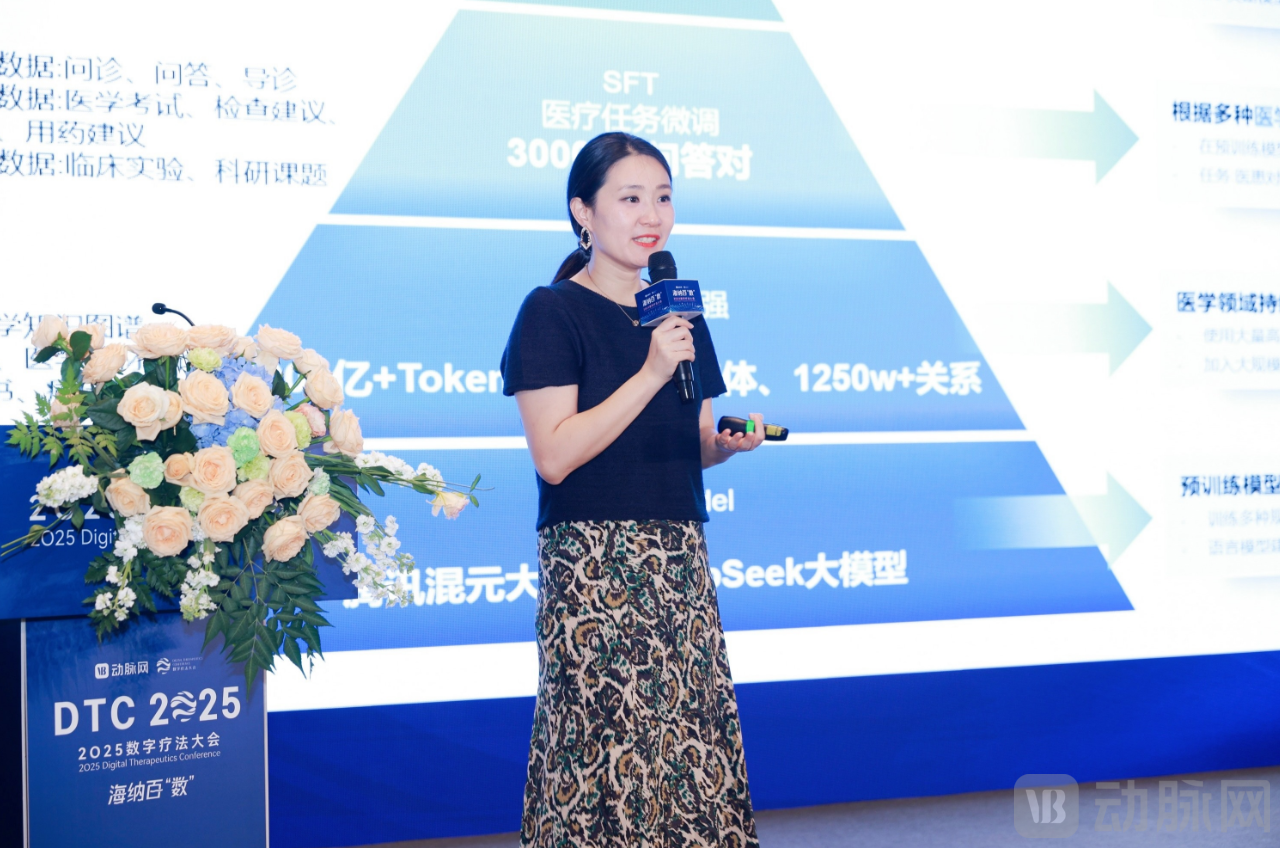
Wang Qianyi, General Manager of Tencent Health Strategy and Medical Products
Wang Qianyi, General Manager of Tencent Health Strategy and Medical Products, pointed out at the conference that Tencent’s layout in medical AI is not merely “theoretical discussion”; its AI solutions for healthcare have been “widely implemented” across the industry, establishing close connections with medical institutions, pharmaceutical companies, the broader health sector, and various consumer-end users. The research, development, and practical implementation of “Tencent Brain Training” serve as a concrete example of Tencent’s pragmatic exploration of digital therapeutics.
According to reports, Tencent Health’s medical AI solutions have been deployed in over 1,300 enterprises and hospitals. Its large-model-driven AI triage and consultation assistance tools, along with full-course disease management services, serve more than 10,000 medical institutions, while AI-assisted medical imaging examinations have surpassed the 10-million mark. Tencent’s AI has become deeply integrated into the healthcare industry, delivering tangible economies of scale.
To raise societal awareness about the prevention and treatment of cognitive disorders in the elderly population and to explore digital and intelligent solutions for cognitive issues, Tencent has successively launched the popular science game “Room 301, Building 6,” the serious game “Pavlov Is Busy,” and the mini-program “Silver Hair Brain Power.” The recently approved “Tencent Brain Training” initiative represents a deep cross-sector collaboration spanning gaming, healthcare, and psychology. Jointly developed by Tencent SSV’s Time Lab, the Tencent Games Social Value Exploration Center, and Tencent Miying, with content support from Tencent Music and product R&D guidance from the Department of Psychology at Sun Yat-sen University, this project marks a significant milestone. With this launch, Tencent has established a comprehensive solution covering “public education–screening–intervention” in the field of cognitive disorders.
For cognitive disorders, the value of “Tencent Brain Training” lies in its ability to help elderly patients with mild cognitive impairment (MCI) delay disease progression and effectively improve cognitive function through a portable, real-time, and engaging approach. After all, no current medication can reverse cognitive decline; however, early intervention during the MCI stage can effectively postpone the onset of Alzheimer’s disease, or even prevent it altogether.
In fact, Tencent Health’s overall strategy in recent years has consistently centered on the “C2B” model: focusing closely on two key service recipients—physicians and patients—and delivering AI-powered services that span the entire care journey, from pre-consultation through consultation to post-consultation. Building on this foundation, it provides digital capabilities, exemplified by AI, to healthcare institutions, pharmaceutical and medical device companies, and health technology enterprises.
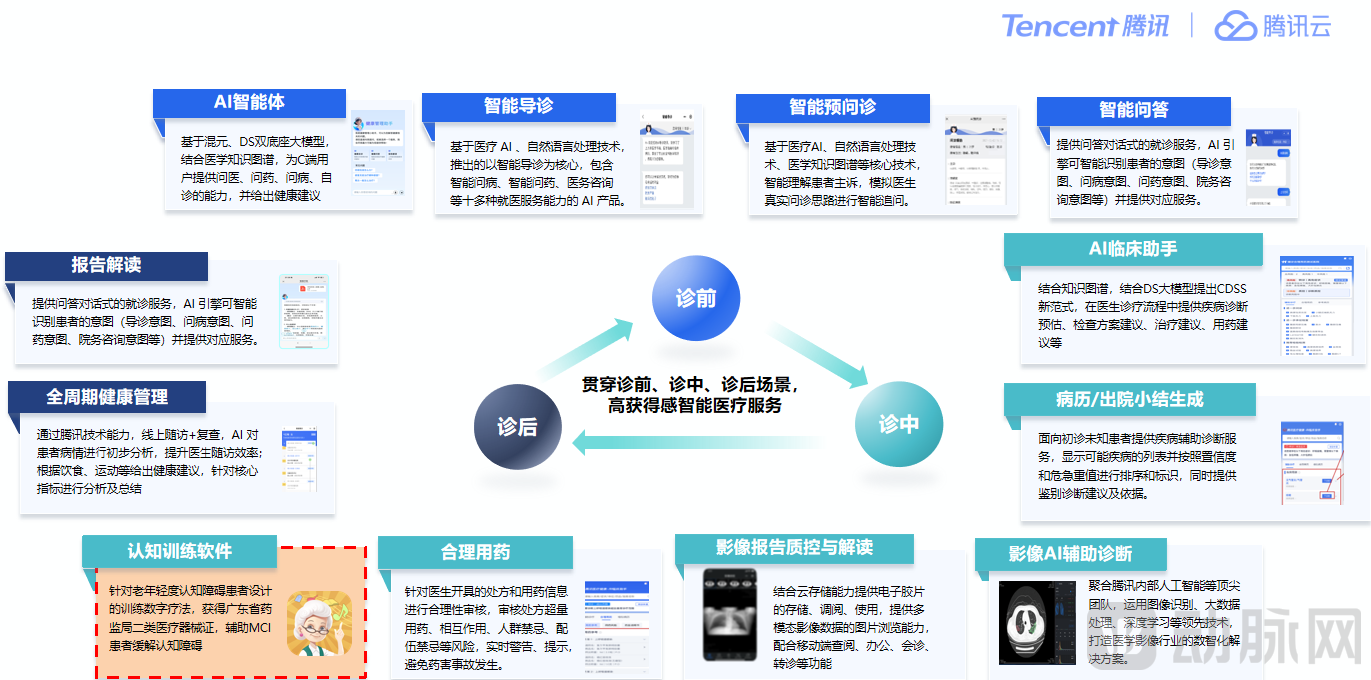 Tencent Health’s Medical AI Has Been Implemented Across the Entire Clinical Diagnosis and Treatment Workflow
The key lies in Tencent Health’s success in mastering the two core elements: “platform” and “service.”
“In Wang Qianyi’s view, patients are at the center of the entire healthcare journey, and Tencent Health can leverage the WeChat platform and its ecosystem to achieve maximized patient engagement. ‘This is Tencent Health’s greatest advantage.’”
“Services” are more complex. On the consumer side, Tencent Health has previously leveraged its own insights to deeply integrate AI into the core workflows of patient diagnosis and treatment, establishing a main framework that delivers simplified, coherent, and high-quality user experiences. In the era of large language models, next-generation technologies have further enhanced the value of these scenarios.
Specifically, the new capabilities iterated by AI in the first wave primarily focused on interaction, achieving genuine semantic understanding and multi-turn question-and-answer functionality. These advancements have driven a qualitative transformation in the user experience of Tencent Health’s consumer-facing (ToC) applications, enabling AI to facilitate human-computer communication with several times greater efficiency than before during both pre-consultation and post-consultation stages. It can be said that Tencent Health has firmly seized the dividends of the first wave of large medical language models.
Revisiting the B-side Market: Tencent Health’s Short-Term Strategy Focuses on “Efficiency Enhancement”Taking the AI applications most frequently used by physicians in their daily practice as an example, one involves the automated generation of textual documents such as medical records and discharge summaries; the other encompasses various auxiliary diagnostic tools, leveraging large language model capabilities to upgrade traditional Clinical Decision Support Systems (CDSS) and specialized imaging-assisted diagnostic solutions.
“AI-Assisted Discharge Summary Generation” is a typical efficiency-enhancing application, currently deployed in the breast surgery, gastrointestinal surgery, and neurosurgery departments of major tertiary A hospitals. Relevant data show that this application reduces the time required for writing discharge records by more than 70%, with an accuracy rate of 95%.
Looking at the landscape of large medical AI models, applications in this era still exhibit the characteristic of isolated breakthroughs, seemingly following no discernible pattern. This is because the surge in healthcare demands driven by technology always expands from specific points to broader areas over time, gradually taking shape. To ensure the stable progression of this process, enterprises must establish a robust core framework capable of integrating emerging applications and continuously providing them with the necessary support.
Within Tencent Health’s architecture, the AI application cluster that covers the entire diagnosis and treatment process serves as its trunk. With this foundational support, Tencent Health can seamlessly integrate new applications.
The “Health Management Assistant” released by Tencent Health in mid-year can be regarded as a typical case.
From a functional perspective, this application focuses on the scenario of health management. It can serve as a “Health Sentinel,” leveraging intelligent interpretation of physical examination reports and laboratory/test results to help users dynamically analyze their health status, identify potential risks, and provide targeted health management plans. It can also act as an “Action Coach,” by continuously tracking changes in health indicators over the long term, helping users effectively and promptly detect potential health risks and overcome the challenges associated with sustaining long-term health management.
Unlike traditional digital applications, Tencent Health has introduced the concept of “proactive management” in its “Health Management Assistant.” Previously, users only sought medical services when experiencing physical discomfort, resulting in low-frequency, passive usage. The “Health Management Assistant” establishes high-frequency, long-term relationships with users by analyzing information in real time, and enables them to access services through Tencent Health’s one-stop platform within WeChat.
Overall, within the vast healthcare industry, there are numerous scenarios akin to health screenings and cognitive digital therapeutics. Not every such scenario allows AI to be successfully translated from a market need into a viable product; each requires individual validation by industry practitioners.
Fortunately, with the support of Tencent Health’s AI health ecosystem, not only have the trial-and-error costs in potential scenarios been significantly reduced, but AI has also been effectively propelled from fragmented innovation toward large-scale value realization.
Through this increasingly lush and leafy tree, we see greater certainty in medical AI.