

Gilead's Kite Pharma Acquires Interius BioTherapeutics for $350 Million to Enter In Vivo CAR-T Arena

Kite Pharma
CAR-T Cell Immunotherapy R&D Provider

Gilead Sciences
Innovative Drug Developer, Distributor
According to incomplete statistics, at least six MNCs have entered the in vivo CAR-T field.
On August 21, Kite Pharma, a subsidiary of Gilead Sciences (hereinafter referred to as “Kite”) announced that it has signed a definitive agreement to acquire Interiusall issued share capital of BioTherapeutics (hereinafter referred to as “Interius”),The total cash consideration is US$350 million (Approx.(equivalent to RMB 2.5 billion)。The company focuses on developing in vivo cell therapies that can generate CAR-T cells and CAR-NK cells within the body (in-vivo cell therapy)。
This transaction integrates Interius’s in vivo integration platform, further expanding Kite Pharma’s advantages in cell therapy.In particular, Interius’s team and operations will be integrated into Kite Pharma’s R&D organization to establish a center of excellence in Philadelphia, accelerating the development of next-generation in vivo therapies. This transaction with Interius is expected to reduce Gilead Sciences’ 2025 GAAP and non-GAAP earnings per share by approximately $0.23 to $0.25.
Since 2025, AstraZeneca (acquiring EsoBiotec for a total of $1 billion) and AbbVie (acquiring in an all-cash deal worth $2.1 billion)Capstan Therapeutics) With a series of major acquisitions to position itself in the field of in vivo CAR-T therapy. Now, Gilead Sciences, holding two approved CAR-T products, has entered the arena, adding fuel to the fire of in vivo cell therapy.
1Interius: Lentiviral Delivery Vectors Targeting T Cells and NK Cells; Lead Pipeline Enters Clinical Trials
In Vivo Cell Therapy is a therapeutic approach that directly modifies or reprograms specific cells within the patient’s body. Unlike conventional cell therapies, which require extracting cells for ex vivo gene editing or modification before reinfusion, in vivo cell therapy delivers specific “instructions” to target cells, enabling them to acquire therapeutic functions directly within the body.
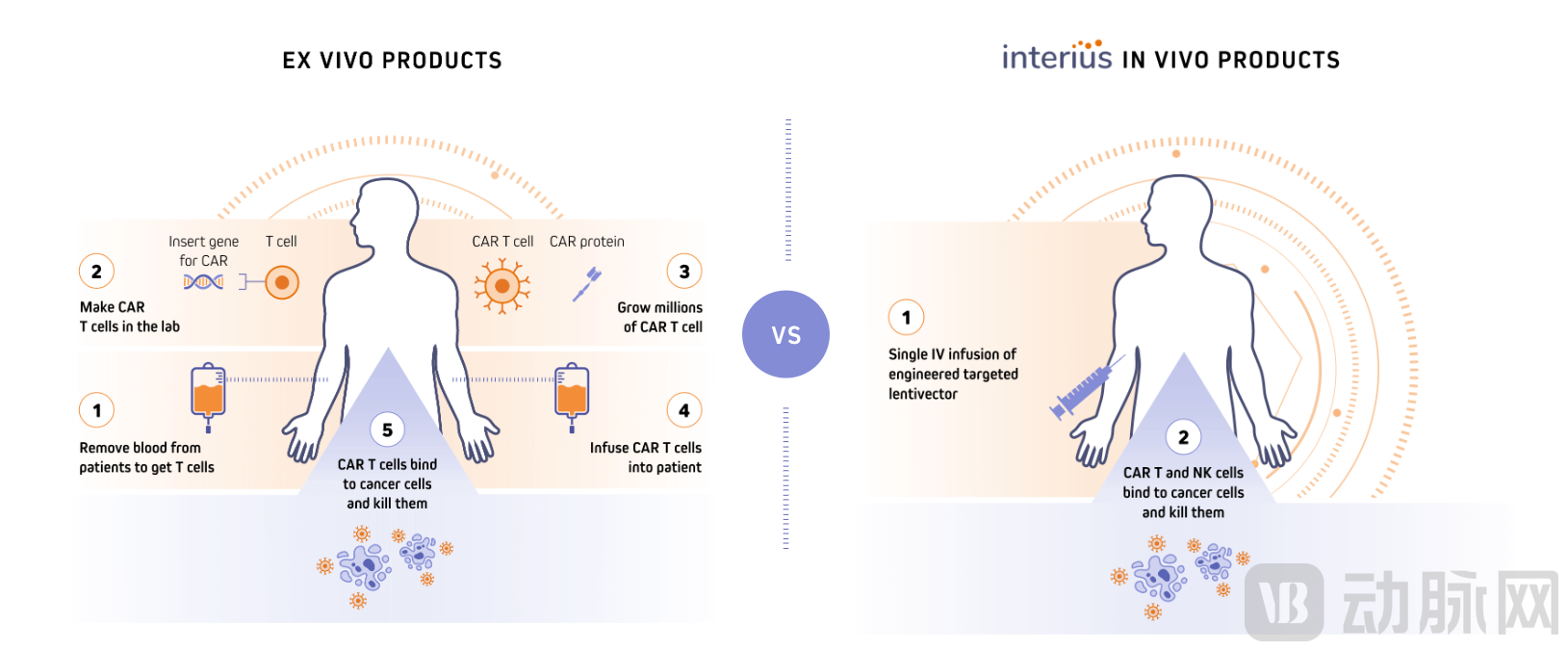
In Vivo Cell Therapy vs. In Vitro Cell Therapy
Interius through engineered slowVirusVectors deliver DNA(CAR Gene)Specifically Delivered to the Patient's Genome via Insertion,Generated directly in vivoReprogrammed CAR-T and CAR-NK,Binding to B cells。This planPromising to deliver more durable and longer-lasting therapeutic effects.
In the clinical setting, unlike ex vivo CAR-T therapies that require cell collection, engineering, and reinfusion, Interius’s off-the-shelf, personalized approach utilizesSingle Intravenous Infusionprovides, eliminating the need for preconditioning chemotherapy and complex cell processing.For advanced B-cell malignancies, etc.For the patient population,No need to wait for weeks of cell preparation processes,This means that timely treatment can be obtained during the critical stage of rapid disease progression, without compromising the patient’s own immune system or reducing the toxicity associated with prior chemotherapy.
From a commercial perspective, single-dose, non-customized products enable industrialized, standardized, low-cost production and transportation.On the one hand, industrially produced viral vectors or nanoparticles are significantly less expensive than personalized cell products and do not require customization at large cell and gene therapy centers.Significant Reduction in Monotherapy CostsOn the other hand, universal off-the-shelf products will establish a pharmacy-to-hospital transportation and storage system, eliminating the need to visit large cell and gene therapy centers that involve costly and lengthy preparation processes.Patient Compliance Significantly Improved。
Notably,In vivoThe core challenge of CAR-T technology lies in how to accurately and efficiently deliver the CAR gene to T cells within patients, while avoiding off-target effects.Adopted by InteriusLentiviral vector systems are currently the most rapidly advancing in vivoOne of the CAR-T technologies,Utilizing engineered lentiviral vectors to specifically infectT cells and deliver the CAR gene.
In terms of technical advantages, the advantages of lentiviruses are primarilylies in its genomic integration capability, which enablesCAR is persistently expressed in T cells, similar to the effects of conventional CAR-T; secondly,In the approved traditionalIn CAR-T therapy, lentiviral vectors haveAccumulated extensiveCMC and clinical experience, with relatively mature manufacturing processes. Furthermore, lentiviruses can carry larger gene fragments (approximately 8 kb), making them suitable for the design of complex CAR structures.
It is not difficult to see that, for cells in the bodyIn terms of therapeutic development, delivery technologies exhibit platform-based and holistic characteristics.Interius, EsoBiotec, and Capstan all emphasize their proprietary delivery platforms"Modularization"Carrier Platform/Architecture: Features high compatibility, adaptable to various cell types, rapidly adjusting to different disease states and production scales; widely applied across diverse therapeutic areas to expand the range of cell therapies.For this very reason,MNCs have pursued full acquisitions of in vivo CAR-T companies, with the key objective being to secure complete technology platforms for future expansion into a broad range of clinical indications.
And inBarriers to Innovation in Underlying Technical PathwaysAfterwards, DebutIn Vivo CARAdvancing the pipeline into the clinical stage signifies that the platform’s safety and efficacy have received preliminary regulatory endorsement.Currently,In VivoCAR therapies have begun to compete for high-profile targets and broad indications—established, popular targets such as BCMA and CD19 remain the primary focus for in vivo CAR-T development; hematologic malignancies, autoimmune diseases, and solid tumors are key areas of competition.
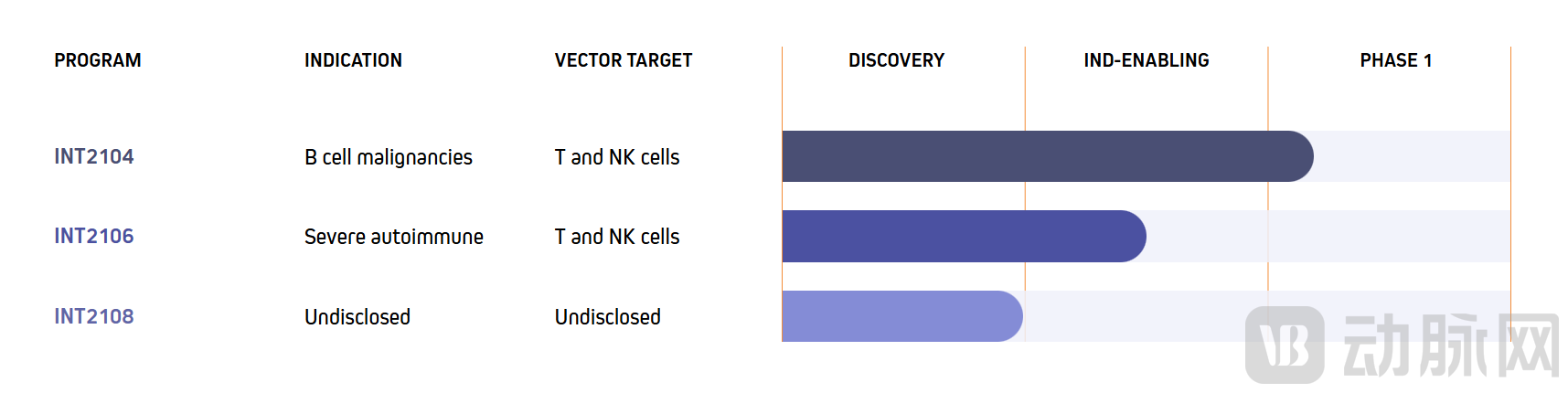
Interius Pipeline Portfolio
InteriusFirst-in-class Pipeline INT2104 Targets InfectionCD7 PositiveofT Cells and Natural Killer (NK) Cells, and transduce CAR transgenes to generate effector CAR-T cells and CAR-NK cells in vivo; the generated effector CAR cells will targetCD20-positiveB cells,for the treatment of B-cell malignancies。
In 2024, INT2104 initiated a global, multicenter, open-label clinical trial to evaluate the safety of a single infusion of INT2104 in adult patients with relapsed/refractory B-cell malignancies, and has completed dosing of the first patient. It is reported that INT2104 is an off-the-shelf, single-dose therapy administered viaIntravenous Injection for Systemic Administration, thereby improving patient accessibility and limiting off-target side effects.
Another preclinical pipeline, INT2106, focuses onSevere Autoimmune Diseases Mediated by Autoantibody Production, inducing the in vivo generation of CAR-T and CAR-NK cells to specifically eliminate CD19-expressing B cells, thereby achieving “immune reset.” Preclinical studies demonstrated complete elimination of human B cells in humanized mouse models, and GLP toxicology data support the safety of the candidate drug, which has best-in-class potential.
Compared to Capstan and EsoBiotec,InteriusAmong its two disclosed pipelines, aside from in vivo CAR-T generation, both explicitly highlight the achievement of in vivo CAR-NK generation as a differentiated design, which may be the key advantage valued by Gilead Sciences.
2Kite: Sales of Two Marketed CAR-T Products Decline; Where Is the Next-Generation CAR Leader?
Acquisitions and investments have always been the main theme of Gilead Sciences’ expansion in cell and gene therapy.
In 2017, just weeks before FDA approval for market launch, Gilead Sciences acquired Kite Pharma for $11.9 billion, obtaining itsThe World’s Second Targeted TherapyYescarta, a CD19-targeted CAR-T product, is primarily indicated for the treatment of relapsed or refractory large B-cell lymphoma (R/R LBCL) and relapsed or refractory follicular lymphoma (FL), marking the commencement of its strategic focus in the field of cell and gene therapy.
Since then, Kite has gradually established the world’s largest autonomous cell therapy manufacturing network, encompassing process development, vector manufacturing, clinical trial supply, and commercial production. In 2020, Kite’s CD19-targeted CAR-T therapy, Tecartus, was approved for marketing to treat patients with relapsed or refractory mantle cell lymphoma (R/R MCL).
In 2022, Yescarta surpassed the $1 billion threshold for the first time, with sales reaching $1.16 billion. Sales continued to rise in 2023, increasing by 24% year-over-year to $1.5 billion. According to the 2024 financial report, CAR-T cell therapies contributed $1.973 billion in revenue to Gilead Sciences, representing a 6% year-over-year increase. To date, 27,000 patients have received treatment with these products.
Despite year-over-year growth in sales, reaching $2 billion in annual revenue remains challenging. The Q2 2025 financial report showed that the CAR-T business underperformed compared to previous years. Yescarta generated $393 million in revenue in the second quarter, a 5% decline from the same period last year; sales of another CAR-T therapy, Tecartus, amounted to $92 million, representing a 14% year-over-year decrease.
Gilead Sciences explicitly pointed out that the decline in sales of both products was mainly due to reduced demand in the U.S. market. In fact,Newly approved products are also continuously squeezing the hematologic malignancy market—on one front, bispecific antibodies and antibody-drug conjugates (ADCs) with higher levels of industrialization, lower prices, and greater accessibility have been successively approved; on the other, CAR-T products such as BMS’s Breyanzi and Johnson & Johnson/Legend Biotech’s Carvykti are in hot pursuit.
Caught in a pincer movement, Gilead Sciences and Kite Pharma are urgently seeking disruptive next-generation cell therapies.
On novel targets for ex vivo CAR-T therapy,Kite Pharma partnered with Arcellx to co-develop the BCMA-targeted CAR-T therapy anito-cel, backed by substantial financial commitments: an initial $225 million upfront payment, up to $3.9 billion in milestone payments, and a $100 million equity investment; followed by a second tranche comprising an $85 million upfront payment and a $200 million equity investment. Recent publicly disclosed efficacy data have been outstanding. In the Phase 1a clinical trial for relapsed or refractory multiple myeloma (RRMM), patients treated with anito-cel demonstratedOverall response rate (ORR) reached 100%, with a complete response/strict complete response (CR/sCR) rate of nearly 80%., and no cases of certain delayed neurotoxicity have been observed in patients; the first patient has already been dosed in the relevant Phase 3 clinical trial.
In terms of universal off-the-shelf CAR therapy, August 2021, KitePartnering with Early-Stage Biotech Companies in Deals Worth Up to $875 MillionAppia Bio is dedicated to the research and development of hematopoietic stem cell (HSC)-derived cell therapies for the treatment of hematologic malignancies. Leveraging its proprietary “ACUA” allogeneic cell therapy platform, the company is developing chimeric antigen receptor invariant natural killer T cell (CAR-iNKT) therapies.
In the field of in vivo CAR therapy,In addition to Interius, which was acquired in this transaction,In 2023, Kite Pharma took an equity stake in Ensoma, a representative company in the field of ex vivo CAR-T therapy. The latter develops...In Vivo CAR-T/Gene Editing Therapies Targeting Hematopoietic Stem Cells. In May this year, the FDA approved the Investigational New Drug (IND) application for its lead candidate, EN-374, an in vivo hematopoietic stem cell (HSC)-targeted therapy for the treatment of X-linked chronic granulomatous disease (X-CGD), a rare genetic disorder.
In vivoThe Inflection Point in the CAR-T Debate: Traditional CAR-T Therapies Gain Recognition for Their Data and Efficacy, Yet Face Challenges in Large-Scale Commercialization and Widespread Adoption
And more chess players have already enteredThe Landscape—In 2023, Sanofi stated that it had three in vivo CAR-T projects in the preclinical development stage; in January 2024, AbbVie announced a collaboration with Umoja for the development of in vivo (in situ) CAR-T therapies, with a potential total value of $1.44 billion; in February of the same year, Astellas announced a partnership with Kelonia to develop in vivo CAR-T therapies, with a potential total transaction value exceeding $875 million; in November, Novartis officially announced a collaboration with Vyriad to develop in vivo CAR-T therapies.
The ultimate goal of this contest is to bypass tradition.Overcoming the Manufacturing Bottlenecks of CAR-T Therapy to Enable More Efficient, Cost-Effective, and Widely Applicable Cell Therapies, to achieve broader patient coverage.
Ultimately, we look forward to therapeutic regimens that offer superior efficacy and greater accessibility.