

China's High-End Medical Imaging Equipment Reaches Global Forefront with Photon-Counting CT Breakthrough

Neusoft
Comprehensive Solution Provider for Clinical Diagnosis and Treatment

United Imaging
High-end Medical Device Developer
Yesterday, China’s high-end medical device manufacturing sector achieved another major breakthrough.
The National Medical Products Administration (NMPA) disclosed that photon-counting CT scanners independently developed by Neusoft and United Imaging have simultaneously passed the NMPA’s review and approval, securing an early lead in the race for “next-generation” CT technology.
The value of photon-counting CT lies in its ability to bring about a qualitative leap in CT technology. It overcomes the imaging bottlenecks of contemporary spiral CT, offering advantages such as higher spatial resolution, lower radiation dose, and direct multi-energy spectral imaging. These capabilities enable researchers to gain deeper insights into human physiological information, significantly advancing the development of precision diagnosis and treatment.
After more than a century of dominance by multinational corporations in the high-end medical equipment manufacturing industry, China’s high-end imaging equipment manufacturing has finally reached the global forefront.
How Difficult Is It to Develop Proprietary Photon-Counting CT?
From the initiation of preliminary research in 2016 to regulatory approval for market launch in 2025, Neusoft Medical spent a decade.
Neusoft’s NeuViz P10, recently approved for market entry, is equipped with cadmium zinc telluride (CZT) photon-counting detectors., by directly capturing and reading individual X-ray photon information via CZT semiconductor crystals to achieve “direct photon counting,” thereby enabling breakthroughs in ultra-high-definition, ultra-low-dose, and multi-energy imaging.
Discuss the specifications of the NeuViz P10.
Neusoft Medical has disclosed that the NeuViz P10 achieves a spatial resolution of 50 lp/cm, surpassing the Canon photon-counting CT TSX-501R, which has a spatial resolution of 40 lp/cm. The latter, also utilizing CZT detectors, received NMPA approval in June this year.
In terms of temporal resolution, the NeuViz P10 is equipped with a new-generation supersonic platform, which, combined with iCMC (intelligent Cardiac Motion Artifact Correction) technology, achieves an ultra-high temporal resolution of 19 ms and whole-heart motion compensation. Supported by these parameters, the NeuViz P10 can effectively suppress motion artifacts in clinical practice, delivering clear coronary artery images even under complex conditions such as high heart rates and arrhythmias, with improved visualization of stents, calcifications, and plaques.
While photon-counting CT provides more detailed patient imaging, it also generates a workload several times greater than before. In this context, AI-based image preprocessing has become virtually indispensable.
Therefore, in addition to hardware innovations, the 17 AI technologies specifically tailored by Neusoft Medical for the NeuViz P10 are also a key highlight. These AI capabilities span intelligent pre-scan planning, real-time parameter adjustment during scanning, deep learning-based reconstruction after scanning, and intelligent post-processing for diagnosis, which can theoretically further enhance the research efficiency of medical researchers.
Currently, Neusoft Medical is engaged in in-depth clinical research collaborations with top-tier Grade 3A hospitals, including Peking Union Medical College Hospital, West China Hospital of Sichuan University, the First Affiliated Hospital of China Medical University, and Beijing Tiantan Hospital, Capital Medical University. These partnerships aim to expand the application of photon-counting CT in more complex disease categories and accelerate the translation of its clinical value.
United Imaging’s disclosed data primarily focuses on detector area and radiation dose.
On the detector path, United Imaging has also chosen CZT as the detector material. It is reported that United Imaging’s photon-counting CT reduces the pixel area of the detector to one-ninth of its original size when achieving ultra-high-resolution imaging, enabling the visualization of more subtle lesion structures. Meanwhile, through innovative correction and reconstruction algorithms, United Imaging has addressed the issue of reduced signal intensity caused by the smaller pixel area, thereby suppressing noise and ensuring image quality.
To address the challenge of processing the large data volumes generated by photon-counting CT, United Imaging has achieved ultra-high-resolution imaging with full collimation coverage, enabling more in-depth exploration in examinations requiring extensive coverage, such as cardiac imaging. Furthermore, photon-counting CT significantly reduces radiation dose, with reduction rates reaching 60% to 70%, and even 80% to 90% for certain tissues and organs, thereby making CT scans safer for patients.
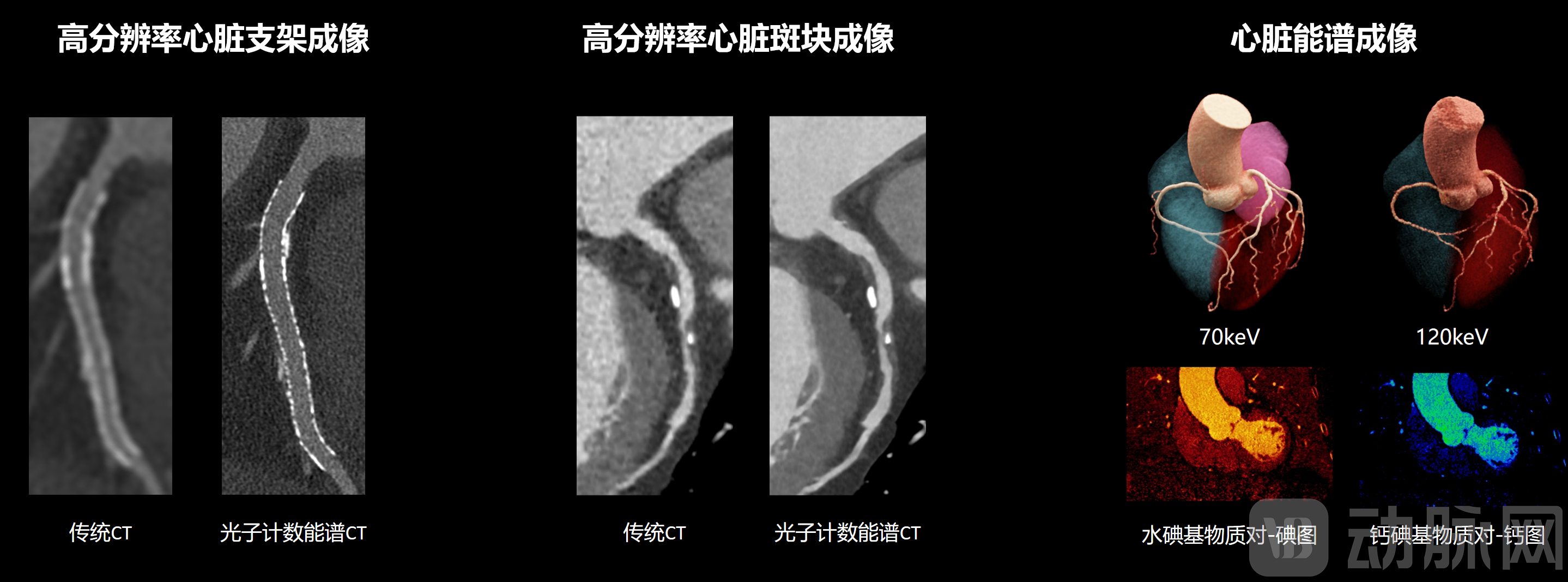 United Imaging Photon-Counting CT Cardiac Imaging
Although no information has been disclosed regarding the ecosystem, United Imaging Healthcare is capable of rapidly establishing a comprehensive system in the fields of diagnosis and even treatment, supported by the capabilities provided by enterprises such as United Imaging Intelligence and United Imaging Smart Finance.
Currently, the first batch of United Imaging’s photon-counting CT scanners has been installed at Zhongshan Hospital and Ruijin Hospital. To date, United Imaging has published more than 10 articles in top-tier journals on its self-developed photon-counting CT technology and has filed over 110 patents.
Despite gaining a first-mover advantage in regulatory approval and market access, the two companies must overcome production capacity constraints and secure market recognition to transform these advantages into sustainable barriers.
To guide optical signals to optical photon sensors and form pixels, traditional energy-integrating detectors (EIDs) rely on gadolinium oxysulfide (GOS) or cesium iodide (CsI) scintillator crystals, employing an indirect conversion pathway of “X-ray → visible light → electrical signal.” This process requires reflective septa or other structures to segment the detector, ensuring that each pixel independently receives optical signals. However, the photoelectric absorption efficiency is only 60%, and there are losses due to light scattering. Furthermore, as detectors reach 320 rows, the minimum unit for detector segmentation has approached its limit, making it difficult to further increase the number of detectors.
In contrast, photon-counting detectors (PCDs) employ wide-bandgap semiconductor materials such as cadmium telluride (CdTe) and cadmium zinc telluride (CZT), which can directly convert deposited X-ray energy into electrical signals without the need for anti-scatter grids. Therefore, the use of PCDs allows for a significant reduction in detector pixel size without compromising geometric detection efficiency, with photoelectric absorption accounting for more than 95% of interactions.
However, the physical property advantages of CdTe and CZT also mean that their mass production is extremely difficult. In nature, it takes 3 million years for cadmium telluride to form; cadmium zinc telluride does not exist in nature and requires extreme conditions for synthesis.
Therefore, the revolution brought about by photon-counting CT is not only a revolution in imaging modalities but also a revolution in materials science. The mass production of photon-counting CT naturally depends on the mass production of CdTe and CZT semiconductor materials.
Among photon-counting CT systems that have received mainstream regulatory approval, Siemens Healthineers has adopted the cadmium telluride (CdTe) pathway. CdTe exhibits characteristics such as a high atomic number, high density, and a wide band gap. Its optimal operating X-ray energy range nearly covers the energy spectra used in all medical imaging, security screening, and non-destructive testing equipment, making it considered the optimal material for implementing multi-energy spectral photon-counting X-ray technology.
Furthermore, the higher atomic number of CdTe detectors implies greater photoelectric absorption efficiency, while high carrier mobility and lifetime ensure that more carriers are transported to the electrodes without being trapped en route, enabling a detection efficiency of over 95% for 60 keV X-rays. In terms of energy resolution, the high resistivity of CdTe also ensures minimal leakage current at high operating voltages, thereby reducing noise during CT operation.
To achieve mass production of CdTe, Siemens Healthineers spent over a decade and invested more than €600 million. In 2023, the company further invested €80 million to build a new semiconductor factory in Forchheim, Germany, which is expected to commence operations in 2026 to expand mass production capacity.
The equipment approved for Neusoft Medical and United Imaging, as well as Canon Medical’s TSX-501R, all utilize cadmium zinc telluride (CZT) as the detector material. CZT and cadmium telluride (CdTe) are both II-VI compound semiconductors with broadly similar performance characteristics and advantages. However, CZT has a lower density, higher resistivity, and wider bandgap, offering superior hole transport properties and charge collection efficiency, thereby delivering better performance at room temperature.
According to relevant articles from the Med-Eng Study Society: Professor Jie Wanqi, who has long been engaged in research on CZT detectors in China, has developed a gamma radiation dosimeter centered on CZT crystals and sized only as large as a mobile phone. This device can detect radiation levels as low as “0.18 μSv/h,” which corresponds to the cosmic background radiation level, demonstrating that the sensitivity of CZT can reach the physical limit.
Currently, Redlen in Canada and Leading Medical in China have achieved mass production of CZT detector modules. United Imaging is also jointly developing CZT detectors with Shaanxi D-Tech, but has not yet disclosed the progress of its R&D efforts.
In addition to CdTe and CZT, GE Healthcare is also exploring the deep-silicon (Si) pathway for detector development. Industry insiders have revealed that GE Healthcare has completed the development of deep-silicon photon-counting CT, but has not disclosed its progress externally.
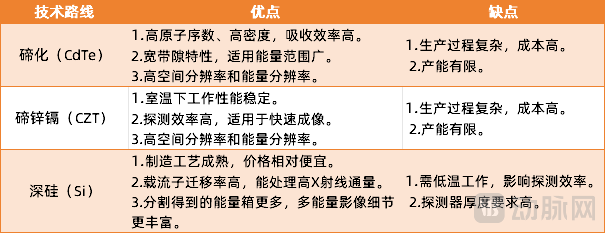
Detector Technology Pathway
Beyond mass production, domestically manufactured equipment still requires significant time and effort to gain market acceptance. The winning bid prices for domestic photon-counting CT systems in China range from RMB 45 million to RMB 55 million, which is relatively high; consequently, hospitals may favor products with established clinical evidence when making procurement decisions.
Therefore, in the early stages of commercialization, domestically produced photon-counting CT systems may need to collaborate with more top-tier hospitals to obtain richer empirical data, or appropriately lower prices. Once this initial phase is overcome, the prospects are bright.
Currently, approximately 20 hospitals in China have purchased photon-counting CT scanners, leaving substantial unmet demand.
Therefore, in addition to Neusoft Medical and United Imaging, many other Chinese enterprises are targeting the emerging market for “next-generation” CT scanners, aiming to lead China’s high-end manufacturing of medical devices.
Ten days ago, Advanced Technology Group also launched VITA Genesis, a photon-counting CT system with fully independent intellectual property rights. At the launch event, Advanced Technology Group revealed that the CZT detector solution for VITA Genesis was independently developed, overcoming core challenges in photon-counting CT technology, including the purification of 7N-grade ultra-high-purity raw materials, mass production of CZT crystals, chip and device design and development, as well as data correction and reconstruction algorithm development. Theoretically, it has successfully addressed every key hurdle in photon counting.
Currently, VITA Genesis by Lead Medical has completed its preclinical studies. Leveraging its mass-production advantage in CZT detectors, VITA Genesis is poised to rapidly scale up capacity after regulatory approval, demonstrating the potential to catch up with and surpass competitors.
In addition, NanoVision Imaging has taken a different approach by innovating CT imaging modalities through “phased-array CT,” achieving resolution on the same order of magnitude as photon-counting CT.
According to the company, the phased-array CT “Compound Eye 24” has completed clinical trials and is poised to receive NMPA approval in 2025.
From Monopoly to Multi-Player Competition: The Prosperity of China’s Medical Imaging Equipment Manufacturing Industry Demonstrates Its Capacity to Incubate Multiple Tiers of Strength in High-End Manufacturing, Foster a Healthy Competitive Landscape, and Jointly Drive Industrial Advancement.
If this sci-tech innovation model is successfully replicated, we may achieve breakthroughs in healthcare and beyond, allowing more high-end industries to shine with “Chinese wisdom.”