

China's Domestic Breakthrough in the 20-Year Monopolized High-End Intraoperative MRI Market

Sino Canada Health
Brain Science Research and Development Provider
Amid the sweeping trend of centralized procurement for medical devices, many domestic manufacturers have carved out their own paths, making headway in the surgical navigation sector.
A while ago, Yiyi Medical achieved the highest market share in the 3D C-arm sector. Recently, Sino Canada Health’s independently developed MOBINEURO Alita 1.5T intraoperative magnetic resonance imaging (iMRI) system received Class III medical device registration approval from the National Medical Products Administration (NMPA). It has become the first iMRI system in China to obtain both international and domestic certifications, as well as the NMPA’s first approved internationally pioneering floor-mounted mobile iMRI system.
From the perspective of the iMRI market’s development trajectory, Sino Canada Health has entered at just the right time.
The iMRI market in developed countries such as those in Europe and the United States has reached maturity, while the Asia-Pacific region, including China, is in its early stages of development with strong growth momentum.
According to research data from Fact.MR, the global market size for intraoperative magnetic resonance imaging (iMRI) equipment is projected to reach $1.22 billion in 2025, maintaining a compound annual growth rate (CAGR) of 8.5% and reaching $2.77 billion by 2035. Benefiting from the price advantages of MRI systems driven by centralized procurement, the increasing penetration of minimally invasive surgeries, and the rapid development of AI technology, China will continue to grow at the fastest global CAGR of 8.6%, becoming the core driver propelling the overall development of iMRI worldwide.
However, breakthroughs at the device level alone are insufficient to seize this wave of opportunities. To achieve large-scale deployment of iMRI in China and expand its application scenarios, domestic pioneers need to integrate upstream and downstream resources and establish a comprehensive system.
Unlike traditional magnetic resonance systems, iMRI deeply integrates magnetic resonance imaging technology with surgical workflows. Applied during surgical procedures within a sterile environment (such as an operating room equipped with dedicated MRI equipment), it acquires high-resolution MR images of the patient’s surgical field in real time, providing surgeons with dynamic and precise anatomical information to assist in surgical execution and decision-making.
Currently, the application of intraoperative MRI (iMRI) in neurosurgery is the most mature. It is suitable for navigation in procedures such as glioma resection, surgery for giant pituitary adenomas, cerebral bypass surgery, functional neurosurgery, and stereotactic brain biopsy. iMRI enables multiple intraoperative functionalities, including functional magnetic resonance imaging (fMRI), diffusion tensor imaging (DTI), perfusion-weighted imaging (PWI), magnetic resonance spectroscopy (MRS), and magnetic resonance angiography (MRA).
Compared with traditional optical navigation, iMRI not only provides real-time imaging to dynamically track the position of interventional devices (such as puncture needles and catheters), monitor lesion changes and surrounding tissue responses, ensure procedural precision (e.g., avoiding damage to blood vessels and nerves), and detect complications such as hemorrhage and thrombosis, but also automatically triggers scans every 10–15 minutes to correct for “brain shift” in real time (such as brain tissue collapse following meningioma resection), thereby reducing localization error from 0.8–1.2 mm with optical navigation to 0.5 mm.
In clinical practice, these advantages can effectively increase the gross total resection rate of complex tumor resections. For example, Huashan Hospital of Fudan University conducted a retrospective study on a total of 1,172 iMRI-navigated surgeries. The data showed that iMRI combined with multimodal brain functional localization technology increased the gross total resection rate of gliomas from 54.39% to 83.34% (P=0.0008), reduced the surgical disability rate for tumors in eloquent areas from 15.3% to 5.6%, and resulted in zero perioperative mortality.
Another NCBI study showed that among 46 glioma patients undergoing third-generation iMRI, the extent of resection (EOR) for enhancing gliomas increased from 84% to 99%, and for non-enhancing gliomas from 63% to 80% (P < 0.001). Surgery was terminated in 23 patients after iMRI confirmed gross total resection, while radical resection was achieved in 21 patients through iMRI-guided supplemental resection.
Beyond neurosurgical applications, many overseas companies are also further exploring the potential of iMRI in other surgical scenarios.
In late July this year, Cook Medical officially announced the establishment of its Interventional MRI Division, with an initial investment of $230 million to drive the research and development, manufacturing, and clinical adoption of magnetic resonance imaging systems.
It is reported that Cook Medical will launch three MRI devices covering different clinical scenarios within the next five years, including its first high-field open MRI optimized for neurology specialties, a 1.5T whole-body MRI system featuring superconducting magnet technology, and a portable low-field MRI solution.
Although Cook Medical has not explicitly disclosed the expansion directions for iMRI scenarios, its product line design suggests that high-field open MRI systems optimized for neurology will upgrade iMRI systems in neurosurgery, while 1.5T whole-body MRI systems can be used in scenarios such as cardiac surgery and urology.
Siemens Healthineers has a more mature layout in the iMRI direction. Last December, Profound Medical and Siemens Healthineers signed a cooperation agreement to jointly promote MRI-guided prostate treatment at the commercial level. Profound Medical's transurethral ultrasound ablation system for the prostate, TULSA.
Guided by iMRI, TULSA can treat diseased prostate tissue without incisions or radiation exposure, reducing the procedure time to a few hours and allowing patients to undergo the treatment on an outpatient basis.
Furthermore, MRI offers superior soft-tissue contrast and enables multi-parametric imaging in any plane and at any angle. It can detect minute lesions that may be missed by ultrasound or CT, thereby enhancing the precision of biopsy and therapeutic interventions. Consequently, it is also applied to the biopsy or treatment of tumors in solid organs such as the liver, lungs, kidneys, pancreas, and retroperitoneum, making it particularly suitable for pediatric patients and individuals requiring frequent interventional procedures.
Brain-computer interfaces, which have developed rapidly in recent years, also have a role to play in iMRI, enabling real-time intraoperative marking of “functional no-go zones” to avoid damage to critical brain regions.
For example, during BCI electrode implantation surgery near the language area, intraoperative brain shift may cause a change in the location of Broca’s area (the language center). iMRI can “overlay” preoperative fMRI functional markers onto real-time intraoperative anatomical images, allowing surgeons to clearly see whether the electrode implantation trajectory avoids Broca’s area, thereby ensuring that electrode placement does not impair the patient’s language function.
Despite the significant clinical advantages of intraoperative MRI (iMRI) in neurosurgery and its substantial potential in other surgical specialties, the deployment of iMRI systems in hospitals across China remains limited, and their application has not yet become mainstream. Statistical data show that only 350 iMRI units were installed in China in 2023, with large tertiary Grade A hospitals being the primary adopters of such systems.
Ultimately, the deployment of iMRI systems and the implementation of related surgical procedures impose high demands on hospitals’ comprehensive capabilities and the maturity of China’s domestic surgical instrument supply chain, leaving many hospitals unable to fully leverage the value of iMRI.
To meet the operational requirements of intraoperative MRI (iMRI) in clinical settings, hospitals need to construct a complex system encompassing imaging equipment, operating room environments, non-ferromagnetic materials, and multimodal information systems, while simultaneously addressing challenges such as magnetic field homogeneity (error < 0.1 ppm) and electromagnetic compatibility (supporting the synchronous operation of surgical robots and electrophysiological monitoring).
The cost of this system is prohibitively high. Statistical data on the construction costs of hospitals that have previously deployed iMRI hybrid operating rooms indicate that building a hybrid operating room equipped with a 1.5T MRI scanner requires an investment of approximately RMB 30 million to 60 million, whereas upgrading to a 3.0T MRI system would entail costs ranging from RMB 60 million to 90 million.
Furthermore, iMRI imposes specific requirements on the materials of instruments used during surgery, further increasing surgical costs. For instance, in the realm of high-value consumables, interventional devices required for procedures (such as biopsy needles, scalpels, and ablation electrodes) must be manufactured from MRI-compatible materials (e.g., non-magnetic metals, carbon fiber). This is essential to prevent attraction by the magnetic field (avoiding instrument displacement) or interference with imaging (reducing artifacts), while also minimizing heat generation within the magnetic field to prevent tissue burns.
Taking biopsy needles as an example, although multiple domestic manufacturers in China are capable of producing such products, their performance still lags behind that of imported counterparts. Imported products demonstrate a magnetic interference resistance of 99.9%, whereas similar domestically produced products achieve only approximately 95%, which may lead to image artifacts.
Additional considerations regarding hospital operations have also hindered the adoption of iMRI to some extent. For instance, under the current reimbursement system, hospital administrators lack sufficient incentive to upgrade navigation equipment when existing technologies already meet performance metrics, thereby indirectly impeding the commercialization of iMRI.
However, the continuous price reduction of MR equipment in recent years has significantly lowered the construction costs of hybrid operating rooms, creating an opening for the large-scale adoption of interventional MRI applications. Various policies are also encouraging hospitals to systematically promote the development of minimally invasive surgical techniques, which is likewise expected to facilitate the implementation of iMRI devices and related applications.
Furthermore, the advancement of AI has endowed intraoperative MRI (iMRI) with new value. For instance, GE’s Sonic DL algorithm can reduce the time required to convert iMRI sequences into images and enhance the automatic identification of tumor boundaries. With further enhancement of iMRI capabilities, it may find viable commercialization pathways in a broader range of clinical scenarios.
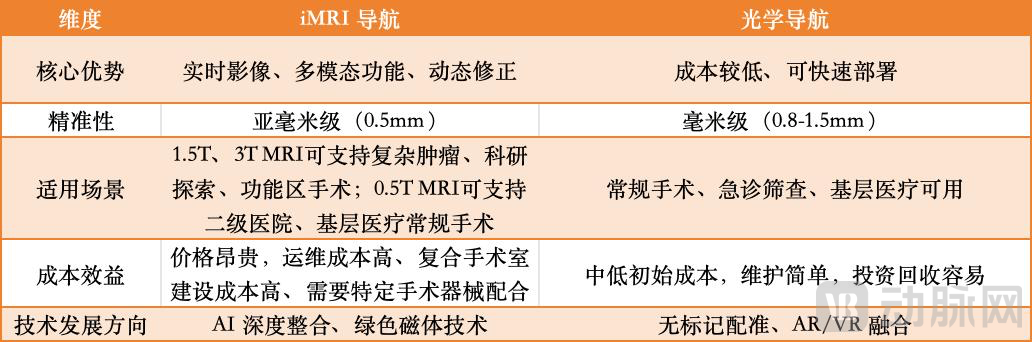
Pros and Cons of iMRI: A Case Study in Neurosurgical Applications
In addition to Sino Canada Health, which has already obtained the Class III medical device registration certificate for a ground-based mobile intraoperative MRI system, domestic players such as United Imaging Healthcare and Shuokin Medical have also entered the market. Leading equipment manufacturers, including Neusoft Medical, Wandong Medical, and Anke, also possess the potential to rapidly enter this sector.
However, as mentioned above, the advancement of iMRI applications requires not only breakthroughs at the equipment level by enterprises, but also the establishment of a systematic supply chain and the identification of more effective entry points in clinical practice.
From the perspective of the current market landscape, Cook Medical’s iMRI initiative is likely to be implemented at a faster pace than those of domestic Chinese companies. This is because it has already established a solid barrier in minimally invasive surgery, enabling it to gain quicker and more precise insights into clinical demands for iMRI, identify scenarios that maximize iMRI’s value, and thereby leverage iMRI to further strengthen its technological moat in minimally invasive surgery.
Among the many enterprises, United Imaging Healthcare holds a leading position in this sector thanks to its “equipment + surgical instruments” strategy. Achieving 100% self-sufficiency in core components such as superconducting magnets and gradient coils has made United Imaging’s MRI systems more price-competitive. Meanwhile, the surgical instruments provided by United Imaging Smart Fusion can be tailored into customized systems according to specific needs, thereby better addressing potential clinical demands.
After obtaining the market access approval for its iMRI equipment, Sino Canada Health has also established a strong first-mover advantage. However, to successfully advance clinical application, the company still needs to identify high-quality partners and deeply integrate its devices with consumables, thereby avoiding detours in clinical practice.