

"Net Profit" Exceeds RMB 1 Billion! Another Domestic Small Molecule Drug Goes Global
Fosun Pharmaceutical
Healthcare Industry Group

Sitala
--
On the night of August 26, Fosun Pharmaceutical announced that its controlling subsidiary, Shanghai Fosun Pharmaceutical Development Co., Ltd., has granted Sitala the rights to develop, manufacture, and commercialize FXS6837 and products containing this active ingredient on a global basis excluding China (including Hong Kong, Macao, and Taiwan), for the diagnosis and treatment of human and animal diseases.
Sitala will payA non-refundable upfront payment of $25 million, and development and commercialization milestone payments of up to $165 million, for a total aggregate amount of up to $190 million (approximately RMB 1.36 billion). In addition, Sitala shall make payments to Fosun Pharmaceutical Development in accordance with the agreement, based on the achievement of annual net sales of the Licensed Products in the Licensed Territory.Fuup to $480 million in sales milestone payments,and a maximum of double-digit percentage points within the agreed future periodRoyalties。
Meanwhile, this overseas expansion alsoPossesses certain Newco characteristics——Based on this license, Fosun Pharmaceutical Industry (or its designated affiliates) mayAcquire Sitala shares valued at USD 5 million at zero consideration, with an estimated post-dilution shareholding not exceeding 10%. Unless otherwise agreed, Fosun Pharmaceutical Industry may conduct global clinical studies on the licensed products jointly with Sitala.
According to the announcement,As ofIn July 2025, Fosun Pharmaceutical is currently targeting this investigational drugCumulative R&D investment was approximately RMBRMB 120 million (unaudited).The non-refundable upfront payment of just $25 million (approximately RMB 179 million) alone has already matched the cumulative R&D investment to date. When combining the upfront payment with development and commercialization milestone payments, this Phase II small-molecule inhibitor is expected to generate net revenues exceeding RMB 1 billion for Fosun Pharmaceutical.
1Sitala: Focusing on the Treatment of Neurodegenerative and Inflammatory Diseases
FXS6837 is a small-molecule inhibitor with independent intellectual property rights owned by Fosun Pharmaceutical, indicated for diseases related to immunomodulation. It is currently in Phase II clinical trials in China and Phase I clinical trials in Australia. The announcement cited IQVIA MIDAS™ data, stating thatIn 2024, global sales of major drugs used to treat related diseases totaled approximately $3.8 billion.
Sitala, the acquirer, was founded in May 2021 and is registered in the United Kingdom. It is a biotechnology company focused on the research and development of innovative drugs in the field of inflammatory and autoimmune diseases. According to the PitchBook analytics platform,Sitala is backed by several renowned European and American investment institutions, including Forbion (European life sciences venture capital), MaasInvest (Dutch family investment fund), and OrbiMed,Shake It Up Australia Foundation (Australian Parkinson's Disease Research Charity Fund)。
Its founder, director,CEO Matthew Cooper is a Fellow of the Royal Society of Medicine,Possesses extensive experience in life science platforms, as well as in the clinical diagnosis and treatment of inflammation, autoimmune diseases, and infectious diseases.Dr. Cooper has founded or co-founded six companies, including Sitala and Inflazome(developing inflammasome inhibitors for chronic inflammatory diseases), Defensin Therapeutics, Cambridge Medical Innovations, Akubio, etc.
According to SitalaOfficial Website: The company’s primary focus is “Stop Harmful Inflammation and Get Better,” with an emphasis on therapeutic treatments.Neurodegenerative and Inflammatory DiseasesSitala Bio aims to treat the symptoms and root causes of diseases affecting many people by providing novel drugs that block harmful inflammation, thereby preventing its onset and progression.
The team believes that the human immune system evolved to respond to infections that cause disease and death. However, as human life expectancy continues to increase, the immune system has begun to triggerChronic (chronic) Low-Grade (low-grade) Inflammation, thereby leading to inflammatory diseases of the brain and body.
In the field of neurodegenerative diseases, evidence indicates that chronic inflammation plays a critical role in the onset and progression of conditions such as Parkinson’s disease and Alzheimer’s disease. Dysfunction of immune cells in the brain, including microglia and astrocytes, leads to the production of inflammatory molecules, thereby impeding the clearance of toxins such as amyloid proteins from the brain.In terms of systemic diseases, harmful inflammation in the body can lead to disorders affecting the musculoskeletal system, lungs, kidneys, intestines, skin, eyes, and other organs.
It is reported that,Chronic Low-Grade Inflammation (Chronic Low-Grade Inflammation refers to the early stage of chronic diseases, which is also a critical window for intervention. Currently, most interventions for chronic diseases focus on management after disease onset; however, with the deepening concept of proactive health, interventions are increasingly shifting toward and targeting this early stage of chronic low-grade inflammation.
2Fosun Pharmaceutical: Second Innovative Drug for Immuno-Inflammatory Diseases Goes Global This Month
Two innovative drug overseas deals within a month mark Fosun Pharmaceutical’s “Focus on Innovative Drugs and High-Value Medical Devices"Strategy: 'In-house R&D + BD'"”Value Realization Driven by a Dual-Engine Strategy.
In the first half of 2025, affected by factors such as the renewal of bids for national centralized volume-based drug procurement and the implementation of local centralized volume-based drug procurement programs, Fosun Pharmaceutical achievedOperating RevenueRMB 19.514 billion, a decrease from the same period last year. Among them, the pharmaceutical business generated revenue of RMB 13.901 billion, a year-on-year decrease of 5.29%.
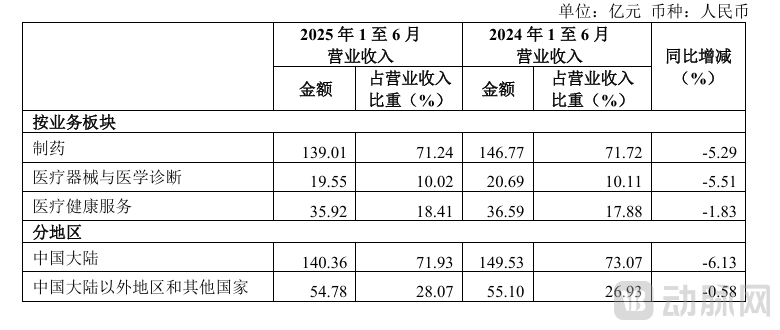
(Fosun Pharmaceutical2025Semi-Annual Report-(Revenue Structure)
But during the same periodInnovative Drug Revenue Grows Steadily, ExceedingRMB 4.3 billion, a year-on-year increase of 14.26%Representative products include Hanquyou (Trastuzumab for Injection and Trastuzumab Bulk Solution), Hanlikang (Rituximab Injection), Hansizhuang (Serplulimab Injection), and Yikaida (Axicabtagene Ciloleucel Injection).
In terms of therapeutic drugs, five indications for four innovative drugs independently developed or licensed-in by Fosun Pharmaceutical have been approved domestically and internationally, four innovative drugs have been submitted for marketing approval, and 57 generic drug varieties have been approved domestically and internationally.
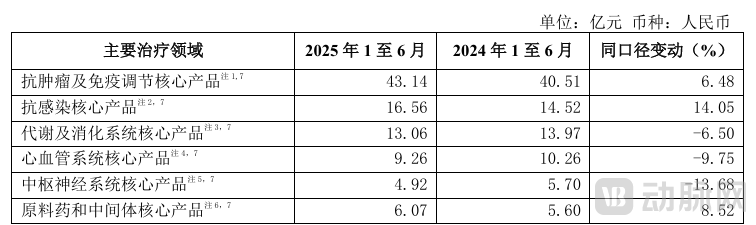
(Fosun Pharmaceutical2025Semi-Annual Report –(Sales Revenue of Core Products in Key Therapeutic Areas of the Pharmaceutical Business)
During the reporting period, R&D investment in the pharmaceutical business amounted to RMB 2.295 billion, accounting for 16.51% of pharmaceutical business revenue; of which, R&D expenses were RMB 1.469 billion, representing 10.57% of pharmaceutical business revenue.
R&D investment exceeding 10% of revenue is indirectly reflected in its robust business development (BD) activities.
August 11, Fosun Pharmaceutical Industry granted Expedition Therapeutics its independently developed small-molecule oral
Two Transactions Within a Month Share Many Similarities, Offering a Glimpse into Fosun Pharmaceutical’s BD Strategy:
First, all assets in the transaction pipeline are small-molecule drugs in the immuno-inflammation field; they have all entered Phase II clinical trials in China and possess preliminary human trial data.Potential indications for XH-S004 includeNon-cystic fibrosis bronchiectasis (NCFB) and chronic obstructive pulmonary disease (COPD). Currently in Phase II clinical trials in China, respectively.Clinical Trials (NCFB) and Phase Ib clinical trial (COPD), with R&D progressing smoothly.
Secondly, Fosun Pharmaceutical retained the rights for the Chinese market and continued to advance clinical research and the marketing approval process. The counterparties were all overseas biotech companies, collaborating on global clinical development.Expedition, which acquired XH-S004, was founded in 2024 as a biotechnology company focused on the research and development of innovative therapies for autoimmune diseases. Its core management team comprises professionals with expertise in drug development and business development from multinational pharmaceutical and biotechnology companies. Yi Larson, former Chief Financial Officer of LianTuo Bio, serves as Chairman and CEO. Current investors include several renowned U.S. investment institutions with extensive industry investment experience.
Furthermore, the upfront payment is substantial, and the payment and negotiation mechanisms are showing a trend toward diversification.Expedition willPay up to$120 million non-refundable upfront payment(US$17 million)Development and Regulatory Milestone Payments, up to $525 million in sales milestone payments, as well as agreed-upon royalties. The collaboration with Sitala goes even further, in addition to$190 Million Upfront Payment and Development and Regulatory Milestone Payments, $480 million in sales milestone payments, and royalties, it also increased its equity stake in Sitala by $5 million.
In the “banner year” for global expansion, Chinese innovative pharmaceutical companies are steadily enhancing their voice and bargaining power, with asset values being visibly realized. Meanwhile, this value realization is exhibiting a data-centric trend—with each developmental stage advanced, asset value grows geometrically, particularly upon the availability of human data from Phase II clinical trials.
For Fosun Pharmaceutical, which boasts strong in-house R&D and commercialization capabilities, partnering with under-the-radar yet resource-rich biotech firms would be the icing on the cake.