

Zhejiang University Taizhou Institute Unveils Two Breakthrough Medical AI Innovations: 'PanYi Knowledge Graph' and 'Spark Medical LLM Full-Stack Toolchain'
On August 30, the Taizhou Research Institute of Zhejiang University held a press conference to release scientific and technological achievements under the theme “Dual-Engine Drive of Capability × Efficiency for Smart Healthcare.” In collaboration with Zhejiang University, Sir Run Run Shaw Hospital affiliated with Zhejiang University School of Medicine, and Zhejiang Xunyi Technology Co., Ltd., the institute unveiled its interim outcomes: the “Panyi Knowledge Graph,” currently known as the largest Chinese clinical medical knowledge graph in China, and the “Xinghuo Medical Large Model Full-Stack Toolchain.” The launch of these two industry-leading innovations at the intersection of artificial intelligence and clinical medicine marks key breakthroughs in “trustworthy clinical decision-making” and “intelligent medical documentation,” providing actionable innovative pathways to address core pain points in healthcare scenarios in the intelligent era.
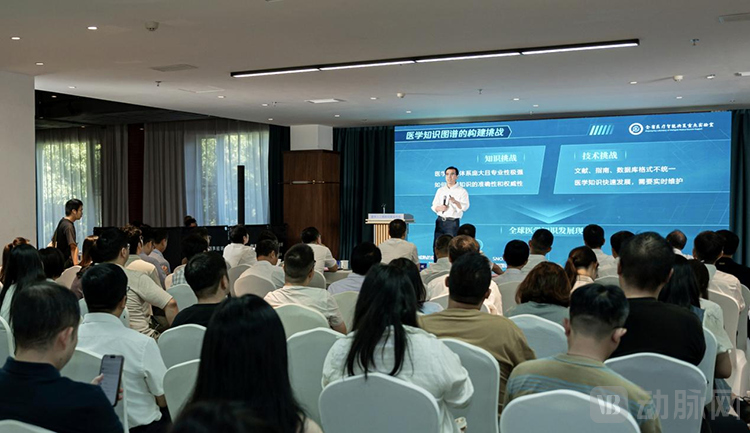
Medical Knowledge Graph: Making Every Clinical Decision Smart and Trustworthy
Over the past two years, large pre-trained models have made remarkable progress, yet their implementation in the healthcare sector has remained elusive. A thorough examination reveals that the core impediments lie in three major bottlenecks: information distortion caused by "hallucinations," lack of interpretability in generated outputs, and significant lag in updating medical knowledge. Medical decisions directly impact patients' health and even lives; any falsehood or misleading information can lead to severe consequences such as misdiagnosis, missed diagnoses, and delays in treatment.
“Knowledge graphs offer unique advantages, including structured knowledge, authoritative sources, full traceability throughout the knowledge lifecycle, and real-time updates,” stated Lin Hui, Director of the Provincial Key Laboratory of Intelligent Medical Decision-Making, Deputy Dean of the College of Biomedical Engineering and Instrument Science at Zhejiang University, and Director of the Internet and Artificial Intelligence Office at Sir Run Run Shaw Hospital, Zhejiang University School of Medicine. He explained that the knowledge reasoning of pre-trained large language models is essentially based on statistical associations stored in parameters, generating outputs through probabilistic predictions. In contrast, knowledge reasoning in knowledge graphs is fundamentally grounded in structured semantic networks, mining implicit relationships from existing knowledge. By leveraging large-scale multimodal knowledge graphs, it is possible to achieve end-to-end traceability from knowledge sources to clinical applications, ensuring that every clinical decision is evidence-based and fully auditable.
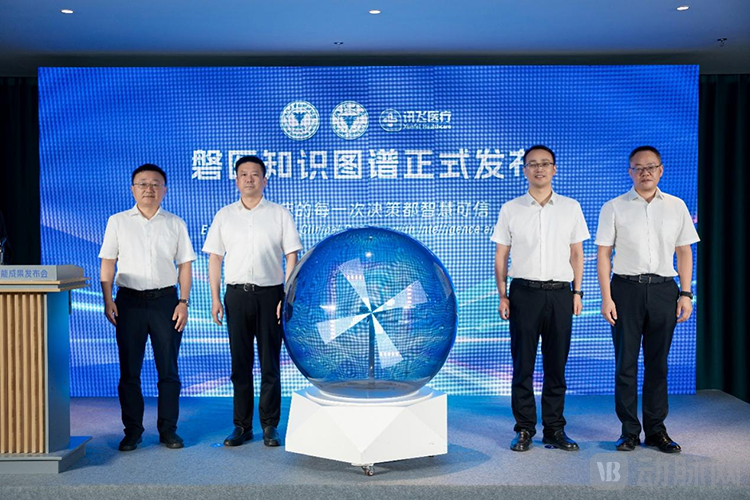
From left to right: Liu Xiaozhou, Director of the Planning and Informatization Division of the Zhejiang Provincial Health Commission; Shi Dongcai, Deputy Director of the Zhejiang Provincial Department of Science and Technology; Jin Shihui, Deputy Secretary-General of the Taizhou Municipal People’s Government; and Wu Yongjun, Dean of the Taizhou Institute of Zhejiang University, jointly witnessed the release of the Panyi Knowledge Graph.
At the press conference, Lin Hui provided a detailed introduction to the Panyi Knowledge Graph. Leveraging large language model-based knowledge extraction, fusion, and dynamic updating technologies, the Panyi Knowledge Graph extracts structured knowledge from multimodal medical big data, including text, imaging, signals, and omics. Combined with an expert review mechanism, it ultimately constructs a trustworthy, co-created, and shared medical knowledge system oriented toward clinical diagnosis and treatment, encompassing the full chain of “knowledge–technology–reasoning.” During its research and development, the knowledge graph successfully overcame multiple key technical challenges, such as intelligent parsing of medical literature, fusion of multi-source heterogeneous data, and knowledge extraction and reasoning, thereby achieving automated construction and dynamic updates.
It is understood that the Panyi Knowledge Graph is currently the largest known medical knowledge graph in China. It covers more than 25,000 clinical diseases, 253 types of medical entities, 416 types of medical relationships, and over 20 million triples (note: the basic unit of knowledge representation). Featuring comprehensive coverage of the full disease spectrum, real-time dynamic updates, and fully traceable reasoning chains, it not only effectively expands the breadth and depth of medical knowledge but also provides an innovative pathway for structured knowledge management in the healthcare industry.
Wang Haishuai, a researcher at the College of Computer Science and Technology, Zhejiang University, stated, “We are building not merely a collection of knowledge, but a ‘medical intelligence foundation’ that is reasoning-capable, verifiable, and evolvable.” The release of the Panyi Knowledge Graph marks a significant breakthrough in China’s independent capability to construct foundational knowledge systems for medical AI. It will serve as secure and controllable “infrastructure” for intelligent decision-making in healthcare institutions, supporting the intelligent upgrading of diverse scenarios, including assisted diagnosis and treatment, clinical research, and medical education.
Xinghuo Medical Large Model Full-Stack Toolchain: Empowering Every Doctor with a Dedicated AI Agent
Clinical documentation has long been a persistent pain point in the healthcare industry, requiring adherence to standards and accuracy while balancing efficiency and the capacity to convey complex information, all while adapting to the dynamic nature of clinical scenarios.
“The advent of the intelligent era has provided large language models with a novel technological pathway and efficiency solutions for clinical documentation,” stated Wang Xiao, General Manager of Zhejiang Xunyi Technology Co., Ltd. He emphasized that the core value of the Spark Medical Large Model’s full-stack toolchain lies in enabling physicians to transition from data entry clerks back to their primary role as clinical decision-makers, thereby unlocking their professional worth.
Xinghuo Medical Large Model Full-Stack ToolchainBuilt upon the iFlytek Xinghuo Medical Large Model, this full-stack toolchain integrates intelligent data processing, specialized model training, and low-code agent orchestration technologies to establish a complete closed loop spanning "data governance," "model iteration," and "generative scenario applications." It not only rapidly transforms raw medical record data into high-quality training datasets but also empowers physicians to build proprietary intelligent models and facilitates the agile development of agents for multi-document scenarios. The toolchain is underpinned by three core platforms: Data Management, Model Management, and Agent Management. The Data Management Platform intelligently processes medical data, instantly converting fragmented raw medical records into a "gold mine" for model training. The Model Management Platform supports one-click training of specialty-specific intelligent models, effectively equipping each physician with a personalized "intelligent brain"; it incorporates over 120 algorithmic models to fine-tune medical record generation models across various specialties. The Agent Management Platform enables the rapid construction of a "application matrix" of medical agents, seamlessly addressing documentation needs in diverse clinical scenarios, including outpatient medical records, discharge summaries, and consultation notes.
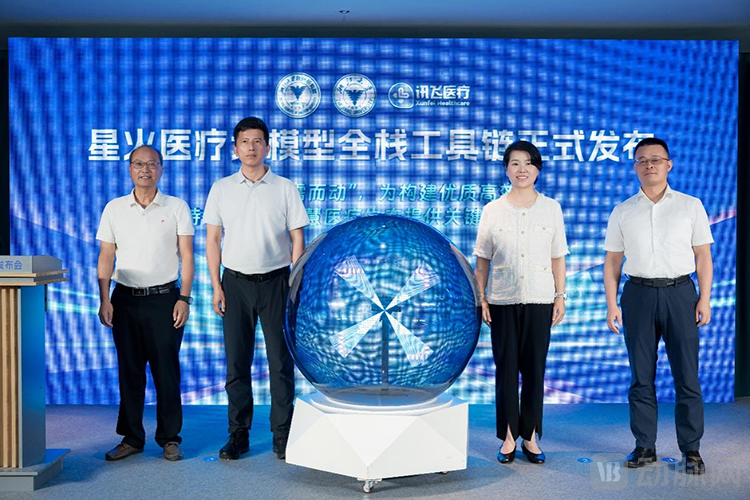
From left to right: Han Deman, Vice President of Taizhou University; Wang Zhicheng, Director of the Taizhou Municipal Science and Technology Bureau; Wang Dan, Director of the Taizhou Municipal Health Commission; and Lu Xiaoliang, Executive President of iFlytek Medical Technology Co., Ltd., jointly witnessed the launch of the Spark Medical Large Model full-stack toolchain.
“Zero-code operation is very user-friendly for us doctors; a small tool tailored to clinical needs can be published in just three minutes.” The toolchain features mentioned by Wang Xiao also include thoughtful capabilities such as multi-model fusion, agent orchestration, and healthcare-enhanced plugins. These features precisely address three major industry pain points: “difficulty in utilizing data,” “imprecise models,” and “slow application deployment.” More importantly, while upholding the baseline standards for standardized medical record documentation, it flexibly adapts to the personalized needs of different departments and physicians. For instance, surgical records often requiring documentation of “surgical incision healing grades” and “dynamic recording of intraoperative blood loss and fluid replacement,” as well as internal medicine physicians’ focus on “medication adjustment records for chronic diseases,” can all be exclusively accommodated through this toolchain.
“The ultimate goal is to enable healthcare institutions and physicians to possess autonomous, controllable, and dedicated AI agents,” said Wang Xiao. He noted that the implementation of this toolchain will not only help reduce costs and improve efficiency in medical scenarios but also provide a solid “digital” foundation for the industry’s intelligent transformation.
High-Level Innovation Platforms: Creating a Replicable and Scalable “Zhejiang Model” for Smart Healthcare
Our province has established a solid foundation in technological breakthroughs, data infrastructure, medical resources, scenario-based applications, and innovation ecosystems within the “AI + Healthcare” sector. It is the only province in China to achieve real-time interoperability of medical institution data across its entire administrative region. The Taizhou Research Institute of Zhejiang University has released achievements such as the “Clinical Medicine Knowledge Graph” and the “Xinghuo Medical Large Model Full-Stack Toolchain.” According to Shi Dongcai, Party Group Member and Deputy Director of the Zhejiang Provincial Department of Science and Technology, these initiatives represent significant explorations in medical artificial intelligence innovation and important attempts to facilitate the practical implementation of AI-driven medical decision-making. They have set a replicable and reference-worthy benchmark for advancing the cross-disciplinary innovation of medical AI in Zhejiang Province from “laboratory theory” to “clinical practice.”
Liu Xiaozhou, Director of the Planning and Informatization Division of the Zhejiang Provincial Health Commission, pointed out that in May this year, Zhejiang was successfully approved as one of the first national pilot bases for artificial intelligence applications in China, with trial operations scheduled to go live by the end of the year. In the future, various AI medical technology products will be able to obtain a “critical springboard” from the laboratory to clinical practice at the pilot base, enjoying standardized and professional pilot testing services. The two achievements—the large-scale multimodal clinical medical knowledge graph and the full-stack toolchain for the Spark Medical Large Model—are vivid practices of the concept of “from clinical practice, back to clinical practice.” Zhejiang will unswervingly support such scientific and technological innovations, encouraging the promotion and application of more advanced medical AI innovations in areas such as clinical decision-making, tiered diagnosis and treatment, chronic disease management, and public health. This will make artificial intelligence technology an “accelerator” for enhancing grassroots medical service capabilities and promoting the balanced distribution of medical resources, injecting continuous technological momentum into the construction of a Healthy Zhejiang.
At the press conference, the unveiling ceremony for the “Key Laboratory of Intelligent Medical Decision-Making in Zhejiang Province” was also held. Led by the Taizhou Research Institute of Zhejiang University, with in-depth participation from Zhejiang University and Zhejiang Xunyi Technology Co., Ltd., the laboratory was officially recognized by the Zhejiang Provincial Department of Science and Technology on June 3, 2025.
According to Lin Hui, the Provincial Key Laboratory of Intelligent Medical Decision-Making focuses on the technological frontiers of intelligent medical decision-making. By leveraging key technologies for the integration of big healthcare data and medical knowledge as a breakthrough point, the laboratory conducts full-chain collaborative research spanning from data to algorithms and from technology to applications. Its aim is to comprehensively enhance the technical proficiency and clinical value of intelligent medical decision-making, establish an innovation chain featuring deep integration among medicine, industry, and information technology, promote interdisciplinary convergence in these fields, and accelerate the industrialization of scientific and technological achievements. The laboratory is committed to building a high-level provincial innovation platform that integrates basic research, technological breakthroughs, achievement translation, and application demonstration.
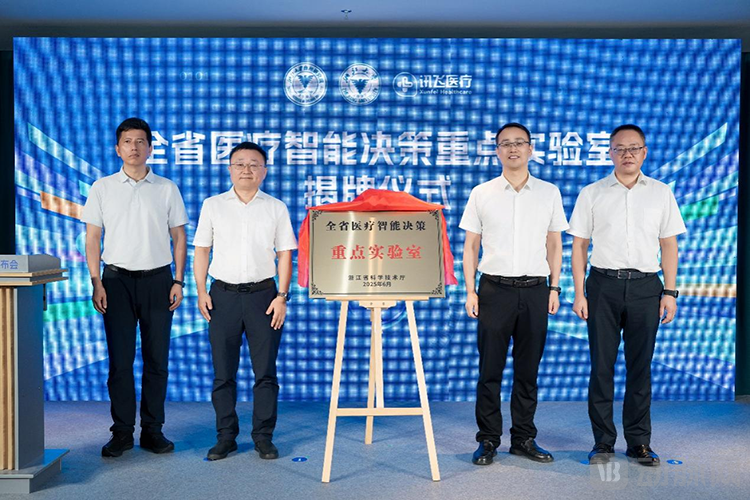
From left to right: Wang Zhicheng, Director of the Taizhou Municipal Science and Technology Bureau; Liu Xiaozhou, Director of the Planning and Informatization Division of the Zhejiang Provincial Health Commission; Jin Shihui, Deputy Secretary-General of the Taizhou Municipal People’s Government; and Wu Yongjun, Dean of the Taizhou Institute of Zhejiang University, jointly witnessed the unveiling ceremony of the Provincial Key Laboratory of Intelligent Medical Decision-Making.
“This launch of achievements is a significant demonstration of the Taizhou Institute of Zhejiang University’s commitment to serving local innovation-driven development strategies and promoting the deep integration of medicine, industry, and information technology. It also showcases the phased accomplishments achieved since the establishment of the ‘Zhejiang Provincial Key Laboratory of Intelligent Medical Decision-Making.’ The Institute will further deepen collaboration among industry, academia, research, and application, facilitate the localization and commercialization of scientific and technological achievements in Taizhou, support the intelligent upgrading of Taizhou’s medical and health industry and the high-quality development of its digital economy, and create a replicable and scalable ‘Taizhou Model’ for smart healthcare. We aim to contribute more significantly to building a high-level innovative city and advancing the development of a Healthy Taizhou and Digital Taizhou,” stated Wu Yongjun, Dean of the Taizhou Institute of Zhejiang University.
Li Chunpu, Director of the Zhejiang Provincial Health Information Center; Jin Shihui, Deputy Secretary-General of the Taizhou Municipal People’s Government; Wang Zhicheng, Director of the Taizhou Municipal Science and Technology Bureau; Wang Dan, Director of the Taizhou Municipal Health Commission; Xiao Jun, Deputy Director of the Institute of Artificial Intelligence at Zhejiang University; and Yu Yonggang, Party Branch Secretary and Deputy Dean of the Taizhou Research Institute of Zhejiang University, were among the dignitaries who jointly witnessed the release of scientific and technological achievements by the Taizhou Research Institute of Zhejiang University.
About Zhejiang University Taizhou Research Institute
Zhejiang University Taizhou Research Institute is a comprehensive, application-oriented research institute jointly established by Zhejiang University and the Taizhou Municipal People’s Government. It is the first local research institution established by Zhejiang University within Zhejiang Province and one of the largest research entities in Taizhou City to date. The Institute has been recognized as one of the Top 10 Zhejiang Provincial Research Institutions for Patent Creation, designated as a New-type R&D Institution of Zhejiang Province, and participated in the establishment of the Zhejiang Provincial Technological Innovation Center for High-End CNC Machine Tools. Since its establishment in July 2007, the Institute, as the supporting entity, has built four provincial-level industrial innovation service complexes, five ministerial- and provincial-level public innovation platforms, one provincial key industrial technology alliance, and three Taizhou Key Laboratories. It has obtained national CNAS laboratory accreditation (for electromagnetic compatibility testing), carried out more than 1,200 horizontal cooperation projects (with contract values exceeding RMB 250 million) and independent research projects, undertaken 31 vertical projects at the ministerial or provincial level or above, achieved breakthroughs in more than 20 common industry technologies, obtained over 250 authorized invention patents, served enterprises more than 5,000 times, and driven an output value exceeding RMB 11.5 billion.
About Sir Run Run Shaw Hospital, Zhejiang University School of Medicine
Sir Run Run Shaw Hospital, Zhejiang University School of Medicine is a public comprehensive tertiary Grade A hospital integrating medical care, teaching, scientific research, and social services. It was funded by the renowned Hong Kong industrialist Mr. Run Run Shaw, with supporting construction provided by the People's Government of Zhejiang Province. The hospital officially commenced operations in May 1994. Currently, it operates seven campuses: Qingchun, Qiantang, Shuangling, Xinjiang Alar, Grand Canal, Shaoxing, and Ningbo (under construction). The hospital has an approved bed capacity of 4,300 and employs more than 8,500 staff members.
About iFlytek Medical Technology Co., Ltd.
iFlytek Medical Technology Co., Ltd. was established in 2016. On December 30, 2024, iFlytek Medical was officially listed on the Hong Kong Stock Exchange under the stock code 02506.HK, becoming the first publicly traded company specializing in large medical AI models. It was also the only enterprise in 2024 to obtain filing approval from the China Securities Regulatory Commission (CSRC) for spinning off its A-share business to list in Hong Kong. Currently, iFlytek Medical’s Smart Doctor Assistant is the world’s first artificial intelligence robot to have passed the National Medical Licensing Examination (Comprehensive Written Test).
About Zhejiang Xunyi Technology Co., Ltd.
Zhejiang Xunyi Technology Co., Ltd. is a key strategic enterprise under the medical division of iFlytek (002230), dedicated to the deep integration of artificial intelligence technology with healthcare. Established in August 2024, the company is registered in Zhuji City, Zhejiang Province. It is wholly owned by iFlytek Medical Technology Co., Ltd., a subsidiary of iFlytek.