

National Medical Device Innovation Platform Launches 2025 Annual Insight Assessment for Industry Participants
At the historical juncture where the final push of the 14th Five-Year Plan converges with the strategic planning for the 15th Five-Year Plan, China’s medical device industry is achieving robust scale expansion with a compound annual growth rate (CAGR) of approximately 10%. Solidifying its position as the world’s second-largest market, it has become a core force reshaping the global healthcare landscape. Behind this surge in scale lies a profound qualitative transformation driven by policy enablement, technological disruption, and ecosystem restructuring. Zheng Hairong, Academician of the Chinese Academy of Sciences and Director of the National Center for Innovation in High-Performance Medical Devices, emphasized, “The medical device industry is currently at the forefront of a new global wave of technological innovation and industrial transformation. High-performance medical devices are a strategic emerging industry prioritized for national development and serve as a critical safeguard for the Healthy China strategy. Innovation will be the primary driver of growth for China’s medical device industry in the next phase.”
In the new round of strategic transformation, a cohort of co-builders in the medical device innovation ecosystem has continued to drive industrial upgrading through diverse approaches. As the sole national-level innovation platform in the medical device sector, the National Innovation Center for High-Performance Medical Devices (hereinafter referred to as the “National Innovation Center”) has consistently remained at the forefront. Over the past five years since its establishment, the National Innovation Center, positioned as an “innovation hub,” has constructed a comprehensive ecosystem encompassing the R&D chain, industrial chain, application chain, and capital chain. Meanwhile, serving as a national-level industrial think tank, it has deeply participated in the top-level strategic design and formulation for the medical device sector, mapped out the national landscape of the high-performance medical device industry, and driven innovative development from the source.
At this historic window of opportunity, the National Medical Device Innovation Center has recently launched the “2025 Annual Insight and Assessment of the Innovation Ecosystem in the Medical Device Industry” (hereinafter referred to as the “Insight and Assessment”). As a national-level authoritative assessment initiative that has operated on a non-profit basis for four consecutive years, the Insight and Assessment uses frontier technology penetration, clinical translation and application, and supply chain self-reliance as its key metrics. Focusing on cutting-edge fields such as AI-driven healthcare and precision therapy, it aims to identify emerging forces in medical device innovation, providing a reference framework of innovation benchmarks and actionable pathways for China’s transition from a major medical device producer to a global leader in the medical device industry.
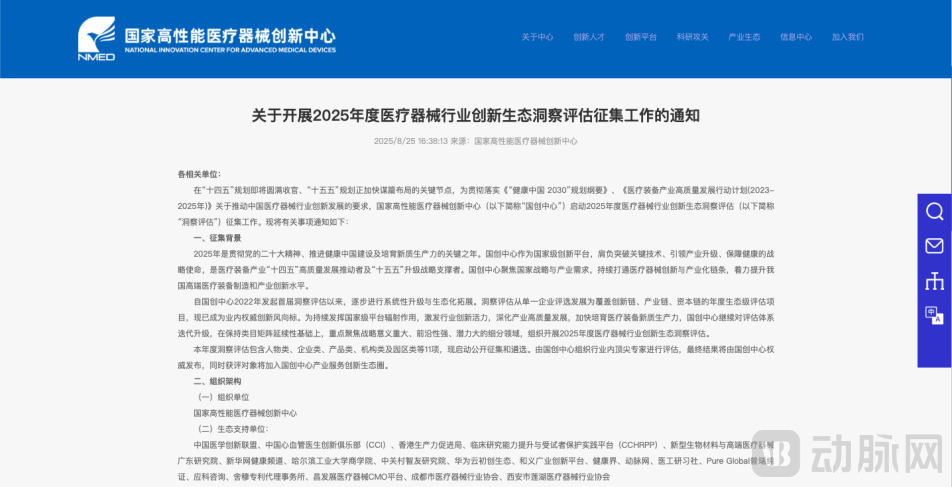
Image source: National Innovation Center
Innovation-Led: National-Level Assessment Builds a Coordinate System for Medical Innovation
“Insights and Assessment of the Innovation Ecosystem in the Medical Device Industry” was initially proposed and launched by Academician Zheng Hairong, based on the strategic consideration that, as a national team, the National Center for Technological Innovation in Medical Devices should “uphold the banner of medical device innovation and steer the course for China’s medical device industry.” The insights and assessment aim to identify innovators with genuine technological breakthrough capabilities and industrial leadership value through a scientific evaluation system. “In an era marked by surging disruptive technologies, particularly amid the accelerated innovative development of the economy and industries, greater attention must be paid to source innovation.”
To date, the Insight Assessment has been held for three consecutive editions, consistently aiming to “identify emerging innovators in medical technology, promote the translation of research outcomes, and empower industrial upgrading.” By leveraging multi-dimensional objective data, it provides a comprehensive overview of enterprises’ innovation capability, translational capacity, influence, and capital recognition, thereby establishing a strategically valuable innovation coordinate system for China’s medical device industry.

According to the assessment results for the past two cycles released by the National Innovation Center, the total number of patent applications (including invention patents and utility model patents) filed by the 2024 Top 100 Emerging Enterprises increased by 13% compared to the 2023 cohort. Across these two cycles, the emerging enterprises cumulatively participated in 35 national-level industry-research collaboration projects and 473 industry-academia-research collaboration projects involving provincial authorities, Project 985 universities, and Grade A tertiary hospitals, demonstrating continuously improving original technological innovation capabilities. Product commercialization has also accelerated; for instance, the 2024 Top 100 Emerging Enterprises secured approval for 87 new products within the following two years, primarily in high-end medical equipment sectors such as advanced imaging systems and surgical robots. Among these, eight products were approved for market launch through the National Innovative Medical Device Approval Pathway, accounting for nearly 10%. Additionally, eight products successfully obtained international certifications, including FDA and CE marks. Chinese intelligent manufacturing is gradually breaking the technological monopoly of multinational corporations and showing strong momentum in expanding into global markets.
The empowering effect of VBInsight’s assessment on the innovation ecosystem has been strongly validated in the capital market. Despite the overall cooling of the capital market in the past two years, companies on the Top 100 Emerging Enterprises list have successfully completed a cumulative total of 69 financing rounds from 2024 to the first half of 2025, bucking the trend. Among the 40 enterprises that received consecutive ratings over the past two years, nearly half secured follow-on financing, demonstrating robust developmental resilience. Meanwhile, outstanding investment institutions featured in the past two editions maintained high investment activity, with an annual average of 81 invested projects and 37 lead-investment projects. Notably, eight portfolio companies backed by these institutions achieved initial public offerings (IPOs) in 2024, fully corroborating the high degree of alignment between the VBInsight assessment framework and market value judgments. This positive feedback loop between capital and innovation is becoming a key driver for the growth of China’s medical device innovation forces.
In terms of clinical translation and ecological synergy, the integration of industry, academia, and research has yielded significant results. In 2024, the total number of medical device patent translations at Pioneer Hospitals for Innovative Achievement Translation increased by 85 compared to 2023, representing a 17% growth. The volume of scientific publications from innovation hubs (universities and research institutes) has maintained a 14% growth rate over the past two years, with industry-academia-research collaborative projects accounting for over 30%. An innovation closed loop driven by “clinical demand pull + technological source support” has been firmly established.
More significantly, the proportion of companies among the 2024 Top 100 Emerging Enterprises that participated in the development of medical guidelines and industry standards increased by 45% compared to 2023, while the number of enterprises receiving national-level honors doubled. This demonstrates that the influence of these recognized companies in the field of medical device innovation is steadily deepening, and the credibility and value of the VBInsight assessment have improved substantially.
Assessment Upgrade: Aligning with National Strategy, Anchoring Future Layout
After three years of accumulation, the “Insight and Assessment of the Innovation Ecosystem in the Medical Device Industry” has established an innovation radar network covering technological R&D, achievement transformation, and capital matchmaking. Guided by national strategic priorities, this national-level assessment system dynamically adjusts its evaluation categories and dimensions to focus on sub-sectors of significant strategic importance, strong frontier characteristics, and high growth potential. It deeply integrates core issues such as domestic substitution and breakthroughs in cutting-edge technologies, aligning closely with the development needs of China’s medical device industry.
In reality, the wave of frontier technologies has already ushered in an industrial revolution within the current medical device sector. Since the beginning of this year, the National Healthcare Security Administration has established brain-computer interfaces (BCIs) as a separate reimbursable item, thereby bridging the “last mile” to clinical commercialization. Seven departments, including the Ministry of Industry and Information Technology, have issued new regulations listing BCIs among the “Ten Landmark Products of Future Industries.” The deep integration of artificial intelligence with surgical robots and precision diagnosis and treatment equipment is driving the industry’s transition from “device manufacturing” to a “smart healthcare ecosystem.” Amidst this surging technological tide, the turning point for innovative development in the medical device industry has arrived.
Therefore, following the introduction in 2024 of dedicated assessment categories for the three critical “bottleneck” sectors—medical imaging, in vitro diagnostics (IVD), and high-value consumables—VBInsight further expanded its scope in 2025 to cover emerging fields such as AI-assisted diagnosis, pan-vascular intervention, and ophthalmic diagnosis and treatment. Pan-vascular intervention directly addresses the pressing challenge of the high prevalence of cardiovascular diseases; ophthalmic care focuses on the domestic substitution of high-end devices such as intraocular lenses; and AI-assisted diagnosis embodies the future of intelligent and precision healthcare.
As the “Healthy China 2030” strategy deepens and efforts to localize high-end medical equipment intensify, the evaluation system is undergoing systematic upgrades and ecological expansion. Evolving from the initial dual dimensions of “companies + individuals,” it now encompasses seven major evaluation dimensions—companies, individuals, products, universities, hospitals, investment institutions, and industrial parks—as well as more than ten evaluation categories. This evaluation network has achieved comprehensive coverage across the innovation chain, industry chain, and capital chain.
According to the call for submissions, the newly added evaluation category for industrial parks this year is a proactive response to regional industrial agglomeration policies. By assessing park performance across dimensions such as technology incubation, supply chain support, and policy incentives, it aims to foster deep integration between regional innovation hubs and national-level platforms.
Furthermore, the evaluation of medical institution categories in collaboration with the China Medical Innovation Alliance has enriched new models for medical-engineering partnerships. Concurrently, the assessment of university categories conducted in partnership with Elsevier, a global leader in scientific and medical information services, has enhanced the authority and objectivity of the evaluations through data-driven outcomes. Meanwhile, the National Innovation Center will continue to identify and recommend a cohort of investment firms that possess deep industry insight and innovation expertise, and can genuinely facilitate corporate growth. It can be said that, anchored by insight-driven assessments, an innovation ecosystem fostering multi-party collaboration and technology transfer—encompassing enterprises, universities, hospitals, and investment institutions—has begun to take shape.
Born to Meet the Moment: The Ecological Empowerment Logic of National-Level Platforms
Behind the evaluation upgrade lies the National Innovation Center’s profound commitment to “driving innovation around the needs of China’s medical device industry.” As the only national-level innovation center in the medical device sector, the National Innovation Center shoulders a triple mission: “conquering core technologies, building an innovation ecosystem, and leading industrial upgrading.” It represents a robust force in cultivating the “national team” for medical innovation, witnessing and driving continuous progress in the industry.
The “rainforest-style” innovation ecosystem cultivated by the National Innovation Center demonstrates robust resource integration capabilities. Vertically, it connects the “R&D chain–industry chain–clinical chain,” linking the National Innovation Center’s Institute for Innovation, top-tier domestic research institutions, Grade A tertiary hospitals, and leading enterprises to nurture the “soil” for innovation and establish a closed loop for translating clinical needs into solutions. Horizontally, it integrates the “capital chain–service chain–incubation chain,” providing multidimensional empowerment to medical device innovators through a suite of industrial services—including investment and financing, industrial space operations, and CDMO-enabled intelligent manufacturing—thereby constructing a dynamically balanced industrial ecosystem.
This multidimensional, interwoven ecosystem enables it to precisely capture the urgent needs of frontline clinical practice while rapidly mobilizing industrial chain resources to achieve technological breakthroughs. The transition of China’s first independently developed complete ECMO system from the laboratory to the operating room, and the clinical translation of the world’s first 5.0T whole-body human medical MRI system, serve as vivid testaments to the empowering impact of this ecosystem.
It is precisely this advantage of comprehensive, multi-level resource integration that endows the “Medical Device Industry Innovation Ecosystem Insight Assessment” with its unique DNA. Compared with evaluations conducted by commercial entities, the Insight Assessment is rooted in clinical validation within real-world medical settings and penetrates capital bubbles to discern the essence of technology. Its published results have become the industry’s “innovation barometer” and “ecosystem compass.” This assessment framework, grounded in national strategic positioning and refined through industrial practice, constitutes the core competitiveness that distinguishes the Insight Assessment from similar evaluations.
Only by transforming original laboratory innovations into “national pillars” that fill gaps in the industrial chain, into public-benefit initiatives that address the aging trend and enhance primary-care diagnosis and treatment capabilities, and into technical standards for participating in global competition, can China’s medical device industry truly complete its transformation from a follower to a leader. In this process, continuously iterated insight assessments are charting an innovation roadmap for the industry that aligns with national strategy.
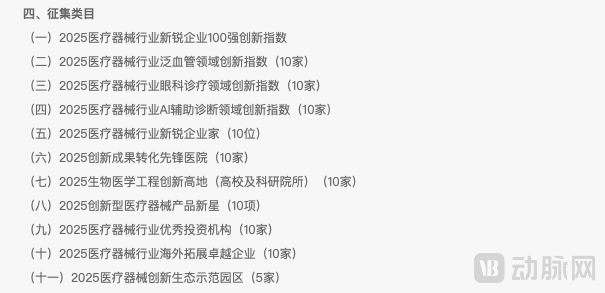
Categories for the 2025 Call for Entries on Insight and Assessment of the Innovation Ecosystem in the Medical Device Industry. Image source: National Innovation Center
It is understood that the call for entries for the Insight Assessment will remain open until October 9. The assessment results will be publicly announced by the National Innovation Center at the end of the year. All evaluated entities will be integrated into the National Innovation Center’s industrial service innovation ecosystem, where they are expected to receive a range of support in areas such as connecting with market capital, accessing clinical resources, pilot-scale testing resources, and facilitating alignment with industry chain resources. Hospitals, universities and research institutes, medical device companies, and entrepreneurs across China may visit the National Innovation Center’s official website (https://nmed.org.cn/Content/xwzx/xw/2025-08/147197.html) to review specific eligibility criteria and registration procedures.
Behind the industry insight assessment lies a reflection of China’s strategic transition from a major manufacturer of medical devices to a leading power in manufacturing. It represents China’s exploration of a path toward becoming an innovative nation in the medical device sector, and further underscores the ambition of the domestically produced medical device industry to pursue independent innovation and high-quality development under the “Healthy China” strategy. From policy support to technological breakthroughs, and from isolated advancements to ecosystem restructuring, the National Innovation Center for Medical Devices, as a national-level innovation think tank, is leveraging strategic height and a global perspective to propel China’s medical device industry from being a technology follower to a rule definer. As revealed by the insight assessment system, only when source innovation resonates with the industrial ecosystem will China’s medical technology truly set sail on its journey toward vast and promising horizons.