

PreciseDx Files for IPO: AI-Powered Breast Cancer Risk Assessment Cuts Diagnostic Turnaround by 90%, Unlocking Critical 3-Week Treatment Window

PreciseDx
Pathological Analysis Service Provider
PreciseDx announced in August 2024 that it had completed a $20.7 million Series B financing round, with investors including medical diagnostic companies such as LabCorp and Agilent Technologies, as well as corporate venture capital firms like the Merck Global Health Innovation Fund.
In June 2025, the company secured an additional $11.2 million in Series B follow-on financing, bringing its cumulative total funding to $42.7 million.
The capital support reflects recognition of its “AI + tumor morphology” technological approach. Founded in 2019, this young company leverages its proprietary technology platform, Precise breast, to reduce the time required for breast cancer recurrence risk assessment from an average of 22 days with conventional genetic testing to just 56 hours, while cutting costs by 80%.
Pathology + AI R&D Background, with a Portfolio of 47 Global Patents
AI R&D Background and Acute Clinical Experience Are the Starting Point for the Team to Rapidly Identify Market Demands.
Founder Carlos Cordon-Cardo, as the Chair of the Department of Pathology at the Icahn School of Medicine at Mount Sinai, has accumulated decades of clinical data in the field of tumor morphology. These clinical data have served as critical training material for the development of PreciseDx technology. Chief Scientific Officer Gerardo Fernandez, M.D., combines expertise in both pathology and AI research and development.
The founding team identified significant limitations in risk assessment for determining the likelihood of breast cancer recurrence during their clinical practice. On one hand, although gene expression testing has benefited breast cancer patients, it is prohibitively expensive, with high per-patient screening costs.
Meanwhile, report generation typically takes two to four weeks, resulting in a lag that may delay treatment decisions. This makes it difficult for physicians and patients to obtain accurate and timely diagnostic information, thereby compromising the scientific rigor and timeliness of treatment decision-making.
The team’s unique patented technology is the key to overcoming this diagnostic limitation.
As of June 2025, the company has filed 47 patent applications worldwide. Its core patents cover the Morphometric Feature Array (MFA) feature extraction algorithm, multimodal pathological image fusion analysis methods, and an AI-based dynamic model for updating recurrence risk.
Three Steps to Complete Cancer Detection: Faster, More Accurate, and More Reliable
Traditional breast cancer risk assessment relies on physicians' subjective interpretation or genetic testing; the former is highly subjective, while the latter is time-consuming and costly.
As the flagship product, Precise breast demonstrates its clinical value through dual breakthroughs: a significant enhancement in end-to-end workflow efficiency and precise stratification of patient heterogeneity.
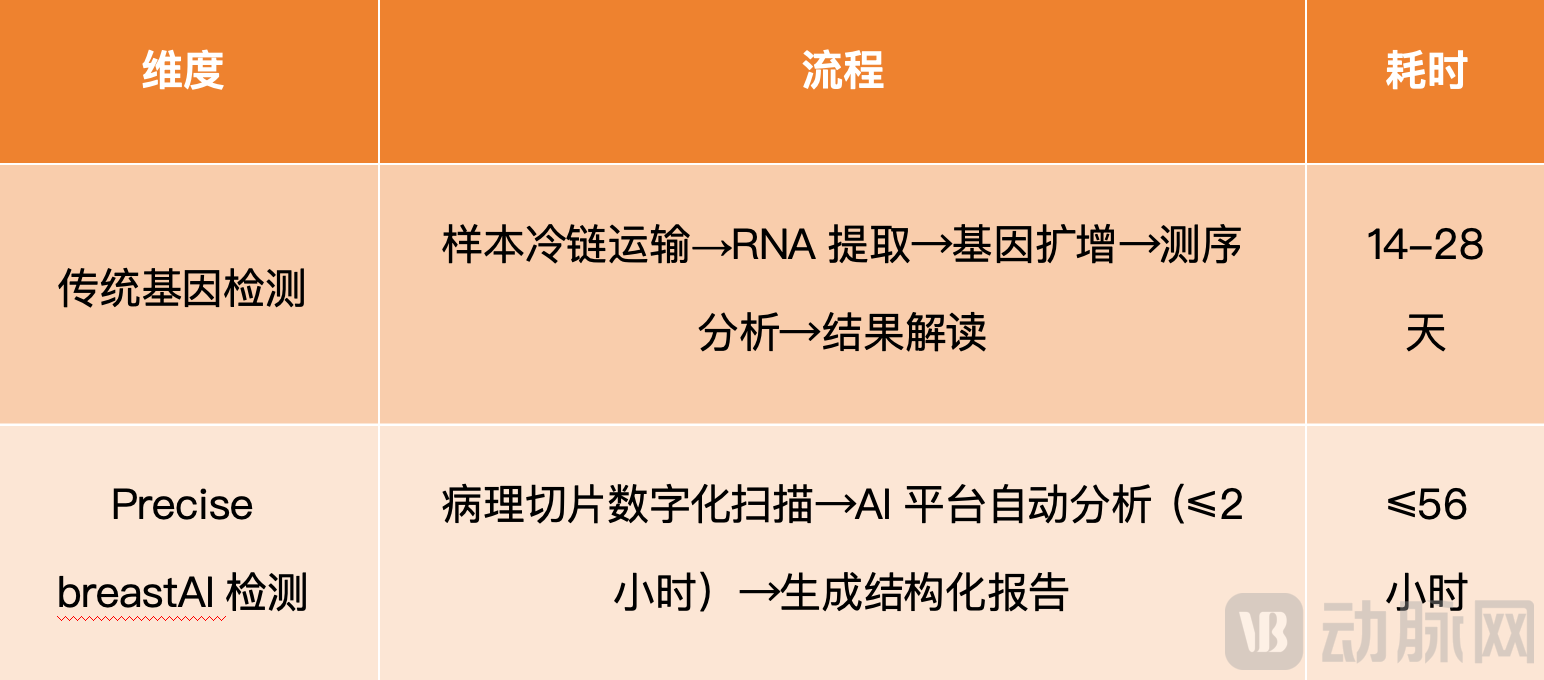
Comparison with Genetic Testing
In terms of testing workflow, the traditional 21-gene assay involves 12 steps, including cold-chain sample transport, RNA extraction, and gene amplification, taking 14–28 days. In contrast, the Precise breast testing workflow requires only three steps.
First, digital scanning of pathological slides is performed, with a scanning resolution of up to 200 nm/pixel. This step enables precise acquisition of microscopic image information from the slides, laying the foundation for subsequent analysis.
Next, the scanned image data is input into the AI platform for automated analysis. The entire computational process takes no more than two hours to perform an in-depth analysis of tumor-related features.
Finally, based on the AI analysis results, a structured report is generated. This report not only includes the breast cancer recurrence risk score but also provides targeted clinical recommendations, offering robust support for physicians in formulating diagnosis and treatment plans.
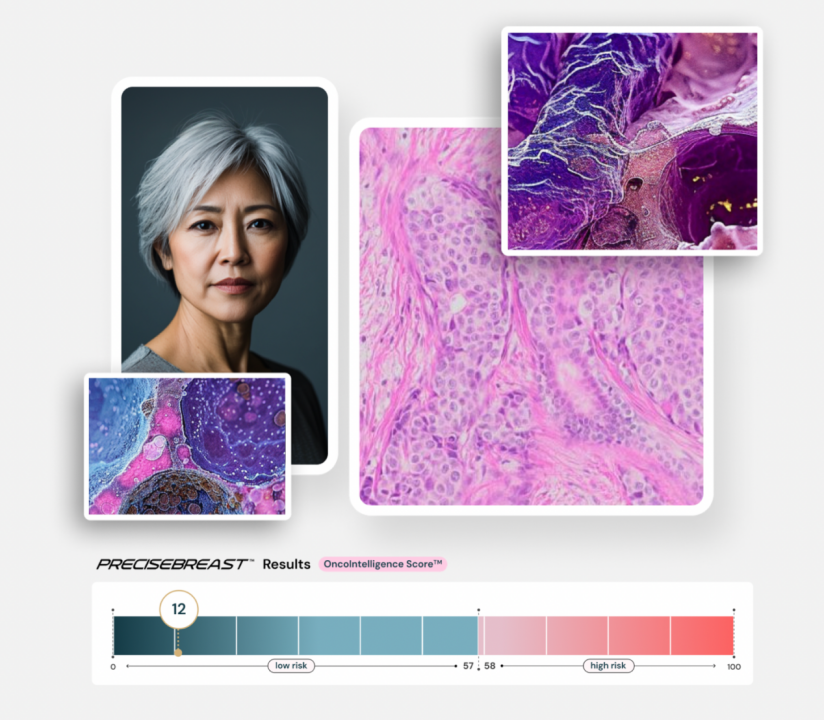
Precise Breast Data Monitoring Results Show
The clinical benefits derived from this process optimization are not only directly reflected in the timeliness of treatment decisions but also feature the optimization of personalized treatment regimens.
Clinical data show that after the adoption of PreciseDx, the time from pathological diagnosis to treatment plan formulation was reduced from an average of 22 days to 56 hours. Among low-risk patients, the chemotherapy avoidance rate increased by 37%, significantly reducing the risk of overtreatment.
According to official website news, Precise Breast has obtained U.S. CLEP certification (Clinical Laboratory Evaluation Program), making it one of the few non-genetic testing products to pass the rigorous CLEP validation.
CLEP is a localized enhanced certification established by the New York State Department of Health (NYSDOH) under the Clinical Laboratory Improvement Amendments (CLIA), specifically targeting laboratory-developed tests (LDTs) or innovative diagnostic technologies. The CLEP certification not only serves as technical recognition for PreciseDx but also demonstrates that AI-based morphological analysis can support the management of complex breast cancer subtypes at lower costs and with greater speed.
Scalable Technology Platform: Expanding from Breast Cancer to All Cancer Types
PreciseDx directly reflects tumor biological behavior through morphological features, maintaining predictive efficacy across special subtypes such as HER2-positive and triple-negative breast cancer. This technological breakthrough is attributed to the effective integration of MFA with the OncoIntelligence artificial intelligence platform.
MFA is not a pathological feature extraction tool in the traditional sense; rather, it employs super-resolution image analysis technology to digitally encode 137 morphological parameters—including nuclear morphology, tissue architecture, and vascular distribution—from pathological slides, thereby constructing a standardized database of feature vectors.
This coding approach overcomes the limitations of traditional pathology reports’ “qualitative descriptions.” Taking cell nuclei as an example, MFA can quantify 23 geometric features, including nuclear area, perimeter, and irregularity, thereby transforming pathological information from subjective descriptions into computable, objective data.
The OncoIntelligence platform employs a multimodal deep learning architecture, with its core algorithms comprising three layers of processing logic:
1Image Preprocessing Layer:
Utilize Convolutional Neural Networks (CNNs) for impurity filtering and feature enhancement in H&E-stained slides, addressing artifacts such as uneven staining and tissue folding commonly encountered in traditional pathological slide preparation.
2Feature Fusion Layer:
Spatiotemporal alignment of morphological features extracted by MFA with clinical data (across four dimensions, including tumor size, lymph node status, and patient age) to identify key risk factors via an attention mechanism;
3Predictive Decision-Making Layer:
A recurrence risk prediction model was constructed based on a Long Short-Term Memory (LSTM) network, outputting an OncoIntelligence score ranging from 0 to 100. Scores ≥70 are defined as the high-risk cohort, scores ≤30 as the low-risk cohort, and the intermediate range as moderate risk.
The uniqueness of this architecture lies in its "morphology-first" design philosophy. This design is achieved through AI-driven analysis that interprets morphological features from standard H&E-stained sections—such as nuclear size and the degree of architectural disorganization—to directly reflect tumor severity.
PreciseDx’s algorithm requires only standard H&E slides (Hematoxylin and Eosin staining, which employs dual staining with hematoxylin and eosin to render cellular structures in sharp contrast under microscopy), without the need for additional immunohistochemistry (IHC) or gene sequencing steps, thereby enabling its widespread adoption even in resource-limited primary care hospitals.
Official website data shows that the platform improves the accuracy of predicting breast cancer recurrence risk by 41% compared to traditional pathological grading, with particularly significant advantages in difficult-to-classify cases such as triple-negative breast cancer.
Furthermore, the robust accumulation of clinical data endows PreciseDx’s AI models with the characteristic of “increasing accuracy with continued use.” From 2024 to 2025, the AUC value for Precise breast’s recurrence risk prediction improved from 0.91 to 0.94, with model prediction accuracy increasing by 2.3% for every additional 1,000 annotated cases.
However, PreciseDx’s technological ambitions are not confined to breast cancer; its OncoIntelligence platform is expanding into multiple cancer types through modular upgrades. The R&D roadmap released in 2025 indicates that the company has initiated the development of AI models for three major cancers: lung cancer, colorectal cancer, and prostate cancer.
Building a Hospital-University Collaboration Network: From Technical Validation to Market Penetration
PreciseDx’s collaborative network development exhibits a clear strategic gradient:
Phase I (2024) focuses on building technical credibility by partnering with COTA and Baptist Health. The former possesses an extensive nationwide oncology real-world database, while the latter is the largest healthcare system in Florida. This combination enables both the optimization of algorithms through diverse patient data and the accumulation of evidence via clinical practice.
Phase II (2025) shifted towards the integration of industrial resources, establishing partnerships with third-party testing giants such as LabCorp and Quest Diagnostics. By leveraging their nationwide logistics networks and customer bases, the company rapidly expanded the coverage of its testing services.
The third phase targets academic excellence by collaborating with the University of California, Los Angeles (UCLA) on research into recurrence prediction for triple-negative breast cancer, thereby strengthening its technical leadership in the field of refractory tumors.
This “clinical validation–industry implementation–academic leadership” pathway aligns closely with the expansion logic of healthcare organizations and integrated diagnosis-and-treatment models. This is also a key factor attracting corporate investment, as investors are drawn not only to PreciseDx’s technology but also to its established closed-loop ecosystem encompassing “AI-based diagnosis–treatment decision-making–efficacy monitoring.”
As of June 2025, PreciseDx has completed three rounds of financing, with a cumulative total of $42.7 million:
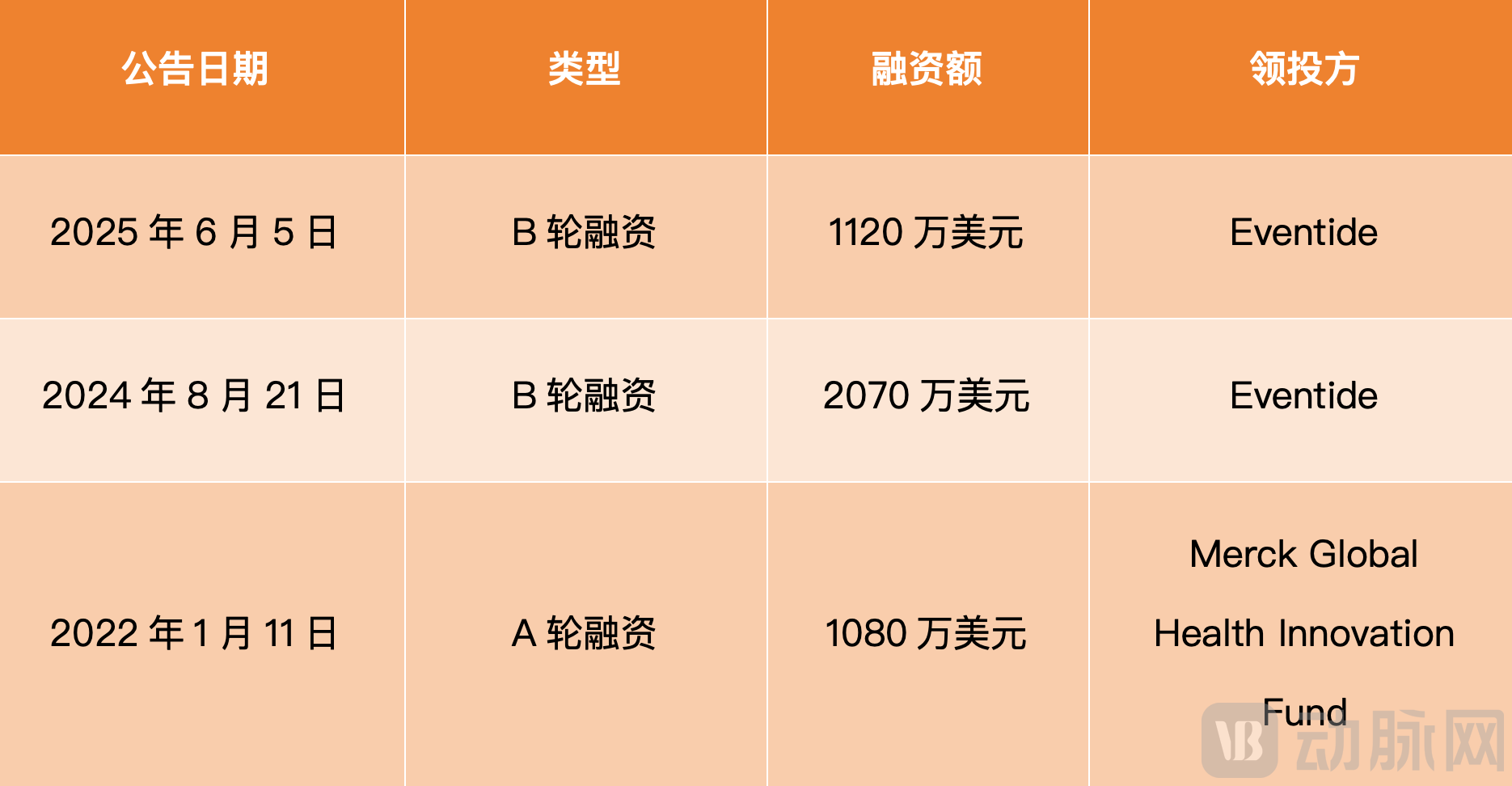
PreciseDx's Historical Financing Rounds
This financing pace is synchronized with the company’s commercialization progress. Taking the additional $11.2 million in funding raised in June 2025 as an example, investor Eventide stated that the proceeds would be used for the global registration and commercialization of Precise breast, particularly to accelerate entry into the European CE market and advance through China’s NMPA approval process.
Notably, the company introduced industrial capital rather than purely financial investors during its financing rounds. As a global leader in laboratory diagnostics, LabCorp can provide its clinical laboratory network to facilitate the deployment of testing services. This “capital + resources” injection model has progressively enhanced PreciseDx’s expansion efficiency.
Final Thoughts: AI Cancer Diagnosis Still Faces Skepticism
Although Precise breast can significantly improve cancer detection efficiency and enhance decision-making capabilities, can complex tumor diagnosis truly be fully delegated to AI? The pathology community still has many concerns on this point.
One aspect is the interpretability of decision-making. Traditional pathological diagnosis relies on visual features, whereas the decision logic of AI models is difficult to present intuitively; the underlying operational logic of AI algorithms is hard to verify, raising transparency concerns. The other aspect is the ambiguity in liability attribution. When AI diagnostic results conflict with the judgments of pathologists, it remains unclear how to determine final interpretive authority, posing risks associated with undefined accountability.
However, for domestic medical innovation enterprises, the rise of PreciseDx reveals three critical pathways: First, technological R&D must be anchored in genuine clinical problems rather than solely pursuing algorithmic accuracy. Second, ecosystem collaboration should take precedence over going it alone, particularly through strategic partnerships with leading medical institutions and industrial capital. Third, capital operations must serve commercial implementation, with each financing round corresponding to clear market milestones, thereby enabling AI healthcare to transition from concept to practical application.