

Ultromics Files IPO Prospectus to Advance AI-Powered Cardiac Ultrasound Platform Targeting Heart Failure and Cardiac Amyloidosis

Ultromics
Cardiovascular Disease Diagnostic Tool Developer
Within the vast spectrum of cardiovascular diseases, heart failure (HF) is often referred to as the “silent threat,” affecting more than 64 million people worldwide.[1]。
Among these, heart failure with preserved ejection fraction (HFpEF) accounts for nearly 50% of all heart failure cases.[2], but clinical identification is extremely challenging. Studies show that approximately 64% of patients with HFpEF are not diagnosed at their initial visit.[3]. Another insidious cardiac disease—cardiac amyloidosis—is also often identified only after disease progression, due to its nonspecific symptoms and inconspicuous early imaging features.
Although conventional echocardiography is a routine modality for cardiac imaging, its results are highly operator-dependent, and it has limited capability in detecting subtle abnormalities in myocardial structure and function, akin to the difficulty of finding a thin thread in dim light. Such diagnostic blind spots mean that a large number of patients miss the optimal window for early intervention, ultimately being relegated to passive management with maintenance medication or complication control.
Ultromics, a healthcare technology enterprise originating from the University of Oxford in the UK, is striving to change this landscape. Its artificial intelligence platform, EchoGo, endows echocardiography with keen insight akin to that of "night vision goggles."In July 2025, Ultromics announced the completion of a $55 million Series C financing round, with plans to accelerate the deployment of EchoGo across the United States and integrate AI analysis into routine cardiac ultrasound workflows., enabling previously overlooked cardiac signals to be promptly revealed in clinical diagnosis and treatment.
430,000 Ultrasound Cases! Oxford PhD Develops FDA-Cleared AI Detection Platform
Ross Upton, a PhD in Cardiovascular Medicine from the University of Oxford and a senior sonographer, has repeatedly encountered the same challenge in his clinical research—Echocardiographic findings in patients with heart failure (particularly HFpEF) are often delayed or even missed due to the subjectivity of parameter interpretation, the high technical threshold for operation, and the time-consuming nature of the procedure.. This dilemma of “knowing a disease is present yet struggling to confirm it definitively” not only troubles physicians but also causes patients to miss opportunities for early intervention.
During his collaboration with Paul Leeson, Professor of Cardiovascular Imaging at the University of Oxford, Ross Upton began to explore the potential of AI in echocardiography analysis. Their goal was not merely to automate parameter measurements, but to directly train algorithms to recognize diseases themselves. Leveraging an exclusive partnership with the Mayo Clinic in the United States, the team gained access to a clinical database that tracks patient outcomes. Furthermore, by tapping into the resources of the UK’s National Health Service (NHS), they accumulated more than 430,000 routine cardiac ultrasound images, establishing a foundation for algorithm training that is both deep and broad.

Figure 1: Profile of the Founder of Ultromics
In 2017, Ultromics was officially spun out from the University of Oxford by Paul Leeson and Ross Upton. Since then, Ultromics has entered a period of rapid growth.
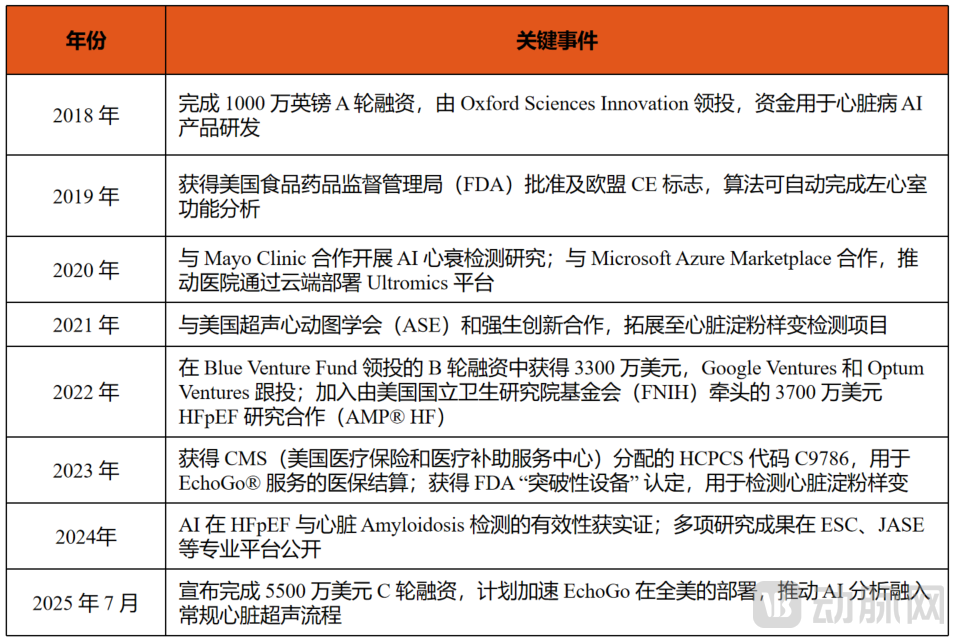
Table 1: Overview of Ultromics Milestones
To date, Ultromics has secured four FDA clearances, two Breakthrough Device designations, and two Medicare reimbursement codes, and has published more than 50 peer-reviewed papers.
From a concept in a doctoral laboratory to a medical technology company now at the forefront of AI-driven cardiac imaging diagnosis, Ultromics has achieved a triple leap in technology, clinical application, and commercialization in less than ten years, providing a replicable model for the integration of AI into routine cardiac diagnosis and treatment.
AI Replaces Manual Frame-by-Frame Analysis, EchoGo Reduces Heart Failure Diagnosis Time to 20 Minutes
The emergence of the EchoGo platform has broken the impasse of missed diagnoses. Ultromics applies artificial intelligence to ultrasound imaging, creating the EchoGo product line that covers heart failure and cardiac amyloidosis, providing targeted early identification and risk assessment solutions for different types of heart diseases.
The system can be directly integrated into existing hospital echocardiogram workflows without requiring hardware replacement. Its core AI model automatically performs image analysis and disease identification, generating structural and risk reports that include probability scores, with the entire process completed in approximately 20 minutes.
1EchoGo Heart Failure: Using AI to Capture the “Invisible Signals” of HFpEF
EchoGo Heart Failure is a deep learning-based cardiac assessment support solution launched by Ultromics, specifically designed to address the diagnostic challenges of heart failure with preserved ejection fraction (HFpEF).
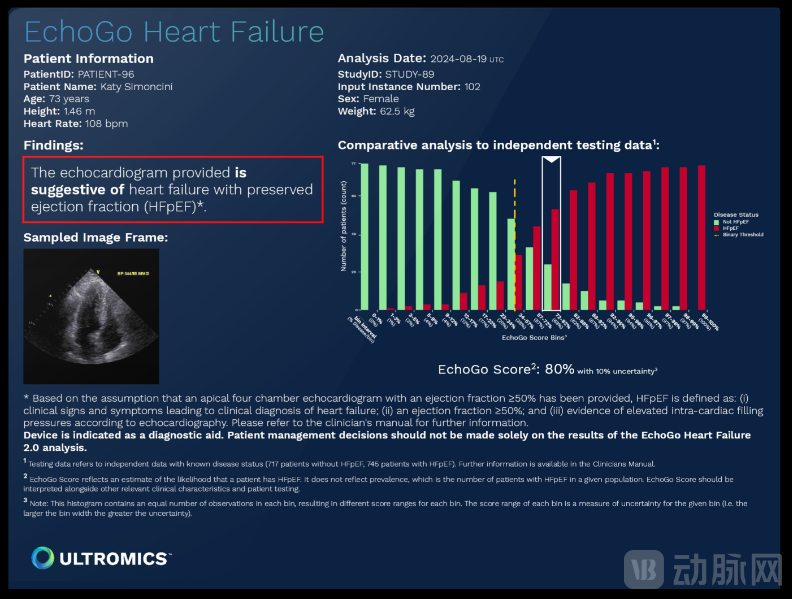
Figure 2: Example of EchoGo Heart Failure Analysis Report
As an FDA-cleared breakthrough technology, it requires only a single apical four-chamber view ultrasound clip toComplete Precise Cardiac Function Analysis Within 20 Minutes, and provides detailed structural information and disease probability scores to support decision-making, assisting clinicians in rapidly identifying HFpEF. This technology was jointly developed by Ultromics, the Mayo Clinic, and the University of Oxford, has been validated in real-world settings with over 6,500 patients, and has been adopted by institutions such as Indiana University and Northwestern University.
In clinical studies,The system demonstrated a diagnostic accuracy of up to 90% in the validation dataset., while significantly reducing the proportion of “indeterminate” cases in routine diagnostics—EchoGo can accurately reclassify approximately 64% and 60% of indeterminate cases under the HFA-PEFF and H2FPEF scoring systems, respectively, thereby substantially enhancing diagnostic efficiency and clarity.
Furthermore,The EchoGo Heart Failure platform is built on a cloud-based architecture, enabling seamless connectivity with all major ultrasound systems from manufacturers such as GE and Philips, and integrating reports into clinical workflows via DICOM and EMR systems.Its security mechanisms comply with information security standards such as HIPAA and ISO 27001, and it can be enabled without additional training, ensuring efficient deployment and use across various healthcare settings. In terms of cost-effectiveness, the examination fees are reimbursable by medical insurance (approximately $1,000 per inpatient case and around $285 for outpatient services).
2EchoGo Amyloidosis: AI-Driven Early Screening for Cardiac Amyloidosis
Cardiac amyloidosis is often diagnosed only at advanced stages of disease progression due to its insidious symptoms and subtle imaging features. EchoGo Amyloidosis was developed to address this challenge, leveraging AI models to identify early signs of amyloid deposition in routine ultrasound images, thereby enabling non-invasive and rapid screening.
EchoGo Amyloidosis has received FDA “Breakthrough Device” designation, indicating its significant potential in improving patient outcomes and promoting early intervention.
EchoGo Amyloidosis generates screening results automatically based solely on routine imaging, without the need for additional sampling. It serves as an efficient, non-invasive initial screening tool, particularly suitable for clinical settings with limited resources or a shortage of specialists. Its primary objective is to assist physicians in identifying at-risk individuals, thereby guiding them toward further diagnostic evaluation.
The results of an international multicenter study published in the *European Heart Journal* show that,The system demonstrated a sensitivity of 84.5% and a specificity of 89.7% in a cohort of over 2,600 patients., demonstrating stability across major subtypes such as AL (light-chain amyloidosis), ATTRwt (wild-type transthyretin amyloidosis), and ATTRv (hereditary transthyretin amyloidosis), while accurately distinguishing cardiac amyloidosis from conditions with similar presentations, including HFpEF and hypertrophic cardiomyopathy.
Currently, EchoGo Amyloidosis has been implemented in numerous medical institutions, including the Mayo Clinic. By ensuring compatibility with major equipment manufacturers such as GE and Philips, it rapidly integrates into clinical workflows, offering a novel technological pathway for the early detection of cardiac amyloidosis.
Building a Cross-Sector Alliance Matrix: EchoGo Deeply Embedded in Clinical and Industrial Ecosystems
Ultromics’ technology has not evolved in isolation; rather, it has been validated through multi-party collaboration while continuously expanding its application scenarios.
At the level of medical cooperationThe company has partnered with top-tier medical systems, including the Mayo Clinic, UChicago Medicine, the University of North Texas Health Science Center, and Northwestern University, to train and validate its AI models using real-world clinical ultrasound data. These collaborations have facilitated the publication of EchoGo technology in peer-reviewed journals such as the Journal of the American College of Cardiology (JACC) and the Journal of the American Society of Echocardiography (JASE), significantly enhancing recognition within the medical community regarding the technology’s efficacy and safety.
In terms of industrial cooperation, Ultromics has established strategic partnerships with Janssen (Johnson & Johnson Innovative Medicine), a subsidiary of pharmaceutical giant Johnson & Johnson, and Pfizer to jointly advance the application of the EchoGo Amyloidosis platform in drug screening and disease risk identification. This collaboration and R&D support have enabled EchoGo Amyloidosis to receive the FDA Breakthrough Device designation, highlighting its significant importance in the early screening of cardiac amyloidosis.
Meanwhile,Ultromics is also actively engaged in collaborations within the realms of public policy and scientific research.As a member of the Foundation for the National Institutes of Health (FNIH) “Accelerating Medicines Partnership® Heart Failure (AMP® HF)” initiative, Ultromics’ AI platform has become a key component of this international multi-stakeholder project, driving the standardization of diagnostic pathways and research into precise phenotyping for heart failure with preserved ejection fraction (HFpEF). In this context, the company was also selected as one of the pilot enterprises for the FDA’s Total Product Life Cycle Advisory Program (TAP), a program limited to only 15 breakthrough cardiovascular device companies, demonstrating that its technology and compliance processes have received high recognition from regulatory authorities.
Three Key Insights from the Implementation of AI in Echocardiography: Technology Integration, Payment Exploration, and Data Construction
From the “keen observation” of the limitations of traditional heart failure imaging diagnostics in doctoral laboratories, to “validation” by clinical teams, and finally to “commercial deployment” on a national scale, Ultromics has established EchoGo as a benchmark for AI in medical imaging in less than a decade. This approach holds significant reference value for China and the broader Asia-Pacific market; however, true adoption should be grounded in localization rather than simple imitation.
1Integrate into existing ultrasound workflows to lower deployment barriers
One of the keys to Ultromics’ success is that EchoGo is compatible with existing echocardiography systems, eliminating the need for additional hardware purchases and enabling hospitals to “upgrade in place.” This strategy is equally applicable in China. For instance, Chison Medical Technologies’ SonoAI platform has launched the SonoFamily series, which embeds AI models into high-end cart-based and handheld ultrasound devices. These devices support multiple clinical scenarios, including cardiology, obstetrics and gynecology, vascular, and thyroid and breast imaging, allowing AI to be seamlessly integrated into routine workflows. The relevant products have obtained regulatory approval and are widely used in numerous Grade A tertiary hospitals across China, gaining market recognition.
2Plan Medical Insurance and Payment Mechanisms in Advance to Facilitate Implementation
Ultromics secured Medicare reimbursement for EchoGo Heart Failure, ensuring a viable commercial revenue pathway and accelerating hospital adoption. China is also accelerating its efforts in this area. For instance, since 2024, the National Healthcare Security Administration has included AI-assisted diagnostic products in its project approval guidelines, offering policy incentives.
The National Health Commission and other departments have also proposed supporting AI-enabled medical devices in applying for the special review process. In light of these favorable policy developments, Chinese medical AI companies should proactively engage with health insurance and regulatory authorities to explore the possibility of including their solutions in pilot health insurance reimbursement programs at the local level or within specific product categories, thereby creating more favorable conditions for technology implementation and widespread adoption.
3Building a Cross-Hospital, Multi-Device Real-World Data Network
The performance of AI models relies on a foundation of authentic, heterogeneous training data. Benefiting from multi-center collaborations with institutions such as the Mayo Clinic and the NHS, Ultromics has constructed a dataset comprising 430,000 cases that cover diverse clinical scenarios.
In China, Mindray, the leading medical device manufacturer, has also carved out a unique path in promoting the integrated application of AI and ultrasound technology. Over the past two years, Mindray has continuously advanced its “digital-intelligence” strategy, taking critical steps in building an ecosystem centered on “devices + IT + AI.” Its ultrasound solutions and big data platforms, such as “Resona Cloud++” and the “Qiyuan Large Language Model,” have been deployed in hospitals across multiple provinces and municipalities, and are evolving toward intelligent imaging Q&A and physician-assisted diagnosis.
Looking ahead, AI is no longer merely an “embellishment” for medical devices, but rather an “accelerant” for process optimization and clinical decision-making. WithUltromics’ Three Core Strategic Pillars: “On-Site Integration, Early Payer Engagement, and Building a Real-World Data Foundation”—Similarly, Chinese medical AI companies are standing at the forefront of localized innovation. In the future, if this approach can be combined with differentiated policy support from local governments and innovations in health insurance mechanisms, it is expected to drive AI from being a “hotspot” to becoming the “norm” in hospital imaging departments. Their experience may also provide a replicable model for the implementation of ultrasound AI across Asia and even in other developing countries.
References:
[1]Bahira Shahim, Chris J Kapelios, Gianluigi Savarese, Lars H Lund, Global Public Health Burden of Heart Failure: An Updated Review, Cardiac Failure Review 2023;9:e11.
[2]Tsao CW, et al. Heart Disease and Stroke Statistics—2022 Update: A Report From the American Heart Association. Circulation [Internet]. 2022;145(8).
[3]Borlaug BA, Sharma K, Shah SJ, Ho J. Heart Failure With Preserved Ejection Fraction. Journal of the American College of Cardiology. 2023;141(12):1001-1026.