

Novartis to Acquire Tourmaline Bio for $1.4 Billion to Advance Anti-Inflammatory Therapy for Atherosclerotic Cardiovascular Disease

Tourmaline Bio
Pharmaceutical R&D Developer
On September 9, 2025, Swiss pharmaceutical giant Novartis announced the acquisition of U.S. clinical-stage company Tourmaline Bio in a cash transaction valued at approximately $1.4 billion.The core objective of this transaction is the latter’s anti-IL-6 antibody drug, pacibekitug, which is in Phase III clinical development—an innovative therapy designed to treat atherosclerotic cardiovascular disease (ASCVD) by inhibiting systemic inflammation. This move represents not merely a simple pipeline expansion, but a strategic positioning by Novartis in the pathway of cardiovascular anti-inflammatory treatment. According to announcements from both parties, the transaction is expected to be completed in the fourth quarter of 2025.
Novartis: Extending Frequent Olive Branches, Targeting Cardiovascular Diseases
As a top-10 global pharmaceutical company headquartered in Basel, Switzerland,Novartis has extensive expertise in the field of cardiovascular disease (CVD).Its flagship product, Entresto (sacubitril/valsartan), has gradually become the gold standard for heart failure treatment since its launch in 2015, with global sales reaching approximately $7.8 billion in 2024. However,With patent expirations and generic competition, Novartis needs new growth engines to maintain its leadership in the cardiovascular market.
Over the past decade, Novartis has been widely perceived as a “giant in oncology and innovative medicines.” However, in the last two years, it has begun to strengthen its cardiovascular segment through multiple acquisitions and partnerships to fill gaps in its pipeline. Unlike the previous mega-deals often exceeding $10 billion, Novartis now favors mid-sized acquisitions in the $1–3 billion range. This approach allows the company to secure core assets in mid-to-late stages of development while mitigating integration risks associated with large-scale mergers and acquisitions.
In 2025, Novartis was particularly active in dealmaking, having invested a total of $17.23 billion in mergers and acquisitions and licensing transactions to date.Early this year, Novartis announced the acquisition of Anthos Therapeutics for up to $3.1 billion, securing the innovative anticoagulant abelacimab. In April, Novartis further strengthened its position in renal and metabolic diseases by acquiring Regulus Therapeutics for up to $1.7 billion. Meanwhile, Novartis entered into a four-year strategic collaboration with Flagship Pioneering to jointly explore next-generation protein therapies, targeting the discovery of protein targets for cardiovascular diseases.
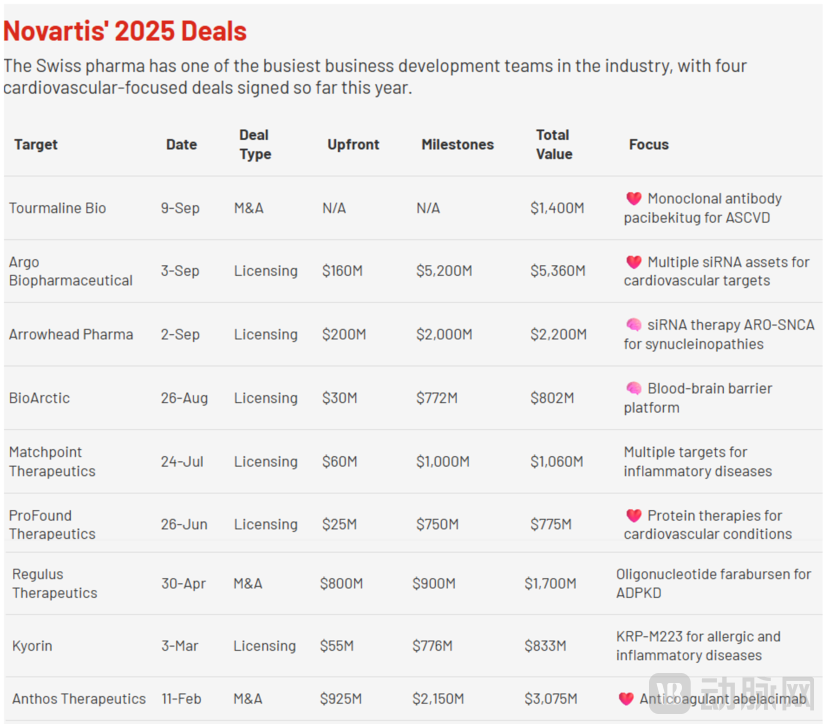
Novartis 2025 Transaction Overview (Image Source: BioSpace)
These mergers, acquisitions, and collaborations are gradually outlining a clear path:Through a series of mid-sized acquisitions and strategic collaborations, Novartis is systematically strengthening its R&D portfolio in cardiovascular and related diseases.
Tourmaline Bio: Focused on the IL-6 Target, Advancing the Development of Potent Anti-Inflammatory Drugs
Unlike Novartis, which has built a cardiovascular therapeutic ecosystem through multi-domain acquisitions (such as Anthos and Regulus) and strategic partnerships (with Flagship Pioneering),Tourmaline Bio Demonstrates the “Single-Point Breakthrough” Characteristic of Startups: Founded in New York in 2018, it rapidly listed on the Nasdaq through a reverse merger in 2023. Its core asset, pacibekitug (formerly known as PF-06835375), originated from a licensing partnership with Pfizer in 2022.
Tourmaline Bio’s R&D strategy centers on pacibekitug, expanding indications around cardiovascular inflammation and immune-related diseases.It is essentially a multi-indication extension of a single IL-6 antibody molecule, rather than a multi-target pipeline layout.
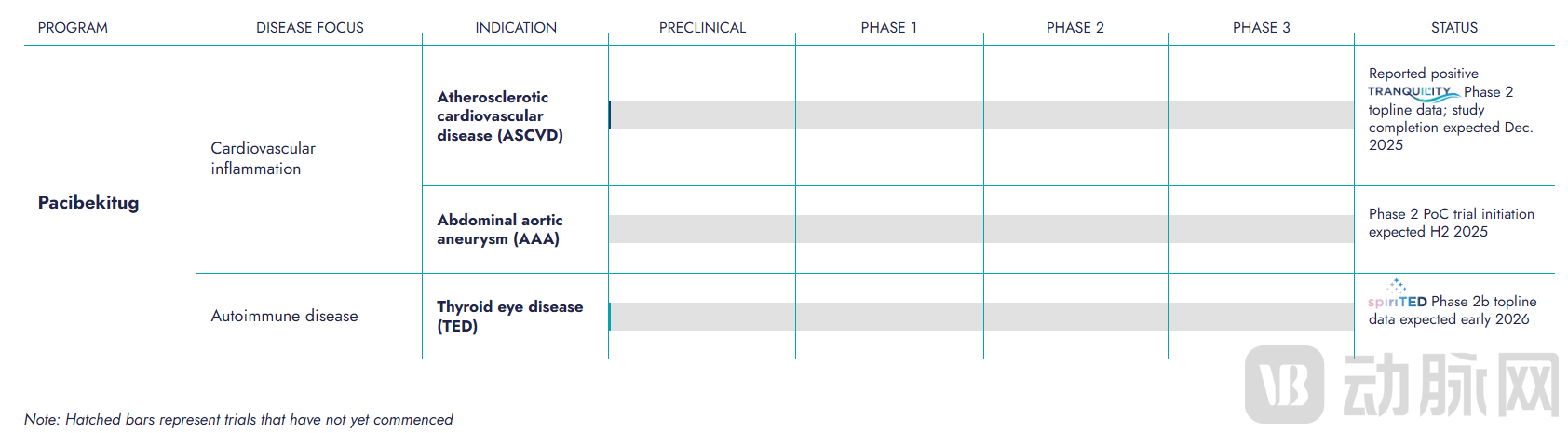
Overview of Tourmaline’s Pipeline
The scientific hypothesis of pacibekitug is based on the mechanism of cardiovascular inflammation. Atherosclerosis is a chronic inflammatory vascular disease, rather than a simple lipid deposition disease. IL-6 plays a key role in the inflammatory cascade and is a potential high-value target:Inhibition of IL-6 can significantly reduce high-sensitivity C-reactive protein (hs-CRP) levels, a marker commonly used to assess the degree of inflammation and cardiovascular risk.As a fully human monoclonal antibody targeting IL-6,Pacibekitug attempts to bypass the traditional “lipid-lowering” pathway by directly blocking inflammatory pathways to reduce cardiovascular risk.
In the TRANQUILITY Phase II trial, pacibekitug demonstrated significant efficacy:Patients receiving monthly 15 mg injections experienced a median reduction in hs-CRP of approximately 85%, while those receiving quarterly 50 mg injections saw a reduction of about 86%, with a safety profile comparable to that of placebo. These results not only confirm potent anti-inflammatory efficacy but also offer a low-frequency, once-quarterly dosing regimen, providing advantages in terms of adherence and convenience.
Cardiovascular Therapy Embarks on the Path of Anti-Inflammatory Treatment
The deeper logic behind this acquisition,lies in the evolutionary trends of the cardiovascular therapeutics sector itself.
Over the past two decades, innovation in cardiovascular drugs has primarily focused on lipid-lowering and anticoagulation.The widespread use of statins has significantly reduced the risk of myocardial infarction and stroke, while the emergence of PCSK9 inhibitors has further optimized lipid management. However, in real-world practice, a considerable proportion of patients still experience cardiovascular events even when low-density lipoprotein cholesterol (LDL-C) levels are controlled within the ideal range, a phenomenon known as “residual risk.”
To address this challenge,Research has gradually shifted toward inflammatory pathways.The CANTOS trial, published in The New England Journal of Medicine in 2017, was a landmark study: it demonstrated among more than 10,000 patients with prior myocardial infarction that treatment with the IL-1β inhibitor canakinumab significantly reduced the risk of major adverse cardiovascular events (MACE) without altering lipid levels. This finding provided the first population-level validation of the causal role of inflammation in atherosclerotic cardiovascular disease (ASCVD). Although the program was ultimately not advanced due to risks of infection and commercialization challenges, it established the clinical foundation for anti-inflammatory therapy as a novel therapeutic pathway.
The market landscape is also undergoing changes. According to a 2025 report by Precedence Research,The global cardiovascular drug market size was $149.99 billion in 2024 and is projected to reach $214.72 billion by 2034, with a compound annual growth rate (CAGR) of 3.62% from 2025 to 2034.In this vast market,Anti-inflammatory therapy represents potential incremental value.Novartis’s move is precisely aimed at this large, unmet market. It was almost inevitable that Tourmaline Bio’s core assets would come into its sights.
Notably, multiple competitors have emerged in the IL-6 target therapeutic landscape:Roche’s tocilizumab, the first IL-6R monoclonal antibody, has been approved for multiple indications, including rheumatoid arthritis and severe COVID-19; Sanofi’s sarilumab, which targets the IL-6 receptor, has demonstrated superior efficacy to placebo in moderate-to-severe rheumatoid arthritis; Janssen’s siltuximab has been approved for the treatment of multicentric Castleman disease; additionally, UCB’s olokizumab and other agents are under clinical development.
Whether pacibekitug can break through by leveraging its “low-frequency dosing” advantage still requires validation from Phase III clinical data. What is certain, however, is thatInflammatory pathways have emerged as a critical breakthrough in the research and development of cardiovascular drugs,“Target Differentiation + Adherence Optimization” will become the core variable in corporate competition.