

Positive Development Secures $51.5M Series C Funding to Scale DRBI Therapy for Autism Spectrum Disorder

Positive Development
Mental and Physical Health Service Providers
In August this year, Positive Development, a leading service provider in the field of autism treatment, announced the completion of a $51.5 million Series C financing round (approximately RMB 360 million). This round was co-led by new investor aMoon Fund and existing investors B Capital and Flare Capital Partners, with participation from Digitalis Ventures, Healthworx (the innovation and investment arm of CareFirst), and other institutions.
As a provider specializing in mental and physical health services, the company plans to use these funds to expand its nationally leading autism developmental treatment model. Leveraging deep investments in technology, artificial intelligence, and data insights, this model has demonstrated mature intervention outcomes. Its services have been incorporated into alternative payment models and fee-for-service contracts by major health plans and state Medicaid programs. With this financial support, the company will further promote the widespread adoption of this treatment model, benefiting a broader population of individuals with autism.
Globally, autism is becoming an increasingly serious health issue.
Autism Spectrum Disorder (ASD), also known as autism, predominantly affects children. Its core features include impaired social communication, restricted interests, and repetitive, stereotyped behaviors. Specifically, it manifests as varying degrees of impairment in social and language abilities, often accompanied by behavioral and intellectual disabilities. Childhood autism is considered the most severe form of pediatric psychiatric disorders. These children are metaphorically described as being like distant stars, separated from the world by a mysterious veil, and are thus referred to as "children of the stars."
Data underscores the growing urgency of this issue. On April 15, 2025, new data released by the U.S. Centers for Disease Control and Prevention (CDC) revealed that 1 in every 31 children in the United States has been diagnosed with autism spectrum disorder (ASD). This represents an increase of more than 16% compared to the 1 in 36 prevalence rate reported in 2023, and is nearly five times the 1 in 150 rate observed in 2000.
However, in stark contrast to the high prevalence, the current field of autism treatment continues to face multiple critical challenges: professional intervention resources are severely scarce, with families in many regions of the United States facing wait times of over six months to access formal treatment; traditional therapies such as Applied Behavior Analysis (ABA) are not only costly but also limited by an excessive focus on behavioral modification at the expense of fostering patients’ emotional and social skills, while their rigid training models fail to accommodate individual differences, resulting in monotonous approaches and suboptimal outcomes; furthermore, the payment system is fragmented, forcing more than 40% of low- and middle-income families to discontinue treatment due to inadequate insurance coverage.
Against this backdrop, Positive Development, an innovative enterprise dedicated to developmental therapy for children with autism and their families, was established in 2020. The organization is built upon the team’s decades of accumulated experience in the fields of autism and other developmental differences. Its members include parents of affected children, family caregivers, and clinicians. Having personally navigated the challenges of treatment, each member is deeply passionate about the transformative potential of developmental care and firmly believes in the efficacy of developmental therapies, aiming to provide more effective support through the establishment of the company.
As one of the few autism care providers currently capable of delivering developmental therapy on a large scale, Positive Development’s core competitiveness stems from its proprietary “Developmental Relationship-Based Intervention” (DRBI). This innovative therapeutic approach for individuals with Autism Spectrum Disorder (ASD) and other developmental differences is grounded in developmental science and relational interaction. By fostering safe and supportive interpersonal connections, it aims to stimulate intrinsic developmental motivation, rather than relying solely on mechanistic behavioral training.
Leveraging Relationships to Unlock Intrinsic Development Potential
DRBI is fundamentally a human development model based on secure attachment and parent-child interaction. At its core, it employs gentle and warm communication to help parents and children establish deep, meaningful connections, thereby activating the child’s capacities for communication, learning, and emotional regulation. Emphasizing “the power of supporting development through the parent-child relationship,” this approach encourages parents to respond sensitively during playful interactions, follow the child’s lead, and provide appropriate challenges to expand the child’s thinking. Rather than relying on mechanical training, DRBI integrates learning into natural interactions.
The core support for DRBI stems from two universal truths:Children’s Innate Love for Play and Their Basic Need for Secure Attachment.In DIRBI, children lead the pace of interaction, while parents enter the child’s “world” through play, deepening trust during free play. When children feel safe and attended to, they are more receptive to developmental improvements, thereby enhancing abilities such as attention, reciprocal interaction, problem-solving, and imagination. Meanwhile, DIRBI features personalization, tailoring interventions to each child’s uniqueness. This individualized approach, combined with research-backed efficacy, constitutes its core advantage.
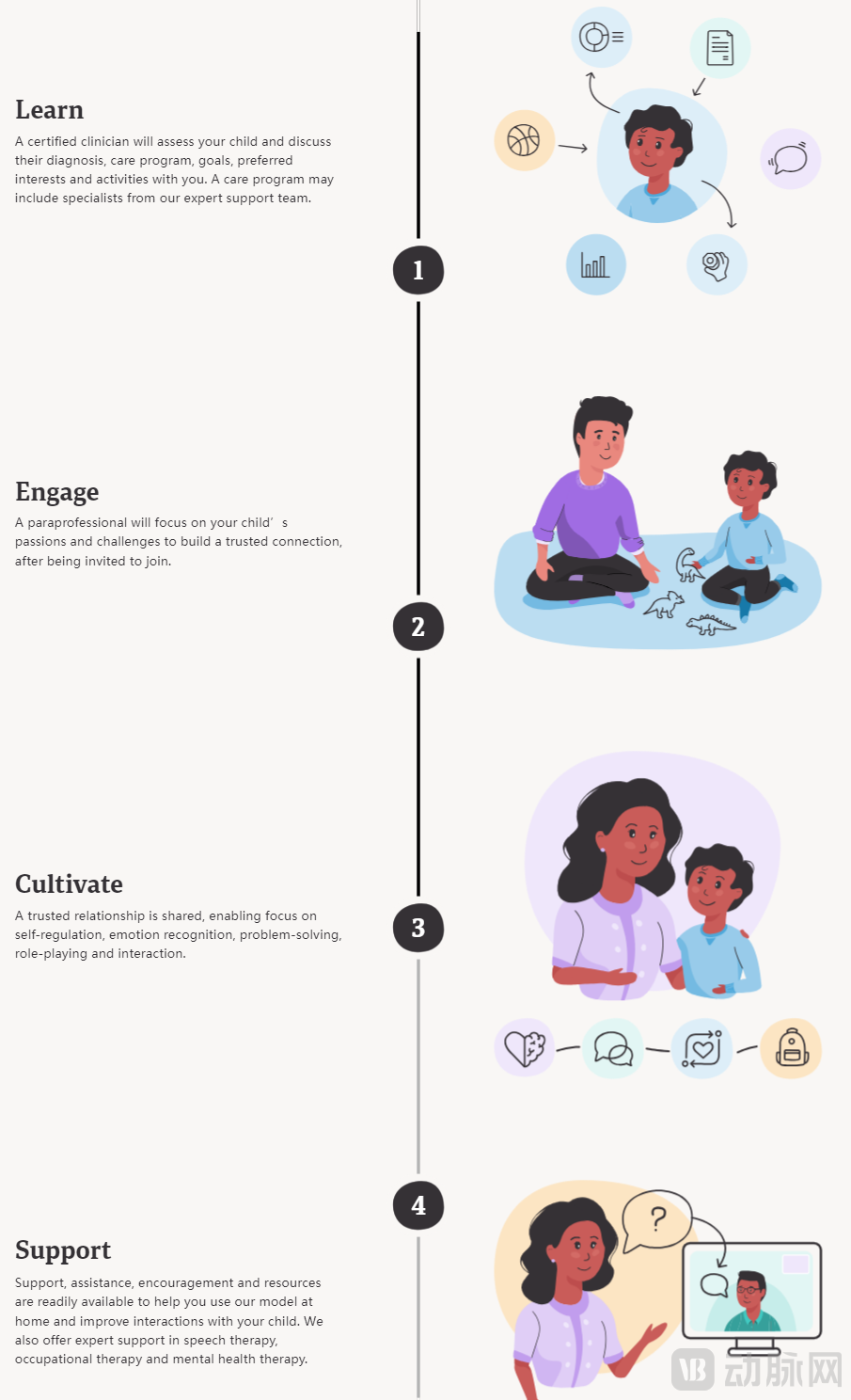
Schematic Diagram of the Four Stages: Learn – Engage – Cultivate – Support. Source: Positive Development Official Website
Family-Centered, Personalized Customization Solutions
The core of DRBI is to activate the intrinsic developmental potential of individuals with autism through trust-based relationships and positive interactions, rather than relying on mechanical training; its framework comprises three pillars.
First, personalized goals based on the 16 Functional Emotional Developmental Capacities (FEDCs).From “sensory perception and emotional connection” in infancy to “abstract thinking and self-identity” in adolescence, the DIR/Floortime model divides human development into 16 stages. Therapists formulate precise goals based on the individual’s current developmental level, thereby avoiding the limitations of the “one-size-fits-all” approach characteristic of traditional therapies.
Next is relationship-driven intervention in natural settings.The therapy is interest-led for children, integrating learning into daily scenarios. For instance, by leveraging a child’s interest in picture books, language expression (“What is this little bear doing?”) and emotion recognition (“The little bear looks a bit sad, doesn’t he?”) training can be naturally incorporated during shared reading. This “incidental teaching” model facilitates the generalization of skills to real-life contexts, rather than confining them to structured training environments.
Finally, interdisciplinary collaborative integrated care.Breaking down traditional disciplinary barriers, an interdisciplinary team comprising speech-language pathologists, occupational therapists, and mental health experts collaboratively analyzes individuals’ sensory preferences, communication patterns, and emotional regulation needs to develop integrated plans encompassing language, motor, and psychological domains.
In actual practice, the implementation of DRBI emphasizes “Low Cost, High Efficiency, Home-Led”, with homes and communities serving as the primary settings, it provides 6–15 hours of face-to-face intervention per week, while simultaneously training parents in core techniques through virtual coaching, thereby extending treatment from clinical institutions into daily life.
Meanwhile, in terms of core competency development, itsFocus on Four Key Areas: Emotional Regulation, Communication Skills, Social Engagement, and Daily Living Skills, and enhance children’s independence in daily living through skill development across these four core domains. Furthermore, technology-driven dynamic optimization constitutes a critical component; leveraging a proprietary AI platform to analyze therapeutic data enables real-time adjustment of treatment plans.
# Building Global Connections with Development as the Goal
Compared with traditional intervention methods (such as Applied Behavior Analysis, ABA), the innovativeness of DRBI is reflected in three aspects.
First, lower costs. The average cost is 50% lower than that of comparable ABA programs. While the annual cost of ABA ranges from $50,000 to $70,000, DRBI can significantly reduce this expense and eliminates the need for additional costs associated with speech therapy, occupational therapy, and other services.
Second, the intensity is better adapted.. Abandon intensive training in favor of a “low-intensity, high-frequency” model tailored to children’s tolerance, thereby reducing resistance. The official website indicates that significant improvements are observed in most cases within 10 to 16 months.
Third, greater emphasis on individual differences. Unlike ABA’s direct behavioral correction, DRBI acknowledges the innate differences of individuals with autism and activates intrinsic motivation through an “acceptance-guidance” model. For example, for children who repeatedly arrange items, this interest is transformed into classification games, simultaneously training logical thinking and language description skills.
This relationship-centered intervention generates a ripple effect as parent-child trust deepens: when children become more receptive to those with whom they share a close bond, they not only engage more proactively in daily interactions but also demonstrate significantly improved cooperation in completing routine tasks such as brushing teeth and getting dressed. It is through this approach that the Developmental, Relationship-Based Intervention (DRBI) fosters specific skills in communication and socialization, while simultaneously helping children build confidence in themselves and their world, thereby gradually reintegrating them into social connections.
In summary, DRBI redefines autism care through a model centered on “relationships as the core, science as the foundation, and families as partners.” It is not merely a therapeutic approach but also offers a practical solution to the current challenges of “high costs and scarce resources” in the autism care market by reducing expenses and improving accessibility.
The autism treatment market is witnessing dual opportunities driven by steady growth and technological innovation. According to statistics from Bizwit Research & Consulting, the global market size for autism treatment programs was valued at USD 2.276 billion in 2024 and is projected to reach USD 3.148 billion by 2029. Currently, behavioral therapy dominates the market, and this segment is expected to maintain its growth momentum in the coming years, fueled by continuous improvements in behavioral interventions and increasing public awareness of autism spectrum disorder.
Driven by technological advancements, digital therapeutics are accelerating their integration into the field of autism rehabilitation, with numerous companies actively expanding their presence in this sector. Baijiayun Group, a publicly traded company on the U.S. stock market, recently announced plans to invest tens of millions of dollars over the next five years to build a new ecosystem for autism rehabilitation using digital therapeutics. This initiative aims to further enhance its intelligent diagnostic assistance platform and promote the practical application of emerging technologies, such as large AI models and virtual reality (VR), in autism rehabilitation.
Nansu Technology also completed a tens-of-millions-of-yuan Series A+ financing round in 2024. The company focuses on the research and development of digital therapeutics for brain dysfunction and neuromodulation technologies. Its products cover rehabilitative treatments for individuals with autism, language disorders, and other conditions, providing closed-loop diagnostic and therapeutic solutions.
Another Chinese enterprise, ALSOLIFE, saw its AI-powered cognitive robot accumulate 5,000 users within just one year of its launch in 2023. This year, ALSOLIFE has further unveiled an innovative achievement: the official launch of China’s first AI-driven social integration system. By leveraging AI technology and combining “digitalization of real-world scenarios” with “neuroplasticity training,” the system reconstructs social learning pathways. It also supports simultaneous multi-user rehabilitation training, effectively enhancing the service quality and operational efficiency of rehabilitation institutions.
Furthermore, the integration of scientific research and clinical practice has become a prevailing trend. Duke Kunshan University and “Rice and Millet” have jointly established a research laboratory that leverages AI technology to collect and analyze multimodal behavioral data in children, thereby facilitating early intervention for autism spectrum disorder. Additionally, “Rice and Millet” has launched its independently developed RICE rehabilitation intervention system, which centers on social interaction to provide personalized and comprehensive intervention plans.
Overall, as the number of individuals with autism spectrum disorder (ASD) increases and medical technology advances, the treatment market will continue to expand. The in-depth application of AI technology and digital therapeutics is not only driving innovation and refinement in treatment methods but also providing patients with more efficient and accessible rehabilitation options.