

Sinopharm Subsidiary Completes $650M Acquisition of Pailin Bio to Expand Blood Products Dominance
SINOPHARM
Comprehensive Pharmaceutical and Health Industry Group
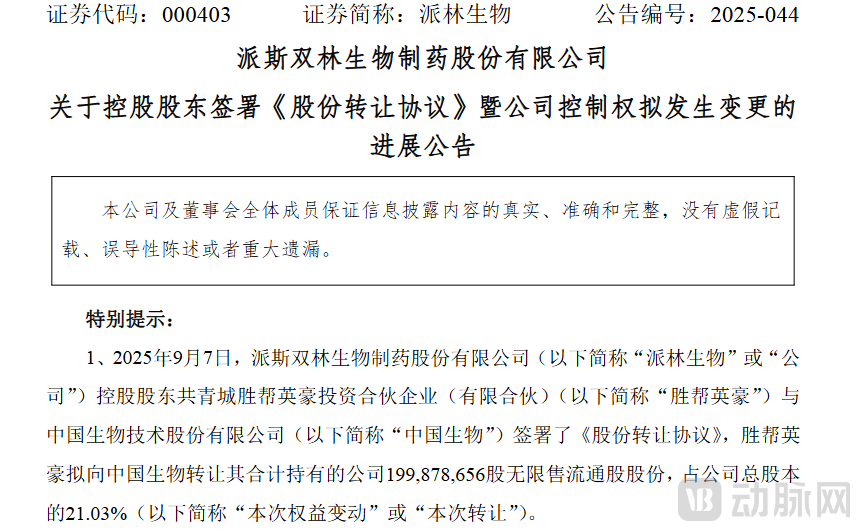
September 7, 2025, China National Biotec Corporation(hereinafter referred to as “China National Biotec Corporation”)with Pailin Bio(Stock Code: 000403.SZ) Controlling Shareholder: Gongqingcheng Shengbang Yinghao Investment Partnership EnterpriseSigned a share transfer agreement to acquire approximately 21.03% of the shares in Pailin Biopharma held by the counterparty for approximately RMB 4.7 billion in cash, with a transaction premium rate ranging between 30% and 32%.If the transaction is successfully completed, China National Biotec Corporation will become the controlling shareholder of Pacific Shuanglin Bio-pharmacy, while China National Pharmaceutical Group Corporation (hereinafter referred to as “Sinopharm Group”) will become its actual controller.
This acquisition not only signifies the further expansion of China National Pharmaceutical Group Corporation’s business footprint in the blood products sector, but also reflects the accelerating trend toward consolidation of production capacity and plasma source resources within China’s blood products industry.
Pacific Shuanglin’s Ups and Downs: China National Biotec Makes Another Move in Blood Products
Pailin Bio's development has been accompanied by significant transformations and multiple changes in control.Its predecessor was Yichun Construction Machinery Co., Ltd., which, when listed on the Shenzhen Stock Exchange in 1996, had no business connection with blood products. Over the following two decades, the controlling shareholders of Pailin Bio underwent multiple changes: Sanjiu Enterprise Group in 1998, Sanjiu Pharmaceutical Co., Ltd. in 2002, Zhenxing Group in 2007, and Hangzhou Zhemin Tou Tianhong Investment Partnership (Limited Partnership) in 2018. It was not until March 2021 that the company was officially renamed Pailin Bio, clearly focusing on the research and development, production, and sales of blood products.
In terms of business development,Pailing Bio has established a relatively comprehensive product portfolio, covering 11 varieties including Human Albumin, Intravenous Immunoglobulin (pH4), and Human Immunoglobulin.As of 2024, the companyOperates 38 plasmapheresis stations, with an annual plasma collection volume exceeding 1,400 tons, ranking among the top three in the industry and joining the ranks of "thousand-ton-level" enterprises.
However, frequent changes in control have also brought uncertainty to the company's development. In March 2023, Shengbang Yinghao Investment Partnership, under Shaanxi Coal and Chemical Industry Group, acquired control of Pailin Bio for RMB 3.844 billion.
Since the takeover by Shengbang Yinghao, Pacific Shuanglin has encountered phased challenges in its business operations. In the first half of 2025, affected by factors such as the production halt for the Phase II capacity expansion of its subsidiary Pasifiko and the delayed release of production capacity at Guangdong Shuanglin, the company’s revenue decreased by 13.18% year-on-year to RMB 986 million, while net profit declined by 27.89% year-on-year to RMB 236 million. As an enterprise under the Shaanxi Coal and Chemical Industry Group, Shengbang Yinghao leverages its state-owned background advantages to provide support in areas such as resource coordination. However, at the governance level, the characteristics of its shareholding structure and decision-making mechanisms have objectively impacted the pace of implementation for certain strategies.
Against this backdrop, China National Biotec Corporation, leveraging the financial strength of China National Pharmaceutical Group Corporation and the mature management system of Tiantan Biological Products, has demonstrated its synergistic potential in integrating Pailin Bio. This acquisition is not merely an adjustment of equity structure, but also involves the optimized alignment of corporate operational models and development pathways, with the potential to enhance overall operational efficiency through resource integration.
For China National Biotec Corporation, this acquisition represents a significant strategic move in the blood products sector.As a core member of China National Pharmaceutical Group Corporation, China National Biotec Corporation has established its industry leadership through its subsidiary Tiantan Biological.In 2024, Tiantan Biological Products achieved a plasma collection volume of 2,781 tons through its 85 operational plasma collection stations, ranking first in China. In the same year, Tiantan Biological Products acquired 100% equity interest in Wuhan Zhongyuan Ruide, a wholly-owned subsidiary of CSL Limited’s Asia-Pacific division and a global leader in blood products, for USD 185 million, further expanding its business footprint.
Upon completion of the transaction,China National Biotec Corporation will account for over 30% of the national plasma resource control in China, holding a total of nine blood product manufacturing licenses.Furthermore, Pailin Bio has established a presence in overseas markets such as Southeast Asia and Pakistan; however, its international expansion has been limited by constraints on scale and distribution channels. In contrast, China National Biotec Corporation possesses cross-border channel resources and experience in mergers, acquisitions, and integration, suggesting potential for resource complementarity between the two parties in their internationalization strategies.
However, the acquisition also brings new challenges. There is an overlap in product structures between Pailin Biopharma and Tiantan Biological Products. China National Biotec Corporation has committed to resolving horizontal competition within five years through measures such as asset swaps, divestitures, or joint ventures. How to balance resource integration with business synergy will be key to determining the success of this acquisition.
Intensifying Competition for Plasma Collection Centers Accelerates Consolidation of the Blood Products Industry into Integrated Giants
The landmark transaction worth RMB 4.699 billion not only marks a change in control of Pacific Shuanglin Bio-pharmacy but also serves as a hallmark event accelerating consolidation within China’s blood products industry. China National Biotec Corporation’s acquisition of a controlling stake in Pacific Shuanglin Bio-pharmacy is, in essence,Industry Resources Concentrate Among Leading Enterprisesthe inevitable trend,Accelerate the formation of an integrated giant landscape featuring “Sinopharm-affiliated,” “China Resources-affiliated,” and “Haier-affiliated (Shanghai RAAS)” entities.—Such enterprises are leading the integration of industry resources through continuous mergers and acquisitions, while independently developed companies like Hualan Biological Engineering Inc. are leveraging their technological advantages to establish differentiated competition. Behind this transaction lie intertwined logics encompassing market demand, policy barriers, and capital maneuvering.
From the perspective of market fundamentals,China's Blood Products Industry Is Caught in a Contradiction Between Rapidly Growing Demand and Rigid Supply Constraints. According to data from the China Research Institute of Industrial Development, the global blood products industry market size reached $49.4 billion in 2024. In terms of growth rate, the global blood products industry market size was $45.4 billion in 2023, with a five-year compound annual growth rate (CAGR) of 4.69%.
However, since the state suspended the approval of new blood products manufacturing enterprises in 2001,Strict control is consistently maintained on the supply side of the industry.. Currently, there are fewer than 30 blood products companies in operation nationwide.Plasmapheresis Stations Implement a "One-to-One" Plasma Donation System, making plasma collection station resources a core asset in corporate competition.
This scarcity of resources is directly reflected in corporate operating data. Taking Tiantan Biological and Pailin Biological as examples, the former achieved an annual plasma collection volume of 2,781 tons by relying on more than 100 plasma collection stations (85 in operation), with a gross profit margin for blood products reaching 54.70% in 2024; in contrast, Pailin Biological’s plasma collection volume of 1,400 tons corresponded to a gross profit margin of 49.13%. The gap in output value per ton of plasma intuitively demonstrates the value of economies of scale. It is against this backdrop thatLeading enterprises are accelerating resource integration through mergers and acquisitions, driving a continuous rise in industry concentration.
Over the past five years,Capital Sparks Wave of Consolidation in Blood Products Sector: China Resources Pharmaceutical acquired Boya Bio-pharmaceutical, promoting an increase in revenue per ton of plasma through resource integration; Shanghai RAAS consolidated its plasma source advantages in Central and South China by acquiring Nanyue Biological; Sinopharm Group continued its strategic layout through China National Biotec Corporation. Prior to taking a controlling stake in Pacific Shuanglin Bio-pharmacy, Sinopharm had already established its industry leadership through Tiantan Biological and plans to take a controlling stake in Weiguang Biological.
According to research report data from Yuekai Securities, the annual demand for blood products in China is approximately 16,000 metric tons, while the annual plasma collection volume stands at only 12,000 metric tons,4,000-ton supply-demand gap drives integrated giants to accelerate the race for remaining plasma collection station resources, the acquisition of Pailin Biopharma is a typical microcosm of this industry trend. As industry consolidation continues to advance, small and medium-sized manufacturers will face further squeezed survival space if they fail to establish differentiated advantages in niche segments such as recombinant coagulation factors.
In the future, competition in the blood products industry will not be limited to the number of plasma collection stations, but will increasingly reflect a comprehensive contest involving management efficiency, internationalization capabilities, and capital operation.The gradual formation of an integrated landscape dominated by industry giants not only signals a rise in market concentration but also marks the acceleration of China’s blood products industry into a new stage of scaled and intensive development.