

Light Aesthetics Drives New Consumption Trends: White Paper Reveals the Medical Aesthetics Industry's Path Toward a RMB 700 Billion Development Phase
Recently, Roland Berger, a globally renowned consulting firm, and Meituan Medical Aesthetics jointly released the “2025 White Paper on the Medical Aesthetics Industry” (hereinafter referred to as the “White Paper”).
According to data from the “White Paper,” China’s medical aesthetics consumer base exhibits a trend of “youth-led dominance, with coordinated follow-up from middle-to-older age groups.” From 2022 to 2024, the proportion of individuals aged 20–29 remained steadily above 55%. Further data from 2025 reveal that the average age of existing medical aesthetics users is 32.8 years, with those aged 26–35 accounting for a combined 60% of the total.
In terms of gender, the proportion of male aesthetic medicine consumers increased from 14% in 2022 to 29% in 2025. This growth rate was significantly higher than that of female consumers, further diversifying the customer base structure of the aesthetic medicine market. Geographically, between 2022 and 2025, the share of aesthetic medicine institutions in second-tier cities and below steadily rose from 59% to 69%. Notably, growth in third-tier cities and below was particularly significant, increasing from 30% to 42%, highlighting the trend toward broader adoption of aesthetic medicine consumption.
At the industry level, the White Paper points out that China’s medical aesthetics market is transitioning from rapid growth to high-quality development. Since 2020, the compound annual growth rate (CAGR) of China’s medical aesthetics market has reached 17.4%, with its scale expected to approach RMB 370 billion by 2025. Although the growth rate may undergo slight adjustments in the future, it is projected to remain at 13.2%, and the overall market size is anticipated to reach nearly RMB 700 billion by 2030.
“Light medical aesthetics,” characterized by minimal invasiveness, rapid recovery, and natural-looking results, will become the core driver of industry growth, significantly lowering the barrier to entry for consumers; its share is projected to rise from 50% in 2020 to 64% in 2030.
Behind this shift lies Chinese consumers’ increasingly rational and mature understanding of “beauty.” The demand for aesthetic enhancement has shifted from pursuing “mainstream beauty standards” to emphasizing “personalized, natural-looking subtle adjustments,” evolving from blind trend-following consumption to “science-backed aesthetic improvement” and “rational decision-making.”
The White Paper also particularly emphasizes that medical aesthetics consumers are becoming increasingly rational in their decision-making. They generally conduct multi-dimensional information comparisons before making decisions, rationally assessing the alignment between treatment outcomes and their personal needs. A growing number of consumers are adopting a cautious stance toward KOL promotions and “soft advertising” on social media, instead placing greater reliance on authentic user feedback and recommendations from professional physicians.
Furthermore, in recent years, the state has continuously strengthened regulatory oversight of the medical aesthetics industry and introduced multiple regulatory policies. Under policy guidance, the industry is also actively establishing self-regulatory mechanisms.
Meituan launched the “Worry-Free Beauty” service assurance system in 2022. This year, Meituan has further upgraded its “Worry-Free Beauty” initiative by partnering with the China Food and Drug Regulatory Data Center to promote the practical application of pharmaceutical and medical device traceability in the medical aesthetics industry. By leveraging drug traceability codes and the Unique Device Identification (UDI) system for medical devices, consumers can scan QR codes using Meituan’s “Worry-Free Beauty” smart devices to trace products back to their source.
As of June 2025, Meituan’s “Fangxin Mei” (Assured Beauty) initiative has provided over 7 million authenticity verification services to consumers across 100 cities in China, and has freely deployed more than 4,000 sets of its self-developed AIoT smart authenticity verification hardware devices at over 2,000 medical aesthetic institutions.
Dai Pu, Co-President of the Roland Berger Managing Committee, stated, “Although demand for medical aesthetics across age groups, genders, and regions continues to be unleashed, deep-seated structural challenges remain. True industry maturity depends not only on market expansion but also on bridging critical gaps in trust, accessibility, and innovation. The future ecosystem of the medical aesthetics industry requires a triple-drive approach: empowering scientific decision-making through credible platforms, transcending homogeneous competition through innovative breakthroughs, and optimizing industry standards through collaborative governance, thereby establishing a paradigm for sustainable development in the medical aesthetics sector.”
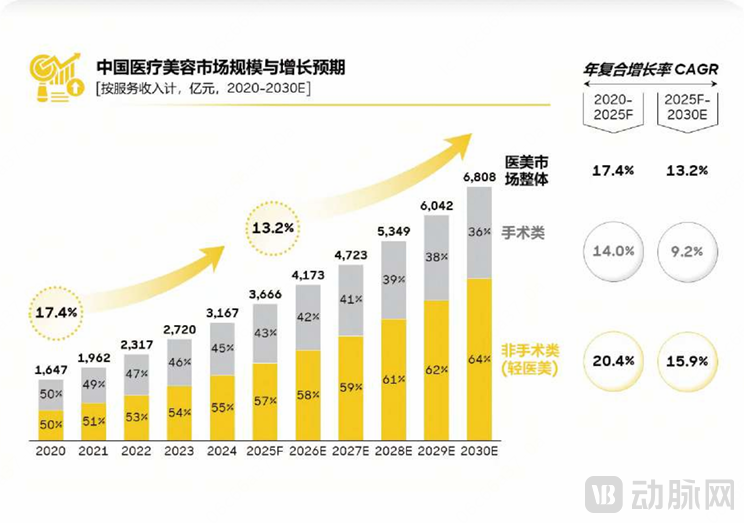
▲ Market Size and Growth Projections for China’s Medical Aesthetics Industry | Source: “2025 White Paper on the Medical Aesthetics Industry”