

Siemens Healthineers and Stryker Join Forces to Launch Next-Gen Neurovascular Robotic Surgery Platform

Siemens Healthineers
Medical Solutions Provider

Stryker
Orthopedic Product Developer
Another Major Player Joins the Surgical Robotics Arena!
Recently, two medical device giants, Siemens Healthineers and Stryker, announced that they will jointly develop a neurovascular interventional surgical robot capable of performing comprehensive elective and emergency neurovascular interventions, including the treatment of stroke and aneurysms.
This neurovascular surgical robot integrates imaging capabilities, surgical consumables, and robotics into a single ecosystem, enhancing surgical precision while reducing treatment time., the duration of neurovascular interventional procedures is a critical factor determining postoperative benefits for patients. Taking acute ischemic stroke, a common type of ischemic cerebrovascular disease, as an example, patients require effective treatment within a short time window; otherwise, rapid disease progression may lead to death. Neurovascular robotic systems are expected to improve patient prognosis by reducing procedure time, thereby ensuring postoperative benefits.
This collaboration encompasses development across multiple areas, including robotic system design, integration of equipment and implantable consumables, robotic navigation imaging, and surgical workflow optimization.
In 2023, Siemens Healthineers halted the application of its vascular interventional surgical robots in cardiology, casting a shadow over the field. Now, Siemens Healthineers has joined forces with another industry giant to make a renewed significant investment, demonstrating its optimism for this sector and injecting greater vitality into the vascular interventional surgical robot market.
As a type of vascular interventional surgical robot, the core value of neurointerventional surgical robots is:Reduce intraoperative radiation exposure to surgeons and improve surgical precision.Surgical robots are primarily used in vascular intervention procedures (including cardiovascular, neurovascular, and peripheral interventions) to advance and navigate catheters. They construct 3D models of patients’ vasculature based on preoperative and intraoperative imaging data, and analyze characteristics such as vessel bifurcations, curves, elasticity, and plaques. This enables real-time tracking and positioning of surgical instruments during the procedure, translating the surgeon’s movements into precise instrument control.
In terms of radiation reduction, conventional vascular interventional procedures are typically performed manually under significant X-ray radiation exposure. Such radiation exposure has adverse effects on human health, and the accumulation of radiation damage from repeated procedures may lead to carcinogenesis. Furthermore, the use of radiation protection devices is not a long-term solution for preventing such physical harm. With vascular interventional surgical robots, physicians can perform remote operations from behind a radiation-shielded console, thereby effectively reducing radiation exposure time while ensuring precise surgical manipulation.
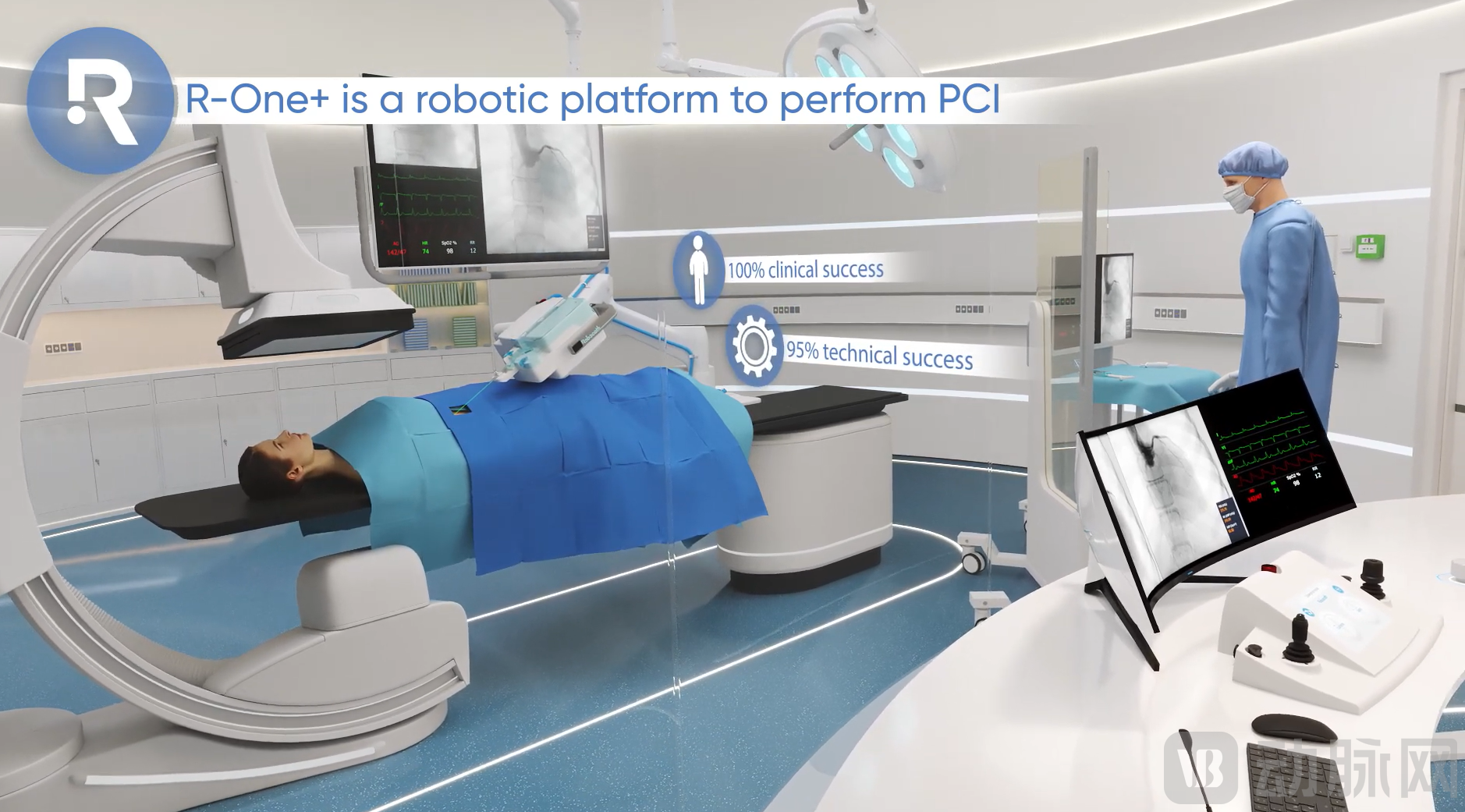
Schematic of the R-ONE Vascular Interventional Surgical Robot
Indications for first-generation vascular interventional surgical robots typically include cardiovascular and neurointerventions; however, they are unable to perform the full workflow of percutaneous coronary intervention (PCI), cover a limited range of procedures, lack force feedback, and require improved compatibility with consumables. Siemens Healthineers and Stryker, two industry giants, are poised to jointly launch next-generation products.
The two industry giants joining forces in this collaboration include Siemens Healthineers, a global leader in medical imaging that provides indispensable imaging navigation support for neurointerventional procedures.
Siemens Healthineers has previously failed in the field of vascular interventional surgical robots.In 2011, Siemens Healthineers acquired Corindus Vascular Robotics for $1.1 billion, gaining the CorPath® GRX vascular interventional surgical robot. In 2023, Siemens Healthineers announced it would discontinue its vascular interventional robotics business in cardiology, shifting its focus to robotic solutions for neurovascular interventions.
Stryker is a medical device giant in the fields of orthopedics, neurointervention, and endoscopy. Its neurointerventional product portfolio covers three major categories: hemorrhagic, access, and ischemic solutions. In 2024, Stryker’s Medical Devices and Neurotechnology segment generated $13.5 billion in revenue. Neurointerventional products include intracranial thrombectomy stents, intracranial thrombus aspiration catheters, coils, and flow diverters. Stryker holds a leading market share in neurointervention; for instance, its Synchro series of high-performance microguidewires commands over 80% of the Chinese market.
Siemens Healthineers’ decision to partner with Stryker may be driven by the latter’s comprehensive portfolio of neurointerventional consumables.Previously, Siemens’ vascular interventional surgical robot ceased its application in the cardiology field. Industry analysts attribute this withdrawal to two major shortcomings that led to commercial performance falling short of expectations: 1) inability to provide full-process assistance for PCI procedures; and 2) stringent requirements for consumables, resulting in incompatibility with all types of consumables. In the field of neurointervention, Siemens Healthineers is expected to address the shortfall in consumable compatibility through its collaboration with Stryker.
In their joint press release, the two companies stated that their early-stage collaboration will focus on co-developing an integrated ecosystem and partnering with leading physicians to validate its clinical value. The synergistic optimization of consumables and systems is expected to enhance the performance of surgical robots, paving the way for a new generation of neurointerventional surgical robot products.
Furthermore, the collaboration between Siemens Healthineers and Stryker to develop neurointerventional surgical robots also enables a deeper understanding of clinical pain points.
The neurointerventional tracks selected by the two giants feature high-growth, inelastic demand.In China, cerebrovascular disease has become a major threat to the health and lives of middle-aged and elderly individuals, with its mortality and disability rates ranking among the highest. The annual volume of neurointerventional procedures in China exceeds 400,000. According to IQVIA data, the domestic neurointerventional market maintained a year-on-year growth of 10% in the first half of 2025.
In vascular interventional surgical robots, cerebrovascular and cardiovascular indications present their respective challenges.Industry insiders stated, “During cardiovascular interventional procedures, the heart is beating, which means that imaging cannot provide the most accurate reference; physicians must rely on their experience to guide intraoperative maneuvers. In contrast, cerebrovascular interventional procedures involve relatively static targets, but the cerebral vasculature is highly tortuous and even three-dimensional. Furthermore, secondary and tertiary cerebral vessels become progressively narrower and more fragile, posing additional operational challenges. Vascular interventional surgical robots must be capable of addressing the distinct challenges associated with different procedural techniques.”
Siemens Healthineers has joined forces with a seasoned player in the neurointerventional field. Leveraging Stryker’s understanding of clinical pain points and its diverse product portfolio, combined with Siemens Healthineers’ expertise in imaging and engineering technologies, the partnership is expected to develop neurointerventional surgical robots that better meet clinical needs.
From the perspective of global competitive dynamics, several vascular interventional surgical robots have been approved for market launch worldwide. These include Robocath’s R-One, which has obtained CE and NMPA certifications; Johnson & Johnson’s Sensei X2 and Stereotaxis’s Genesis RMN, which have received FDA approvals; and Siemens Healthineers’ CorPath GRX, which has secured CE, FDA, and NMPA certifications. The indications for most companies’ products cover both cardiovascular and neurointerventional procedures.
Domestic vascular interventional surgical robots are keeping pace with international R&D, and multiple domestically produced products have received approval. These include the PANVIS-A™ Cerebrovascular Interventional Surgical Assistance System by Aibo Hechuang; the VAS HERO Neurovascular Interventional Robot by Wansi Medical; and the ETcath® Interventional Surgical Robot by Weimai Medical, among others.
Chinese enterprises are at the forefront of exploring vascular interventional surgical robots, and such robots developed in China generally feature force feedback technology.. Chinese enterprises are also exploring remote surgery. In October 2024, Aibo Hechuang successfully completed the world’s first live broadcast of an animal trial for remote endovascular interventional therapeutic procedures (aneurysm embolization and basilar artery stenting). It is reported that domestic companies are developing AI-autonomous vascular intervention robots and have made progress.
From a commercialization perspective, vascular interventional surgical robots are currently in the early stages of market adoption.Among global commercial offerings, Siemens Healthineers’ CorPath GRX demonstrates a relatively leading commercial performance. Since acquiring the CorPath GRX technology, Siemens Healthineers has not disclosed updated global installation figures for the CorPath® GRX system; previously released data indicated 53 installations worldwide as of 2019. Overall, the global field of vascular interventional surgical robotics remains in a critical phase of technological maturity validation and clinical value translation. Companies worldwide are generally conducting multicenter, large-sample clinical studies to enhance recognition and overcome clinical trust barriers in the commercialization process.
Domestic vascular interventional surgical robots have also achieved a commercial breakthrough!In 2024, MicroPort MedBot’s R-ONE vascular intervention robot won bids at five leading public hospitals in Shanghai, including Zhongshan Hospital Affiliated to Fudan University, and achieved the first two commercial installations in the Chinese market. The rapid commercialization of MicroPort MedBot’s vascular intervention surgical robot is primarily attributable to its high degree of synergy with the cardiovascular business of MicroPort Scientific Corporation. This demonstrates that achieving strong synergy with consumables businesses is a key factor in the commercialization of vascular intervention surgical robots.
From a technological perspective, vascular interventional surgical robots are entering a period of vigorous innovation, with domestic and international companies accelerating product iterations. From a cost perspective, the surge in development of humanoid robots has also driven down costs across the surgical robot supply chain. In the future, the emergence of vascular interventional robots will facilitate the decentralization of interventional surgical techniques, reduce the learning curve for physicians, and enhance the accessibility of interventional procedures.