

CapsoVision Raises Over $100M and Files IPO Prospectus, Leading Pediatric Capsule Endoscopy with FDA-Approved CapsoCam Plus

CapsoVision
Medical Device R&D Manufacturer
In January 2025, CapsoVision Secured Two Landmark FDA Approvals:
On January 9, its flagship product, the CapsoCam Plus 360° panoramic capsule endoscopy system, received FDA approval for use in pediatric patients aged two years and older. Subsequently, the FDA further approved the system for use outside of healthcare facility settings, enabling fully remote operation throughout the entire process after patients swallow the capsule at home.
The approvals for pediatric use and remote usability underscore CapsoCam Plus’s absolute advantage in clinical safety, marking the fruition of two decades of technological accumulation for this Silicon Valley-based company.
By addressing the “painful experience” associated with traditional endoscopy through its capsule endoscopy system and establishing a closed loop of “panoramic imaging + AI + cloud platform,” CapsoVision’s development path offers a classic paradigm of “deep technological expertise + scenario adaptation” for medical innovation.
360° Panoramic Imaging: Technological Innovation from “Visible” to “Comprehensive”
In the field of gastrointestinal diagnosis, “blind spots in the visual field” and “patient fear” were once two major unresolved challenges.
In conventional endoscopy, standard capsule endoscopes, due to their single-view design, struggle to comprehensively cover complex gastrointestinal structures such as the small intestine. This often leads to missed detections of minute lesions, severely limiting diagnostic accuracy for subtle gastrointestinal bleeding and mucosal lesions associated with Crohn's disease.
Next is patient fear. Traditional gastrointestinal endoscopy requires intubation, resulting in a poor examination experience and causing significant discomfort to patients. This is also the main factor contributing to patients' reluctance to undergo gastrointestinal examinations. Although early capsule endoscopes were non-invasive, they still required patients to wear bulky data recorders and return the equipment after the procedure. This process not only interfered with daily life but also increased psychological stress for patients.
These limitations of current examinations have resulted in low adoption rates for early gastrointestinal diagnosis. CapsoVision’s breakthrough lies in anchoring its technological innovations to meet genuine clinical needs.
CapsoVision’s endoscopy system, comprising the CapsoCam Plus disposable capsule, CapsoCloud, and CapsoView software, achieves three core breakthroughs: 360° panoramic imaging, remote diagnosis, and AI empowerment.
1360° Panoramic Imaging: From Blind Spots to Anatomical-Level Insight
Traditional endoscopic equipment employs distal-tip cameras, which typically capture a field of view ranging from 120° to 180°, thereby creating "blind spots" in the folded or curved regions of the gastrointestinal tract.
Clinical data from CapsoVision Inc. show that traditional forward-viewing capsule endoscopes (such as Medtronic’s PillCam SB series and Olympus’ EndoCapsule) achieve a visualization rate of only approximately 10% for the ampulla of Vater (an anatomical structure in the gastrointestinal tract, also known as the hepatopancreatic ampulla, which is the opening into the duodenum where the pancreatic duct and common bile duct converge), underscoring their inherent imaging limitations.
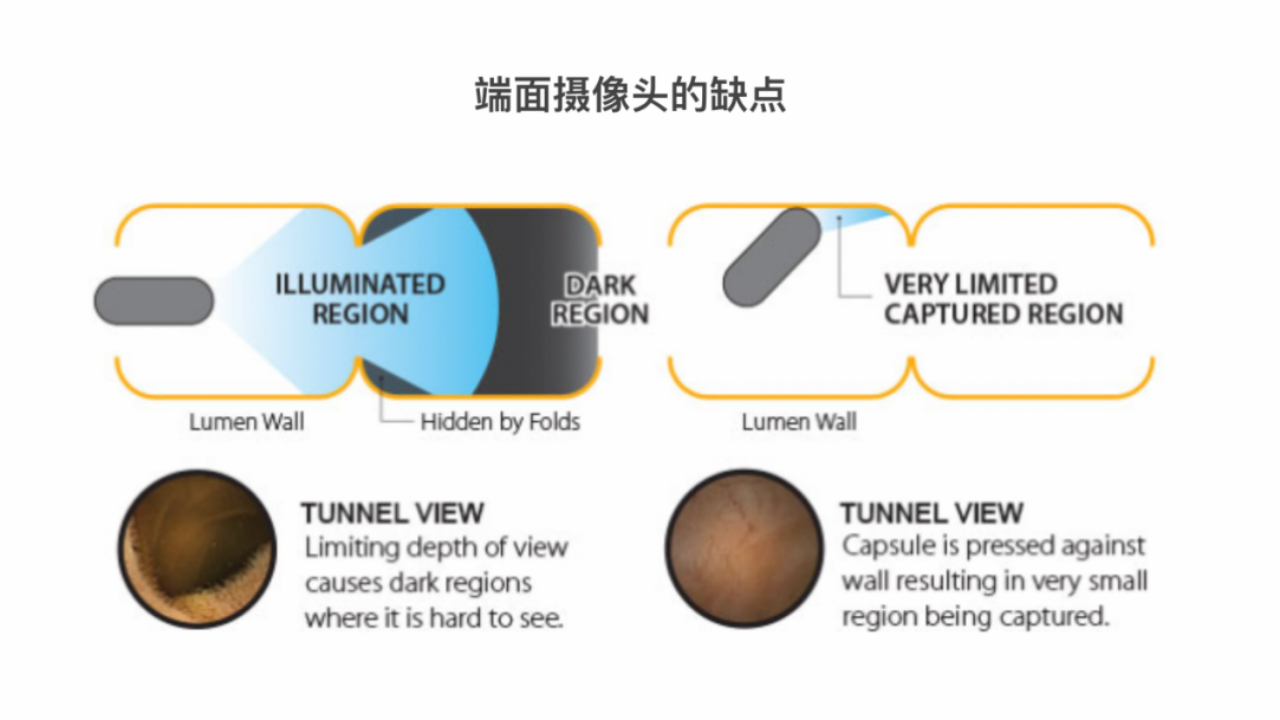
Limitations of Traditional Forward-Viewing Endoscopic Cameras
CapsoCam Plus’s four lateral high-definition cameras, through a unique optical design, achieve 360° comprehensive coverage of the small intestinal mucosa without blind spots. The high frame rate of 20 frames per second, combined with four-directional image stitching technology, generates anatomically detailed high-definition images.
Four-Directional Synthesis Technology is the key to achieving panoramic imaging. It integrates images captured from different angles—such as the lateral walls and folds of the digestive tract—by four separate cameras into a single, complete, and continuous panoramic view, akin to assembling a “3D map” of the entire inner lining of the digestive tract from multiple puzzle pieces.
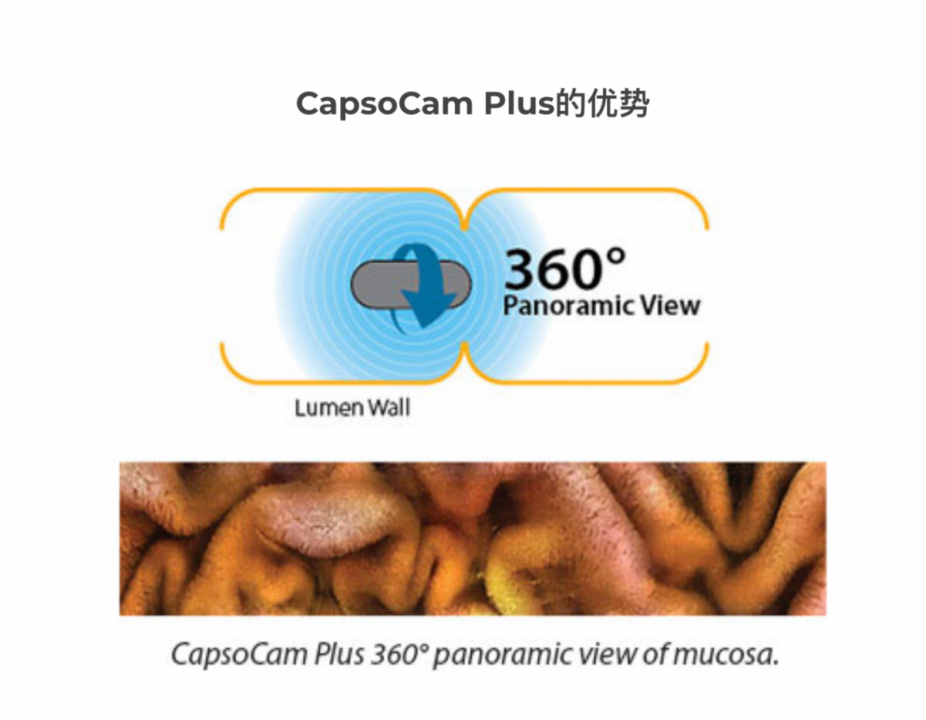
Imaging Advantages of CapsoCam Plus
This system clearly visualizes complex anatomical structures such as the ampulla of Vater. In clinical trials involving 1,327 cases, it achieved a detection rate of 84.8% for polyps with a diameter ≥6 mm and improved the identification rate of mucosal lesions in Crohn’s disease by 37%.
Compared with the single-view limitations of traditional capsule endoscopy, the panoramic imaging of CapsoCam Plus not only improves diagnostic accuracy but also enables physicians to directly observe lesion morphology rather than relying on indirect inference, thereby providing a precise basis for formulating subsequent treatment plans.
2Cloud Storage and Telemedicine: Restructuring from Device Bundling to Unrestricted Clinical Practice
The wireless onboard storage chip of CapsoCam Plus integrates with the CapsoCloud cloud platform, transforming the traditional standalone usage model of capsule endoscopy. After swallowing the capsule, patients are not required to wear any external devices; all examination data is uploaded in real time to the cloud via encrypted channels, enabling physicians to access dynamic imaging through CapsoCloud anytime and anywhere. This design advantage will significantly optimize the experience for both patients and healthcare providers.
For example, pediatric patients are spared the psychological burden of wearing bulky recorders, while adult patients can move freely during the examination, significantly improving compliance.
The system’s advantages are also reflected in medical efficiency, as CapsoCloud is equipped with automated image management capabilities.
On one hand, it can automatically complete the acquisition, transmission, storage, and preprocessing of medical images, eliminating the steps in traditional models where doctors manually organize and import images. This significantly reduces the preparation time before image interpretation from an average of 45 minutes to just 12 minutes.
On the other hand, this feature supports seamless integration with electronic medical record (EMR) systems, allowing physicians to directly access patient history within the imaging interface without switching between multiple systems. Meanwhile, automated report templates can rapidly generate preliminary diagnostic conclusions, reducing redundant data entry and significantly accelerating the production of examination reports.
Finally, the standardized data output from the cloud platform also provides health insurance agencies with quantifiable bases for evaluation. In simple terms, the cloud platform design organizes, records, and outputs various types of information generated during capsule endoscopy examinations (such as examination duration, lesion location, etc.) according to unified standards.
Health insurance agencies can leverage these standardized data to evaluate metrics such as diagnostic accuracy, patient re-examination rates, and consistency in lesion detection across different medical institutions using the device. This assessment helps determine whether the examination truly enhances medical efficiency and reduces overall healthcare costs, thereby informing decisions on its inclusion in health insurance reimbursement coverage and the establishment of appropriate reimbursement rates.
In the United States, CapsoCamPlus small bowel examinations are covered by Medicare and 95% of commercial insurance plans. With clearly defined CPT codes (Current Procedural Terminology), hospitals can quickly determine reimbursement amounts and patient out-of-pocket costs when evaluating equipment procurement, thereby eliminating the need for repetitive explanations during insurance settlement processes.
As a result, the hospital procurement decision-making cycle will be effectively shortened. This positive feedback loop between technology and reimbursement also lays the foundation for the large-scale adoption of the product.
3AI Empowerment: The Efficiency Leap from Manual Interpretation to Intelligent Diagnosis and Treatment
CapsoVision’s AI technology, trained on 100,000 clinical imaging cases, automatically flags suspicious lesions and performs risk stratification during examinations. This real-time feedback mechanism enables physicians to adjust their focus on-site, thereby minimizing the risk of missed diagnoses.
AI empowerment further amplifies the technical advantages of CapsoCam Plus. After the examination, when paired with the intelligent analysis algorithms of the CapsoView software, the system can automatically flag abnormalities such as suspected bleeding sites and Crohn’s disease lesions, thereby enhancing physicians’ image review efficiency and diagnostic accuracy.
From “Single-Scenario” to “Full Gastrointestinal Tract Coverage”: A Gradient Layout
CapsoVision’s product development strategy is not a “one-and-done” approach, but rather a continuous expansion into more indications.
CapsoCamPlus, the flagship product for the diagnosis and treatment of small bowel diseases, has emerged as an absolute market leader: since receiving FDA 510(k) clearance in 2016, it has achieved cumulative sales of 135,000 units, reaching a 26% penetration rate in the U.S. market. According to the company’s financial reports, CapsoCamPlus generated $11.8 million in revenue in 2024, becoming a major component of the company’s income.
The next-generation product, CapsoCamColon, targets a larger market: addressing the pain points in colon polyp detection, this product adds AI-powered automatic recognition and 3D diameter measurement capabilities, enabling precise differentiation between adenomatous and hyperplastic polyps. If successfully launched, it will directly enter the $213 million colon examination market.
Furthermore, CapsoVision plans to launch a study on esophageal varices screening in the second half of 2025 and advance its early pancreatic cancer screening project in 2026. This expansion “from common diseases to complex and rare conditions” leverages the reusability of its existing technology platform while gradually unlocking incremental growth opportunities.
Led by a Silicon Valley team, with cumulative financing exceeding $105 million
CapsoVision’s clear commercialization trajectory has made it a favorite among investors. In July 2025, CapsoVision successfully listed on the Nasdaq Capital Market under the ticker symbol “CV.” This listing is significant, as it not only provides the company with financial support but also helps enhance its influence within the industry.
To date, CapsoVision has undergone 11 rounds of financing, raising a total of $105.6 million,
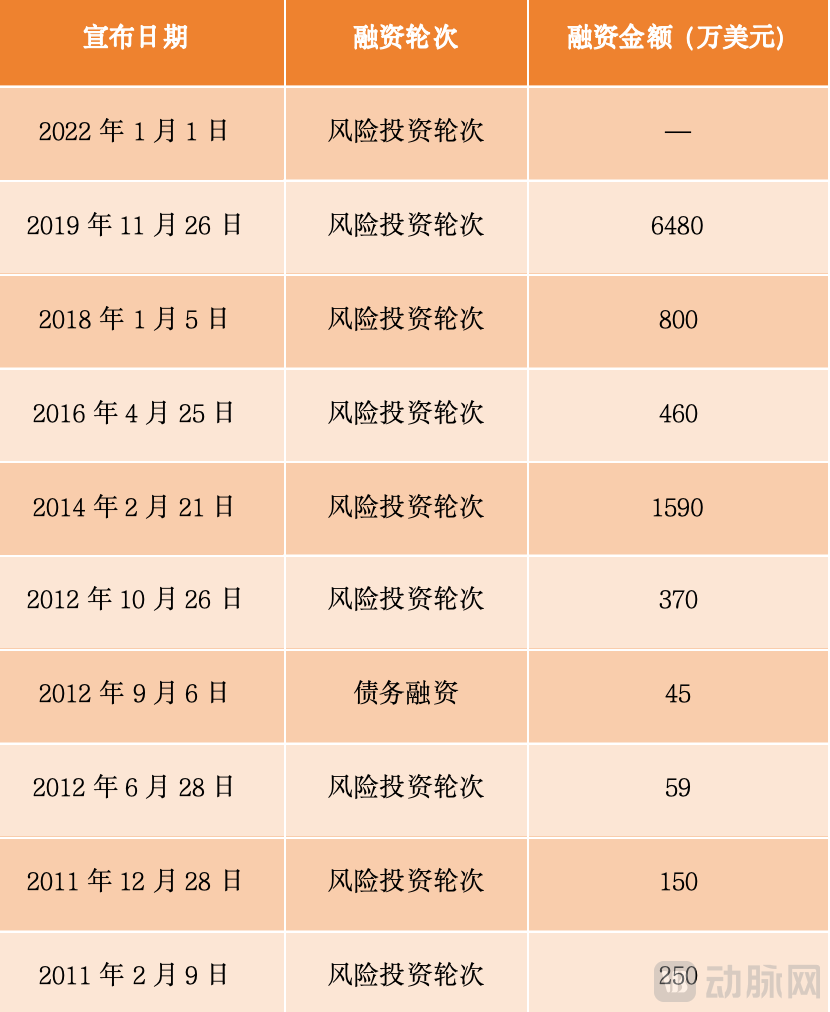
CapsoVision Historical Financing Information Table (Source: Crunchbase)
This performance record reflects the capital market’s recognition of its business model, which is inextricably linked to the strength of the team behind the company.
CapsoVision is a “Silicon Valley-style” team, with its key members having clearly defined responsibilities and authority in their respective fields.
As President of the company, Kang Huai Wang is responsible for overseeing overall operations and strategic advancement, playing a pivotal role in corporate financing and market expansion.
Johnny Wang serves as Chief Executive Officer, Chief Technology Officer, President, and a member of the Board of Directors. As the core figure in the company’s technological R&D and strategic decision-making, he has spearheaded the technical iteration of core products such as CapsoCam Plus, ranging from early panoramic imaging technology to subsequent AI feature development, thereby driving breakthroughs in clinical applications.
As Deputy Manager of Channel Sales, Elina Filipova focuses on expanding sales channels. By liaising with healthcare institutions and partners, she facilitates product penetration in the global market, playing a positive role particularly in optimizing channel strategies and enhancing customer coverage.
Overall, the company has established a synergistic chain of “technological innovation–clinical validation–market promotion,” which has supported the end-to-end advancement from product development to commercialization and laid the foundation for securing over $105 million in cumulative financing and achieving a successful IPO.
Implications for Domestic Enterprises: Seizing Market Space Through Technological Breakthroughs
Turning our attention back to China, CapsoVision’s development trajectory also offers valuable insights for domestic medical technology companies.
According to industry report data from Zhongcheng Shuke, the domestic capsule endoscopy market size in China reached RMB 1.54 billion in 2024, with a CAGR of 35.87% from 2019 to 2022. The top three domestic manufacturers (Jinshan Science & Technology, Ankon Technologies, and Zifu Medical) accounted for over 80% of the market share by sales volume, while imported brands (Medtronic and Olympus) held less than 10%.
It is evident that the domestic capsule endoscopy market is dominated by Chinese brands, which possess unique competitive advantages. For instance, Ankon and Jinshan utilize external magnetic fields to control capsule movement, thereby addressing blind spots in gastric examinations. The table below provides details on major domestic capsule endoscopy manufacturers:

Overview of Major Domestic Capsule Endoscopy Companies
(Source: National Medical Products Administration, official websites, and industry reports compiled by Zhongcheng Shuke and QYResearch)
Therefore, domestic innovative enterprises need to place greater emphasis on technological upgrading in order to secure a certain share of the market.
Domestic enterprises should prioritize technological upgrades to optimize product quality, thereby enabling continuous, in-depth exploration of multiple indications from the small intestine to the colon. This “single-point breakthrough–technology reuse–scenario expansion” pathway is more conducive to establishing competitive barriers.
Next is optimizing payment and distribution channels. By integrating with the national medical insurance system during the product R&D phase and adopting a flexible “direct sales + agency” channel strategy, technological innovations can be rapidly converted into market share.
Currently, as its colon-related products approach market launch and its AI capabilities undergo further iteration, CapsoVision is transitioning from a “capsule endoscopy supplier” to a “provider of digestive tract diagnostic solutions.” Its journey demonstrates that the ultimate competitive advantage in medical innovation lies in the ability to create a closed loop that translates technological breakthroughs into solutions that are accessible to patients, recognized by clinicians, and valued by the market—a key capability that Chinese companies must strive to develop.