

China's Cardiovascular Imaging Enters the 'DeepSeek Moment': Launch of Qiguang AI-OCT Large Model and DBdate Cardiovascular Database
At the “Special Session on AI-OCT Applications in Precision Diagnosis and Treatment of PCI,” held during the 27th Annual Conference of the Chinese Society of Cardiology in Xi’an on September 20, China’s first cardiovascular AI-OCT large language model—the Qiguang AI-OCT Large Model—was officially launched. By empowering medical imaging equipment with AI large models and leveraging a vast foundation of clinical data from cardiovascular databases, this system enhances the efficiency and precision of OCT image interpretation, significantly lowers the barrier to adopting OCT technology, and holds promise as the most precise guidance tool for percutaneous coronary intervention (PCI) procedures.
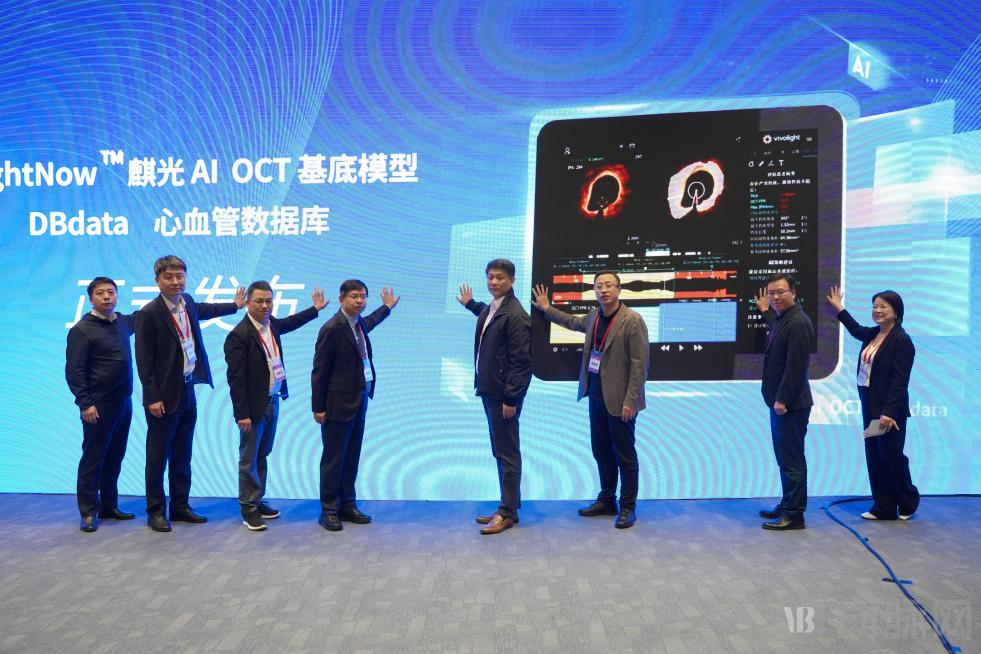
Official Launch of the Qiguang AI-OCT Large Model and DBdate Cardiovascular Database
Intravascular imaging technologies play an increasingly important guiding role in percutaneous coronary intervention (PCI) for cardiovascular diseases. In particular, optical coherence tomography (OCT), with its ultra-high resolution, can clearly delineate intravascular lesion morphology and stent characteristics, making it an indispensable diagnostic and therapeutic tool for precision PCI. However, OCT image interpretation is highly dependent on the operator’s experience and expertise, and variations in surgical strategies may lead to suboptimal treatment outcomes. Meanwhile, the steep learning curve associated with intravascular image interpretation also limits the widespread adoption of this advanced technology in primary care hospitals.
At this thematic symposium, more than ten medical experts and industry scholars from major tertiary Grade-A hospitals in China focused on cutting-edge technologies in the cardiovascular field. They engaged in discussions and exchanges centered on the clinical applications, challenges, and optimization directions of integrating large AI models with Optical Coherence Tomography (OCT) technology. Two innovative achievements were unveiled at the event: first, the “Dongbi Cardiovascular Corpus,” a knowledge base and data foundation specifically built for the cardiovascular sector; and second, the Qiguang AI-OCT Large Model, an AI-powered Optical Coherence Tomography (AI-OCT) system.
Multiple experts in the cardiovascular field have stated that the synergy between a specialized corpus and the AI-OCT system not only addresses the challenges of a “steep learning curve” and “limited diagnostic capacity at primary care levels” in intravascular imaging, but also ensures accuracy through evidence-based data, thereby providing a viable pathway toward “precision and inclusivity” in cardiovascular diagnosis and treatment.
Collaborative Efforts to Build China’s First AI-Powered OCT Large Model for Cardiovascular Care
At the conference, Wu Dengsheng, Distinguished Professor at Shenzhen University and CEO of Shenzhen Dongbi Tech Data (hereinafter referred to as “Dongbi Tech Data”), delivered a report titled “Data-Empowered Medicine: Accessibility of Medical Advances.” He introduced that, leveraging its experience in data mining, standardized curation of authoritative literature, and compliant validation of clinical data, Dongbi Tech Data has developed the “Dongbi Cardiovascular Corpus.” This corpus covers articles from 129 top-tier global journals and authoritative clinical guidelines. Through rigorous screening and validation, it ensures the clinical reference value of the data, providing core data support for the implementation of cardiovascular AI technologies.
Since 2024, Dongbi Tech Data has partnered with Shenzhen Zhongke Weiguang Medical Device Technology Co., Ltd. (“Zhongke Weiguang”) to initiate the research and development of clinical medical AI agents. Following the launch of its high-quality literature database this January, Dongbi Tech Data has supported Zhongke Weiguang in developing a cardiovascular AI large language model and building an AI-OCT system. Furthermore, Dongbi Tech Data released the DongBi Index for journal evaluation and open-sourced its high-quality literature assessment algorithm, thereby establishing industry standards for quality control of medical AI data.
“The reliability of medical AI is rooted in the ‘quality and compliance’ of data. In the past, many AI models in the industry encountered issues primarily because their training data was either disorganized or disconnected from clinical reality, which lies at the heart of ‘model hallucinations.’” Wu Dengsheng explained at the forum that corpora provide critical linguistic support for the development and refinement of large language models (LLMs). By working synergistically, they bridge the gap between a “high-quality data foundation” and “clinical device endpoints,” jointly advancing the construction of specialized LLMs for cardiology in China.
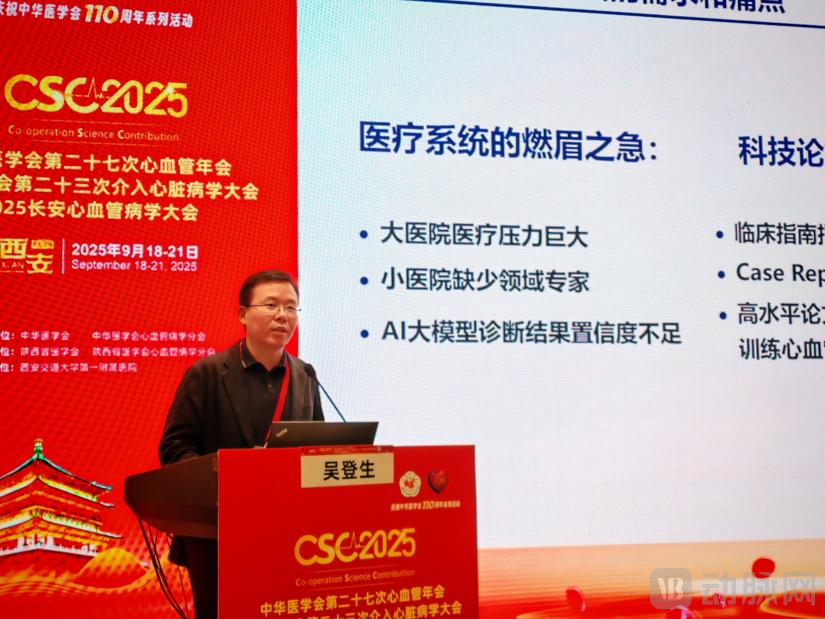
Wu Dengsheng, Distinguished Professor at Shenzhen University and CEO of Dongbi Technology Data, Delivered a Report at the Thematic Conference
Zhongke Weiguang is a company dedicated to the research, development, manufacturing, and clinical translation of high-end medical imaging equipment in the cardiovascular field. With years of deep expertise in Optical Coherence Tomography (OCT) technology, it is currently the only Chinese manufacturer whose OCT products have received both U.S. FDA clearance and China NMPA approval. Known in the industry as “optical biopsy” for cardiovascular imaging, OCT technology offers ultra-high resolution of 10–20 μm and serves as a core tool for diagnosing complex lesions such as atherosclerosis and plaque erosion. Building on its OCT technology, Zhongke Weiguang has further integrated clinical evidence-based medicine with large AI models, achieving a leapforward enhancement in diagnostic and therapeutic capabilities.
Zhu Rui, founder of Zhongke Weiguang, stated, “We identified critical clinical pain points at an early stage. The diagnostic capabilities of primary care hospitals are relatively weak, while cardiovascular medical resources at top-tier tertiary hospitals are scarce. The inability of a large number of cardiovascular patients to access high-quality diagnosis and treatment has become the primary contradiction. Advanced diagnostic and therapeutic technologies have also failed to reach the grassroots level. Through our collaboration with Dongbi Technology Data, leveraging its high-quality data, this AI-OCT system not only achieves a lower misdiagnosis rate than the average human physician but also generates reports in seconds. This lowers the threshold for adopting OCT technology, facilitates the widespread adoption of the concept of precise PCI across hospitals at all levels, and helps standardize diagnostic and treatment quality across different regions and institutions. By transforming the ‘clinical expertise of top-tier operators’ into an accessible tool, we aim to achieve healthcare equity.”
The Qiguang AI-OCT large model automatically generates diagnostic reports by intelligently identifying key information such as vulnerable plaques, calcium distribution, and stent apposition, while retrieving real-time data on surgical plans for similar cases and evidence-based medicine. This empowers experts to focus on complex diagnoses and treatments, significantly improving surgical efficiency and enabling more precise surgical treatment strategies.
Experts Reach Consensus: AI-OCT Ushers Diagnosis and Treatment into a New Era of Intelligence
To validate its clinical utility, in May this year, Zhongke Weiguang, in collaboration with four top-tier cardiovascular hospitals in China, simultaneously launched a multicenter clinical trial for its AI-OCT device and AI large language model. The results demonstrated that the system not only achieves a low misdiagnosis rate and enables "second-level" image analysis but also automatically generates structured diagnostic reports compliant with academic standards. At the conference, department directors from several leading hospitals participating in the clinical trial shared their findings on the clinical application of the AI-OCT system, providing the industry with a replicable framework for upgrading diagnostic and treatment protocols.
Professor Wu Xiaofan from Beijing Anzhen Hospital, Capital Medical University, presented a report titled “How AI-OCT Enhances Decision-Making and Efficiency in Precision Diagnosis and Treatment of Coronary Artery Disease” at the conference. She stated, “Currently, cardiac interventional procedures involve vast amounts of information and complex decision-making, heavily relying on physicians’ experience. The AI-OCT system has achieved a leap from ‘image interpretation’ to ‘treatment planning,’ addressing clinical needs and truly facilitating the transition into an era of intelligent diagnosis and treatment.”

Address by Professor Yuan Zuyi, Vice President of the First Affiliated Hospital of Xi’an Jiaotong University and Director of the Department of Cardiology
Professor Yuan Zuyi, Vice President of the First Affiliated Hospital of Xi’an Jiaotong University and Director of the Department of Cardiology, stated, “AI-OCT is driving the transformation of intracoronary assessment from an ‘auxiliary tool’ to a ‘decision-making hub.’ It is leading PCI into a new era of greater precision. This will profoundly influence our clinical thinking and practice patterns, enabling us to manage coronary artery disease, a complex condition, with unprecedented depth and breadth.”
“Not long ago, the paper on the DeepSeek AI model was featured on the cover of Nature, a premier international journal. This signifies our transition from technology followers to leaders. Today, with the release of the first large AI model for cardiovascular optical coherence tomography (OCT), we are marking not just a technological launch in the high-end medical field, but also declaring a new beginning. We are defining what the next generation of cardiovascular imaging AI should look like—more precise, more reliable, and better aligned with clinical practice—through originality and systematic innovation. This truly marks the beginning of China’s smart cardiovascular healthcare going global,” said Zhu Rui.