

Meiwei Dental Accelerates Full-Chain AI Integration to Empower Chain-Wide Intelligent Management
In 2025, large language models and AI agents are accelerating their penetration into various industries.In the medical field, the specialization of AI applications is accelerating, with a surge in specialty-specific large language models and intelligent agents; meanwhile, AI is also poised to become a transformative force in the dental industry.
Historically, AI applications in dentistry have been largely fragmented, yet they have significantly enhanced the efficiency of clinical workflows and patient services. However, the operation of dental healthcare institutions extends beyond clinical care to encompass various aspects such as workforce allocation, financial control, and supply chain management. These areas remain underexplored by AI but are in urgent need of technological intervention to improve operational efficacy.
Amid an increasingly competitive market landscape and a bottleneck in profit growth, fragmented AI applications are no longer sufficient to meet healthcare institutions’ heightened demands for efficiency gains. Notably,Since 2025, dental chain enterprises represented by Meiwei Dental have launched an AI offensive, extending AI applications across all business scenarios to establish a more comprehensive value system, with the aim of seizing early-mover advantages in the new phase of the dental market.
The Oral Healthcare Industry Has Reached a Crossroads for Transformation and Upgrading.
Driven by factors such as the centralized procurement of dental implants and the broader consumer environment, the oral healthcare sector has entered a period of temporary downturn. Financial reports from multiple listed companies indicate that over the past two years, while the volume of oral healthcare services—represented by dental implant procedures—has grown, profit margins have been squeezed. Furthermore, amid a challenging market landscape, a number of small and medium-sized clinics have gone out of business. Recurring incidents of “clinics absconding with funds before patients’ treatment courses were completed” have further eroded the overall credibility of the private oral healthcare sector.
However, it is undeniable that public demand for high-quality oral care products and services has never waned. With the accelerating trend of population aging and heightened national awareness of oral health, the market’s long-term growth drivers are clearly defined.
Faced with the current predicament,Dental healthcare institutions must further reduce costs and improve efficiency while enhancing medical quality and service standards, relying on quality and reputation to attract more returning patients and uncover new growth opportunities. In light of the “impossible triangle” in healthcare, technological breakthroughs have become the key pathway to achieving this goal.
AI is undoubtedly one of the technological forces with the fastest current update and iteration cycles, penetrating into various industries at a rapid pace.Continuously evolving along the “general–medical–specialized” pathway, with steadily improving alignment to actual industry needs.
In short, at a critical juncture where the dental industry urgently needs technological breakthroughs, the development of AI technology has provided a favorable opportunity.Taking Meivi Dental as an example, the group concentrated its efforts on unlocking AI value in 2025, building on its AI application explorations over the past few years, thereby becoming a typical industry benchmark.
Looking back on its development journey, Meivie Dental established “technology + healthcare” as its core strategic focus from the outset and has consistently adhered to this principle over the past decade. According to Zheng Cheng, Head of Informatics and Artificial Intelligence at Meivie Dental, the company has accumulated vast amounts of data related to business operations, employees, and user behavior after progressing through stages of informatization and digitalization. The significant potential for unlocking the value of these data assets represents a major advantage for Meivie Dental in its AI initiatives.
Looking more deeply,Meiwei Dental will leverage AI to enhance work efficiency, further unleashing human intelligence, energy, and productivity; strengthen quality and risk management through AI, reduce operational losses in chain management, and solidify the foundation for the long-term healthy development of large-scale dental chains; centering on employees and patients as two “core assets,” enable AI to serve as an efficient connector between them, thereby achieving lean operations and superior patient services.
The complexity of oral health conditions, the prolonged treatment cycles for major services such as orthodontics and dental implants, and the high degree of personalization involved necessitate frequent interactions between healthcare providers and patients to monitor their health status. From a management perspective, everything from large imaging equipment to small items like a packet of orthodontic elastics must be subject to strict, refined management. These characteristics collectively determine the diversity and complexity of AI application scenarios in the field of dentistry.
As early as 2021–2022, Meiwei Dental had already embarked on the exploration of AI applications, successively partnering with Yuyi Ganlan and Microsoft Azure to integrate AI tools into certain business processes.
Since 2025, Meiwei Dental has progressively integrated high-quality large language models, such as DeepSeek, into its self-developed Weixiaomei Medical Cloud Intelligent Platform, accelerating the development and application of AI technologies. On one hand, it continues to iterate and enhance previously deployed AI applications, including AI-assisted diagnosis and patient services. On the other hand, in response to the urgent need for cost reduction and efficiency improvement in dental chain management, it has developed risk control and management applications for human resources, finance, and assets, continuously expanding the value boundaries of AI.
Zheng Cheng introduced that, based on the integration of various business data into a large database, Meivie Dental has leveraged the capabilities of open-source large models to carry out personalized algorithm development and training, comprehensively advancing AI applications in four major areas: content generation, perceptual analysis, interaction interfaces, and decision optimization.
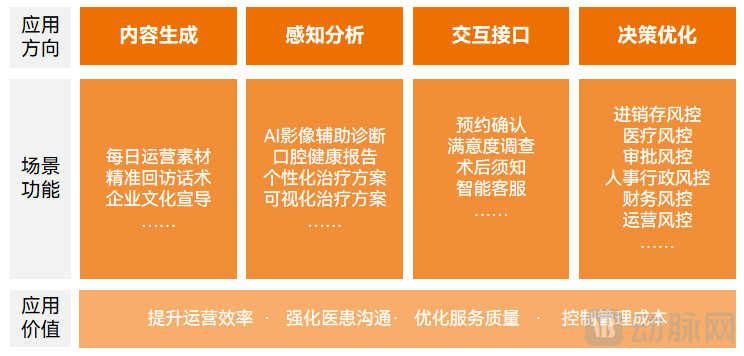
A Panoramic Overview of AI Applications at Meiwei Dental
In terms of content generation,Generative AI offers a wide range of practical applications, including: generating daily content for WeChat Moments, enabling operations staff to share it with a single click; creating precise follow-up scripts for healthcare professionals based on patient diagnosis and treatment information; and extracting corporate culture content to generate related text and images for display on the internal system’s homepage, thereby strengthening the promotion of corporate culture.
In terms of perceptual analysis,The primary focus is on integrating capabilities such as discriminative AI into clinical workflows. For instance, AI can rapidly identify pathological sites using CBCT images and intraoral photographs to generate oral health reports or personalized treatment plans. Additionally, an AI-powered visual treatment planning feature will be launched, enabling dentists to more intuitively demonstrate procedures such as dental implant placement and surgical guide fabrication to patients.
In terms of interactive interfaces,Leverage WeCom group chat bots to push appointment confirmations, satisfaction surveys, and post-operative instructions to clients. The system can also distribute smart coupons to boost customer activation and engagement, and even facilitate customer acquisition through coupon gifting. Additionally, an intelligent customer service module will be launched to promptly respond to patient inquiries and address common non-medical issues.
It is understood that,Most of the aforementioned features have been implemented, demonstrating significant effectiveness in enhancing customer operational efficiency, strengthening doctor-patient communication, and optimizing service quality. As the feature matrix continues to mature, related efficacy will be further enhanced.
Notably, optimizing decision-making is a key focus area for Meiwei Dental’s AI initiatives, with its core lying in embedding AI into multi-dimensional risk control management.
For a long time, standardized management has been a major challenge for dental chain operations. As the number of medical institutions increases and cross-regional expansion advances, management complexity rises exponentially. This is one of the primary reasons why many dental chains focus on deepening their presence in a few neighboring provinces or cities, with only a rare few achieving nationwide coverage across China.
In other words,If dental chain clinics successfully leverage AI to overcome management bottlenecks, they will not only achieve cost reduction and efficiency improvement in the management of existing institutions but also lay a solid foundation for future scalable growth.
Currently, Meiwai Dental’s medical institutions cover 28 cities across China, operating and managing 151 dental hospitals and clinics under 15 dental chain brands. At this scale, the adoption of AI technology to achieve lean management, reduce costs, and enhance efficiency has become an inevitable choice.
Zheng Cheng stated,In terms of decision-making optimization, Meiwei Dental has established an AI-driven risk control system spanning six key dimensions: inventory management (procurement, sales, and stock), clinical care, approval workflows, finance, operations, and HR/administration. Among these, risk controls for inventory management and clinical care are the top priorities.
Specifically,Procurement, Sales, and Inventory Risk ControlPrimarily targeting medical consumables, it monitors key aspects such as suppliers, procurement prices, purchase volumes, inventory overstock, and payment settlements, while providing risk early warning and control for each stage.
Medical Risk ControlBy leveraging AI to analyze patient consultation records, imaging reports, electronic medical records (EMRs), treatment plans, and other medical documentation, this approach evaluates the quality of treatment protocols and the completeness of EMRs, thereby mitigating the risk of medical disputes.
Approval Risk ControlCovers OA approval workflows, including contract approvals, with predefined control points for different processes. AI analyzes historical approval data and alerts initiators and approvers to risks when anomalies are detected.
Furthermore, risk control in HR administration, finance, and operations focuses on detailed management within their respective domains, leveraging AI technology to conduct real-time monitoring of human resources, financial reimbursement, and store operational data.
In the past, informatization facilitated the migration of key aspects of dental chain management from offline to online channels. However, risk control still required manual intervention, with a notable limitation being that both scheduled and unscheduled “spot checks” could only reflect the status at the time of intervention or within specific local areas, thereby necessitating corresponding reactive remedial measures. AndAI applications can enable 24/7 comprehensive, real-time early warning, facilitating timely issue detection and corrective actions, thereby significantly enhancing the proactivity and precision of management.
Taking inventory management as an example, dental medical institutions use a wide variety and large volume of consumables, with many potential points of loss; among these, high-value consumables account for a significant proportion of capital, directly impacting the enterprise's liquidity.After implementing real-time risk control, the AI-powered inventory management system can directly reduce cost losses previously caused by managerial inefficiencies and decrease capital tied up due to inventory overstock.
It is evident that, in terms of both strategic layout and implementation outcomes, Meiwei Dental has initially achieved the integration of AI technology across the entire chain of its medical operations and human, financial, and material resource management, providing a practical model for the transformation and upgrading of dental chain enterprises.
The rapid evolution of AI in healthcare is evident to all. As large language models and intelligent agents become increasingly specialized in their applications, leading enterprises such as Meiwei Dental have launched aggressive AI initiatives, further driving the dental industry’s shift from “marketing hypercompetition” to “technology-driven growth,” thereby helping to break through growth bottlenecks.
It was revealed that,Meiwei Dental will continue to refine its AI application matrix, empowering technology to deliver greater impact. In the short term, it will focus on improving efficiency in specific scenarios, while aiming for value reconstruction in the long run.
From the perspective of technological development stages, current AI and intelligent agents are predominantly focused on passive information processing or reasoning. The industry is driving the evolution of technology toward “proactive AI,” enabling AI to actively interact with and execute tasks in the external world.
Zheng Cheng also predicts that in the coming years, the level of imaging intelligence driven by discriminative AI will increase significantly. Features such as rapid generation of precise diagnoses after imaging, visualized deduction of disease progression and treatment outcomes may become standard, substantially improving diagnostic and therapeutic quality as well as doctor-patient communication efficiency. In terms of large models, digital human technology and doctor-patient interaction capabilities will also make leapfrog advances, while AI risk control will cover a broader scope with finer granularity.
In light of these trends, Meiwei Dental will also focus on exploring the application value of “proactive AI,” including developing products such as the “Xiaomei Copilot” intelligent assistant and digital human doctors. For instance, “Xiaomei Copilot” is designed to free employees’ hands by having the AI automatically break down task steps around a specific goal and execute them end-to-end, including data entry and queries, permission requests, data comparison and analysis, and result delivery.
Technological leaps will inevitably bring about changes in scenarios. In the long run, the application of AI in the field of dentistry is not only an efficiency upgrade for existing digital scenarios but also promotes the reconstruction of scenarios and values.
Overall,The oral care industry still has enormous room for growth, while AI’s penetration in this field is only just beginning.
Looking ahead to the future landscape of the oral health industry, niche markets focusing on “the elderly and children” are poised for rapid growth. For instance, early orthodontic treatment for children is gaining increasing attention from parents, and such early intervention synergistically promotes pediatric caries prevention and control programs. Meanwhile, the surge in demand for dental implant restoration is also driving growth in oral healthcare services for middle-aged and older adults. From a regional perspective, high-quality oral healthcare resources are currently concentrated primarily in first- and second-tier cities and along the eastern coastal regions. As public awareness of oral health strengthens and consumer spending recovers, there remains significant untapped market potential in third- and fourth-tier cities that awaits development.
Amid such shifts in the landscape,AI has immense potential, whether applied to personalized prevention of oral diseases, precision treatment, or enhancing the diagnostic and therapeutic capabilities of primary care.
AI applications will also become one of the core competencies for enterprises. Those that have accumulated substantial data assets, can fully unlock the value of data, and truly integrate AI into all scenarios of healthcare and management will be better positioned to navigate economic cycles and seize first-mover advantages in the next phase of the market.