

Hengrui Pharma Licenses Marketed HER2 ADC SHR-A1811 to Glenmark Specialty for Up to $1.093 Billion

Hengrui Pharma
Innovative and High-Quality Pharmaceutical Developer
Glenmark Specialty
New Drug Research, Development, and Manufacturer
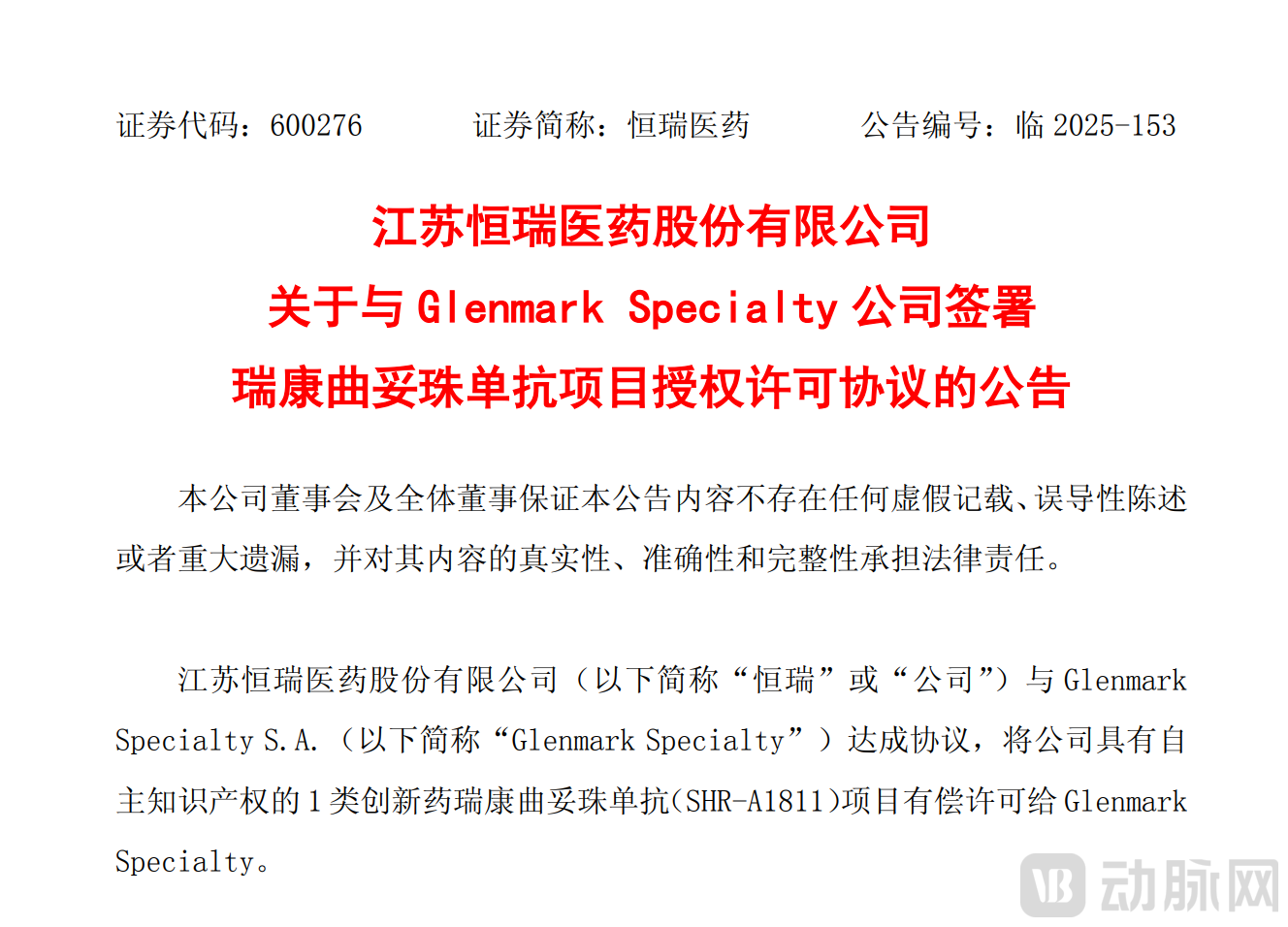
On the evening of September 24, 2025, Jiangsu Hengrui Pharmaceuticals Co., Ltd. (hereinafter referred to as “Hengrui Pharma”) announced that it had entered into an agreement with Glenmark Specialty S.A. (hereinafter referred to as “Glenmark Specialty”) to grant a paid license for its proprietary Class 1 innovative drug, Rekang Trastuzumab (SHR-A1811), to Glenmark Specialty.
Under the agreement, Hengrui Pharma has granted Glenmark Specialty an exclusive, paid license to develop and commercialize RC48 (disitamab vedotin) globally, excluding China, the United States, Canada, Europe, Japan, Russia, Armenia, Azerbaijan, Belarus, Kazakhstan, Kyrgyzstan, Moldova, Tajikistan, Turkmenistan, and Uzbekistan.
Under the financial terms of the agreement, Glenmark Specialty will pay Hengrui Pharma an upfront payment of $18 million. Hengrui is eligible to receive milestone payments related to registration and sales, totaling up to $1.093 billion (approximately RMB 7.795 billion). Based on the sales performance of Ruikang Trastuzumab within the licensed scope, Glenmark Specialty will pay corresponding sales royalties to Hengrui.
Hengrui Pharma stated that this transaction will help expand the overseas market for Ruikang Trastuzumab.
SHR-A1811: The Lightning-Fast Pace of Global Expansion Upon Launch
It is worth noting that SHR-A1811, the subject of this transaction, is not an early-stage project fitting the stereotypical perception of Chinese innovative drugs going global; rather, it is a cash cow in Hengrui Pharma’s HER2 ADC pipeline that is extremely close to commercial realization.
RC48 is an HER2-targeted antibody-drug conjugate (ADC) independently developed by Hengrui Pharma. It binds to HER2-expressing tumor cells and undergoes endocytosis, where proteolytic cleavage in the lysosomes releases the toxin, inducing cell cycle arrest and subsequent tumor cell apoptosis. The released toxin exhibits high membrane permeability, enabling a bystander killing effect that further enhances anti-tumor efficacy.
Ruikang’s trastuzumab was approved for marketing in China in May 2025. It is indicated for the treatment of adult patients with unresectable locally advanced or metastatic non-small cell lung cancer (NSCLC) harboring HER2 (ERBB2) activating mutations who have previously received at least one prior systemic therapy. This marks the first domestically developed antibody-drug conjugate (ADC) approved in China for NSCLC patients with HER2 mutations.
Furthermore, multiple clinical studies of Ruikang Trastuzumab are actively underway.
In August 2025, Ruikang Trastuzumab in combination with Adebrelimab and chemotherapy received Orphan Drug Designation from the U.S. FDA for the indication of gastric cancer or gastroesophageal junction adenocarcinoma.
In September 2025, the National Medical Products Administration (NMPA) accepted the marketing application for Ruikang Trastuzumab for a new indication related to breast cancer and included it in the priority review program.
To date, Ruikang Trastuzumab has had nine indications included in the Breakthrough Therapy Designation list by the Center for Drug Evaluation (CDE) of the National Medical Products Administration (NMPA), covering disease areas such as non-small cell lung cancer, breast cancer, gastric or gastroesophageal junction adenocarcinoma, colorectal cancer, biliary tract cancer, and gynecologic malignancies.
In other words, at the precise moment when the domestic commercialization window first opened, Hengrui Pharma immediately initiated overseas licensing. This strategy not only mitigated the uncertainties associated with later-stage sales but also allowed Glenmark Specialty, with its deeper familiarity with local markets, to capture the valuation upside, thereby achieving a seamless transition from domestic launch to global expansion.
Reverse List: Mapping the “No Global Expansion” Strategy
It is worth noting that Hengrui Pharma’s latest announcement contains several noteworthy and even anomalous elements.
First, it is worth noting that, under the agreement, the transaction establishes a “Joint Development and Commercialization Committee,” with each party appointing two representatives and holding equal say in global development strategy. This arrangement ensures that Hengrui Pharma continues to lead global clinical development while enabling Glenmark Specialty to be deeply involved in regional regulatory registrations, thereby precluding a passive, hands-off role.
The anomaly lies in the global expansion roadmap outlined in the agreement.
According to the announcement, Hengrui Pharma retains rights in China, the United States, Canada, Europe, the United Kingdom, Japan, Russia, the Caucasus region, and certain Central Asian countries. Glenmark Specialty has obtained rights for African and Oceanian countries, as well as those in Southeast Asia, the Middle East, and Latin America. Notably, clinical development in Australia will continue to be led by Hengrui Pharma.
In other words, this marks a rare instance in Hengrui Pharma’s global expansion history where licensing was granted via an ex-China list approach, thereby clearly reflecting its strategic prioritization of regions.
The core self-operated regions are China, Europe, the United States, and Japan. These regions have strong purchasing power and are expected to achieve higher sales peaks; therefore, Hengrui Pharma will retain its in-house teams or ensure deep involvement by NewCo.
The regions pending assessment include Russian-speaking countries, Central Asia, and other areas; due to high political and payment uncertainties, authorization is temporarily withheld.
The new growth regions are undoubtedly emerging markets such as India, Latin America, the Middle East, and Africa. Although their payment capacity is not as strong as that of core regions, the rapid volume growth is expected to enable quick revenue realization by leveraging Glenmark Specialty’s distribution channels.
Here we return to the other key player in the transaction, Glenmark Specialty. According to the announced agreement, the company is a subsidiary of Glenmark Pharmaceuticals, a research-driven global pharmaceutical company headquartered in Mumbai, India, listed on the National Stock Exchange of India (stock code: GLENMARK) and the Bombay Stock Exchange (stock code: 532296).
Glenmark Pharmaceuticals’ business spans innovative drugs, generics, and the OTC sector, with a strategic focus on respiratory, dermatology, and oncology therapeutics. The company operates 11 world-class manufacturing facilities across four continents and has a presence in more than 80 countries. According to the Scrip 100 rankings, Glenmark Pharmaceuticals was listed among the top 100 biopharmaceutical companies by pharmaceutical sales in 2023.
For Hengrui Pharma, entrusting “non-core markets” to Glenmark Specialty provides immediate access to high-growth regions such as India, Latin America, the Middle East, and Africa, without the need to build an overseas sales force; for Glenmark Specialty, securing a blockbuster HER2 ADC asset rapidly strengthens its oncology innovation pipeline and enables a significant brand elevation.
Hengrui Pharma Goes Global Again in Less Than a Month, Accelerating Its Internationalization Pace
In early September, Hengrui Pharma chose to take HRS-1893 global through a NewCo model. This move was underpinned by an in-depth analysis and precise positioning within the global cardiomyopathy treatment market landscape, representing a strategic decision made after careful consideration of its own R&D capabilities, financial status, and assessment of the global market.
Notably, Hengrui Pharma’s impressive financial performance and sustained R&D investment have served as the core engine for its internationalization. According to its financial report for the first half of 2025, Hengrui Pharma reported operating revenue of RMB 15.761 billion, a year-on-year increase of 15.88%; net profit attributable to shareholders of the listed company amounted to RMB 4.450 billion, representing a year-on-year growth of 29.67%.
Among these, sales and licensing revenue from innovative drugs reached RMB 9.561 billion, accounting for 60.66% of total revenue. Sales revenue from innovative drugs amounted to RMB 7.570 billion. Out-licensing of innovative drugs has become a routine business activity and an important component of Hengrui Pharma’s revenue. During the reporting period, the company received upfront payments of USD 200 million from Merck Sharp & Dohme and USD 75 million from IDEAYA for out-licensing agreements.
Notably, although Hengrui Pharma has made significant progress in licensing transactions, the proportion of overseas sales revenue from its independently innovative drugs remains relatively low. This is why the industry has long criticized Hengrui Pharma for its conservative approach to international expansion. According to the 2024 annual report, overseas sales accounted for only 2.56% of Hengrui’s total revenue.
However, on the other hand, overseas business development (BD) transactions for innovative drug pipelines have also become an important source of revenue for Hengrui Pharma. The upfront payments from BD transactions recognized in the first half of 2025 alone amounted to approximately RMB 2 billion.
Since the second half of 2025, Hengrui Pharma has completed three business development (BD) deals for its pipeline within a period of less than three months. In a bundled pipeline transaction with GSK, Hengrui Pharma received an upfront payment of $500 million; in another pipeline deal with Braveheart Bio, it secured an additional upfront payment of $65 million. These two transactions alone have generated approximately RMB 4 billion in new revenue.
In other words, even without considering subsequent milestone payments and potential sales royalties, Hengrui Pharma’s cash flow is no longer a concern once the upfront payment is received.
With an expected present value exceeding RMB 7.7 billion, this transaction has surpassed Hengrui Pharma’s estimated 2025 net profit attributable to shareholders. Its relatively cautious yet dominant approach to global expansion offers a cash flow channel that incurs no sales expenses and does not tie up production capacity, sufficiently prompting the market to reassess China’s global pricing power in ADCs.