

Shanghai State Capital's $13B Healthcare Investment Playbook: A Five-Year Blueprint from Early-Stage Bets to Cross-Border M&A

SIIC
Venture Capital, Asset Management Institutions
Since its establishment in 2020, SIIC, as a Shanghai state-owned asset fund management brand, has left a clear mark on the biopharmaceutical industry.
Over the past five years, SIIC has cumulatively invested approximately RMB 9.4 billion in the healthcare sector, funding around 60 companies. Its investments span sub-sectors including innovative drugs, high-end medical devices, innovative payment solutions, pharmaceutical equipment, and life sciences. The firm has achieved multiple successful exits through IPOs or M&A, with notable portfolio companies such as WeLish Biopharma, ArriVent Biopharma, Xintai Medical, Lepu Biopharma, Allist Pharmaceuticals, and Lixin Pharma.
SIIC serves as the lead investor in as many as 75% of all its projects. In the realm of equity investment, the lead investor is often the “discoverer” of industry value, the “controller” of investment pacing, and the “primary bearer” of risk and liability. This figure demonstrates that SIIC dares to make independent judgments and investment decisions in the biopharmaceutical sector, rather than following the crowd. For a state-owned investment institution, such a stance is particularly commendable.
SIIC Capital is the proactive fund management platform and innovative investment expansion platform under the Shanghai Industrial Investment (Holdings) Co., Ltd. (SIIC Group). It has established a dual-core fund matrix focused on biopharmaceuticals and green technology, covering an investment ecosystem that spans “early-stage incubation, mid-stage growth, M&A integration, cross-border innovation, and capital operations.”
Over the past five years, the healthcare sector has witnessed both investment booms and financing troughs. How does this investment firm, which accounts for 75% of lead investments, approach healthcare investing? What are its strategic considerations and outlook for the future? VCBeat analyzes its investment logic and strategy by examining and deconstructing its portfolio companies.
For a long time, the commercialization of scientific research achievements and early-stage projects have been among the highest-risk segments in the investment sector—marked by significant uncertainty in technology implementation and prolonged cycles for commercial validation, which have deterred many institutions. However, SIIC has proactively chosen to focus on this area.
In August 2021, SIIC established Phase I of the Shanghai Biopharmaceutical Innovation and Translation Fund.Prioritize investments in projects with original scientific achievements and potential for technological translation.。
According to the analysis, 75% of the companies invested in by SIIC are at Series B or earlier stages. It has incubated and nurtured 17 innovative healthcare enterprises, including Yufang Biotechnology, Baiquan Biotechnology, Nameixin Biotechnology, and Xunyao Biotechnology.
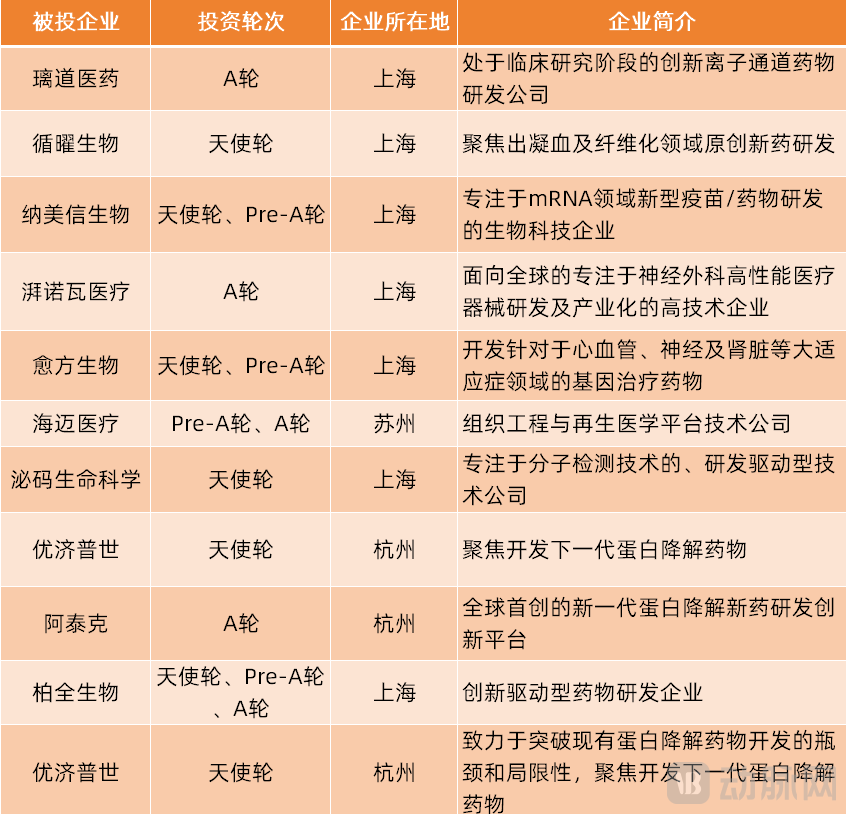
(Partial Investment Cases of SIIC)
These portfolio companies are truly one in a hundred. So, how does SIIC conduct its screening process?
First, SIIC prefers founders who have experience in translating scientific research achievements into commercial applications prior to starting their ventures.Most founders of companies such as Namexin, Lidao Pharma, and Xunyao Biotech had already achieved industrial translation of their scientific research outcomes while working at research institutes. For example, Dr. Qian Zhikang, founder of Namexin, developed a class of double-stranded Preparation Methods and Applications of Small RNA Molecules, with a Successfully Granted Patent. This technology can be utilized in the development of hepatitis B drugs. Leveraging the advantages of high efficiency and low-cost production of small RNA molecules, this patent was licensed by Dr. Qian’s laboratory to a major domestic pharmaceutical company for industrial commercialization.
Secondly, SIIC Capital favors innovative enterprises with global first-in-class or best-in-class products, which possess absolute technical barriers and unique clinical value.. The field focuses on innovative drugs, innovative medical devices, innovative diagnostics, and life sciences omics.
For example, in April 2024, the team led by Dr. Xu Jie, Founder and Chief Scientist of Boquan Bio, published the world’s first research findings on the CD3L1 immune therapy target in the prestigious international journal Cell. This study revealed the critical role of the novel immune checkpoint CD3L1 in tumor immune evasion, providing new insights for cancer immunotherapy.
Currently, Baiquan Biologics’ first-in-class anti-tumor drug developed against this target has simultaneously received clinical trial approvals from the U.S. FDA and China’s NMPA, and is now conducting Phase I multi-center clinical studies for various solid tumors and hematologic malignancies.
Based on assessments of industry value and product innovativeness, SIIC has been deeply involved throughout the entire incubation phase of Boquan Bio.Participated and, as an angel investor, continuously injected additional capital across three rounds of financing, providing the company with critical funding and resource support to facilitate its rapid entry into the clinical research phase.
Furthermore, Yufang Biotech, Aiteke, Xunyao Biotech, and Painova Medical have all launched products that are first-in-class globally, first-in-class within their category, or the first of their kind in China. Statistics show that among the projects invested in by Phase I of the Shanghai Biomedical Innovation and Translation Fund, those involving first-in-class drugs or medical devices account for as high as 70%.
Finally, in terms of geographic layout, SIIC shows a particular preference for regions such as the Yangtze River Delta and the Greater Bay Area.This choice is by no means accidental: on the one hand, the aforementioned regions boast a high concentration of universities and research institutes, which not only possess robust R&D capabilities but also offer streamlined channels for the commercialization of scientific achievements, thereby providing fertile ground for the growth of early-stage projects; on the other hand, this aligns closely with the strategic objective of the Shanghai Biomedical Fund to “be based in Shanghai, coordinate with the Yangtze River Delta and the Greater Bay Area, and face the global market,” creating a bidirectional support system between resources and strategic goals.
Despite the extremely high risks associated with early-stage projects, SIIC’s actions demonstrate considerable confidence in its professional judgment: for targets identified as high-quality, it provides long-term support through multiple rounds of capital injection. For instance, Nameixin, Yufang Biotech, and Haimai Medical have each received two consecutive rounds of investment from SIIC, while Boquan Biotech has secured three additional rounds of follow-on investment.
This precise early-stage positioning reflects the effectiveness of SIIC’s investment strategy: its early-stage portfolio companies often demonstrate strong appeal for subsequent financing rounds.
The continuous influx of capital and market recognition has injected critical momentum into corporate growth: Attene’s pipeline of molecular glue drug candidates, developed based on its ATTEC platform, has secured collaborations with global pharmaceutical giants and completed a new round of financing in August 2025; Haimai Medical announced the first-in-human (FIM) clinical study results of its independently developed biological artificial vascular graft in July 2025, and the product has entered the registration-enabling clinical trial phase; Xunyao Biologics’ SV003, a globally first-in-class subcutaneously administered nanobody bispecific antibody for hemophilia A, is nearing completion of preclinical validation; and Yufang Biologics has completed investigator-initiated trials (IIT) for its gene therapy drug targeting heart failure, with all these companies poised to rapidly advance into registration-focused clinical trials.
“Those who succeed must leverage prevailing trends.” The outstanding performance of Phase I Fund not only validated the feasibility of SIIC’s investment logic but also garnered market recognition for its strategic direction. At the end of 2024, the Shanghai Biopharmaceutical Innovation and Translation Fund Phase II, under SIIC, completed its first closing with a size of RMB 500 million. The fund received capital commitments from Shanghai Qianyan, Futeng Capital, relevant entities affiliated with Shanghai Fengxian State-owned Assets Supervision and Administration Commission, as well as market-oriented high-net-worth individuals. Building on the practical experience gained from Phase I, this fund will continue to focus on early- to mid-stage innovative projects in the biopharmaceutical sector, facilitating the translation of more scientific achievements from the laboratory to the marketplace.
This also means that SIIC will continue to screen and invest in early-stage innovative projects based on its previous logic and preferences.
In addition to early-stage projects, SIIC’s portfolio also features a high proportion of leading companies in their respective niche sectors, such as Lixin Pharma, Baoji Pharmaceutical, ArriVent, Chengfan Medicine, NewOrigin Pharma, Lepu Cardiac Technology, Silicon-based Bionics, MedxHealth, and Meili Weiye.

(Leading enterprises in selected niche sectors invested by SIIC)
Analysis reveals that SIIC’s investments in leading companies within niche sectors are primarily conducted through the Shanghai Biopharmaceutical Fund. This approach differs from the investment logic of innovation and transformation funds that focus on early-stage projects; under SIIC, the Shanghai Biopharmaceutical FundFocus on the leading enterprises in each niche sector.
By sector, in the medical devices field, the Shanghai Biopharmaceutical Fund primarily targets leading enterprises poised to resolve critical technological bottlenecks or establish high-quality domestic alternatives.. For instance, leading enterprises such as Silicon-based Bionics, Xintai Medical, Meili Weiye, and Shurui Robotics have all broken overseas monopolies through technological innovation, driving the substitution of domestic products for imports.
Taking Silicon-Based Bionics as an example, its independently developed continuous glucose monitoring (CGM) system has broken the monopoly held by foreign brands such as Abbott and Dexcom. Since receiving regulatory approval in 2021, Silicon-Based Bionics’ CGM product, Guiji Donggan GS1, has ranked first in sales among domestically produced CGMs for three consecutive years (2022, 2023, and 2024), achieving import substitution and expanding into overseas markets. It has been successfully exported to nearly 100 countries and regions across Europe, the Middle East, Latin America, and Southeast Asia, serving over 2.3 million diabetic patients worldwide.
In the field of innovative drugs, SIIC places greater value on companies that master foundational technological innovations and maintain globally leading drug pipelines.Lixin Pharma has built a globally leading antibody discovery and ADC technology platform, leveraging which it secured a business development (BD) deal with Merck & Co., featuring an upfront payment of $588 million and a total potential value of $3.288 billion. In July 2025, Lixin Pharma was acquired by Sino Biopharmaceutical at a valuation of $1 billion, marking the largest M&A transaction in China’s innovative drug sector this year. Orange Sail Pharma completed its Pre-A and Pre-A+ financing rounds totaling $110 million, led by SIIC Capital, within six months, and closed two overseas BD deals worth over $1.2 billion in less than half a year.
Additionally, SIIC also values leading enterprises that can provide significant support to the industrial chain.As a leading enterprise in innovative payment and insurance, Magnesium Health will provide diversified innovative payment solutions for the healthcare industry, supporting the accelerated market adoption of innovative medical products. As a leading pharmaceutical equipment manufacturer, Tofflon will provide cutting-edge equipment to innovative pharmaceutical companies, facilitating rapid drug development and large-scale commercial production.
The subsequent high-quality development of leading enterprises in these niche sectors further validates SIIC’s deep industry insights and precise professional judgment. Since the beginning of this year, Weili Zhibo has successfully listed on the Hong Kong Stock Exchange; Baoji Pharmaceutical, InnoMicro Medicine, and Mageline Health have each filed applications for listing in Hong Kong; and Puang Medical’s IPO on the Beijing Stock Exchange has entered the inquiry stage. These cases all demonstrate SIIC’s keen eye for investment opportunities.
Building on its past successful practices, SIIC is further intensifying its strategic investments. At the recently held SIIC 2025 Annual Investors Conference, SIIC simultaneously hosted the launch ceremony for Phase II of the Shanghai Biomedical Fund and a strategic cooperation signing event. It is reported that Phase II of the Shanghai Biomedical Fund will focus on key areas supported for the high-quality development of Shanghai’s biomedical industry, covering innovative drugs, novel therapies, high-end medical devices, and advanced formulations.
Since 2025, SIIC has been highly active:
In February, SIIC Capital (Hong Kong) was officially unveiled, aiming to deepen Shanghai-Hong Kong collaboration, increase cross-border investment, and expand its international business footprint.
In March, the Hong Kong Biotech Fund was established with a target size of HK$500 million, managed by SIIC (Hong Kong); SIIC Capital and International Venture Capital, the fund management brands under the Shanghai Industrial Holdings Group, officially completed their merger.
In April, the Shanghai Biopharmaceutical M&A Fund completed its first closing with a size of RMB 5 billion, managed by SIIC.
Based on these initiatives, SIIC will intensify its efforts in industry M&A and Shanghai-Hong Kong collaboration in the future.
In terms of mergers and acquisitions, SIIC will subsequently focus its strategic layout on serving the chain-leading enterprises in Shanghai’s pharmaceutical sector, promoting asset restructuring, and enhancing the industrial chain.
Since its establishment, the Shanghai Biopharmaceutical M&A Fund has completed or is advancing the closing of three landmark transactions: facilitating Shanghai Pharmaceuticals’ strategic acquisition of Shanghai Hutchison Pharmaceuticals, acquiring a controlling stake in Kanghua Biology, and making a strategic equity investment in MicroPort Scientific.
As the core instrument for SIIC’s entry into industry M&A, the Shanghai Biopharmaceutical M&A Fund focuses on synergizing with leading “chain-owner” enterprises in Shanghai, strengthening industrial clusters and supply chains, and empowering asset restructuring. It aims to help leading “chain-owner” companies scale up and strengthen their market position, thereby promoting the integration and upgrading of Shanghai’s biopharmaceutical industry chain.
Shanghai-Hong Kong Collaboration,SIIC will lay out early-stage innovative projects in the biotechnology sector in the Hong Kong region.
This also aligns with the strategic positioning of SIIC’s parent company, Shanghai Industrial Holdings (SIIC Group): leveraging the research and innovation ecosystems in both Shanghai and Hong Kong to build a translational bridge from basic research to industrial application, thereby fostering the development of biotechnology, supporting Hong Kong’s establishment as an international innovation and technology hub, and accelerating Shanghai’s emergence as a global highland for biopharmaceuticals.
As the active fund management platform under the Shanghai Industrial Investment (Holdings) Co., Ltd. (SIIC) Group, SIIC Capital promotes Shanghai-Hong Kong collaboration from an investor’s perspective. Its managed Hong Kong Biotech Fund was jointly initiated by SIIC Group and The Hong Kong University of Science and Technology, and willFocusing on Hong Kong and the Greater Bay Area, dedicated to early-stage innovative projects in biotechnology,Focus on the commercialization of research outcomes in the strong disciplines of top-tier universities such as HKUST,Promote the incubation and commercialization of innovative technologies and achievements from Hong Kong’s universities and research institutions.
Although it has been established for only six months, the Hong Kong Biotech Fund has already invested in multiple innovative projects. For instance, Editact, an innovative enterprise incubated from research achievements at the Hong Kong University of Science and Technology (HKUST), and Opharmic, a medical technology company founded by Dr. Sun Weiliang, an HKUST alumnus, have both secured new rounds of financing from the Hong Kong Biotech Fund.
Among them, Editact has pioneered the development of a “one-to-many” gene editing therapy, which holds promise as a clinical treatment that addresses familial Alzheimer’s disease at its root cause. Opharmic employs ultrasound technology for the non-invasive delivery of macromolecular drugs, aiming to resolve clinical pain points such as adverse reactions and poor patient compliance associated with intraocular injections. Currently, the company has established platform technologies in three areas—ophthalmology, dermatology, and cell therapy—and is committed to delivering breakthrough non-invasive drug delivery methods.
In addition to the Hong Kong Biotechnology Fund, SIIC (Hong Kong) formally signed a strategic cooperation agreement on the construction of the Future Intelligent Technology (Hong Kong) Incubator with the Institute of Emerging Technologies at the University of Hong Kong and the Shanghai Industrial Technology Research Institute this April. This partnership aims to integrate Hong Kong’s international scientific research capabilities with Shanghai’s industrial resources, improve the sci-tech innovation ecosystem, and accelerate the transformation of scientific and technological achievements and industrial upgrading in both regions.
SIIC has long established a presence in Hong Kong and the Greater Bay Area. For instance, its portfolio company, Painova Medical, is an innovative enterprise rooted in the Guangdong-Hong Kong-Macao Greater Bay Area with a global outlook. Leveraging the Greater Bay Area as its R&D and industrialization base, Painova Medical is dedicated to developing next-generation high-performance neurosurgical medical devices.
In 2022, SIIC also signed a strategic cooperation memorandum with Shanghai Pharmaceuticals and Hong Kong Science Park Company to jointly launch the “Biopharmaceutical Co-Incubation Program,” actively pursuing in-depth collaboration in the biopharmaceutical sector, and facilitated the establishment of the Shanghai-Hong Kong Joint Innovation Incubator, 01LABS@Hong Kong.
Meanwhile, SIIC has guided the establishment of more than ten innovative pharmaceutical and medical device companies in Hong Kong through its investments. Leveraging the complementary strengths of Shanghai and Hong Kong, these efforts collectively serve the development of the biotechnology industry.