

Shields Health Solutions: From $0 to $24.8 Billion in 13 Years — The Capital Leap of an Embedded Specialty Pharmacy

Shields
Integrated Solutions Provider for Specialty Pharmacies
Recently, the healthcare sector witnessed its largest single financing deal of the year: Shields Health Solutions, a provider of comprehensive specialty pharmacy solutions, secured $3.5 billion in funding (approximately RMB 24.8 billion). The round was led by Evernorth, the health services arm of insurance giant Cigna, with co-investment from J.P. Morgan and others. The capital will be used to expand specialty pharmacy services, particularly for specialty medications targeting complex and chronic diseases.
As the first company in the United States to embed specialty pharmacies within hospitals and clinics, Shields has evolved from a Massachusetts-based startup into a healthcare powerhouse backed by $3.5 billion in investment. What has propelled Shields to become a focal point of acclaim among both investors and the medical community in just a few short years? The answer lies in its strategic choices at every step.
Founding, Acquisition, and Independence: Three Pivotal Turns in a “Pharmacy”’s Fate
Shields’ story is far more than a tale of one company’s success; it also offers a side view of how specialty pharmacies explore ways to address real-world pain points in healthcare settings.
In 2012, serial entrepreneur Jack Shields founded Shields Health Solutions in Massachusetts.
The entrepreneur who built Shields MRI into the largest diagnostic imaging service provider in New England has keenly identified a critical pain point in specialty drug management within the U.S. healthcare system: patients with complex conditions, such as cancer and rare diseases, often experience treatment delays due to difficulties in accessing medications and cumbersome payment processes.
Guided by his original aspiration to “make specialty medications readily accessible,” he proposed a disruptive concept: embedding specialty pharmacies directly within hospitals and clinics to seamlessly integrate medication management with clinical care.
In its early stages, Shields leveraged the founder’s 30 years of accumulated resources in the healthcare sector to rapidly establish partnerships with multiple hospitals in the New England region, validating the value of its business model through tangible outcomes: by integrating pharmaceutical company resources with insurance networks, it increased the success rate of patients accessing limited-distribution drugs from the industry average of 60% to over 90%.
This breakthrough achievement earned Jack Shields the Ernst & Young Entrepreneur of the Year Award in 2015, propelling the company into a period of rapid expansion; by 2018, it had expanded its reach to healthcare systems across 20 states.
After 2018, the specialty pharmacy market entered a period of explosive growth. Shields’ unique “embedded model” attracted Walgreens, the U.S. retail pharmacy giant, to enter the fray. This partnership was not a simple acquisition, but rather a gradual, deep strategic alignment.
2019: Initial capital injection, laying the groundwork for future collaboration.Walgreens first partnered with the private equity firm Welsh, Carson, Anderson & Stowe to acquire a majority stake in Shields for $800 million. At the time, the industry interpreted this move as “a key strategic step by traditional pharmacy giants toward transitioning into specialty healthcare.” Walgreens possesses an extensive nationwide brick-and-mortar pharmacy network but lacks clinical management capabilities for specialty medications; meanwhile, Shields precisely needed capital and distribution channels to expand from a regional player to a national one.
2021: Increased controlling stakes to consolidate market leadership.Recognizing Shields’ growth potential in their partnership, Walgreens invested an additional $970 million, raising its stake to 71% and achieving absolute controlling interest. In the same year, with Walgreens’ support, Shields acquired its largest competitor, ExceleraRx, propelling it to the leading position in the U.S. in-hospital pharmacy consolidation sector.
2022: Wholly acquired and fully integrated into the giant’s ecosystem.Walgreens ultimately completed the acquisition of the remaining 29% stake for a total of approximately $2.34 billion, making Shields its wholly-owned subsidiary. Leveraging Walgreens’ resources, Shields accelerated its national expansion, extending its service network from 20 states to all 50 states and covering more than 40 healthcare systems.
This acquisition marked a turning point, freeing Shields from the resource constraints typical of startups. No longer burdened by concerns over distribution channels and capital, the company can now focus on optimizing its service capabilities. However, it has also transitioned from an independent decision-making entity to a business unit under a corporate giant.
In early 2024, market rumors circulated that Walgreens was considering selling Shields at a valuation exceeding $4 billion. Although CEO Timothy Wentworth subsequently publicly denied any plans to sell, he hinted that the company would “seek options to maximize the business’s value.”
The Real Turning Point Arrived in 2025:
March: Change of ownership at the parent company, creating an opportunity for independence.Private equity firm Sycamore Partners acquired Walgreens for approximately $23.7 billion. In this largest M&A deal in the U.S. retail sector, Sycamore’s core strategy is to “focus on Walgreens’ core pharmacy-retail business,” while the specialty pharmacy segment where Shields operates is considered a “non-core, high-growth segment” and has been designated as an “asset available for divestiture.”
August: Official independence, regaining decision-making autonomy.Following the completion of the acquisition, Sycamore swiftly announced the spin-off of Shields into an independent entity, allowing it to focus on the specialty pharmacy sector. This separation was not a passive divestiture but rather the result of Shields’ proactive efforts. The company sought to break free from the strategic constraints imposed by retail giants, thereby enabling more agile integration with healthcare systems and insurance resources.
September: Secured $3.5 billion in strategic investment, launching a new growth curve.Just one month after becoming independent, Shields secured a $3.5 billion preferred equity investment from Evernorth, the healthcare services arm of insurance giant Cigna, setting a new industry record for a single investment round. To date, the company’s partnership network has expanded to include more than 80 health systems and over 1,000 hospitals, with annual prescription value exceeding $30 billion.
Three pivotal turns essentially represent three recalibrations of Shields’ strategic positioning: at its founding, it was a solver of healthcare pain points; during its acquisition, it served as an enabler for the giant’s transformation; and after becoming independent again, it emerged as a definer of industry rules. Each step may have appeared coincidental, yet all remained anchored to its original mission of “making specialty medications more accessible”—a core logic that likely underpins its ability to achieve continuous breakthroughs amidst the complex transformations in the healthcare industry.
Embedding, Connecting, and Empowering: How Shields Reshapes the Specialty Pharmacy Value Chain
Shields’ growth extends far beyond the favor of capital. To understand why it has continuously garnered recognition from industry giants and secured sky-high investments, one must deconstruct this “pharmacy without a pharmacy,” examining how it reshapes the value chain of specialty pharmacies by embedding itself into medical scenarios, connecting multi-party resources, and empowering clinical care and management.
Shields’ moat is not a single advantage, but a robust ecosystem woven from multiple barriers:
Relational Networks: Replacing Simple Cooperation with Deep Integration.Shields has established exclusive or in-depth partnerships with nearly 80 top-tier healthcare systems. These collaborations, built on a foundation of high trust, involve data interoperability and process integration, resulting in prohibitively high switching costs that constitute its core asset.
Technical Data: TelemetryRx Efficiency Engine.Shields’ self-developed TelemetryRx platform serves as a digital hub, integrating prescription management, patient follow-up, data analytics, and reimbursement functionalities. It seamlessly interfaces with hospital electronic medical record (EMR) systems, pharmaceutical manufacturers’ distribution databases, and pharmacy benefit manager (PBM) systems. By leveraging AI to predict patient adherence risks in real time and enable automated interventions, the platform enhances therapeutic outcomes. The economies of scale generated by this system continuously reduce marginal service costs as the number of partner hospitals increases.
Professional Services: Pharmacists as Core Members of the Diagnostic and Treatment Team.For complex diseases such as cancer, rare diseases, and autoimmune disorders, Shields has assembled a team of pharmacists and nurses with deep clinical expertise to provide medication guidance, side effect management, and continuous monitoring. This has become key to winning hospital trust and differentiating itself from traditional distributors.
Economies of scale: leveraging large prescription volumes to secure concessions from multiple parties.Shields’ massive prescription volume grants it strong bargaining power, enabling it to secure more favorable drug pricing and reimbursement terms for partner health systems—a scale advantage that new competitors will find difficult to match in the short term.
Shields’ core strategy is to operationalize the aforementioned four barriers into an embedded service loop spanning from clinical care to payment, thereby forming the “Shields Care Continuum.” By progressing through five sequential stages—COORDINATE, ENGAGE, ENHANCE, INTERVENE, and RENEW—and leveraging a dual-track synergy of “centralized + on-site” operations, Shields systematically addresses the pain points in specialty drug management.
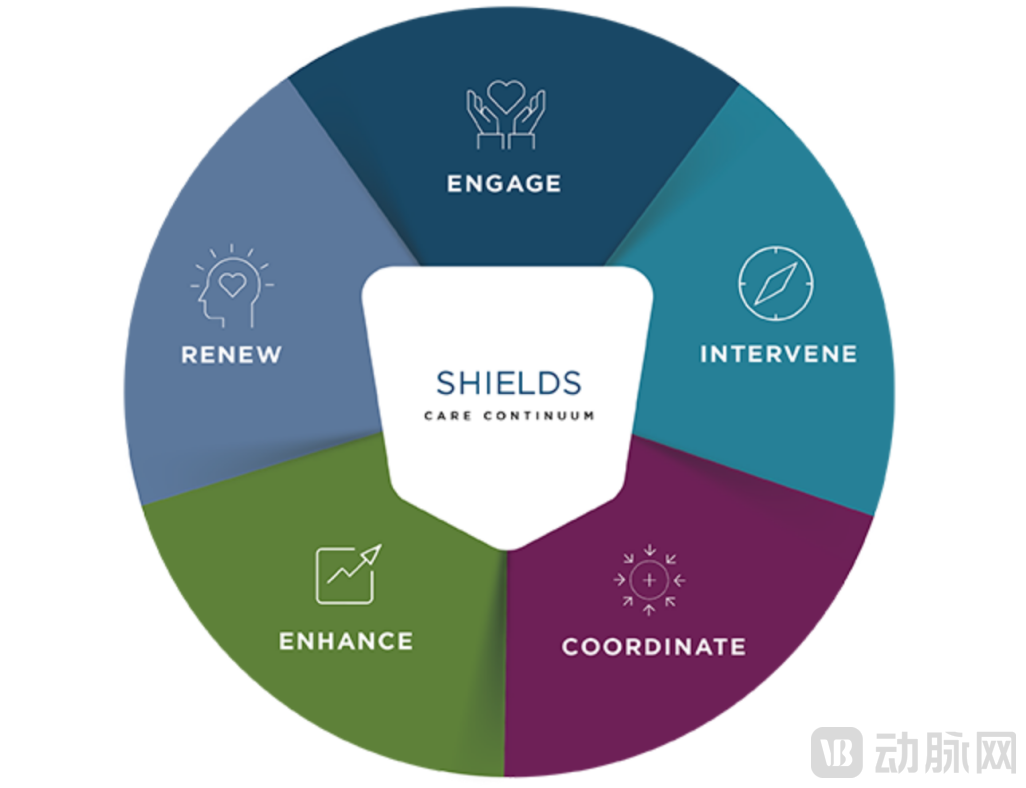
Schematic Diagram of the Shields Care Continuum Model Source: Shields Health Solutions Official Website
● COORDINATE: Shields proactively investigates patients’ insurance benefits, completes prior authorizations for medications, and identifies financial support opportunities such as pharmaceutical patient assistance programs and government subsidies. According to 2024 data from its official website, this effort secured $2.3 billion in financial aid for patients throughout the year, directly lowering the economic barriers to medication access and preventing treatment delays due to cost concerns.
● ENGAGE (Integration): Establishing Patient Awareness During Medication Use. In the early stages of treatment, Shields engages deeply with patients through both outpatient consultations and telemedicine. On one hand, it explains to patients the necessity of pharmacological therapy and the impact of adherence on therapeutic efficacy; on the other hand, it reminds patients to complete routine laboratory tests on schedule, such as complete blood count monitoring during oncology drug therapy.
● ENHANCE: Providing comprehensive, multi-dimensional nursing support. Shields delivers holistic patient support through multi-role collaboration involving pharmacists and pharmacy liaisons, encompassing emotional support, patient education, and care coordination. This integrated service model transcends the traditional limitations of pharmacies focused solely on medication dispensing, enabling patients to receive more compassionate medical support.
● INTERVENE: Mitigating clinical risks in medication use. Clinical pharmacists play a core role at this stage by providing strategies to alleviate side effects, monitoring drug interactions in real time, and analyzing laboratory test results to dynamically adjust medication dosages.
● RENEW (Continued Maintenance): To ensure long-term therapeutic efficacy after medication initiation. This phase is not merely a medication refill service, but involves continuous efficacy monitoring and care optimization. Shields experts regularly communicate with patients regarding their medication experience, proactively identify care milestones requiring adjustment, and synchronize follow-up data with the attending physician, thereby establishing a tripartite collaboration among the patient, pharmacist, and physician.
In practice, dual-track collaboration enhances process efficiency. The online component (TelemetryRx + PSC) handles patient identification and administrative burden reduction, while the offline component (clinical pharmacists + pharmacy liaisons) provides face-to-face services and medication dispensing. This approach ensures that “services are delivered wherever patients are,” thereby maintaining continuity and efficiency in specialty medication management.
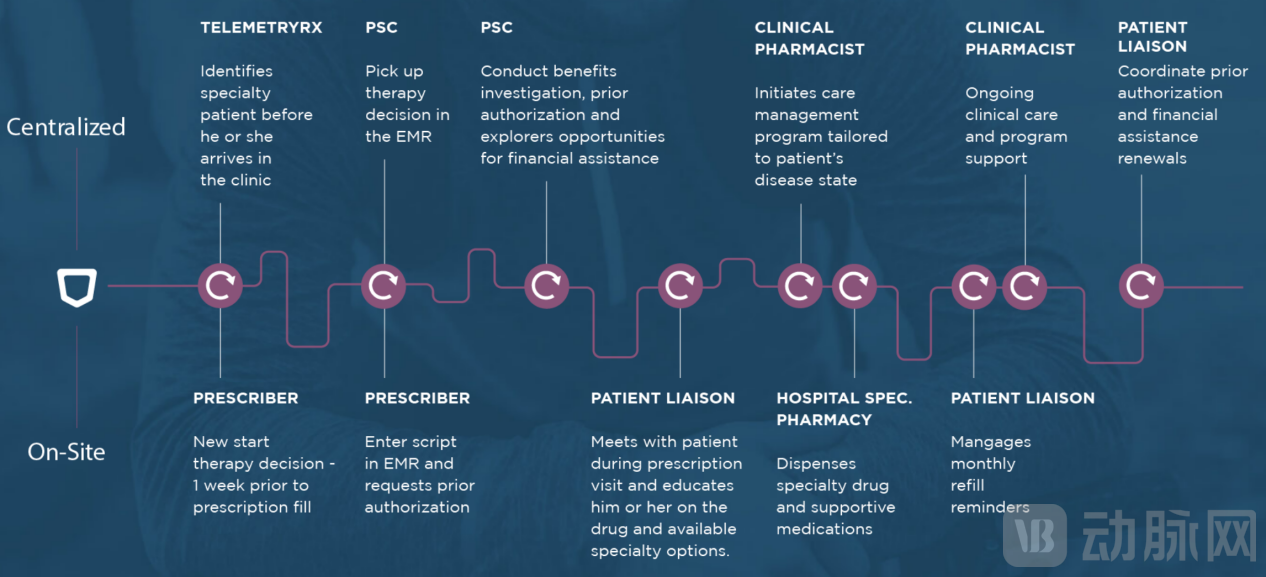
Schematic Diagram of the Dual-Track Collaborative Care Process Source: Shields Health Solutions Official Website
Shields is not merely a simple intermediary in healthcare, but a value hub that precisely connects pharmaceutical manufacturers with supply chain partners.
For pharmaceutical manufacturers, Shields provides full-cycle support, from accelerating R&D to scaling up for market launch.
During the R&D phase, Shields conducts research on new drug pipelines 18–24 months in advance to identify unmet clinical needs. In the early post-launch period, it collects feedback from frontline physicians to help pharmaceutical companies promptly adjust their R&D or marketing strategies, thereby reducing trial-and-error costs. For rare diseases such as hereditary angioedema (HAE) and hemophilia, Shields also provides customized specialized services to ensure the standardized implementation of complex therapies and improve patient medication adherence.
Entering the market expansion phase, Shields connects to limited distribution drugs (LDDs) through a single-source network contract, leveraging its nationwide health system network to help pharmaceutical companies eliminate the costs associated with coordinating across multiple institutions. It utilizes TelemetryRx to provide standardized real-world data for validating drug value and establishes single-point account management to streamline processes such as contract negotiations and LDD access, thereby expanding patient coverage.
For supply chain partners, Shields delivers value through the dual assurance of enhanced efficiency and reduced risk.
In terms of efficiency enhancement, Shields leverages its expertise in Trade Relations to customize market access solutions, shortening the cycle for Limited Distribution Drug (LDD) and pipeline product access; utilizes multi-channel payer contracting (including PBMs, managed care organizations, and direct-sign networks) to rapidly engage major payers and reduce delays in reimbursement access; and relies on a network covering more than 80 health systems nationwide to optimize allocation pathways for distributors and lower channel expansion costs for pharmaceutical companies.
In terms of risk mitigation, Shields not only avoids policy and audit risks through end-to-end compliance management but also helps partners optimize drug pricing within a compliant framework via the 340B Drug Pricing Program, thereby reducing procurement costs and preventing margin compression. Furthermore, by leveraging clinical data such as a 97% cure rate for hepatitis C and an HIV viral suppression rate that exceeds the national average in China by 29%, Shields reduces efficacy-related disputes and market trust risks for its partners, including pharmaceutical companies.
This two-way service capability makes Shields an irreplaceable hub in the industry chain. Pharmaceutical companies rely on it to demonstrate drug value and expand market coverage, while suppliers leverage it to optimize resource allocation and improve turnover efficiency. Shields, by integrating the needs of both parties, highlights its ecological operational value that surpasses traditional pharmacies.
Breakthrough, Transformation, and Restructuring: From Pharmacy Management to the Healthcare Ecosystem
When a company secures $3.5 billion in strategic investment, its narrative is no longer just about the past and present, but more importantly, about how it defines the future.
As Cigna CEO David Cordani stated in the investment announcement, “This investment significantly enhances our ability to deliver integrated services to patients, providing a seamless pharmacy experience wherever they are.” This statement not only articulates Cigna’s strategic intent but also reveals a fundamental transformation underway in specialty pharmacies: evolving from simple drug distribution channels into value hubs that connect patients, hospitals, pharmaceutical companies, and payers.
Amid the wave of industry transformation, Shields is not passively adapting; instead, leveraging the opportunity brought by capital injection, it is accelerating the expansion of its strategic footprint from a new starting point.
Deep mining of data value is Shields' most anticipated growth pole.The TelemetryRx platform has accumulated a substantial dataset of real-world medication use, transforming it from a mere pharmacy management tool into a platform for efficacy insights. These data not only provide pharmaceutical companies with critical evidence for new drug development and indication expansion but, more importantly, help drive the transition in healthcare payment models from volume-based to value-based reimbursement.
Expansion of disease indications is another clear direction.Having solidified its position in core areas such as oncology and autoimmune diseases, Shields is replicating its model in chronic disease management fields, including psychiatry and cardiology. Data from the National Alliance on Mental Illness (NAMI) reveals that nearly 60% of patients with mental illness struggle with medication adherence, highlighting a substantial market opportunity.
Leveraging the Cigna Network for Global Expansion.Although not yet officially announced, Cigna’s global network provides Shields with a natural channel for international expansion. Demand for specialty pharmacy services is strong in European and Asian markets, but significant differences in local payment systems necessitate localized adaptation capabilities, placing higher demands on Shields’ strategic flexibility.
Shields’ proactive breakthrough must be examined against the broader backdrop of the “failure of traditional pharmacy models.”As traditional pharmacies grapple with the dual challenges of shrinking profit margins and sluggish growth, the industry has come to a stark realization: restructuring the value proposition of specialty pharmacies is not an “optional choice,” but a “matter of survival.”
In terms of market size, the global pharmacy industry appears to be continuing its growth. According to statistics from Bizwit Research & Consulting LLP, the global pharmacy market was valued at USD 1231.77 billion in 2024 and is projected to reach USD 1627.74 billion by 2030. North America holds the largest share of the global pharmacy market, primarily driven by the presence of major chains such as CVS Health and Walgreens.
Beneath the surface-level growth, traditional pharmacies have reached a critical tipping point in their struggle for survival: on one hand, e-commerce giants like Amazon are squeezing retail margins through low-priced generic drugs and online pharmacy services; on the other, changes in prescription drug reimbursement policies are intensifying cost pressures. Without offering high-value-added professional services, reliance solely on drug price differentials is no longer sufficient for survival.
For example, Walgreens Boots Alliance faced sustained performance pressure due to its failure to transform in a timely manner, ultimately leading to its privatization by Sycamore Partners in 2025 and plans to close a significant number of stores. In contrast, CVS Health established a new ecosystem integrating insurance, healthcare, and pharmaceuticals through its acquisition of Aetna, and announced a $20 billion investment over ten years to enhance healthcare interoperability.
This comparison also confirms that the traditional pharmacy model, which relies solely on drug price differentials, is unsustainable. As a critical link between innovative drugs and patients, specialty pharmacies can only break through this predicament by embedding services and integrating into the ecosystem.
The collapse of traditional models answers the question of “why change,” while the maturation of artificial intelligence technology resolves the critical issue of “how to change.”AI is the core technological foundation driving specialty pharmacies to evolve from labor-intensive distribution centers into data-driven value engines.
Industry data indicates that AI penetration in the healthcare sector has entered an acceleration phase. According to Grand View Research, the global AI healthcare market size was $19.27 billion in 2023 and is projected to reach $208.2 billion by 2030. AI technology has already permeated core pharmacy scenarios, including prescription processing, patient management, and drug development.
Beyond Shields’ TelemetryRx system, numerous healthcare systems are leveraging AI to reduce costs and enhance efficiency. Amazon Pharmacy applies generative AI to process prescriptions, reducing potential errors by 33%–50% and increasing processing speed by up to 90%. Northwell Health, in partnership with Aegis Ventures, developed the Ascertain platform, which streamlines discharge planning operations from 150 clicks to just six, and compresses the processing time for patient referral authorizations from two hours to six seconds.
The Chinese market is also actively deploying AI in healthcare. At the 2025 China International Fair for Trade in Services (CIFTIS), the Beijing National Pilot Base for Artificial Intelligence Applications showcased achievements such as trusted health data services and an AI-driven drug R&D platform. Ping An Good Doctor launched its “Ping An Xin Yi” AI assistant, which leverages digital human technology and medical big data to provide users with 24/7 comprehensive health advice, while empowering physicians to enhance diagnostic and treatment efficiency.
In China, one of the largest pharmaceutical markets globally, what does the development landscape of specialty pharmacies look like? With the normalization of medical insurance cost containment and the full implementation of the “dual-channel” policy for nationally negotiated drugs, specialty pharmacies—represented by Direct-to-Patient (DTP) pharmacies—are gradually evolving from a supplementary channel for innovative drug distribution into a core platform for absorbing outpatient prescription outflows and a key node within the healthcare service system.
As of the end of 2023, there were over 1,500 certified DTP (Direct-to-Patient) pharmacies across China, covering 90% of the catchment areas of Grade IIIA hospitals. The proportion of out-of-hospital sales for innovative drugs surged from 21% in 2016 to 95% in 2020, making DTP pharmacies the primary channel for oncology and rare disease medications.
However, the Chinese market also faces unique challenges. Although 4,894 pharmacies have obtained “dual-channel” qualifications, most enterprises remain confined to pharmaceutical warehousing and distribution, with pharmaceutical care services accounting for only 12% of their revenue, compared to an average of 22% in the United States. Furthermore, there is a significant shortage of professional talent; the supply-to-demand ratio for licensed pharmacists stands at 1:2.3, and only 7% of pharmacists are capable of handling consultations for rare diseases, thereby constraining service upgrades.
Currently, some enterprises have begun to explore the value-based healthcare model. For instance, Si Pai Health focuses on the integration of “medical care, pharmaceuticals, health management, and insurance,” providing customers with end-to-end services spanning disease prevention, diagnosis, treatment, and rehabilitation by integrating its medical service network, pharmaceutical supply chain, and customized insurance operations. Yuanxin Technology, leveraging agent clusters as its technological foundation, is achieving simultaneous breakthroughs in the three sectors of pharmaceuticals, medical care, and insurance: on the pharmaceutical front, it has built an out-of-hospital intelligent patient management system to improve medication adherence; on the medical front, it has implemented a full-process interaction system to enhance service efficiency; and on the insurance front, it has optimized policy administration and claims services. These efforts connect in-hospital patient services, out-of-hospital patient management, and health protection across the entire value chain, thereby driving the reconstruction of the healthcare value ecosystem.
In Closing
For the industry, Shields’ greatest contribution lies in redefining the role of specialty pharmacies. This shift in positioning has triggered a chain reaction across the industry ecosystem: pharmaceutical companies are more willing to prioritize new drug supplies to pharmacies capable of providing end-to-end management; hospitals increasingly rely on specialty pharmacies to mitigate risks associated with the proportion of pharmaceutical expenditures; and payers place greater trust in reimbursement models supported by robust data.
Looking ahead, Shields still faces significant challenges. There are no standard answers to questions such as how to maintain service quality while scaling up, how to balance data utilization with privacy protection, and how to navigate profit fluctuations driven by policy changes. What is certain, however, is that the importance of specialty pharmacies as the invisible infrastructure of the healthcare system will continue to grow.
Shields’ case demonstrates that enterprises capable of deeply integrating professional service capabilities, technological integration capabilities, and ecosystem synergy capabilities will ultimately gain a competitive edge in the wave of healthcare value reconstruction. Its exploration is not merely a business story, but also a microcosm of the entire healthcare industry’s transition toward patient-centric care.