

Dual-Payload ADCs Surge: Biotechs Rush In, Poised to Deliver the Next BD Blockbuster?
In recent years, the development of antibody-drug conjugates (ADCs) has been gaining significant momentum. Data shows that the number of global ADC deals increased from 9 in 2015 to 62 in 2023, making 2023 the year with the highest number of ADC transactions on record. Based on disclosed transaction amounts, the total value of global ADC deals exceeded $140 billion between 2015 and 2025.
As of now, a total of 19 antibody-drug conjugate (ADC) drugs have been approved and marketed globally. According to forecasts by WuXi XDC and Frost & Sullivan, the global ADC market size is projected to reach $66.2 billion by 2030, with a compound annual growth rate (CAGR) of approximately 31% from 2024 to 2030. Data from PharmaCube shows that as of September 29, 2025, there were 1,457 actively developed ADC candidates worldwide, of which 70.97% were in the preclinical stage, 14.00% in Phase I clinical trials, and 8.44% in Phase II clinical trials.
With the widespread application of antibody-drug conjugates (ADCs), issues of tumor heterogeneity and drug resistance associated with ADC products have begun to emerge. To overcome ADC resistance and address tumor heterogeneity, optimization of the intrinsic components of ADCs has become a current focus and hotspot in development.Among these, dual-payload ADCs significantly enhance therapeutic efficacy by precisely regulating the ratio of two drugs to deliver synergistic payloads accurately to cancer cells. Furthermore, employing payloads with two distinct mechanisms of action can substantially reduce the incidence of drug resistance.
In the first half of this year, leading multinational corporations (MNCs) such as Pfizer and Roche have sensed business opportunities and rapidly entered the dual-payload ADC sector. Meanwhile, domestic and international companies—including Innovent Biologics, Kanghong Pharmaceutical, Aikeresi, Alphamab Oncology, BioCytoGen, Yilian Biotechnology, Bairuiyi, TargetLink Biologics, Adcoris, BioRay, GeneQuantum, and Sutro—are also competing in this arena, vying for a foothold in this emerging blue-ocean market.
At the 2025 AACR Annual Meeting held this year, dual-payload antibody-drug conjugates (ADCs) have emerged as a new focal point. According to abstracts released at the conference, at least 14 dual-payload ADCs were presented, with most of these projects having never been disclosed before. In contrast, only four dual-payload ADCs were featured at the AACR Annual Meeting one year ago.
Various signals indicate that dual-payload ADCs, as emerging contenders in the ADC field, are on the verge of an explosion. As early-stage dual-payload ADC pipelines progressively enter clinical trials and yield preliminary data validation, the next major breakthrough in business development (BD) may well emerge from this area.
Designed to Overcome ADC Resistance and Optimize the Therapeutic Window
Before understanding why dual-payload ADCs have become a hotspot, we need to know what dual-payload ADCs are.
In most effective cancer chemotherapy regimens, complementary drug combinations are required to overcome the heterogeneous sensitivity of tumor cells to different agents. This well-established strategy is analogous to dual-payload antibody-drug conjugates (ADCs). The so-called dual-payload ADC refers to a single ADC molecule that simultaneously carries two payloads with distinct mechanisms of action, or two differentiated linker forms of the same payload. By precisely modulating the total drug-to-antibody ratio (DAR) and its release kinetics, this approach aims to achieve synergistic cytotoxicity, overcome drug resistance, and expand therapeutic indications.
As early as 2017,Levengood et al. were the first to employ two different types of microtubule polymerization inhibitors, MMAE and MMAF, conjugated via short peptide linkers to cysteine residues, thereby enabling researchers toPreliminary concepts for dual-payload ADCs have been established.Among them, MMAE is cell-permeable and can exhibit a bystander effect, killing neighboring antigen-negative cells; however, MMAE can induce multidrug resistance, leading to reduced activity in cells with high expression of efflux pumps. In contrast, MMAF is less susceptible to drug efflux, retaining activity in multidrug-resistant cells, but its extremely low cell permeability means it does not exhibit a bystander effect. Relevant pharmacodynamic studies have confirmed that this dual-payload ADC demonstrates potent antitumor activity, while overcoming tumor cell resistance through the addition of complementary payloads, thereby significantly enhancing the cytotoxic effect of the ADC on cancer cells.
Based on the preliminary concept of dual-payload ADCs, it is necessary to further clarify that in the early stages of industry development, “dual-toxin ADCs” are often confused with “dual-payload ADCs,” although the latter encompasses a broader scope.In dual-payload antibody-drug conjugates (ADCs), the “dual payloads” can refer to two cytotoxic drugs (e.g., a DNA-damaging agent plus a microtubule inhibitor, i.e., “dual-toxin ADCs”); alternatively, they may consist of one cytotoxic drug combined with a non-toxic payload such as an immune agonist or radiosensitizer; or even involve the same toxin released via two different linkers (achieving differential release in terms of timing and spatial distribution).
It is easy to understand that the purpose of dual-payload ADCs is to “kill multiple birds with one stone”—by integrating two complementary or differentiated therapeutic warheads onto the same antibody scaffold, they achieve multi-target, multi-spatiotemporal, and multi-mechanistic synergy in a single molecule, which traditionally requires combination therapies. Therefore, theoretically, dual-payload ADCs offer four major technical advantages:
① Synergistic Mechanism:Simultaneously targeting different biological pathways or distinct nodes within the same pathway significantly enhances cytotoxic efficiency. For example, antibody-drug conjugates (ADCs) co-loaded with topoisomerase inhibitors and PARP inhibitors can exert potent cytotoxic effects against both tumors with homologous recombination repair (HRR) deficiencies and those with intact homologous recombination mechanisms.
② Overcoming Drug Resistance:The combined action of multiple mechanisms can reduce primary resistance and slow the development of acquired resistance. For example, the combination of microtubule inhibitors and immunomodulators can directly kill tumor cells while also activating anti-tumor immunity, forming a “kill–immune” positive feedback loop;
③ Bystander Effect:Certain payloads (e.g., RNA interference molecules) can target cancer-associated fibroblasts or immunosuppressive cells, remodeling the microenvironment to enhance overall therapeutic efficacy;
④ Optimizing the Therapeutic Window:Mitigating dose-limiting toxicity of monotherapy through fine-tuning of the drug-to-antibody ratio (DAR) and release kinetics.
Recognizing these advantages, MNCs such as Roche and Otsuka Pharmaceutical have become the first movers since 2025, pioneering collaborations in the field of dual-/multi-payload ADCs.In January 2025, Chugai Pharmaceutical, a Roche subsidiary, entered into a collaboration with Araris Biotech (valued at $780 million) to jointly develop multi-payload antibody-drug conjugates (ADCs) and explore more complex payload combination strategies. In March 2025, Taiho Pharmaceutical, an Otsuka Pharmaceutical subsidiary, acquired Araris Biotech for $1.14 billion, gaining access to the latter’s ADC linker technology platform, Aralinq, to accelerate its deployment in dual-payload ADCs.
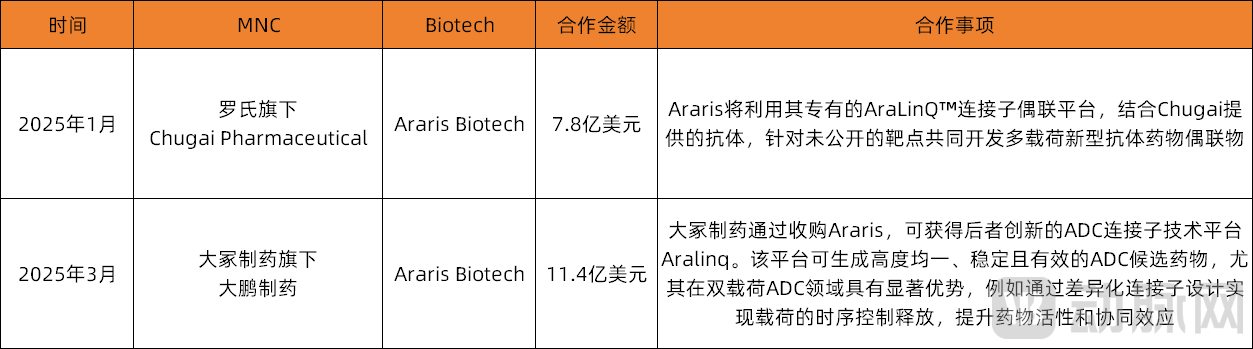
MNCs That Have Closed Deals in the Dual-/Multi-Payload ADC Field
Furthermore, in March 2025, during its ADC R&D investor event, Pfizer also revealed that it would prioritize the “development of next-generation payloads” as a key strategic focus, with dual-payload ADCs being one of the areas under development.It is easy to foresee that more multinational corporations (MNCs) will enter this sector through partnerships, locking in seed-stage pipelines at lower prices before the sector’s explosive growth, thereby avoiding premium-priced “scrambles” for assets at later stages. A cohort of startups with genuine dual- or multi-payload technological capabilities is poised to become the darlings of the business development (BD) community.
Chinese Biotech Leads in Clinical Development
According to public data statistics compiled by VCBeat, nearly 20 pharmaceutical companies worldwide have explicitly disclosed their pipelines for dual-payload antibody-drug conjugates (ADCs), while many other enterprises have indirectly revealed their involvement in this field through financing, acquisitions, and strategic collaborations. These companies include overseas firms such as Araris, Acepodia, Callio, CatenaBio, CrossBridge, Hummingbird, Sutro, and BrickBio, as well as Chinese enterprises including Kanghong Pharmaceutical, Accuris Therapeutics, Alphamab Oncology, Yilian Biopharma, Innovent Biologics, DuoXi Bio, Qide Medicine, Bio-Thera Solutions, Affinity Biosciences, TopAlliance Biosciences, Bairuiyi, and TargetLink Biopharma.
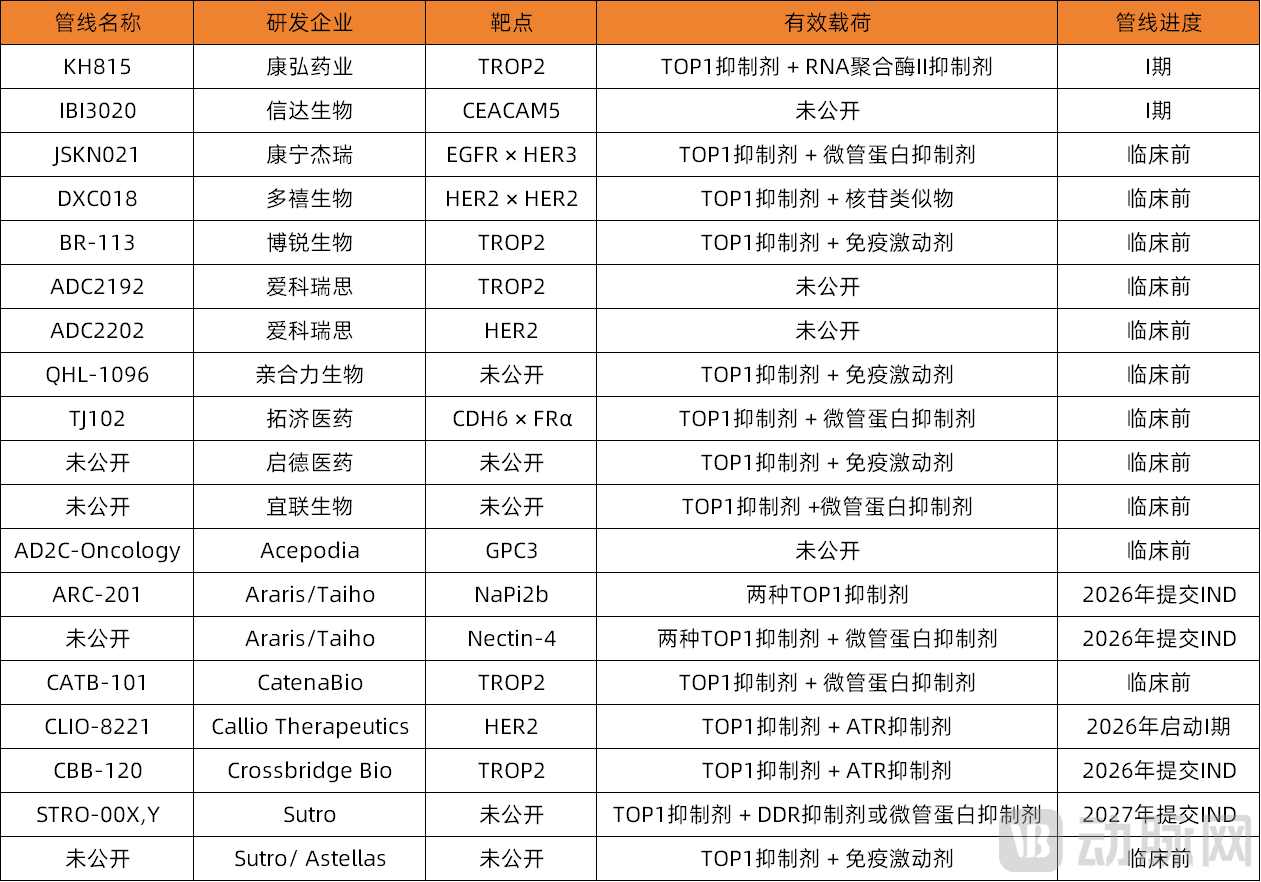
According to incomplete statistics, the currently disclosed dual-payload ADC pipelines
(Data source: Nature Reviews Drug Discovery and other public sources)
Among them, Kanghong Pharmaceutical’s KH815 and Innovent Biologics’ IBI3020 are currently the only two dual-payload ADC pipelines globally that have received IND approval.
In March 2025, the Investigational New Drug (IND) application for KH815, developed by Chengdu Kanghong Biotech, a wholly-owned subsidiary of Kanghong Pharmaceutical, was approved by the Human Research Ethics Committee in Australia, making it the first dual-payload antibody-drug conjugate (ADC) pipeline globally to enter clinical trials. In April 2025, the pipeline further received the "Notice of Approval for Clinical Drug Trials" issued by the Center for Drug Evaluation (CDE), authorizing the commencement of clinical trials.
KH815 achieves simultaneous inhibition of tumor cells at both the RNA and DNA levels through a dual synergistic mechanism; furthermore, it reduces the expression of P-gp and HSP70 proteins, thereby overcoming drug resistance and enhancing cellular sensitivity to chemotherapeutic agents.
In vitro efficacy studies of this pipeline demonstrated that KH815 exhibits nanomolar-level cytotoxic activity against tumor cells with varying levels of TROP2 expression. In vivo efficacy studies showed that KH815 exerts dose-dependent inhibition of tumor growth in multiple CDX and PDX models across various tumor types. Furthermore, KH815 also demonstrated antitumor activity in several CDX and PDX models resistant to camptothecin-based antibody-drug conjugates (ADCs).
The dual-payload design is expected to confer a high antitumor response rate in humans for KH815, and it holds therapeutic potential for patients resistant to camptothecin-based antibody-drug conjugates (ADCs).
The world’s second dual-payload ADC pipeline to receive clinical trial approval comes from Innovent Biologics. In April 2025, the Center for Drug Evaluation (CDE) website indicated that Innovent Biologics’ dual-payload ADC candidate IBI3020 had been approved for clinical trials. Although IBI3020 was not the first pipeline to receive an Investigational New Drug (IND) application approval, it is the first dual-payload ADC developed on Innovent Biologics’ proprietary DuetTx ADC platform and the first dual-payload ADC of its kind globally known to have completed dosing in clinical patients.
IBI3020 is an antibody targeting carcinoembryonic antigen-related cell adhesion molecule 5 (CEACAM5). Upon selective binding to CEACAM5-expressing tumor cells, it undergoes CEACAM5-dependent internalization of the antibody-drug conjugate (ADC), followed by lysosomal degradation. Furthermore, the release of its two payload cytotoxic drugs exerts a dual cytotoxic effect on tumors. In preclinical studies, IBI3020 demonstrated robust antitumor activity across various tumor-bearing pharmacological models and exhibited a bystander killing effect. Meanwhile, IBI3020 showed a favorable safety profile in preclinical models, with overall safety being manageable.
In terms of clinical progress,Chinese pharmaceutical companies have gained a first-mover advantage. The forward-looking and strategic investments made by domestic firms in the cutting-edge field of dual-payload antibody-drug conjugates (ADCs) are highly likely to create more opportunities for future collaborations with multinational corporations (MNCs). However, true leadership will depend on key clinical results over the next two to three years, as well as successful Phase III trials and eventual regulatory approval for commercialization.
In the capital markets,In contrast, foreign companies have been more active. Over the past year, startups CrossBridge and Callio have successively announced the completion of financing rounds: In November 2024, CrossBridge announced the closing of a new $10 million funding round to advance its innovative TROP2-targeting dual-payload ADC drug, CB-120, into IND-enabling development, utilizing exatecan and an ATR inhibitor as its payloads; in March 2025, Callio announced the completion of a $187 million Series A financing round to support clinical proof-of-concept studies for its HER2-targeting dual-payload ADC and a second undisclosed ADC program.
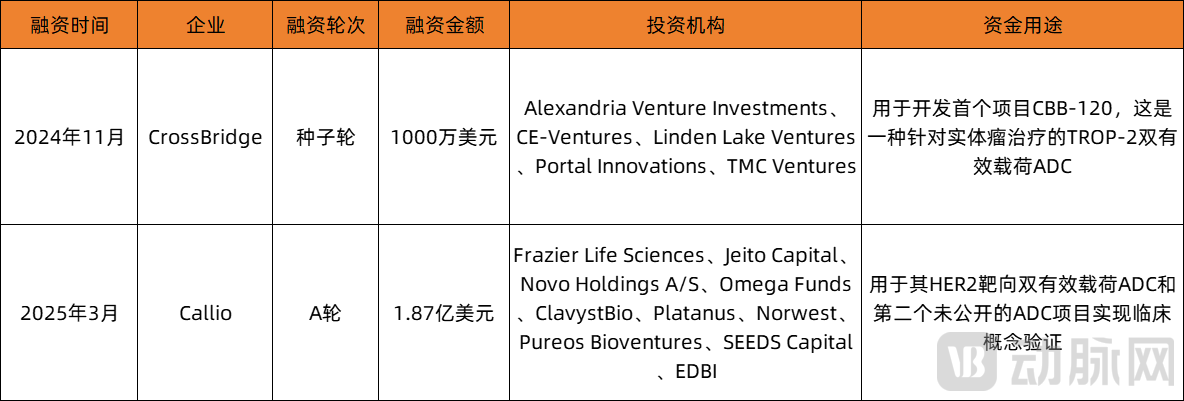
Dual-Payload ADC Companies That Completed Financing in the Past Year
Admittedly, although most dual-payload antibody-drug conjugates (ADCs) remain in the preclinical stage—with some innovative therapies yet to disclose even basic details such as pipeline names, targets, or payloads—this has not diminished the sector’s appeal to global pharmaceutical companies. Following years of technological breakthroughs and accelerated investments and strategic positioning by multinational corporations (MNCs) over the past year, dual-payload ADCs may well lead the next wave of Chinese biotech companies expanding into global markets, against the backdrop of the current surge in domestic ADC internationalization.
Dual-Payload ADCs Face Three Major Industry Challenges
Currently, a large number of experimental studies on dual-payload antibody-drug conjugates (ADCs) are underway, and related research has confirmed the numerous advantages of dual-payload ADCs.However, in the process of practical translation, it has also been found that such drugs still face three major industrial challenges:
First, the issue of regulatory ambiguity,Currently, neither the FDA nor the EMA has established independent technical guidance documents for dual-payload antibody-drug conjugates (ADCs), and there is ongoing debate over whether they should be regarded as single agents or combination therapies. This uncertainty will directly impact clinical pathway design (e.g., whether toxicological validation is required for each payload) and commercial registration strategies (e.g., whether each component requires separate registration and licensing). To address this issue, many companies currently favor defining dual-payload ADCs as “single composite molecules” to qualify for ADC-specific accelerated review pathways, although regulatory ambiguity persists.
Next is the challenge of "synchronization" in drug release,The release of dual-drug payloads must be controlled across the dimensions of tissue selectivity, cellular selectivity, intracellular environment, and time.Precision Control. Premature or unbalanced release can lead to excessive release of one type of toxin, resulting in enhanced toxicity; insufficient release of one type leads to loss of synergistic effects; excessive exposure of extra-tumoral tissues causes safety issues.
Next is the CMC challenge of dual-load ratio regulation,Compared with traditional ADCs, dual-payload ADCs face higher regulatory hurdles in aspects such as CMC stability, establishment of quality standards, batch release logic, and control of homogeneity for dual-toxin conjugation. Furthermore, global pipelines of dual-payload ADCs are currently in early stages, requiring more data to validate their long-term safety and ability to overcome drug resistance.
There is no quick, standard solution to the aforementioned challenges; companies can only continuously optimize their approaches and gradually reveal the answers to the industry over time.In the future, dual-payload ADCs will focus on the following directions:
① Continuous Deepening of Payload Innovation:Exploration of novel payloads, such as DNA damage response (DDR) inhibitors (e.g., ATR inhibitors) and immune stimulants (e.g., CpG oligonucleotides), continues to break new ground. For instance, CLIO-8221, developed by Callio and targeting HER2, combines a TOP1 inhibitor with an ATR inhibitor, featuring a drug-to-antibody ratio (DAR) of 4+4. Callio plans to initiate the first-in-human trial of CLIO-8221 in the first quarter of 2026. CrossBridge Bio is also developing a dual-payload antibody-drug conjugate (ADC) combining TOP1 and ATR inhibitors. Its preclinical data demonstrated that in a model resistant to Dato-DXd, all mice responded to the dual-payload ADC, with responses lasting over 120 days.② The triple-payload system is already on the way:Araris’ Nectin-4-targeting tripayload ADC (two TOP1 inhibitors + the microtubule inhibitor MMAE) has completed proof of concept.③ Expansion of Indications:Expanding into refractory areas with unmet needs, such as small cell lung cancer and triple-negative breast cancer.
The core value of dual-payload antibody-drug conjugates (ADCs) lies not only in the innovation and complexity of their structural engineering but also in the synergy of pharmacological mechanisms and the optimization of the therapeutic window. This represents a key technological leap in tumor-targeted therapy, evolving from “single-mechanism intervention” to “multi-mechanism integration.” Research in this field not only drives cross-disciplinary innovations in drug delivery systems, linker chemistry, and synthetic biology but also demonstrates unique advantages in overcoming tumor heterogeneity, delaying drug resistance, expanding indication boundaries, and achieving immune synergy. In an era of fierce competition among industry giants where single-agent therapies have become a red ocean, dual-payload ADCs may offer a path to a differentiated market—a journey that is challenging yet promising. With Kanghong Pharmaceutical and Innovent Biologics successively receiving clinical trial approvals in the first half of 2025, the first Phase I clinical data for dual-payload ADCs are expected to emerge in the second half of 2025.
References:
1.Nature Reviews Drug Discovery,《Dual-payload ADCs move into first oncology clinical trials》
2. Science China Press, “Research Progress on Payloads of Antibody-Drug Conjugates”
3. China Pharmaceuticals, March 2025, Vol. 39, No. 3, “Reflections on the General Chapter for Human Antibody-Drug Conjugates in the Pharmacopoeia of the People’s Republic of China”
4. Frontiers in Pharmacy, May 2025, Vol. 29, No. 5, “Research Progress on Antibody-Drug Conjugates and Analysis of Their Current Application in Patients with Gastric Cancer”
5. Journal of Oncology, 2025, Vol. 31, No. 7, “Research Progress on Biomarkers and Resistance Mechanisms of Antibody-Drug Conjugates for Solid Tumors”
6. Journal of Nanjing Medical University (Natural Sciences), “Research Progress on Resistance Mechanisms of Antibody-Drug Conjugates in the Treatment of Breast Cancer”
7. “Listening to Kuanhao’s Winning Hand: Dual-Payload ADCs in Clinical Oncology”
8. "Dual-Payload ADCs: On the Eve of an Explosion"