

Citizen Health: A Digital Platform Empowering Rare Disease Patients Through Data, AI, and Community
Citizen Health
Artificial Intelligence Consumer Health Platform
Amid the digital wave sweeping through the healthcare industry, issues such as fragmented patient medical data, difficulties in data sharing, and low utilization efficiency continue to hinder the implementation of precision medicine and the advancement of patient health management.
The emergence of Citizen Health offers a solution to this industry pain point. While most digital health companies remain preoccupied with helping hospitals reduce costs and improve efficiency, Citizen Health, as an AI-focused consumer health platform, is quietly transforming patients with rare diseases into both data producers and beneficiaries.
Citizen Health is an AI-powered consumer health platform headquartered in San Mateo, California, USA. Its development trajectory is deeply intertwined with the founding team’s original mission. It stands as a quintessential example of “patient-centricity” in the healthcare industry.
Citizen Health did not start from scratch; rather, it emerged from nearly a decade of exploration in medical data. Its predecessor was Ciitizen, founded in 2017. Initially focused on integrating medical data for oncology patients, its core business was helping patients manage and share their medical records.
In 2021, genetic diagnostics giant Invitae acquired it for $325 million. This acquisition equipped the team with critical capabilities for integrating genetic testing data, laying the foundation for the company’s subsequent business expansion.
In December 2023, following Invitae’s strategic restructuring, Ciitizen was spun off from its parent company to become an independent entity, officially rebranding as Citizen Health and repositioning itself as a digital health solutions provider in the rare disease space. During the same period, the company secured $14.5 million in seed funding led by Transformation Capital. This August, the company announced another financing milestone, completing a $30 million Series A round led by 8VC.
Securing two rounds of funding in under two years, with a total raise of $44 million, Citizen Health’s growth trajectory precisely reflects the healthcare industry’s resolve to transition toward a “patient-centric” model.
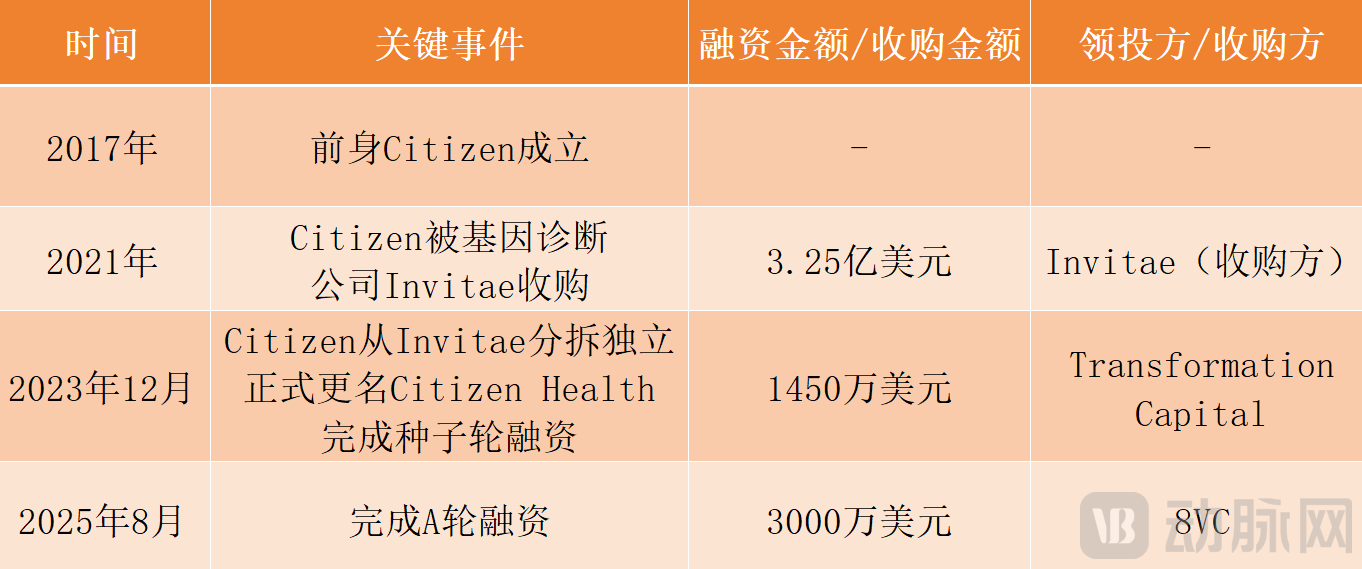
Citizen Health Development History Overview
The birth and growth of Citizen Health stem from the founding team’s profound empathy for patient needs.
Co-founder Nasha Fitter’s connection to rare diseases began when her youngest daughter was diagnosed with FOXG1 syndrome, a rare disorder. Despite receiving meticulous care for her daughter, Nasha discovered that diagnostic and therapeutic information on this condition was extremely scarce, with no targeted therapies available on the market. To address this gap, she initially established a nonprofit organization. However, through practical experience, she realized that the lack of rich, coherent clinical data was the most significant bottleneck hindering research into treatments for rare diseases.
Meanwhile, Farid Vij, another founder with extensive experience in healthcare data, also recognized this patient need and began collaborating with Nasha. Previously a senior executive at the genetic diagnostics company Invitae, Farid was deeply involved in building and operating healthcare data platforms, bringing mature expertise to the end-to-end logic of data integration and value conversion.
In 2023, with a further clarified strategic direction, Nasha and Farid co-founded Citizen Health, expanding its business focus from oncology to rare diseases. They assembled a core team that combines industry expertise with patient empathy, comprising not only executives deeply experienced in medical technology but also a specialized advisory board of genetic diagnostics experts and rare disease patient advocates.
Among the more than 400 million rare disease patients worldwide, 95% still lack approved treatments, underscoring the urgency of Citizen Health’s mission. Currently, Citizen Health’s key solutions are being implemented through the synergistic integration of its three core business pillars.
● Health Platform: Activating Static Medical Records to Build “Living” Infrastructure for the Industry
As the cornerstone of its business, Citizen Health’s core health platform breaks through the limitations of traditional medical records—“fragmented, static, and difficult to reuse”—by leveraging technological means to transform patients’ full-cycle health data into searchable, research-ready core assets.
The platform supports patients in uploading various forms of health documents, such as PDF medical records, imaging data, and genetic testing reports. It completes data structuring in just 10 minutes, automatically extracting key information like diagnostic conclusions and medication records, while also generating a timeline-based “Personal Health Journey” to enable patients to clearly trace the progression of their condition.
To date, the platform has processed over 12 million health documents, covering 123 rare and complex diseases. Furthermore, the U.S. FDA has accepted the platform’s de-identified datasets for new drug regulatory submissions. This provides critical support for pharmaceutical companies to shorten R&D cycles and ensure compliance, truly transforming static medical records once confined to hospital archives into living infrastructure that drives industry progress.
● AI Advocate, a personal health decision-making assistant for patients
Building on its data integration capabilities, Citizen Health has further launched its core intelligent tool—AI Advocate (AI Health Advisor)—and plans to gradually release the first public version to the community in the third quarter of 2025.
According to company data, this tool leverages the platform’s vast datasets and AI algorithms to interpret medical records within 10 seconds, generating three core recommendations for patients: accurately matching them with the appropriate medical department based on their condition to avoid treatment delays caused by incorrect registration; real-time push notifications of highly relevant clinical trial recruitment opportunities, enabling patients to access potential treatment options in a timely manner; and synchronization of the latest symptom-specific care experiences from peer support groups, providing references for daily health management.
More practically, the tool has built-in appointment and follow-up management functions, allowing users to jump directly to the registration page or generate follow-up reminders. A mother of a child with a rare disease who participated in the beta test reported: “In the past, we carried stacks of medical records while seeking medical help everywhere. Now, the mobile app directly tells us which outpatient clinic to register for next and which clinical trials still have openings, with the appointment button ready to use.” This intuitively demonstrates how AI Advocate improves patients’ healthcare experience.
● Patient Community: Weaving a Mutual Aid Network Through Data Sharing
To strengthen patient engagement and unlock the value of data, Citizen Health has established more than 60 active rare disease patient communities and partnered with over 70 patient advocacy organizations. These communities serve not only as mutual support spaces where patients can exchange treatment experiences and receive emotional support, but also as a critical source of data resources for the platform.
Benefiting from the trust-based atmosphere fostered by community building and the consensus on data-driven therapeutic R&D, 98.3% of patients are willing to anonymously share their health data for research purposes. This has created a virtuous cycle in which patient mutual support promotes data accumulation and accelerates R&D. This community model not only provides patients with emotional and informational support beyond medical services but also reserves high-quality real-world data for future industry collaborations, serving as a bridge of trust between patients and the industry.
Currently, the company has signed data cooperation agreements with more than 10 pharmaceutical enterprises, covering the entire drug R&D process. During the clinical trial design phase, the company leverages patient lifecycle data accumulated on its platform to optimize trial protocols and minimize ineffective designs. In the patient recruitment phase, it precisely matches patients who meet inclusion criteria, thereby shortening the recruitment cycle. After drug launch, the company continuously collects real-world medication feedback, providing data support for pharmaceutical companies to monitor long-term efficacy and safety and to optimize medication guidelines.
In addition to industry partnerships, Citizen Health actively collaborates with professional institutions and research entities. In 2025, the global non-profit organization Critical Path Institute (C-Path) and Citizen Health announced a new strategic partnership. Leveraging C-Path’s expertise in regulatory science and the development of R&D standards, both parties will jointly explore the standardized application of rare disease R&D data and compliant optimization pathways for clinical trial design, thereby helping to address the additional pain point of “substandard data quality” in rare disease research and development.
In May of the same year, the Company further entered into a strategic partnership with the Chan Zuckerberg Initiative (CZI). Leveraging CZI’s resources in cutting-edge technologies such as biomedical research, gene editing, and AI-driven drug discovery, the Company will focus on elucidating the pathogenesis of rare diseases and identifying drug targets, thereby accelerating the translation of novel therapies from the laboratory to the clinic.
Today, as its collaborations with C-path, CZI, and more than ten pharmaceutical companies deepen, Citizen Health’s ecosystem continues to expand. It is no longer just a health technology company; it has become a bridge connecting patient needs, scientific breakthroughs, and industrial progress.
In the future, as AI Advocate expands to cover more communities, as real-world data supports the launch of more new drugs, and as an increasing number of patients with rare diseases are able to find treatment directions through the platform, Citizen Health may truly realize its vision: empowering every patient, no matter how rare their condition, to take control of their health and embrace hope in the digital age.